
BuddhistCatholicContemplativeEvangelicalGeneral ChristianHinduJewishLatter-day SaintMuslimNew VisionsProgressive Christian
Beliefs
- Buddhist
- Catholic
- Contemplative
- Evangelical
- General Christian
- Hindu
- Jewish
- Latter-day Saint
- More Voices
- Muslim
- New Visions
- Pagan
- Progressive Christian
Topics
- Religion News
- Food and Religion
- Sports and Religion
- Religious Art
- Religious Music and Entertainment
- Religious Events
- History and Religion
- Style and Religion
- Politics and Religion
- Women in Religion
- Recreation Outdoors and Religion
- Business Finance and Religion
- Careers Workplace and Religion
- Education and Religion
- Family Parenting and Religion
- Health Fitness and Religion
- Home and Religion
- Relationships and Religion
- Technology and Religion
- Travel and Religion
Columnists
- Buddhist Columnists
- Business Finance and Religion Columnists
- Careers Workplace and Religion Columnists
- Catholic Columnists
- Contemplative Columnists
- Education and Religion Columnists
- Evangelists Columnists
- Family Parenting and Religion Columnists
- General Christian Columnists
- Health Fitness and Religion Columnists
- Hindu Columnists
- History and Religion Columnists
- Home and Religion Columnists
- Jewish Columnists
- More Voices Columnists
- Latter Day Columnists
- Muslim Columnists
- New Visions Columnists
- Nonreligious Columnists
- Pagan Columnists
- Politics and Religion Columnists
- Progressive Columnists
- Recreation Outdoors and Religion Columnists
- Relationships and Religion Columnists
- Religion News Columnists
- Religious Art Columnists
- Religious Events Columnists
- Religious Music and Entertainment Columnists
- Sports and Religion Columnists
- Style and Religion Columnists
- Technology and Religion Columnists
- Travel and Religion Columnists
- Women in Religion Columnists
Resource Library
- 2026 Calendar
- Library of World Religions
- The 100 Most Holy Places on Earth
- Patheos Answers
- Podcasts
- Videos
- Faith Leaders Database
- Anglican Episcopalian
- Bahai
- Baptist
- Buddhism
- Christianity
- Confucianism
- Eastern Orthodoxy
- Hinduism
- Holiness and Pentecostal
- ISKCON
- Islam
- Judaism
- Lutheran
- Methodist
- The Church of Jesus Christ of Latter-day Saints
- New Age
- Paganism
- Presbytarian and Reformed
- Protestantism
- Religion Behind the Scenes
- Roman Catholic
- Scientology
- Shia Islam
- Sikhism
- Sufism
- Sunni Islam
- Taoism
- Zen
- See all religions
Research Tools
 Ad-Free & Subscriber Log-In Subscription Support
Ad-Free & Subscriber Log-In Subscription Support
Follow Patheos 

- Trending:
- Forgiveness
- |
- Marriage
- |
- Consciousness
- |
- Death Penalty
- |
- Election
- |
- Halloween
 Teaching Nonviolent Atonement
- Home
- Progressive Christian
- Wednesday Sermon: Abraham’s Bosom – Redefining Hell
Wednesday Sermon: Abraham’s Bosom – Redefining Hell
Last updated on: September 28, 2016 at 12:47 pm by Tom Truby
Wednesday Sermon: Abraham’s Bosom – Redefining Hell 2016-09-28T12:47:35-05:00 Tom Truby
Patheos Explore the world's faith through different perspectives on religion and spirituality! Patheos has the views of the prevalent religions and spiritualities of the world.
 Pastors have a frequent question when they begin to discover mimetic theory. “That’s great. But how does it preach?”
Reverend Tom Truby shows that mimetic theory is a powerful tool that enables pastors to preach the Gospel in a way that is meaningful and refreshing to the modern world. Each Wednesday, Teaching Nonviolent Atonement will highlight his sermons as an example of preaching the Gospel through mimetic theory.
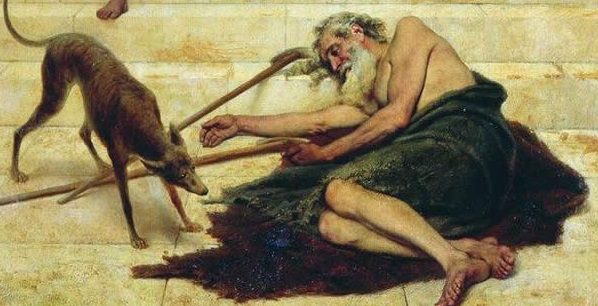
In this sermon, Tom explores the story of the rich man and Lazarus. Often viewed as a warning about hell after we die, he asserts this is a warning about hell here on earth. As Tom states, “Life is about connectedness and caring and hell is something we create for ourselves in this life when we cut ourselves off from the others who inhabit our world.”
Year C, Pentecost 19
September 25th, 2016
By Thomas L. Truby
Luke 16:19-31
Abraham’s Bosom
In our gospel text today Jesus is telling a “St. Peter and the pearly gates” kind of story. These stories are not descriptions of heaven or secret prescriptions on how to get there. They are stories full of meaning about how to live life in ways that make us whole and serve our neighbor now, not after we die.
Jesus begins his story by setting up a powerful contrast between a very rich man who can afford the best, even ostentatious clothes and has a house so big that it has a gate in front of it and a very poor man, in terrible health who is so weak he can’t chase the dogs away that are licking his wounds. The poor man lies on the ground outside the rich man’s gate and Jesus says the poor man’s a name is Lazarus. He doesn’t give the rich man a name. Let’s see where Jesus is going with his story.
“In due course the poor man died, and was carried by the angels into Abraham’s bosom.” I picture Lazarus being flown up on angel’s wings and deposited inside Abraham’s robe where he looks out at the world, safe and secure, like a two year old in his father’s arms. “The rich man also died, and was buried.” Notice the poor man gets carried by the angels and the rich man gets buried. Ah, don’t you love it! We have always been envious of the rich in this life but now at death we get our revenge as the tables have turned. Now the poor man is close to God, in the catbird seat, and the rich man is six feet under. But it doesn’t end here.
“As he (the rich man) is being tormented in Hades (Greek for the place you don’t want to go and a signal that this is just a story), he looks up and sees Abraham far away and Lazarus in his bosom.” Can you picture this? “Father Abraham! He calls out. ‘Have pity on me! Send Lazarus to dip the tip of his finger in water and cool my tongue! I’m in agony in this fire!” With exclamation marks after every phrase he is saying, “I’m in Hell here, get me out.”
Notice how the rich man goes to the top, to “Father Abraham.” He feels entitled; he makes a direct appeal. Just as it was on earth so now he literally goes over Lazarus’ head and speaks directly to Abraham. He wants a moment of relief from the hell he finds himself in and he wants Lazarus to deliver it.
Has the rich man repented from the days in which he ignored Lazarus? Does he see Lazarus any more clearly now? Well, maybe, now he acknowledges his existence and knows his name. But he still sees him as an inferior, as in the servant’s position, a lesser soul—not someone with whom you could connect.
Abraham’s response is very tender. He holds no malice toward the rich man but must regretfully apprise him of the realities and there are two. “‘My child,’ replied Abraham, ‘remember that in your life you received good things, and in the same way Lazarus received evil (actually the evil came from the rich man who ignored him). Now he is comforted here, and you are tormented.’”
This is stated as an unquestionable fact, something so obvious it is not worth discussing. But this was not obvious at all. In fact, almost everyone thought the rich man was rich because God had blessed him and Lazarus was poor and afflicted because he was evil. Poverty and affliction, so this thinking goes, are not caused by human greed and selfishness, by economic systems that are distorted so as to benefit some and make it nearly impossible for others. No, it is a moral thing and Lazarus is where he is because he or his parents were immoral or lazy. They were just losers. Do you see how the story presents a huge challenge to their thinking? I dare say we Caucasians often have this same attitude toward those caught in poverty and those with darker skin.
Being in the bosom of Abraham is the last place they would expect to find Lazarus. Common belief expects he will be in the fire and his earthly afflictions are but justified foretastes of what he’s got coming.
And then Abraham reveals one more thing. “Besides that, there is a great chasm standing between us. People who want to cross over from here to you can’t do so, nor can anyone get across from the far side to us.” I picture this chasm as an empty abyss that goes down forever. It is not a wall; it’s a vacuum, and things fall through it endlessly. It’s like a dark well where sound goes down but no echo returns. There is no awareness of anyone else in this abyss. It’s the world the rich man has inhabited.
Do you feel lonely and desolate as you think about this man who didn’t notice the world around him when he had a chance? He was too self-absorbed. We were not made to be lonely like that. We need to be connected, in relationship, aware of the world. This man had allowed himself to be cut-off from Abraham, Lazarus and all the others who populated his world. He hides behind his walls and his fancy clothes.
Why do you think Jesus is telling this story this way? Has the rich man who feasts sumptuously everyday cut himself off from life? Is his need to be exclusive excluding him from those sources of life that could give him vitality? When he ignored the poor man at his gate, whose name we now discover he does know, did he sever his connection to his own humanness?
If you find this a bit convicting as I do, you will understand our rich brother’s next request. “Please, then, Father,’ he said, ‘send him to my father’s house. I’ve got five brothers. Let him tell them about it, so that they don’t come into this torture-chamber.’” In turns out our brother, the rich man, does have room in his heart for love. He loves his brothers and he doesn’t want them to end up where he is. So it isn’t that he can’t love, he can. It is the restriction he puts on whom he loves that creates the problem. He could have expanded his love and enriched his life.
Now remember this is a tricky story. It sounds like Jesus is saying if we aren’t inclusive and help people we go to hell. But he doesn’t believe God is like that so he takes this story and subverts it from within. He manages to turn everything upside down and suggest that scapegoating and exclusion are the things that destroy life for the living, for us here as we live in our world. Life is about connectedness and caring and hell is something we create for ourselves in this life when we cut ourselves off from the others who inhabit our world.
In Jesus’ story Abraham turns down the rich man’s request for a special visitation to his brothers, saying, “‘they’ve got Moses and the prophets, let them listen to them.’” Apparently Abraham thinks the history of God’s benevolence is sufficient to see God’s character and turn these brothers toward concern for their neighbor. But the rich man disagrees. He knows how we resist seeing the power of benevolence and adventure. “‘No, Father Abraham,’ he replied, ‘but if someone went to them from the dead, they would repent!’”
Is that true? If someone were resurrected from the dead and went to the five brothers of this world would they repent? Would they decide to see God and themselves differently and reach out to all God’s children? Abraham says, “If they don’t listen to Moses and the prophets, neither would they be convinced, even if someone rose from the dead.” He may have a point! Now that the resurrection has happened will we humans change or are we doomed to isolation and endless self-inflicted torment? The jury is out. In the meantime I am choosing to open up as best I can and I hope you will choose that too. Amen.
*Image: Wikipedia, Public Domain, some changes made.


Previous Post

September 26, 2016
Protest is Essential to Peace
Next Post
September 29, 2016 Trump, "Miss Piggy," and How To Lose Your Soul
Browse Our Archives
Select a Category Atonement and Current Events Curriculum Faith and Families Interviews Jesus the Forgiving Victim Lent Montessori politics Reviews The Bible Explained Uncategorized Valentine's Day Wednesday Sermon Who is God?
Select a Month July 2020 November 2019 October 2019 September 2019 August 2019 July 2019 June 2019 May 2019 April 2019 March 2019 February 2019 January 2019 December 2018 November 2018 October 2018 September 2018 August 2018 July 2018 June 2018 May 2018 April 2018 March 2018 February 2018 January 2018 December 2017 November 2017 October 2017 September 2017 August 2017 July 2017 June 2017 May 2017 April 2017 March 2017 February 2017 January 2017 December 2016 November 2016 October 2016 September 2016 August 2016 June 2016 May 2016 April 2016 March 2016 February 2016 January 2016 December 2015 November 2015 October 2015 September 2015 August 2015 July 2015 June 2015 May 2015 April 2015 March 2015 February 2015 January 2015 December 2014 November 2014 October 2014 September 2014 August 2014 July 2014 June 2014 May 2014 April 2014 March 2014 January 2014 December 2013 September 2013 August 2013 July 2013
Follow Us!
TAKE THE
Religious Wisdom Quiz
In the New Testament what is the last book?
Select your answer to see how you score.
Luke Titus Matthew Revelation
Related posts from Teaching Nonviolent Atonement
Sermon: The Eleventh Commandment

Being Careful to Live Wisely: Faith and Climate...


Let Light Shine Out of Darkness
TRENDING AT PATHEOS Progressive Christian

What Being a Modern-Day Apostle Means to Me
In my last column, I discussed the ins and outs of modern-day...

Did Ancient China Once Worship the God of...
Across human history, a common thread weaves through the origins of the...

Love Your Neighbor – Including Earth-Kin: Lev. 19,...
God’s command to love your neighbor means acting in an ethical and...

Lead a Church Study of “Jesus and Lao...
Guest writer Jack Thomas (The Irreverent Reverend) reflects on leading his church...

Pastoral Wisdom for Responding to Sermon Pushback
Getting sermon pushback on your social justice sermon? Learn practical, Proverbs-based strategies...

Principles for Understanding the Apostolic Ministry Today
Whenever people discover that my formal ministry title is "apostle," as in...
view all Progressive Christian blogs
Ad-Free & Subscriber Log-In Subscription Support
- About Us
- 2026 Calendar
- Videos
- Podcasts
- Library of World Religions
- Faith In Media Tracker
- Advertise With Us
- Write for Us
- Privacy Policy
- Terms of Service
- Do Not Sell My Data
- Contact Us
- Radiant Digital
- Manage Newsletter Subscriptions
- Unsubscribe From Notifications
- Sitemap
Copyright 2008-2026, Patheos. All rights reserved.
Subscription Support Ad-Free & Subscriber Log-In
Follow Patheos