
BuddhistCatholicContemplativeEvangelicalGeneral ChristianHinduJewishLatter-day SaintMuslimNew VisionsProgressive Christian
Beliefs
- Buddhist
- Catholic
- Contemplative
- Evangelical
- General Christian
- Hindu
- Jewish
- Latter-day Saint
- More Voices
- Muslim
- New Visions
- Pagan
- Progressive Christian
Topics
- Religion News
- Food and Religion
- Sports and Religion
- Religious Art
- Religious Music and Entertainment
- Religious Events
- History and Religion
- Style and Religion
- Politics and Religion
- Women in Religion
- Recreation Outdoors and Religion
- Business Finance and Religion
- Careers Workplace and Religion
- Education and Religion
- Family Parenting and Religion
- Health Fitness and Religion
- Home and Religion
- Relationships and Religion
- Technology and Religion
- Travel and Religion
Columnists
- Buddhist Columnists
- Business Finance and Religion Columnists
- Careers Workplace and Religion Columnists
- Catholic Columnists
- Contemplative Columnists
- Education and Religion Columnists
- Evangelists Columnists
- Family Parenting and Religion Columnists
- General Christian Columnists
- Health Fitness and Religion Columnists
- Hindu Columnists
- History and Religion Columnists
- Home and Religion Columnists
- Jewish Columnists
- More Voices Columnists
- Latter Day Columnists
- Muslim Columnists
- New Visions Columnists
- Nonreligious Columnists
- Pagan Columnists
- Politics and Religion Columnists
- Progressive Columnists
- Recreation Outdoors and Religion Columnists
- Relationships and Religion Columnists
- Religion News Columnists
- Religious Art Columnists
- Religious Events Columnists
- Religious Music and Entertainment Columnists
- Sports and Religion Columnists
- Style and Religion Columnists
- Technology and Religion Columnists
- Travel and Religion Columnists
- Women in Religion Columnists
Resource Library
- 2026 Calendar
- Library of World Religions
- The 100 Most Holy Places on Earth
- Patheos Answers
- Podcasts
- Videos
- Faith Leaders Database
- Anglican Episcopalian
- Bahai
- Baptist
- Buddhism
- Christianity
- Confucianism
- Eastern Orthodoxy
- Hinduism
- Holiness and Pentecostal
- ISKCON
- Islam
- Judaism
- Lutheran
- Methodist
- The Church of Jesus Christ of Latter-day Saints
- New Age
- Paganism
- Presbytarian and Reformed
- Protestantism
- Religion Behind the Scenes
- Roman Catholic
- Scientology
- Shia Islam
- Sikhism
- Sufism
- Sunni Islam
- Taoism
- Zen
- See all religions
Research Tools
 Ad-Free & Subscriber Log-In Subscription Support
Ad-Free & Subscriber Log-In Subscription Support
Follow Patheos 

- Trending:
- Forgiveness
- |
- Marriage
- |
- Consciousness
- |
- Death Penalty
- |
- Election
- |
- Halloween
 Teaching Nonviolent Atonement
- Home
- Progressive Christian
- Protest is Essential to Peace
Protest is Essential to Peace
Last updated on: September 26, 2016 at 12:30 pm by Lindsey Paris-Lopez
Protest is Essential to Peace 2016-09-26T12:30:55-05:00 Lindsey Paris-Lopez
Patheos Explore the world's faith through different perspectives on religion and spirituality! Patheos has the views of the prevalent religions and spiritualities of the world.
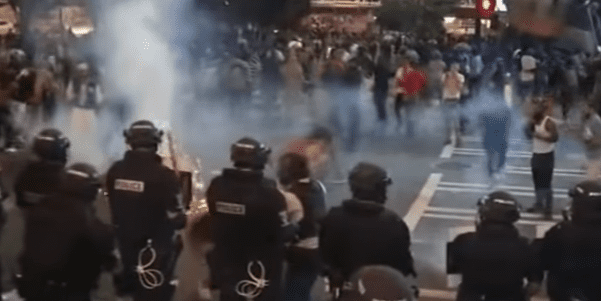 Protest is not antithetical to peace. Protest is essential to peace. The uprising in Charlotte, portrayed (at least for the first 2 days) by the mainstream media as an out-of-control riot, was a peacemaking event that will in time, in combination with other uprisings from shore to shore, help our nation live into its heretofore elusive motto of liberty and justice for all.
The media gave a skewed narrative of the events of Wednesday night’s protest over the police shooting of Keith Lamont Scott, presenting those marching on behalf of the victims of state-sanctioned violence as being the sole perpetrators of violence. Live Facebook feeds, which have since been censored, told a different story. Accounts from participants describe the march, from the opening vigil in Marshall Park up until several hours later, as a peaceful event that became violent only after police repeatedly attempted to disperse crowds with tear gas and rubber bullets. Videos of people coughing in toxic gases, their eyes burning with chemicals, documented excessive force. Before it was pulled, I saw video of a man leading the crowd in a 1-word chant, “Love,” before being pulled behind police lines. The message that needed urgent attention – that black people are being targeted, harassed, and killed by law enforcement with impunity, and this status quo will no longer be tolerated – was brutally suppressed not only by the officers, but by the media covering the story. And this skewed coverage, undermining the essential message of the uprising and highlighting one side of the violence while ignoring its cause, is a service to the myth of American exceptionalism – a myth that must be dismantled.
The narrative of America as the “indispensable nation” and the “my country, right or wrong” patriotism drilled into the citizenry is – according to some interpretations – undermined by citizens rising up to express their anger and grief in acts of protest (although others wisely argue that the right to protest is part our nation’s beauty.) In particular, uprisings that speak to systemic injustices and inequities are rarely tolerated by those who have a stake in perpetuating the status quo. Unfortunately, the status quo – the American normal – is not the standard-bearer of freedom, justice and equality that so many people claim it to be. The United States is a nation built on slavery and genocide that has never fully acknowledged or repent of the sins of her past, which have reincarnated throughout the generations in myriad forms, from Jim Crow laws to lynchings to redlining to school-to-prison pipelines. Behind every police shooting of an unarmed African American is a history that permeates and poisons our nation – a history of dehumanization, segregation and discrimination. As I have argued before, police officers are the front lines of systemic injustice that runs far deeper than policing.
But the myth of American exceptionalism wants to deny this injustice. It therefore ignores the heart of the injustice that protestors condemn and marginalizes those who express their anger as trouble-makers. That scapegoating narrative not only denies the particular grievance of police brutality, but is in itself a part of the systemic injustice that feeds and exacerbates that brutality.
Myths feign greatness by disappearing victims, and the marginalization of protestors is cleverly crafted to erase or delegitimize grievances and demonize those who utter them. Thus, so many see protestors as unnecessary agitators disturbing the peace.
But there is no peace in a nation where people can be killed by officers of the law with no accountability because of the color of their skin. There is no peace when African Americans are targeted for arrest more often and imprisoned for longer terms than whites for the same crimes. There is no peace when African American communities – segregated first by law and then by white flight – are economically depressed because resources and services are taken away. There is no peace in a nation where generations of demonization and pseudo-science leave a subconscious fear of African Americans in the minds of whites – a fear that is rarely acknowledged or repented but acted on in innumerable microaggressions.
The popular slogan, “No justice, no peace,” is not a threat, it is a truth. Until there is justice, peace is worse than an illusion, it is a lie meant to hide the suffering of real people.
That’s why those who march are instruments of peace. They put their full humanity – in all of its courage and compassion and faith in the power of the people to affect change – on display in a society that would deny it. They express frustration and holy anger toward a system that would repress other human beings – living images of God – rather than content themselves in a world of indifference to suffering. Wednesday night was not free of violence, but the great majority of the protestors remained peaceful, and the violence of a few does not negate the intention or steadfast dedication to nonviolence of the many. While we should denounce all violence, we must start with the systemic violence that protests expose and condemn.
Peace is hard-won through struggle – not through fighting, but through courageously declaring truth. That truth will be resisted by those who want to deny charges of injustice, who want to believe that reasons for discontent lie with individuals and communities instead of systemic pathologies infecting our whole nation. They will accuse protestors of being divisive and contentious, and believe skewed media narratives that attribute all violence and civil unrest to them.
But Jesus, even as he came to bring peace on earth, once said, “I have not come to bring peace, but division!” He said this because peace that is built on the backs of victims is disrupted when those victims rise up, assert their humanity, and refuse to be victims any longer. Peace and prosperity built at the expense of African Americans, as well as Native and Latino Americans – a sense of identity built over and against others – must be gutted of its rotten foundation and rebuilt upon the principals of love and universal human dignity. The Civil Rights marches of the 60s drew us closer to that true peace, and protests today carry on that tradition.
Peace is created, piece by piece, by people standing up in love for one another. Men and women of all ages and races are doing that in Charlotte. We must all do likewise in many ways, every day, everywhere, until the full dignity of every human being is acknowledged and God’s image is honored in all of its 7 billion reflections.
Previous Post

September 22, 2016
Can Politics Lead To Peace?
Next Post
September 28, 2016 Wednesday Sermon: Abraham’s Bosom - Redefining Hell
Browse Our Archives
Select a Category Atonement and Current Events Curriculum Faith and Families Interviews Jesus the Forgiving Victim Lent Montessori politics Reviews The Bible Explained Uncategorized Valentine's Day Wednesday Sermon Who is God?
Select a Month July 2020 November 2019 October 2019 September 2019 August 2019 July 2019 June 2019 May 2019 April 2019 March 2019 February 2019 January 2019 December 2018 November 2018 October 2018 September 2018 August 2018 July 2018 June 2018 May 2018 April 2018 March 2018 February 2018 January 2018 December 2017 November 2017 October 2017 September 2017 August 2017 July 2017 June 2017 May 2017 April 2017 March 2017 February 2017 January 2017 December 2016 November 2016 October 2016 September 2016 August 2016 June 2016 May 2016 April 2016 March 2016 February 2016 January 2016 December 2015 November 2015 October 2015 September 2015 August 2015 July 2015 June 2015 May 2015 April 2015 March 2015 February 2015 January 2015 December 2014 November 2014 October 2014 September 2014 August 2014 July 2014 June 2014 May 2014 April 2014 March 2014 January 2014 December 2013 September 2013 August 2013 July 2013
Follow Us!
TAKE THE
Religious Wisdom Quiz
Which Psalm contains the phrase, "Be still, and know that I am God"?
Select your answer to see how you score.
Psalm 8 Psalm 100 Psalm 91 Psalm 46
Related posts from Teaching Nonviolent Atonement

Jesus Unmasked: Jesus Brings the Fire!

Perfect Love Casts Out Fear, But Can It...
Racism: Survivors and Perpetrators Find Healing in Africa

The One Thing: My Dad, City Slickers, and...
TRENDING AT PATHEOS Progressive Christian

What Being a Modern-Day Apostle Means to Me
In my last column, I discussed the ins and outs of modern-day...

Did Ancient China Once Worship the God of...
Across human history, a common thread weaves through the origins of the...

Love Your Neighbor – Including Earth-Kin: Lev. 19,...
God’s command to love your neighbor means acting in an ethical and...

Lead a Church Study of “Jesus and Lao...
Guest writer Jack Thomas (The Irreverent Reverend) reflects on leading his church...

Pastoral Wisdom for Responding to Sermon Pushback
Getting sermon pushback on your social justice sermon? Learn practical, Proverbs-based strategies...

Principles for Understanding the Apostolic Ministry Today
Whenever people discover that my formal ministry title is "apostle," as in...
view all Progressive Christian blogs
Ad-Free & Subscriber Log-In Subscription Support
- About Us
- 2026 Calendar
- Videos
- Podcasts
- Library of World Religions
- Faith In Media Tracker
- Advertise With Us
- Write for Us
- Privacy Policy
- Terms of Service
- Do Not Sell My Data
- Contact Us
- Radiant Digital
- Manage Newsletter Subscriptions
- Unsubscribe From Notifications
- Sitemap
Copyright 2008-2026, Patheos. All rights reserved.
Subscription Support Ad-Free & Subscriber Log-In
Follow Patheos