
BuddhistCatholicContemplativeEvangelicalGeneral ChristianHinduJewishLatter-day SaintMuslimNew VisionsProgressive Christian
Beliefs
- Buddhist
- Catholic
- Contemplative
- Evangelical
- General Christian
- Hindu
- Jewish
- Latter-day Saint
- More Voices
- Muslim
- New Visions
- Pagan
- Progressive Christian
Topics
- Religion News
- Food and Religion
- Sports and Religion
- Religious Art
- Religious Music and Entertainment
- Religious Events
- History and Religion
- Style and Religion
- Politics and Religion
- Women in Religion
- Recreation Outdoors and Religion
- Business Finance and Religion
- Careers Workplace and Religion
- Education and Religion
- Family Parenting and Religion
- Health Fitness and Religion
- Home and Religion
- Relationships and Religion
- Technology and Religion
- Travel and Religion
Columnists
- Buddhist Columnists
- Business Finance and Religion Columnists
- Careers Workplace and Religion Columnists
- Catholic Columnists
- Contemplative Columnists
- Education and Religion Columnists
- Evangelists Columnists
- Family Parenting and Religion Columnists
- General Christian Columnists
- Health Fitness and Religion Columnists
- Hindu Columnists
- History and Religion Columnists
- Home and Religion Columnists
- Jewish Columnists
- More Voices Columnists
- Latter Day Columnists
- Muslim Columnists
- New Visions Columnists
- Nonreligious Columnists
- Pagan Columnists
- Politics and Religion Columnists
- Progressive Columnists
- Recreation Outdoors and Religion Columnists
- Relationships and Religion Columnists
- Religion News Columnists
- Religious Art Columnists
- Religious Events Columnists
- Religious Music and Entertainment Columnists
- Sports and Religion Columnists
- Style and Religion Columnists
- Technology and Religion Columnists
- Travel and Religion Columnists
- Women in Religion Columnists
Resource Library
- 2026 Calendar
- Library of World Religions
- The 100 Most Holy Places on Earth
- Patheos Answers
- Podcasts
- Videos
- Faith Leaders Database
- Anglican Episcopalian
- Bahai
- Baptist
- Buddhism
- Christianity
- Confucianism
- Eastern Orthodoxy
- Hinduism
- Holiness and Pentecostal
- ISKCON
- Islam
- Judaism
- Lutheran
- Methodist
- The Church of Jesus Christ of Latter-day Saints
- New Age
- Paganism
- Presbytarian and Reformed
- Protestantism
- Religion Behind the Scenes
- Roman Catholic
- Scientology
- Shia Islam
- Sikhism
- Sufism
- Sunni Islam
- Taoism
- Zen
- See all religions
Research Tools
 Ad-Free & Subscriber Log-In Subscription Support
Ad-Free & Subscriber Log-In Subscription Support
Follow Patheos 

- Trending:
- Forgiveness
- |
- Marriage
- |
- Consciousness
- |
- Death Penalty
- |
- Election
- |
- Halloween
 Teaching Nonviolent Atonement
- Home
- Progressive Christian
- Prisons: The Nightmarish Underbelly of the American Dream
Prisons: The Nightmarish Underbelly of the American Dream
Last updated on: September 19, 2016 at 5:38 pm by Lindsey Paris-Lopez
Prisons: The Nightmarish Underbelly of the American Dream 2016-09-19T17:38:28-05:00 Lindsey Paris-Lopez
Patheos Explore the world's faith through different perspectives on religion and spirituality! Patheos has the views of the prevalent religions and spiritualities of the world.
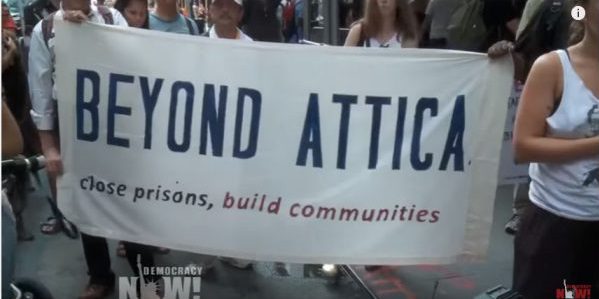 Myths disappear their victims, and the myth of American exceptionalism relies on a vast, extensive series of cages to house the unwanted and thrown away in order to thrive. With the largest prison population in the world, consisting predominately of those with dark skin, indigence, or mental illness, the United States could be said to be exceptional in its hypocritical lip-service to freedom. But the cries of the captives are now reverberating beyond the walls that confine them, as prisoners throughout the country – in at least 12 states and by some counts 25 – have commenced a labor strike on the 45th anniversary of the uprising at Attica prison. On September 9th, thousands of prisoners – at great risk to themselves – took a stand to, in the words of formerly incarcerated Kenneth Glasgow of the Free Alabama Movement, “end prison slavery.”
The idea that slavery ever ended is a myth within the larger myth too many Americans accept without question, which is that we are exceptional because we have moved beyond the sins of our past to become a beacon of liberty and self-made success, the world’s only indispensable nation. Of course, the horrors of whips and chains and dehumanization have no place in this myth, so we draw a definitive line between our present and our past, and take pride in our 13th Amendment, which abolished slavery.
Except it didn’t. The 13th Amendment left a loophole that allows slavery in the case of “punishment for crime whereof the party shall have been duly convicted,” and for more than 150 years, that loophole has been exploited to provide a free labor force for some of our most common goods and services. The modern prison industrial complex finds its roots in the Reconstruction era, when Southern plantation owners, eager to reclaim the slaves on which their livelihoods had depended, were able to lease convicts for a slight fee paid to newly-formed prisons. Trumped-up charges for such vague offenses as “vagrancy” put a large number of the African American population back into slavery.
Little has changed in a century and a half in a nation where too many African Americans are funneled through school-to-prison pipelines and set up for individual failure for the success of a suppressive system. While a larger percentage of African, Latino, and Native Americans are incarcerated than other ethnic demographics, the United States’ criminal justice system also disproportionately targets the poor and mentally ill of all races. And a workforce that produces many things from McDonald’s hamburgers to Victoria’s Secret garments in unprotected conditions for pennies (if anything) on the hour is not the only way our criminal justice system exploits a vulnerable population for profit. As Donna Murch of Rutgers University explains, a variety of fees accrue from the time someone is arrested, and prisons also charge for such necessities as medical care or phone calls. And economic exploitation is just the tip of the iceberg. The dehumanizing conditions of American prisons quite often exceed the crimes for which inmates are punished and perpetuate, rather than curtail, violence and cruelty.
So as I reflect in admiration upon the prisoners peacefully and resolutely taking a stand for their humanity and that of future inmates, I am struck by the realization that prisons are the nightmarish underbelly of the American dream. It is not simply that so much of American “freedom” is the freedom to consume a variety of goods made available through exploitation (of which prison labor is simply one form). It’s also the fact that with the targeting of racial minorities and the criminalization of poverty and mental illness, we have created a system in which we can lock those who belie the myth of the American dream out of sight, out of mind.
The myth of American exceptionalism is so sacred that those who challenge it often face significant backlash. So many of us are so committed to the idea that America is the greatest nation in the world, and we don’t want to hear otherwise, particularly not from the victims (within and outside our nation’s borders) of American aggression.
But hear from them we must. For there is nothing “exceptional” about either our best qualities or our self-glorification at the expense of those who don’t fit the of the American success story. As René Girard asserts, all nations have their founding myths – stories written by the winners, to highlight their best qualities… over and against others. Human communities from the beginning of time have been founded in united opposition to scapegoats, those against whom we measure our identity. Trying to be “exceptional” by measuring ourselves over and against others is a universal human phenomenon – and a detrimental one at that. Forget “exceptional;” nations can only be good when they acknowledge and repent of their victimization. And the United States has a very long way to go.
Scapegoating of prisoners in the United States is widespread. Prejudice against the incarcerated is widely justified with the argument that criminals have already proven themselves “unworthy.” This uncharitable sentiment fails to acknowledge the fact that some prisoners are innocent, many are disproportionately punished, and all are permanently and unconditionally deserving of human dignity. It also fails to account for the fact that mass incarceration of marginalized communities is in itself a crime. Generations of racism, segregation and discrimination, failing to meet the needs of the mentally ill, and criminalizing poverty are systemic crimes reinforcing the lop-sided power dynamic of the status quo. Our criminal justice system is vengeful rather than virtuous, retributive rather than rehabilitating. It isolates the already vulnerable not only by walls, but also by an immoral morality that displaces its own responsibility for setting populations up for failure back onto the victims. It is a means of scapegoating.
We all bear a responsibility – by virtue of being fellow members of the human community – to recognize the dignity of prisoners and stand in solidarity with them as they demand their human rights. Consequences for serious crimes are appropriate; economic exploitation of the most poor and vulnerable is not. Labor in the prison system – with compensation, worker protections and training for post-incarceration employment — could contribute to rehabilitation, but slave labor cannot. And cruel and inhumane conditions are always unacceptable.
We can take concrete steps to show our support for prisoners by volunteering for prison visitation projects, writing letters to prison facilities telling them that repression is unacceptable, and suggesting laws be passed that, for example, require companies that use prison labor to hire the same percentage of prisoners post-incarceration. Beyond such specific demands, we can advocate for truth and reconciliation commissions and reparations, recognizing that disproportionate arrests are the products of racism and the wealth inequality that it has produced. In these ways, we can work to transform criminal justice from retributive to restorative, because only restorative justice affirms the dignity of prisoner and victim alike and ensures a more peaceful and prosperous society.
If we want to make ourselves and our nation live up to the best of our ideals – compassion, kindness, respect for all life – we must repent of our scapegoating – of defining ourselves against others, including prisoners. We must awaken from our dream of being exceptional; for it is only a dream, a delusion that has rendered life a living nightmare for the many in our prisons trapped not only by walls, but by cycles of poverty and abuse. Only in awakening to the truth that prison walls do not negate human dignity can we transform that nightmare into a more just reality.
Previous Post

September 15, 2016
Daniel, God, and Apocalyptic Nonviolence: Bible Matters
Next Post
September 21, 2016 Wednesday Sermon: Forgetting To Forgive
Browse Our Archives
Select a Category Atonement and Current Events Curriculum Faith and Families Interviews Jesus the Forgiving Victim Lent Montessori politics Reviews The Bible Explained Uncategorized Valentine's Day Wednesday Sermon Who is God?
Select a Month July 2020 November 2019 October 2019 September 2019 August 2019 July 2019 June 2019 May 2019 April 2019 March 2019 February 2019 January 2019 December 2018 November 2018 October 2018 September 2018 August 2018 July 2018 June 2018 May 2018 April 2018 March 2018 February 2018 January 2018 December 2017 November 2017 October 2017 September 2017 August 2017 July 2017 June 2017 May 2017 April 2017 March 2017 February 2017 January 2017 December 2016 November 2016 October 2016 September 2016 August 2016 June 2016 May 2016 April 2016 March 2016 February 2016 January 2016 December 2015 November 2015 October 2015 September 2015 August 2015 July 2015 June 2015 May 2015 April 2015 March 2015 February 2015 January 2015 December 2014 November 2014 October 2014 September 2014 August 2014 July 2014 June 2014 May 2014 April 2014 March 2014 January 2014 December 2013 September 2013 August 2013 July 2013
Follow Us!
TAKE THE
Religious Wisdom Quiz
Who said, "Lord, to whom shall we go? You have the words of eternal life"?
Select your answer to see how you score.
James Peter Paul John
Related posts from Teaching Nonviolent Atonement

Perfect Love Casts Out Fear, But Can It...

Jesus Unmasked: Kingdom Economics: On Being Rich Toward...
Racism: Survivors and Perpetrators Find Healing in Africa

The One Thing: My Dad, City Slickers, and...
TRENDING AT PATHEOS Progressive Christian

Why Christians Have a Sacred Duty to Vote:...
The Bible offers strong support for the sacred duty to vote. Here...

What Being a Modern-Day Apostle Means to Me
In my last column, I discussed the ins and outs of modern-day...

Did Ancient China Once Worship the God of...
Across human history, a common thread weaves through the origins of the...

Love Your Neighbor – Including Earth-Kin: Lev. 19,...
God’s command to love your neighbor means acting in an ethical and...

Lead a Church Study of “Jesus and Lao...
Guest writer Jack Thomas (The Irreverent Reverend) reflects on leading his church...

Principles for Understanding the Apostolic Ministry Today
Whenever people discover that my formal ministry title is "apostle," as in...
view all Progressive Christian blogs
Ad-Free & Subscriber Log-In Subscription Support
- About Us
- 2026 Calendar
- Videos
- Podcasts
- Library of World Religions
- Faith In Media Tracker
- Advertise With Us
- Write for Us
- Privacy Policy
- Terms of Service
- Do Not Sell My Data
- Contact Us
- Radiant Digital
- Manage Newsletter Subscriptions
- Unsubscribe From Notifications
- Sitemap
Copyright 2008-2026, Patheos. All rights reserved.
Subscription Support Ad-Free & Subscriber Log-In
Follow Patheos