
BuddhistCatholicContemplativeEvangelicalGeneral ChristianHinduJewishLatter-day SaintMuslimNew VisionsProgressive Christian
Beliefs
- Buddhist
- Catholic
- Contemplative
- Evangelical
- General Christian
- Hindu
- Jewish
- Latter-day Saint
- More Voices
- Muslim
- New Visions
- Pagan
- Progressive Christian
Topics
- Religion News
- Food and Religion
- Sports and Religion
- Religious Art
- Religious Music and Entertainment
- Religious Events
- History and Religion
- Style and Religion
- Politics and Religion
- Women in Religion
- Recreation Outdoors and Religion
- Business Finance and Religion
- Careers Workplace and Religion
- Education and Religion
- Family Parenting and Religion
- Health Fitness and Religion
- Home and Religion
- Relationships and Religion
- Technology and Religion
- Travel and Religion
Columnists
- Buddhist Columnists
- Business Finance and Religion Columnists
- Careers Workplace and Religion Columnists
- Catholic Columnists
- Contemplative Columnists
- Education and Religion Columnists
- Evangelists Columnists
- Family Parenting and Religion Columnists
- General Christian Columnists
- Health Fitness and Religion Columnists
- Hindu Columnists
- History and Religion Columnists
- Home and Religion Columnists
- Jewish Columnists
- More Voices Columnists
- Latter Day Columnists
- Muslim Columnists
- New Visions Columnists
- Nonreligious Columnists
- Pagan Columnists
- Politics and Religion Columnists
- Progressive Columnists
- Recreation Outdoors and Religion Columnists
- Relationships and Religion Columnists
- Religion News Columnists
- Religious Art Columnists
- Religious Events Columnists
- Religious Music and Entertainment Columnists
- Sports and Religion Columnists
- Style and Religion Columnists
- Technology and Religion Columnists
- Travel and Religion Columnists
- Women in Religion Columnists
Resource Library
- 2026 Calendar
- Library of World Religions
- The 100 Most Holy Places on Earth
- Patheos Answers
- Podcasts
- Videos
- Faith Leaders Database
- Anglican Episcopalian
- Bahai
- Baptist
- Buddhism
- Christianity
- Confucianism
- Eastern Orthodoxy
- Hinduism
- Holiness and Pentecostal
- ISKCON
- Islam
- Judaism
- Lutheran
- Methodist
- The Church of Jesus Christ of Latter-day Saints
- New Age
- Paganism
- Presbytarian and Reformed
- Protestantism
- Religion Behind the Scenes
- Roman Catholic
- Scientology
- Shia Islam
- Sikhism
- Sufism
- Sunni Islam
- Taoism
- Zen
- See all religions
Research Tools
 Ad-Free & Subscriber Log-In Subscription Support
Ad-Free & Subscriber Log-In Subscription Support
Follow Patheos 

- Trending:
- Forgiveness
- |
- Marriage
- |
- Consciousness
- |
- Death Penalty
- |
- Election
- |
- Halloween
 Teaching Nonviolent Atonement
- Home
- Progressive Christian
- Daniel, God, and Apocalyptic Nonviolence: Bible Matters
Daniel, God, and Apocalyptic Nonviolence: Bible Matters
Last updated on: September 20, 2016 at 4:01 pm by Adam Ericksen
Daniel, God, and Apocalyptic Nonviolence: Bible Matters 2016-09-20T16:01:39-05:00 Adam Ericksen
Patheos Explore the world's faith through different perspectives on religion and spirituality! Patheos has the views of the prevalent religions and spiritualities of the world.
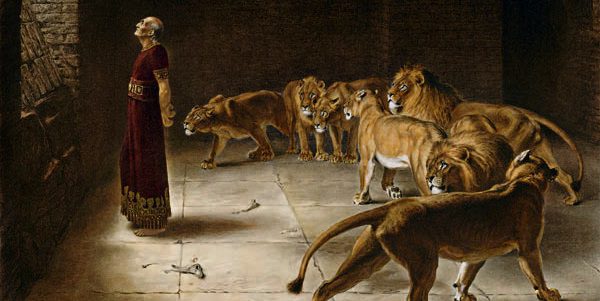 The book of Daniel is apocalyptic literature. Usually we think apocalyptic literature as end of the world destruction. That could be a part of it, but apocalypse really means “Revealing” or “Unveiling.”
Daniel reveals the truth about human relationships, specifically about human violence.
Violence is the big problem in Daniel, as it is throughout the Bible. From the beginning to the end of Daniel, we see violence. And the point of Daniel is to explore how the faithful people of God should respond to violence. Daniel says we should respond with nonviolent protest.
In chapters 1-6, Daniel and his people are conquered by the Babylonian empire. They are taken from Jerusalem and spread throughout the empire. Daniel ends up responding to this violence not with his own violence, but by working his way up through the ranks of the Babylonian empire, to become an advisor to the king.
In chapters 7-12, Daniel has apocalyptic visions. In the end times, Kings of the North and the South battle one another. They are locked in what Rene Girard calls a mimetic, or imitative, rivalry of violence. One defeating the other, and the other winning in a battle. The war goes back and forth between these two kings in an escalating rivalry of violence.
The book even says “evil shall increase.” From the beginning of Daniel to the end, there is an apocalyptic warning about violence. Human violence will eventually destroy the world.
How should the faithful respond to this violence? With nonviolence.
Daniel responds with nonviolence. Take the story of Daniel and the lion’s den, for example. Daniel has worked his way up to become an advisor to the king. Other advisors are jealous of Daniel’s relationship with the king. They turn against Daniel. They unite against him in an act of scapegoating. They tell the king that he should make sure that everyone prays only to him.
Daniel, as a good Jew*, isn’t going to pray to the king. Instead, he’s going to keep praying to his God. The people who are jealous of Daniel know he will pray to his God. They catch him in the act and they tell the king. The king then throws Daniel into the lion’s den.
Daniel trusts that God is going to be with him in the lion’s den. He doesn’t respond to violence with violence of his own. He doesn’t respond with anger or resentment. He just goes into the lion’s den, trusting that God will be with him.
Daniel survives, but the king is locked into violence. He ends up killing not only the men who united against Daniel, but also their wives and children.
A similar pattern happens with Daniel’s friends Shadrach, Meshach, and Abednego. The king creates a golden statue of himself and making everybody worship the statue. Shadrach, Meshach, and Abednego, as good Jews, refuse to participate in this form of national worship. They only worship their God. Others who are jealous of the three friends see that they refuse to worship the statue. They tell the king, who sends them to the furnace.
Shadrach, Meshach, and Abednego say to the king that they will go into the furnace, and that their God may or may not save them. They had doubts, but the most important thing was to show the king that they wouldn’t give their lives to him. Rather, in an act of political protest, they gave their lives to God.
They went into the furnace and survive. A fourth person, a godly figure, joins them. The kings saw the fourth person and says that their God, the true God, was with them the whole time. He let them out, and then said that if anyone says anything against their God, he would tear them “limb from limb.”
Once again, the king is stuck in violence. This pattern of violence happens repeatedly in Daniel. Soon the pattern leads to the apocalyptic visions of chapters 7-12. The kings are stuck in a rivalry of apocalyptic violence against one another that could destroy the world.
How are we to respond to that violence? Daniel has already made the case for nonviolent protest, but there is more. Earlier, Daniel went up to the king and told him that he could atone for his sins by giving “mercy to the oppressed.”
Challenging political rulers to care for the marginalized and oppressed is part of the prophetic nonviolent protest that we see throughout the Bible.
Another way to respond to violence is found in chapter 11. When the King of the North and the South are locked in a violence battle, it’s almost as if the people of God are standing back and watching it happen because their mutual violence will cause their own destruction. But chapter 11 says the people are supposed to “take action.”
But their action isn’t violent. “The wise among the people shall give understanding to many.” Understanding of what? In the apocalyptic visions, God tells Daniel to not be afraid. That people may die, but don’t give into violence. Do not be afraid. Stay true to your mission, which is to stand with the oppressed and protest political corruption nonviolently.
Daniel ends with this teaching, “Happy are those who persevere.” For violence will come. God calls us not to mimic that violence, but to persevere with love and nonviolence.
For more videos in the Bible Matters series, click here.
Stay in the loop! Like Teaching Nonviolent Atonement on Facebook!
Image: Wikimedia, Daniel, by Britton Riviere, Public Domain.

*Daniel wasn’t technically a Jew. Judaism as we know it took form in the 1st century. The technical term for Daniel is “Judahite,” since he was from the land of Judah. But the term Jew is easier than Judahite, so I use it here.
Previous Post

September 14, 2016
Wednesday Sermon: Joy Breaks Out!
Next Post
September 19, 2016 Prisons: The Nightmarish Underbelly of the American Dream
Browse Our Archives
Select a Category Atonement and Current Events Curriculum Faith and Families Interviews Jesus the Forgiving Victim Lent Montessori politics Reviews The Bible Explained Uncategorized Valentine's Day Wednesday Sermon Who is God?
Select a Month July 2020 November 2019 October 2019 September 2019 August 2019 July 2019 June 2019 May 2019 April 2019 March 2019 February 2019 January 2019 December 2018 November 2018 October 2018 September 2018 August 2018 July 2018 June 2018 May 2018 April 2018 March 2018 February 2018 January 2018 December 2017 November 2017 October 2017 September 2017 August 2017 July 2017 June 2017 May 2017 April 2017 March 2017 February 2017 January 2017 December 2016 November 2016 October 2016 September 2016 August 2016 June 2016 May 2016 April 2016 March 2016 February 2016 January 2016 December 2015 November 2015 October 2015 September 2015 August 2015 July 2015 June 2015 May 2015 April 2015 March 2015 February 2015 January 2015 December 2014 November 2014 October 2014 September 2014 August 2014 July 2014 June 2014 May 2014 April 2014 March 2014 January 2014 December 2013 September 2013 August 2013 July 2013
Follow Us!
TAKE THE
Religious Wisdom Quiz
In 2 Peter, what does Peter say he will soon put aside?
Select your answer to see how you score.
His job His life His ministry His burdens
Related posts from Teaching Nonviolent Atonement


How Forgiveness Can Transform Our Violence and Build...

Jesus Unmasked: Jesus Brings the Fire!

St. Francis Preaches on Violence
TRENDING AT PATHEOS Progressive Christian

What Being a Modern-Day Apostle Means to Me
In my last column, I discussed the ins and outs of modern-day...

Did Ancient China Once Worship the God of...
Across human history, a common thread weaves through the origins of the...

Love Your Neighbor – Including Earth-Kin: Lev. 19,...
God’s command to love your neighbor means acting in an ethical and...

Lead a Church Study of “Jesus and Lao...
Guest writer Jack Thomas (The Irreverent Reverend) reflects on leading his church...

Pastoral Wisdom for Responding to Sermon Pushback
Getting sermon pushback on your social justice sermon? Learn practical, Proverbs-based strategies...

Principles for Understanding the Apostolic Ministry Today
Whenever people discover that my formal ministry title is "apostle," as in...
view all Progressive Christian blogs
Ad-Free & Subscriber Log-In Subscription Support
- About Us
- 2026 Calendar
- Videos
- Podcasts
- Library of World Religions
- Faith In Media Tracker
- Advertise With Us
- Write for Us
- Privacy Policy
- Terms of Service
- Do Not Sell My Data
- Contact Us
- Radiant Digital
- Manage Newsletter Subscriptions
- Unsubscribe From Notifications
- Sitemap
Copyright 2008-2026, Patheos. All rights reserved.
Subscription Support Ad-Free & Subscriber Log-In
Follow Patheos