
BuddhistCatholicContemplativeEvangelicalGeneral ChristianHinduJewishLatter-day SaintMuslimNew VisionsProgressive Christian
Beliefs
- Buddhist
- Catholic
- Contemplative
- Evangelical
- General Christian
- Hindu
- Jewish
- Latter-day Saint
- More Voices
- Muslim
- New Visions
- Pagan
- Progressive Christian
Topics
- Religion News
- Food and Religion
- Sports and Religion
- Religious Art
- Religious Music and Entertainment
- Religious Events
- History and Religion
- Style and Religion
- Politics and Religion
- Women in Religion
- Recreation Outdoors and Religion
- Business Finance and Religion
- Careers Workplace and Religion
- Education and Religion
- Family Parenting and Religion
- Health Fitness and Religion
- Home and Religion
- Relationships and Religion
- Technology and Religion
- Travel and Religion
Columnists
- Buddhist Columnists
- Business Finance and Religion Columnists
- Careers Workplace and Religion Columnists
- Catholic Columnists
- Contemplative Columnists
- Education and Religion Columnists
- Evangelists Columnists
- Family Parenting and Religion Columnists
- General Christian Columnists
- Health Fitness and Religion Columnists
- Hindu Columnists
- History and Religion Columnists
- Home and Religion Columnists
- Jewish Columnists
- More Voices Columnists
- Latter Day Columnists
- Muslim Columnists
- New Visions Columnists
- Nonreligious Columnists
- Pagan Columnists
- Politics and Religion Columnists
- Progressive Columnists
- Recreation Outdoors and Religion Columnists
- Relationships and Religion Columnists
- Religion News Columnists
- Religious Art Columnists
- Religious Events Columnists
- Religious Music and Entertainment Columnists
- Sports and Religion Columnists
- Style and Religion Columnists
- Technology and Religion Columnists
- Travel and Religion Columnists
- Women in Religion Columnists
Resource Library
- 2026 Calendar
- Library of World Religions
- The 100 Most Holy Places on Earth
- Patheos Answers
- Podcasts
- Videos
- Faith Leaders Database
- Anglican Episcopalian
- Bahai
- Baptist
- Buddhism
- Christianity
- Confucianism
- Eastern Orthodoxy
- Hinduism
- Holiness and Pentecostal
- ISKCON
- Islam
- Judaism
- Lutheran
- Methodist
- The Church of Jesus Christ of Latter-day Saints
- New Age
- Paganism
- Presbytarian and Reformed
- Protestantism
- Religion Behind the Scenes
- Roman Catholic
- Scientology
- Shia Islam
- Sikhism
- Sufism
- Sunni Islam
- Taoism
- Zen
- See all religions
Research Tools
 Ad-Free & Subscriber Log-In Subscription Support
Ad-Free & Subscriber Log-In Subscription Support
Follow Patheos 

- Trending:
- Forgiveness
- |
- Marriage
- |
- Consciousness
- |
- Death Penalty
- |
- Election
- |
- Halloween
 Teaching Nonviolent Atonement
- Home
- Progressive Christian
- Wednesday Sermon: The Day the Clouds Cleared for a Moment
Wednesday Sermon: The Day the Clouds Cleared for a Moment
Last updated on: August 24, 2016 at 3:10 pm by Tom Truby
Wednesday Sermon: The Day the Clouds Cleared for a Moment 2016-08-24T15:10:12-05:00 Tom Truby
Patheos Explore the world's faith through different perspectives on religion and spirituality! Patheos has the views of the prevalent religions and spiritualities of the world.
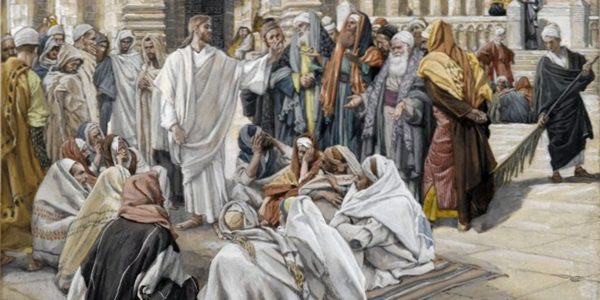 Pastors have a frequent question when they begin to discover mimetic theory. “That’s great. But how does it preach?”
Reverend Tom Truby shows that mimetic theory is a powerful tool that enables pastors to preach the Gospel in a way that is meaningful and refreshing to the modern world. Each Wednesday, Teaching Nonviolent Atonement will highlight his sermons as an example of preaching the Gospel through mimetic theory.
In this sermon, Tom explores the meaning behind Jesus healing a woman on the Sabbath. Jesus brings her into a loving community and identifies her as a beloved daughter of God, which upsets the power structure of the religious community. The powerful criticize Jesus, not because Jesus healed on the Sabbath, but because they see his healing actions as a rival to their own power. Tom shows where this will all lead – the forgiveness of Christ revealed on the cross.
Year C, 14th Sunday after Pentecost, Proper 16c
August 21st, 2016
By Thomas L. Truby
Luke 13:10-17
The Day the Clouds Cleared for a Moment
It was the Sabbath and Jesus is in the synagogue teaching. “A woman was there who had been disabled by a spirit for eighteen years. She was bent over and couldn’t stand up straight.” I can picture her. A thousand pictures of women bearing huge bundles of sticks back to their homes to burn in their small fires, of girls carrying water from distant wells through hot and dangerous terrain, of somber mothers working two or three jobs in desperate attempts to provide for their children converge in my mind to form a picture of her.
A disabling spirit has attacked her sense of worth. It bent her over with heavy burdens and she finds it’s impossible to stand up straight. What is a disabling spirit? Could a disabling spirit be what everybody thinks is true but it really isn’t? This woman thinks she is of no value because no one sees her as having any. We are formed by how the other sees us. Everywhere she looks her worthlessness is confirmed.
But Jesus saw her, called her to him and said “woman, you are set free from your sickness.” He took the initiative. He touched her and she stood tall and praised God. His touch had more power than the old spirit that had oppressed her for eighteen years. Jesus sees her through his eyes formed by the kingdom of God. He can value her as a daughter of Abraham and do this in a culture totally blind to her. Now she knows she has value no matter what the community thinks. She has been set free of her sickness that was really the community’s sickness all along.
The scene shifts to the synagogue leader. He is incensed that Jesus healed on the Sabbath. Do you really think he cares about the day of the week or is he more concerned that Jesus upstaged him by doing something really wonderful?
The leader is in rivalry with Jesus, sees him as a threat and decides to relate to him as an enemy. He upbraids Jesus for doing work on the Sabbath. Ah, I suspect the issue isn’t the Sabbath. No, it’s just that the religious leader can’t say “I hate you Jesus because you have just made me look bad and threatened my power base here at the synagogue.” He doesn’t care about this woman bent down and suffering for eighteen years. He thinks, “You can tell who God has blessed and who God hasn’t by noting who is sick and in poverty and who has the goods and the respect of the community. I’m the synagogue leader because I worked for it, exercised good judgment and kept God’s rules. Jesus, don’t you come along with your so-called compassion and mess that up.”
But of course, he can’t say that, it doesn’t even run through his head as a train of thought because those are the kinds of things he can’t admit, even to himself. So he short circuits it and out comes “There are six days during which work is permitted. Come and be healed on those days, not on the Sabbath day.”
“The Lord replied, ‘Hypocrites!’” He uses the plural. I wonder who he is thinking of besides the leader. Hypocrites say one thing and do another. They don’t see the connection between their words and their actions. For a second week in a row we ask what can’t they see?
They treat their livestock better than this woman. The woman and the animals are both in bondage but they make sure the animals are watered even on the Sabbath. Why do they have no problem untying the animals but vigorously resist untying their sister? Could it be that she is their measuring stick telling them who they are, whereas their livestock are just livestock–dumb animals with no meaning.
She has meaning. She is a fellow human and they are all players on the human stage. Where she stands on the stage has implications for where they stand. Who people think she is impacts how people see themselves. They need her to be bent so that they can be seen as blessed and deserving. That she is a child of God just like them does not factor in their reckoning. They don’t really want her to get well.
This woman is vital to the synagogue leader’s identity and all the others who see themselves as especially deserving. They have a relationship with her that is powerfully colored by where they stand in their community. The whole structure isn’t about God and keeping God happy, it’s about people knowing their place and staying in it.
The text now introduces a surprise. It seems the woman has been bound by Satan. Satan throughout the New Testament is the accuser. Could Satan be a stand-in for the accusing community who says “You are just a woman. You were born to carry this burden. Don’t try to escape it.” Does this story have application for any person or group of people our culture asks to carry our burdens; to be the ones in whom we store our resentments and who absorb our dysfunction?
In this story from Luke, Jesus comes along and sees a woman bent by her culture. Jesus decides to set her free. Jesus has asked us to model ourselves after him. When we see someone bent, or perhaps a whole population bent, shaped by the weight they are carrying even though it is not their burden, what should we do? Should we feel their plight and call out to them in identification or do we ignore them knowing that the synagogue leader will like us better that way? How can we place our hands on them so they can stand up and praise God? This is the question the passage raises for me.
All of this happened on the Sabbath, the day of rest and worship. The Sabbath is meant to break the routine and gives us an opportunity to reflect on our lives. Wouldn’t it be a good day for this woman to discover she is a loved child of God, no different than all other children of God? And wouldn’t it be a good day for us humans to discover that we participate in each other’s bondage? The Sabbath, that day for resetting life and getting things right is the perfect day for us all to be freed.
Jesus must have said all of this in such a way that everyone saw the connections. They recognized that those on top in that culture were there because others were on the bottom. Somehow on that day top and bottom got leveled out to where all of them recognize they were just human, God’s loved children, no inferiors and no superiors. Everyone breathed pure air and it was exhilarating.
With things suddenly clarified, the opponents of Jesus felt ashamed—as they should. But we know they are forgiven too. Jesus is on his way to the cross to make that explicit and tangible so that they will be able to see it and feel it in their bones. In exposing the mechanism by which their little village worked, with its synagogue at the center, they have been given a great gift. Though the leaders may not know it, they too are in bondage. Their bondage is their need to keep their sister bent and to hide that they do that even from themselves. It keeps them from claiming and celebrating their full humanity and praising God.
When the dark clouds of human ignorance and self-deceit cleared for a moment, the crowd saw it and rejoiced. I suspect they didn’t understand what had happened but they knew Jesus had done something extraordinary. Many would understand it later, after the crucifixion and resurrection. Amen.
Image: James Tissot [No restrictions or Public domain], via Wikimedia Commons
![James Tissot [No restrictions or Public domain], via Wikimedia Commons](https://commons.wikimedia.org/wiki/File:Brooklyn_Museum_-_The_Pharisees_Question_Jesus_%28Les_pharisiens_questionnent_J%C3%A9sus%29_-_James_Tissot.jpg)
Previous Post

August 23, 2016
Jesus is at the Border: Immigration, Barriers, and God’s Economy
Next Post
August 25, 2016 Ryan Lochte and Everything Wrong with America
Browse Our Archives
Select a Category Atonement and Current Events Curriculum Faith and Families Interviews Jesus the Forgiving Victim Lent Montessori politics Reviews The Bible Explained Uncategorized Valentine's Day Wednesday Sermon Who is God?
Select a Month July 2020 November 2019 October 2019 September 2019 August 2019 July 2019 June 2019 May 2019 April 2019 March 2019 February 2019 January 2019 December 2018 November 2018 October 2018 September 2018 August 2018 July 2018 June 2018 May 2018 April 2018 March 2018 February 2018 January 2018 December 2017 November 2017 October 2017 September 2017 August 2017 July 2017 June 2017 May 2017 April 2017 March 2017 February 2017 January 2017 December 2016 November 2016 October 2016 September 2016 August 2016 June 2016 May 2016 April 2016 March 2016 February 2016 January 2016 December 2015 November 2015 October 2015 September 2015 August 2015 July 2015 June 2015 May 2015 April 2015 March 2015 February 2015 January 2015 December 2014 November 2014 October 2014 September 2014 August 2014 July 2014 June 2014 May 2014 April 2014 March 2014 January 2014 December 2013 September 2013 August 2013 July 2013
Follow Us!
TAKE THE
Religious Wisdom Quiz
Who was Timothy's mother?
Select your answer to see how you score.
Eunice Lois Mary Priscilla
Related posts from Teaching Nonviolent Atonement
Sermon: The Eleventh Commandment

Being Careful to Live Wisely: Faith and Climate...


Let Light Shine Out of Darkness
TRENDING AT PATHEOS Progressive Christian

What Being a Modern-Day Apostle Means to Me
In my last column, I discussed the ins and outs of modern-day...

Did Ancient China Once Worship the God of...
Across human history, a common thread weaves through the origins of the...

Love Your Neighbor – Including Earth-Kin: Lev. 19,...
God’s command to love your neighbor means acting in an ethical and...

Lead a Church Study of “Jesus and Lao...
Guest writer Jack Thomas (The Irreverent Reverend) reflects on leading his church...

Pastoral Wisdom for Responding to Sermon Pushback
Getting sermon pushback on your social justice sermon? Learn practical, Proverbs-based strategies...

Principles for Understanding the Apostolic Ministry Today
Whenever people discover that my formal ministry title is "apostle," as in...
view all Progressive Christian blogs
Ad-Free & Subscriber Log-In Subscription Support
- About Us
- 2026 Calendar
- Videos
- Podcasts
- Library of World Religions
- Faith In Media Tracker
- Advertise With Us
- Write for Us
- Privacy Policy
- Terms of Service
- Do Not Sell My Data
- Contact Us
- Radiant Digital
- Manage Newsletter Subscriptions
- Unsubscribe From Notifications
- Sitemap
Copyright 2008-2026, Patheos. All rights reserved.
Subscription Support Ad-Free & Subscriber Log-In
Follow Patheos