
BuddhistCatholicContemplativeEvangelicalGeneral ChristianHinduJewishLatter-day SaintMuslimNew VisionsProgressive Christian
Beliefs
- Buddhist
- Catholic
- Contemplative
- Evangelical
- General Christian
- Hindu
- Jewish
- Latter-day Saint
- More Voices
- Muslim
- New Visions
- Pagan
- Progressive Christian
Topics
- Religion News
- Food and Religion
- Sports and Religion
- Religious Art
- Religious Music and Entertainment
- Religious Events
- History and Religion
- Style and Religion
- Politics and Religion
- Women in Religion
- Recreation Outdoors and Religion
- Business Finance and Religion
- Careers Workplace and Religion
- Education and Religion
- Family Parenting and Religion
- Health Fitness and Religion
- Home and Religion
- Relationships and Religion
- Technology and Religion
- Travel and Religion
Columnists
- Buddhist Columnists
- Business Finance and Religion Columnists
- Careers Workplace and Religion Columnists
- Catholic Columnists
- Contemplative Columnists
- Education and Religion Columnists
- Evangelists Columnists
- Family Parenting and Religion Columnists
- General Christian Columnists
- Health Fitness and Religion Columnists
- Hindu Columnists
- History and Religion Columnists
- Home and Religion Columnists
- Jewish Columnists
- More Voices Columnists
- Latter Day Columnists
- Muslim Columnists
- New Visions Columnists
- Nonreligious Columnists
- Pagan Columnists
- Politics and Religion Columnists
- Progressive Columnists
- Recreation Outdoors and Religion Columnists
- Relationships and Religion Columnists
- Religion News Columnists
- Religious Art Columnists
- Religious Events Columnists
- Religious Music and Entertainment Columnists
- Sports and Religion Columnists
- Style and Religion Columnists
- Technology and Religion Columnists
- Travel and Religion Columnists
- Women in Religion Columnists
Resource Library
- 2026 Calendar
- Library of World Religions
- The 100 Most Holy Places on Earth
- Patheos Answers
- Podcasts
- Videos
- Faith Leaders Database
- Anglican Episcopalian
- Bahai
- Baptist
- Buddhism
- Christianity
- Confucianism
- Eastern Orthodoxy
- Hinduism
- Holiness and Pentecostal
- ISKCON
- Islam
- Judaism
- Lutheran
- Methodist
- The Church of Jesus Christ of Latter-day Saints
- New Age
- Paganism
- Presbytarian and Reformed
- Protestantism
- Religion Behind the Scenes
- Roman Catholic
- Scientology
- Shia Islam
- Sikhism
- Sufism
- Sunni Islam
- Taoism
- Zen
- See all religions
Research Tools
 Ad-Free & Subscriber Log-In Subscription Support
Ad-Free & Subscriber Log-In Subscription Support
Follow Patheos 

- Trending:
- Forgiveness
- |
- Marriage
- |
- Consciousness
- |
- Death Penalty
- |
- Election
- |
- Halloween
 Teaching Nonviolent Atonement
- Home
- Progressive Christian
- Exercises in Empathy: Seeing Humanity Through the Flames
Exercises in Empathy: Seeing Humanity Through the Flames
Last updated on: August 22, 2016 at 10:41 am by Lindsey Paris-Lopez
Exercises in Empathy: Seeing Humanity Through the Flames 2016-08-22T10:41:38-05:00 Lindsey Paris-Lopez
Patheos Explore the world's faith through different perspectives on religion and spirituality! Patheos has the views of the prevalent religions and spiritualities of the world.
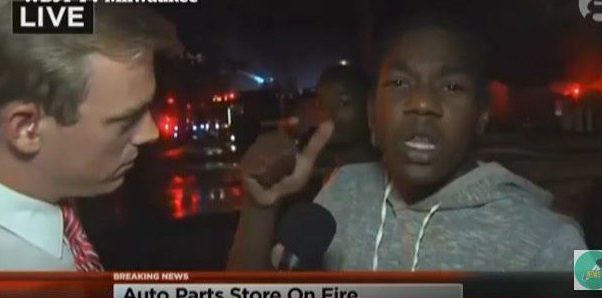 Milwaukee, the shooting of Sylville Smith, uprisings, a toxic, lethal system catching fire… words fail me.
I can’t imagine the challenge of growing up black in the most segregated city in a nation built on slavery, trying to stay in school in a district where the drop-out rate and the achievement gaps are at their highest. I can’t imagine growing up black where the incarceration rate for black males is twice a too-high national average. I can’t imagine living in a world where upward mobility is crushed under the boots of racist oppression, trapped in the nightmarish underbelly of the American dream.
Here in the privilege of my white skin, I cannot know the depths of that nightmare. I can learn about asystem of greed and power-hunger that stole people from their homelands and forced them to be tools of another’s prosperity; I can read about a warped theology that whitewashed Jesus Christ and refused to see those with dark skin as members of his body. I can try to imagine being a black child being taught to revere American heroes like Thomas Jefferson who owned my ancestors as property. I can recall laws that kept people from coming to know each other as some were denied resources for quality education, housing and employment. I can understand how segregation erected barriers in hearts and minds that laws alone could not demolish. Intellectually I can connect the dots to see how generations of dehumanization built a system of poverty and prejudice and oppression. But I cannot know what it is like to live it.
I cannot know… but I’m trying to imagine. Because if I could immerse myself into that life, maybe I could start to feel some of the fear Sylville Smith felt as he heard the sirens behind him. Maybe the names of Sandra Bland and Philando Castile would flash in my mind. Maybe I would entertain a brief hope that I could outrun a cop or a bullet, maybe I would feel the futility of it all halfway down the street, out of breath, and turn around, gun still in hand. Try as I might to imagine, I don’t know what I would have done if I were Sylville Smith, searching for a way to protect myself before a bullet tore through my chest.
Then I try to imagine watching from a window as Sylville is shot, wondering if I or someone I love will be the next to be tried in the street not by peers but by judge, jury and executioner in uniform. I try to imagine living in a nation that has shown time and again that my life and the life of my family doesn’t matter, or matters primarily as a source of exploitation. I try to imagine all the rage and pain that erupted in fire and gunshots, and the life of systemic oppression multiplied throughout segregated communities all across the country that lead to that eruption.
Dr, Martin Luther King Jr. said, “A riot is the language of the unheard,” and last weekend in Milwaukee, cries of anguish and urgency rose through the smoke across the chasm of segregation that deafens those in denial of privilege. African Americans feel threatened in their own neighborhoods, some finding catharsis and perceiving their only avenue of communication in violence. How did the situation come to this?
Before we condemn the violence of the Milwaukee riots, we must condemn the conditions that created the violence in the first place. Those conditions crystallized in the shooting of Sylville Smith, but they did not begin with him. They began with chains in Africa, ships on the Atlantic, centuries of inequality that continues to keep schools and neighborhoods segregated. Conditions of poverty, fueled by racism and prejudice, are exacerbated by the “New Jim Crow” of mass incarceration that disproportionately targets African Americans. In the past few years, this systemic injustice has manifested in police brutality, shootings, and exonerations of officers that that have become public knowledge in the age of mass media.
Yet police officers are just the front lines of this systemic injustice that runs far deeper than policing. American policing reinforces a status quo that scapegoats African Americans, regardless of the race of the officers. But that status quo is a white supremacy so deeply ingrained in American culture that it infects us all, not just officers, many who take seriously their mission “to serve and protect.” Thus, even as I hear the desperate humanity in the uprising voices, such as the impassioned plea of Sylville Smith’s brother, Sedan, I also try to empathize with the police officer who shot Sylville. I try to imagine being an enforcer of law in a nation armed to the teeth. I try to imagine how a career of dealing with people at their most dangerous would affect my thoughts. When police officers take all the blame for violence against African Americans when the responsibility for our culture of racism spreads so far and wide, they ironically become scapegoats on behalf of a scapegoated community.
This is not to deny the need for consequences for excessive force or training to avoid lethal action, or to deny “blue privilege” which allows most officers who kill African Americans to avoid any consequence. (Even if the police video reveals that the officer shot in self-defense, more training must be devoted to de-escalation, and the fear that leads to escalation is an indictment of our culture, not just policing). Nor is this to excuse the random violence of the protests that have harmed innocent business owners, injured police officers, and led to arrests. But it is to suggest that we look to the deep, human pain finding its expression in fear and violence. While some wish to dehumanize protestors and others want to dehumanize officers, there is nothing more human than responding to fear and violence with more violence and fear. This cycle of negative mimesis is a large part of how humans relate to one another, especially when barriers prevent us from truly coming to know each other.
But we can do better. We can relate to each other in empathy and compassion by acknowledging and breaking down the systemic barriers that segregate us. It is up to those of us with privilege to break the cycle of violence by first dismantling and healing the damage from our own. As we come to the see humanity of those we demonize, even through the flames of violence, we will recognize the redeeming truth: that our humanity is bound up together.
Stay in the loop! Like Teaching Nonviolent Atonement on Facebook!
Previous Post

August 19, 2016
The Apocalypse Revealed - The Bible Explained: Part 4
Next Post
August 23, 2016 Jesus is at the Border: Immigration, Barriers, and God’s Economy
Browse Our Archives
Select a Category Atonement and Current Events Curriculum Faith and Families Interviews Jesus the Forgiving Victim Lent Montessori politics Reviews The Bible Explained Uncategorized Valentine's Day Wednesday Sermon Who is God?
Select a Month July 2020 November 2019 October 2019 September 2019 August 2019 July 2019 June 2019 May 2019 April 2019 March 2019 February 2019 January 2019 December 2018 November 2018 October 2018 September 2018 August 2018 July 2018 June 2018 May 2018 April 2018 March 2018 February 2018 January 2018 December 2017 November 2017 October 2017 September 2017 August 2017 July 2017 June 2017 May 2017 April 2017 March 2017 February 2017 January 2017 December 2016 November 2016 October 2016 September 2016 August 2016 June 2016 May 2016 April 2016 March 2016 February 2016 January 2016 December 2015 November 2015 October 2015 September 2015 August 2015 July 2015 June 2015 May 2015 April 2015 March 2015 February 2015 January 2015 December 2014 November 2014 October 2014 September 2014 August 2014 July 2014 June 2014 May 2014 April 2014 March 2014 January 2014 December 2013 September 2013 August 2013 July 2013
Follow Us!
TAKE THE
Religious Wisdom Quiz
What was the name of the man who suffered great loss but remained faithful to God?
Select your answer to see how you score.
Noah Job Abraham Elijah
Related posts from Teaching Nonviolent Atonement

Perfect Love Casts Out Fear, But Can It...

Building God's Kingdom or Destroying Ourselves? Sodom, The...
Racism: Survivors and Perpetrators Find Healing in Africa

The One Thing: My Dad, City Slickers, and...
TRENDING AT PATHEOS Progressive Christian

What Being a Modern-Day Apostle Means to Me
In my last column, I discussed the ins and outs of modern-day...

Did Ancient China Once Worship the God of...
Across human history, a common thread weaves through the origins of the...

Love Your Neighbor – Including Earth-Kin: Lev. 19,...
God’s command to love your neighbor means acting in an ethical and...

Lead a Church Study of “Jesus and Lao...
Guest writer Jack Thomas (The Irreverent Reverend) reflects on leading his church...

Pastoral Wisdom for Responding to Sermon Pushback
Getting sermon pushback on your social justice sermon? Learn practical, Proverbs-based strategies...

Principles for Understanding the Apostolic Ministry Today
Whenever people discover that my formal ministry title is "apostle," as in...
view all Progressive Christian blogs
Ad-Free & Subscriber Log-In Subscription Support
- About Us
- 2026 Calendar
- Videos
- Podcasts
- Library of World Religions
- Faith In Media Tracker
- Advertise With Us
- Write for Us
- Privacy Policy
- Terms of Service
- Do Not Sell My Data
- Contact Us
- Radiant Digital
- Manage Newsletter Subscriptions
- Unsubscribe From Notifications
- Sitemap
Copyright 2008-2026, Patheos. All rights reserved.
Subscription Support Ad-Free & Subscriber Log-In
Follow Patheos