
BuddhistCatholicContemplativeEvangelicalGeneral ChristianHinduJewishLatter-day SaintMuslimNew VisionsProgressive Christian
Beliefs
- Buddhist
- Catholic
- Contemplative
- Evangelical
- General Christian
- Hindu
- Jewish
- Latter-day Saint
- More Voices
- Muslim
- New Visions
- Pagan
- Progressive Christian
Topics
- Religion News
- Food and Religion
- Sports and Religion
- Religious Art
- Religious Music and Entertainment
- Religious Events
- History and Religion
- Style and Religion
- Politics and Religion
- Women in Religion
- Recreation Outdoors and Religion
- Business Finance and Religion
- Careers Workplace and Religion
- Education and Religion
- Family Parenting and Religion
- Health Fitness and Religion
- Home and Religion
- Relationships and Religion
- Technology and Religion
- Travel and Religion
Columnists
- Buddhist Columnists
- Business Finance and Religion Columnists
- Careers Workplace and Religion Columnists
- Catholic Columnists
- Contemplative Columnists
- Education and Religion Columnists
- Evangelists Columnists
- Family Parenting and Religion Columnists
- General Christian Columnists
- Health Fitness and Religion Columnists
- Hindu Columnists
- History and Religion Columnists
- Home and Religion Columnists
- Jewish Columnists
- More Voices Columnists
- Latter Day Columnists
- Muslim Columnists
- New Visions Columnists
- Nonreligious Columnists
- Pagan Columnists
- Politics and Religion Columnists
- Progressive Columnists
- Recreation Outdoors and Religion Columnists
- Relationships and Religion Columnists
- Religion News Columnists
- Religious Art Columnists
- Religious Events Columnists
- Religious Music and Entertainment Columnists
- Sports and Religion Columnists
- Style and Religion Columnists
- Technology and Religion Columnists
- Travel and Religion Columnists
- Women in Religion Columnists
Resource Library
- 2026 Calendar
- Library of World Religions
- The 100 Most Holy Places on Earth
- Patheos Answers
- Podcasts
- Videos
- Faith Leaders Database
- Anglican Episcopalian
- Bahai
- Baptist
- Buddhism
- Christianity
- Confucianism
- Eastern Orthodoxy
- Hinduism
- Holiness and Pentecostal
- ISKCON
- Islam
- Judaism
- Lutheran
- Methodist
- The Church of Jesus Christ of Latter-day Saints
- New Age
- Paganism
- Presbytarian and Reformed
- Protestantism
- Religion Behind the Scenes
- Roman Catholic
- Scientology
- Shia Islam
- Sikhism
- Sufism
- Sunni Islam
- Taoism
- Zen
- See all religions
Research Tools
 Ad-Free & Subscriber Log-In Subscription Support
Ad-Free & Subscriber Log-In Subscription Support
Follow Patheos 

- Trending:
- Forgiveness
- |
- Marriage
- |
- Consciousness
- |
- Death Penalty
- |
- Election
- |
- Halloween
 Teaching Nonviolent Atonement
- Home
- Progressive Christian
- Transcending Phobias, Finding Hope, Building Peace after Orlando
Transcending Phobias, Finding Hope, Building Peace after Orlando
Last updated on: June 17, 2016 at 11:18 am by Lindsey Paris-Lopez
Transcending Phobias, Finding Hope, Building Peace after Orlando 2016-06-17T11:18:25-05:00 Lindsey Paris-Lopez
Patheos Explore the world's faith through different perspectives on religion and spirituality! Patheos has the views of the prevalent religions and spiritualities of the world.
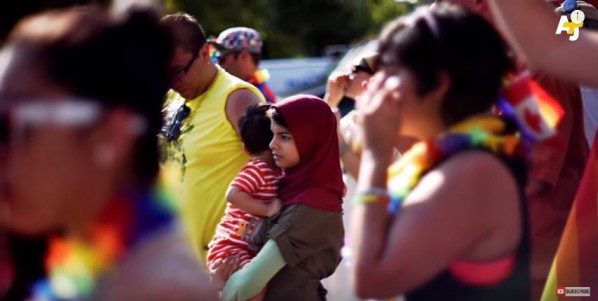 Love must transform our fears, turn our arms of war into arms of embrace, strip us down to our human core. Love must make us one.
On Tuesday night, in the raw heartache following the Pulse Nightclub massacre, I saw this love — born from shared grief, vulnerability, and longing for peace — in embraces that collapsed boundaries of religion and sexual orientation. I was at the Ahmadiyya Muslim Community Center in Glen Ellyn, IL, for a prayer vigil and iftar (Ramadan fast-breaking) dinner. What had been planned as an evening of interfaith hospitality had grown to include a memorial service in honor of 49 beautiful lives taken too soon, and an opportunity to build understanding and friendship beyond deadly prejudices and divides.
Sitting among Muslims who, in a climate of political hatred directed against them, had thrown open doors of welcome, I watched as members of the queer community, among others, came to the microphone to grieve and receive love and support. When a teenage girl expressed through her tears how devastated she was that in 2016, people can be killed simply for “who we love and for being who we are,” I was moved with awe and compassion.
Listening to her courageous witness, my first thought was that I had never before considered a mosque a safe space for being “out.” I have witnessed homophobia in Muslim as well as Christian communities, and have myself struggled to understand scripture beyond homophobic interpretations. And while my friends and I have grown in understanding of both our LGBTQIA sisters and brothers and the one God who loves us all exactly as we are, I was still amazed to see that truth affirmed so beautifully in a mosque. I could feel old prejudices sloughing off my heart like dead skin as the warmth in the room enveloped me.
Almost simultaneously, another thought arose. A mosque has become a safe space for LGBTQIA mourners to grieve their lack of safety partly because the Muslim community abroad and at home can empathize, vulnerable as they are to the same danger. Muslims around the world are being killed in air strikes for “being who they are.” Whether they are among the majority of innocent civilians in the vicinity of an identified target, coming to the rescue of others, or mourning their dead, Muslims are killed by the world’s largest terrorist organization – the United States military-industrial complex — every day. As groups like ISIS emerge from the carnage, the United States continues to fuel terror by responding to terror with terror. And Muslim citizens at home are stereotyped and subjected to the vitriol and venom of those blind to their own violence and the systemic violence of US policy.
Muslims and members of the LGBTQIA community both know what it’s like to be prejudged and demonized. Discrimination and malicious rhetoric feed into a culture that make LGBTQIA people afraid to be themselves in public and may even drive self-loathing. Similar prejudices have made Muslims fear to wear hijab or pray in public and constantly be on their guard. At the Ahmadiyya mosque, members of different communities living on the underside of social and political violence, survivors in a world of dehumanizing and deadly hate, came together in love.
But the light of this grace must spread beyond this moment, illuminating hard truths. Omar Mateen was motivated by both homophobia, projecting self-loathing for at least homoerotic curiosity outward, and vengeance in the wake of deadly Islamophobia, retaliating for the destruction of Afghanistan and the Middle East. While God’s love transcended both phobias at the memorial service, we must take a hard, honest look at the fear and violence that lurk in our religious and national traditions.
When our faith brings us a sense of peace, we are reluctant to see its violence. But religion and violence are deeply intertwined. Religion, René Girard posits, arose from violence in order to control and contain it. As humanity evolved, our ability to imitate one another’s desires expanded, erupting in conflict as we fought over what we couldn’t or wouldn’t share. Our ancestors found a cure to the all-against-all violence born of mutual desire by uniting against a random victim to pour out their collective violence. This scapegoat, falsely blamed for the chaos of the mimetic crisis, was killed in a communal sacrifice, and the sense of peace that emerged from the unified purging was thought divine in origin. Over time, sacrifice was ritualized and ancient religions were born.
Perceiving divinity in violence, humanity was wrong about the nature of God from the very beginning. The Hebrew Bible traces God’s redirection of human misunderstanding from sacrifice to mercy, and in the Christian tradition, this revelation culminates in God’s self-disclosure as embodied Love in Jesus. The Qur’an, too, traces an evolution of religious understanding from the age of violent ignorance, the Jahiliyah, to God’s all-encompassing compassion. Our scapegoats – those condemned, excluded, and killed in the name of God, or peace, or security — are revealed to be dear to God’s heart. But ancient habits die hard, and we continue to scapegoat, blind to God’s love for our victims. Modern religions, in our flawed interpretation and practice, are a commingling of the false transcendence of exclusion and God’s revelation of inclusive compassion.
Popular interpretations of the Abrahamic faiths have long scapegoated the LGBTQIA community, rendering their own queer adherents anxious and isolated. But there are more loving ways to interpret the “clobber texts” of both the Judeo-Christian and Islamic traditions in light of God’s radical inclusivity. We must look carefully at our own faith traditions to see where we still hold ancient misunderstandings of God as exclusive and violent. Any religious interpretation that fuels discrimination is not from God.
Likewise, Muslims are among the scapegoats of the national religion of American Exceptionalism. Like ancient religions, its perceived value lies in the sense of unity it gives its adherents, but that unity, over and against others, is deadly. Like ancient religions, it must be transformed from an instrument of violence to an instrument of peace. America is not exceptional, but we can be good. We must repent, make reparations, and build friendships. We must mourn the victims of our drone strikes as we mourn the victims of mass shootings on our own soil. We must turn our resources from war to reconciliation and embrace the marginalized. We must find transcendence not in warmongering but in peace-building. God blesses America as God blesses everyone, by illuminating a way out of our violence into love.
If we can find the courage to listen to those on the underside of our prejudices and policies, we will find God magnified in them. We will trade our false sense of superiority for friendship rooted in equality. We will trade our fleeting security rooted in violence for the eternal peace of Love.
The Pulse Nightclub massacre, fueled by homophobia and vengeance, fueling Islamophobia, reminds us of how much work we need to do to reorient ourselves from exclusion to empathy. But as God’s children embrace across barriers of faith and sexual orientation and all other divides, that work begins in hope. May we continue the task of reconciliation in joy.
Image: Screenshot from Youtube: “Gay and Queer Muslims Dismiss GOP Attempts To Woo Them After #Orlando” by AJ+
Previous Post

June 16, 2016
Let Me Introduce You To "Radical Islam"
Browse Our Archives
Select a Category Atonement and Current Events Curriculum Faith and Families Interviews Jesus the Forgiving Victim Lent Montessori politics Reviews The Bible Explained Uncategorized Valentine's Day Wednesday Sermon Who is God?
Select a Month July 2020 November 2019 October 2019 September 2019 August 2019 July 2019 June 2019 May 2019 April 2019 March 2019 February 2019 January 2019 December 2018 November 2018 October 2018 September 2018 August 2018 July 2018 June 2018 May 2018 April 2018 March 2018 February 2018 January 2018 December 2017 November 2017 October 2017 September 2017 August 2017 July 2017 June 2017 May 2017 April 2017 March 2017 February 2017 January 2017 December 2016 November 2016 October 2016 September 2016 August 2016 June 2016 May 2016 April 2016 March 2016 February 2016 January 2016 December 2015 November 2015 October 2015 September 2015 August 2015 July 2015 June 2015 May 2015 April 2015 March 2015 February 2015 January 2015 December 2014 November 2014 October 2014 September 2014 August 2014 July 2014 June 2014 May 2014 April 2014 March 2014 January 2014 December 2013 September 2013 August 2013 July 2013
Follow Us!
TAKE THE
Religious Wisdom Quiz
What happened when Peter tried to walk on water?
Select your answer to see how you score.
He ran ahead of Jesus He sank when he doubted The Spirit descended upon him He led other disciples out
Related posts from Teaching Nonviolent Atonement

How My Atheist Father Helps Me Appreciate The...

The Unity of All Things: How to Be...
We Are One: Unity in Christ with Victims,...
Good Friday? Or Worst Day Ever Friday? –...
TRENDING AT PATHEOS Progressive Christian

What Being a Modern-Day Apostle Means to Me
In my last column, I discussed the ins and outs of modern-day...

Did Ancient China Once Worship the God of...
Across human history, a common thread weaves through the origins of the...

Love Your Neighbor – Including Earth-Kin: Lev. 19,...
God’s command to love your neighbor means acting in an ethical and...

Lead a Church Study of “Jesus and Lao...
Guest writer Jack Thomas (The Irreverent Reverend) reflects on leading his church...

Pastoral Wisdom for Responding to Sermon Pushback
Getting sermon pushback on your social justice sermon? Learn practical, Proverbs-based strategies...

Principles for Understanding the Apostolic Ministry Today
Whenever people discover that my formal ministry title is "apostle," as in...
view all Progressive Christian blogs
Ad-Free & Subscriber Log-In Subscription Support
- About Us
- 2026 Calendar
- Videos
- Podcasts
- Library of World Religions
- Faith In Media Tracker
- Advertise With Us
- Write for Us
- Privacy Policy
- Terms of Service
- Do Not Sell My Data
- Contact Us
- Radiant Digital
- Manage Newsletter Subscriptions
- Unsubscribe From Notifications
- Sitemap
Copyright 2008-2026, Patheos. All rights reserved.
Subscription Support Ad-Free & Subscriber Log-In
Follow Patheos