
BuddhistCatholicContemplativeEvangelicalGeneral ChristianHinduJewishLatter-day SaintMuslimNew VisionsProgressive Christian
Beliefs
- Buddhist
- Catholic
- Contemplative
- Evangelical
- General Christian
- Hindu
- Jewish
- Latter-day Saint
- More Voices
- Muslim
- New Visions
- Pagan
- Progressive Christian
Topics
- Religion News
- Food and Religion
- Sports and Religion
- Religious Art
- Religious Music and Entertainment
- Religious Events
- History and Religion
- Style and Religion
- Politics and Religion
- Women in Religion
- Recreation Outdoors and Religion
- Business Finance and Religion
- Careers Workplace and Religion
- Education and Religion
- Family Parenting and Religion
- Health Fitness and Religion
- Home and Religion
- Relationships and Religion
- Technology and Religion
- Travel and Religion
Columnists
- Buddhist Columnists
- Business Finance and Religion Columnists
- Careers Workplace and Religion Columnists
- Catholic Columnists
- Contemplative Columnists
- Education and Religion Columnists
- Evangelists Columnists
- Family Parenting and Religion Columnists
- General Christian Columnists
- Health Fitness and Religion Columnists
- Hindu Columnists
- History and Religion Columnists
- Home and Religion Columnists
- Jewish Columnists
- More Voices Columnists
- Latter Day Columnists
- Muslim Columnists
- New Visions Columnists
- Nonreligious Columnists
- Pagan Columnists
- Politics and Religion Columnists
- Progressive Columnists
- Recreation Outdoors and Religion Columnists
- Relationships and Religion Columnists
- Religion News Columnists
- Religious Art Columnists
- Religious Events Columnists
- Religious Music and Entertainment Columnists
- Sports and Religion Columnists
- Style and Religion Columnists
- Technology and Religion Columnists
- Travel and Religion Columnists
- Women in Religion Columnists
Resource Library
- 2026 Calendar
- Library of World Religions
- The 100 Most Holy Places on Earth
- Patheos Answers
- Podcasts
- Videos
- Faith Leaders Database
- Anglican Episcopalian
- Bahai
- Baptist
- Buddhism
- Christianity
- Confucianism
- Eastern Orthodoxy
- Hinduism
- Holiness and Pentecostal
- ISKCON
- Islam
- Judaism
- Lutheran
- Methodist
- The Church of Jesus Christ of Latter-day Saints
- New Age
- Paganism
- Presbytarian and Reformed
- Protestantism
- Religion Behind the Scenes
- Roman Catholic
- Scientology
- Shia Islam
- Sikhism
- Sufism
- Sunni Islam
- Taoism
- Zen
- See all religions
Research Tools
 Ad-Free & Subscriber Log-In Subscription Support
Ad-Free & Subscriber Log-In Subscription Support
Follow Patheos 

- Trending:
- Forgiveness
- |
- Marriage
- |
- Consciousness
- |
- Death Penalty
- |
- Election
- |
- Halloween
 Teaching Nonviolent Atonement
- Home
- Progressive Christian
- Wednesday Sermon: Shall We Gather at the River?
Wednesday Sermon: Shall We Gather at the River?
Last updated on: May 4, 2016 at 1:33 pm by Tom Truby
Wednesday Sermon: Shall We Gather at the River? 2016-05-04T13:33:20-05:00 Tom Truby
Patheos Explore the world's faith through different perspectives on religion and spirituality! Patheos has the views of the prevalent religions and spiritualities of the world.
 Pastors have a frequent question when they begin to discover mimetic theory. “That’s great. But how does it preach?”
Reverend Tom Truby shows that mimetic theory is a powerful tool that enables pastors to preach the Gospel in a way that is meaningful and refreshing to the modern world. Each Wednesday, Teaching Nonviolent Atonement will highlight his sermons as an example of preaching the Gospel through mimetic theory.
In this sermon, Tom explores the conclusion of the book of Revelation. A troubling book for many, Tom finds hope in this obscure passage where the new heaven and earth meet to create a “place outside of human rivalry, envy, jealousy and conflict.” A river with life giving water runs through the new city, and the tree is for the healing of the nations. Indeed, let us gather at the river.
Year C, Easter 6
May 1, 2016
Thomas L. Truby
Revelation 21:1-10, 22-22:5 (Common English Bible, c. 2011)
Shall We Gather at the River?
An old hymn dating from 1864, the year before the Civil War ended, asks “Shall We Gather at the River.” The river according to the book of Revelation contains life giving-water that flows from the throne of God and from the Lamb. The leaves of the trees that grow on the edge of this river are for the healing of the nations. Do we know how that healing works and our part in it?
“Then I saw a new heaven and a new earth, for the former heaven and the former earth had passed away, and the sea was no more.” John has his vision in the midst of turbulent times. The world looks broken. No one knows what will happen and it’s easy to panic and clutch onto things hoping to stay afloat. His vision responds to all of this. He sees a new heaven and a new earth. Something new has arrived and it has displaced the old. Even the sea, that ancient symbol of chaos and confusion is no more in John’s vision. All the frothing and foaming have ceased.
The new thing appears as the holy city, New Jerusalem, coming down out of heaven from God. It’s from heaven; that place outside human rivalry, envy, jealousy and conflict. This force-field of tension we get caught up in has disappeared in the holy city where all are like a bride beautifully dressed for her husband. This bride, unaware of her peers and how impressed they may be with her appearance, focuses on her husband, the Lamb of God, the Christ. Her singular and simple focus makes her beautiful. The passage shimmers with shifting images.
John now hears a loud voice coming from the throne. “Look! God’s dwelling is here with humankind.” The voice names no specific group; not the Jews, not the Christians, but all humankind. The voice announces God’s location and it is here with us and not some distant place far away.
“They will be his peoples.” “Peoples” not people suggesting that God likes diversity. All of this has been written to give us hope. It is an announcement of a new reality that is profoundly true, coming and already here in the Lamb of God.
The voice from the throne speaks a second time. “Look! I am making all things new. Write this down, for these words are trustworthy and true.” Trustworthy and true; how refreshing! Where do we find voices we can say that about, particularly when they are talking about reality and the future? Can any voice be trusted? Don’t all voices carry a self-serving agenda?
Now the voice intimately addresses John in a quieter tone. “All is done. I am the Alpha and the Omega, the beginning and the end.” The voice tells us we have all the pieces we need now. In Jesus, the slain Lamb of God, revelation is complete. We live on the other side of the life, death, resurrection and ascension of Jesus. All is done!
“To the thirsty I will freely give water from the life-giving spring.” Compassion, forgiveness, and willingness to suffering rather than impose suffering is the water from the life-giving spring. It’s not easy and the temptation to quit or get around it is strong but “those who emerge victorious will inherit these things. I will be their God, and they will be my sons and daughters.”
Sadly, we come now to where John of Patmos fails to drink freely from the life-giving spring his vision points to. Even he falls into typical hell-bent religiosity. The text speaks for itself. “But for the cowardly, the faithless, the vile, the murderers, those who commit sexual immorality, those who use drugs and cast spells, the idolaters and all liars—their share will be in the lake that burns with fire and sulfur. This is the second death.”
John of Patmos doesn’t seem to have a way of understanding how we bring hell on ourselves and so resorts to “hellfire” language. Many scholars think John of Patmos was part of the Christian community in Jerusalem who had difficulty with Paul. Paul and the writers of Mark, Luke and John had worked this out and understood Jesus in a deeper way than the folks in Jerusalem, but the writer of Revelation has not been in a community willing to go that far. Even the New Testament must be read through the eyes of the non-violent Jesus.
Beginning in verse 22 the vision presents us with a series of surprises. John of Patmos says “I didn’t see a temple in the city, because its temple is the Lord God Almighty and the Lamb.” Temples aren’t needed when all sacrifice has ended. Religion and all it represents has ended. Instead we have the Lord God Almighty and the Lamb taking the place of religion. This is the religion-less Christianity Bonhoeffer envisioned while in prison. Religion creates an “in” and an “out” and John’s vision of the New Jerusalem moves us beyond that.
“The city doesn’t need the sun and the moon to shine on it, because God’s glory is its light, and its lamp is the Lamb.” The light illumines human behavior revealing the driver of darkness and provides an alternative. This is why “The nations will walk by its light and the kings of the earth will bring their glory into it.” God’s glory lights the sky and the Lamb is the lamp that reveals it. Even the kings of this earth will learn to live by it. Even they will one day model behavior they see in the Lamb. They will rival each other to see who can serve their people the best. Does this give you hope? It does me.
“Its gates will never be shut by day, and there will be no night there.” So it is that everything will be filled with light with no room for darkness. This is a description of the character of God.
“Nothing unclean will ever enter it, nor anyone who does what is vile and deceitful, but only those who are registered in the Lamb’s scroll of life.” Only those who are living as the Lamb does are here. John almost resorts again to the language of “in” and “out” but he is trying to portray a kingdom that is beyond words. Even our words are fallen and have become carriers of deceit. Maybe this is why we need poetry and the sacraments.
“Then the angel showed me the river of life-giving water, shining like crystal, flowing from the throne of God and the Lamb through the city’s main street.” On each side of the river is the tree of life that constantly provides fruit. The leaves of this tree are for the healing of the nations. Notice there is no tree of the knowledge of good and evil. It’s not needed here for, “There will no longer be any curse.” The curse we have called down on each other since Adam and Eve ate the apple disappears. No one will be saying you are bad and we must destroy you.
The problem of identity will go away, for each of us will know whose we are, for the Lamb’s name will be written on our foreheads. We won’t covet the being of another and try to grasp it from them, for we will see his face and his face will hold us in its gaze.
We end by asking, “Shall we gather at the River?” The refrain replies, “Yes, we’ll gather at the river, the beautiful, the beautiful river, gather with the saints at the river that flows by the throne of God.” Amen.
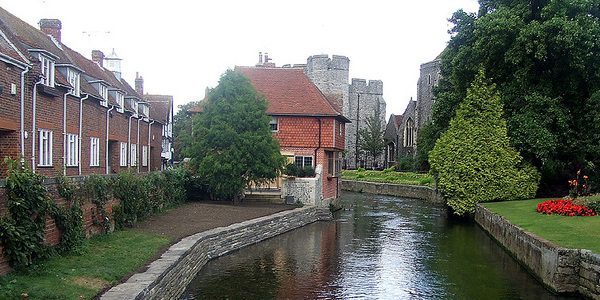
Image: Flickr: Canturbury River – 1, by Graham C 99, Creative Commons License, some changes made.
Stay in the loop! Like Teaching Nonviolent Atonement on Facebook!
Previous Post

May 3, 2016
Ted Cruz: “You Suck” – Children Hecklers and the Politics of Parenting
Next Post
May 4, 2016 Star Wars: The Mask of Evil
Browse Our Archives
Select a Category Atonement and Current Events Curriculum Faith and Families Interviews Jesus the Forgiving Victim Lent Montessori politics Reviews The Bible Explained Uncategorized Valentine's Day Wednesday Sermon Who is God?
Select a Month July 2020 November 2019 October 2019 September 2019 August 2019 July 2019 June 2019 May 2019 April 2019 March 2019 February 2019 January 2019 December 2018 November 2018 October 2018 September 2018 August 2018 July 2018 June 2018 May 2018 April 2018 March 2018 February 2018 January 2018 December 2017 November 2017 October 2017 September 2017 August 2017 July 2017 June 2017 May 2017 April 2017 March 2017 February 2017 January 2017 December 2016 November 2016 October 2016 September 2016 August 2016 June 2016 May 2016 April 2016 March 2016 February 2016 January 2016 December 2015 November 2015 October 2015 September 2015 August 2015 July 2015 June 2015 May 2015 April 2015 March 2015 February 2015 January 2015 December 2014 November 2014 October 2014 September 2014 August 2014 July 2014 June 2014 May 2014 April 2014 March 2014 January 2014 December 2013 September 2013 August 2013 July 2013
Follow Us!
TAKE THE
Religious Wisdom Quiz
According to Titus, what did God do when his kindness and love appeared?
Select your answer to see how you score.
He established his church He destroyed his enemies He saved us through the washing of rebirth and renewal by the Holy Spirit He sent his Son
Related posts from Teaching Nonviolent Atonement

How Forgiveness Can Transform Our Violence and Build...

God Doesn’t Smite Anyone - Reflections on Sodom,...
Jesus Unmasked: Episode 2 – Pride and the...

How My Atheist Father Helps Me Appreciate The...
TRENDING AT PATHEOS Progressive Christian

What Being a Modern-Day Apostle Means to Me
In my last column, I discussed the ins and outs of modern-day...

Did Ancient China Once Worship the God of...
Across human history, a common thread weaves through the origins of the...

Love Your Neighbor – Including Earth-Kin: Lev. 19,...
God’s command to love your neighbor means acting in an ethical and...

Lead a Church Study of “Jesus and Lao...
Guest writer Jack Thomas (The Irreverent Reverend) reflects on leading his church...

Pastoral Wisdom for Responding to Sermon Pushback
Getting sermon pushback on your social justice sermon? Learn practical, Proverbs-based strategies...

Principles for Understanding the Apostolic Ministry Today
Whenever people discover that my formal ministry title is "apostle," as in...
view all Progressive Christian blogs
Ad-Free & Subscriber Log-In Subscription Support
- About Us
- 2026 Calendar
- Videos
- Podcasts
- Library of World Religions
- Faith In Media Tracker
- Advertise With Us
- Write for Us
- Privacy Policy
- Terms of Service
- Do Not Sell My Data
- Contact Us
- Radiant Digital
- Manage Newsletter Subscriptions
- Unsubscribe From Notifications
- Sitemap
Copyright 2008-2026, Patheos. All rights reserved.
Subscription Support Ad-Free & Subscriber Log-In
Follow Patheos