
BuddhistCatholicContemplativeEvangelicalGeneral ChristianHinduJewishLatter-day SaintMuslimNew VisionsProgressive Christian
Beliefs
- Buddhist
- Catholic
- Contemplative
- Evangelical
- General Christian
- Hindu
- Jewish
- Latter-day Saint
- More Voices
- Muslim
- New Visions
- Pagan
- Progressive Christian
Topics
- Religion News
- Food and Religion
- Sports and Religion
- Religious Art
- Religious Music and Entertainment
- Religious Events
- History and Religion
- Style and Religion
- Politics and Religion
- Women in Religion
- Recreation Outdoors and Religion
- Business Finance and Religion
- Careers Workplace and Religion
- Education and Religion
- Family Parenting and Religion
- Health Fitness and Religion
- Home and Religion
- Relationships and Religion
- Technology and Religion
- Travel and Religion
Columnists
- Buddhist Columnists
- Business Finance and Religion Columnists
- Careers Workplace and Religion Columnists
- Catholic Columnists
- Contemplative Columnists
- Education and Religion Columnists
- Evangelists Columnists
- Family Parenting and Religion Columnists
- General Christian Columnists
- Health Fitness and Religion Columnists
- Hindu Columnists
- History and Religion Columnists
- Home and Religion Columnists
- Jewish Columnists
- More Voices Columnists
- Latter Day Columnists
- Muslim Columnists
- New Visions Columnists
- Nonreligious Columnists
- Pagan Columnists
- Politics and Religion Columnists
- Progressive Columnists
- Recreation Outdoors and Religion Columnists
- Relationships and Religion Columnists
- Religion News Columnists
- Religious Art Columnists
- Religious Events Columnists
- Religious Music and Entertainment Columnists
- Sports and Religion Columnists
- Style and Religion Columnists
- Technology and Religion Columnists
- Travel and Religion Columnists
- Women in Religion Columnists
Resource Library
- 2026 Calendar
- Library of World Religions
- The 100 Most Holy Places on Earth
- Patheos Answers
- Podcasts
- Videos
- Faith Leaders Database
- Anglican Episcopalian
- Bahai
- Baptist
- Buddhism
- Christianity
- Confucianism
- Eastern Orthodoxy
- Hinduism
- Holiness and Pentecostal
- ISKCON
- Islam
- Judaism
- Lutheran
- Methodist
- The Church of Jesus Christ of Latter-day Saints
- New Age
- Paganism
- Presbytarian and Reformed
- Protestantism
- Religion Behind the Scenes
- Roman Catholic
- Scientology
- Shia Islam
- Sikhism
- Sufism
- Sunni Islam
- Taoism
- Zen
- See all religions
Research Tools
 Ad-Free & Subscriber Log-In Subscription Support
Ad-Free & Subscriber Log-In Subscription Support
Follow Patheos 

- Trending:
- Forgiveness
- |
- Marriage
- |
- Consciousness
- |
- Death Penalty
- |
- Election
- |
- Halloween
 Teaching Nonviolent Atonement
- Home
- Progressive Christian
- Changing Our Mind About War
Changing Our Mind About War
Last updated on: May 30, 2016 at 11:07 am by Lindsey Paris-Lopez
Changing Our Mind About War 2016-05-30T11:07:39-05:00 Lindsey Paris-Lopez
Patheos Explore the world's faith through different perspectives on religion and spirituality! Patheos has the views of the prevalent religions and spiritualities of the world.
 “We must change our mindset about war itself.”
Throughout the entire Obama presidency, none of his words have resonated so deeply with me as these, folded into his speech at Hiroshima last week. Their truth goes to the very core of our deepest needs as a people: to imagine solutions to our conflicts beyond blame and fear and to see within our enemies fellow human beings – friends waiting to be reconciled. Indeed, we must change our minds, we must wipe from our brains the old and deadly debris of violence that has poisoned us since the foundation of the world.
But this radical reorientation can only come when we dare to look past the mask of false nobility to the raw, ugly horror of our own violence and recognize it for the crime and abomination that it is. This frightening prospect will upend the mythos that permeates our entire self-perception and leave us vulnerable to our own worst self-judgments in ways few of us are ready for. Ultimately, this is why President Obama could not apologize at Hiroshima, this is what all the political calculations amount to. We as a people are terrified of repentance.
And on days like today, Memorial Day, we keep the myth of noble violence alive in a flourish of fanfare and ritual. Patriotic rhythms drown our conscience. We conflate mourning our dead soldiers and honoring acts of real heroism (sacrificing personal safety with the intention of protecting kin and country, rescuing comrades from danger, etc.) with celebrating a perceived righteousness of the cause for which they fought.
The truth is, there is no good war. Cases have been made by peace activists like David Swanson that causes achieved by war, including abolition and liberation, could have been achieved more thoroughly and more deeply by other means. Noble justifications for war are propagandized after wars are planned and often after they are already launched for power and profit. War dehumanizes fighters on all sides, increases hatred and cruelty, enables murder, coercion, rape, destruction of homes and livelihoods, and all crimes humanity has ever known. It is the supreme injustice. Yet we honor and glorify it, ever sanctifying our violence. The specter of a foe that we refuse to recognize as human binds us together for a time; the enemies abroad refocuses enmity away from home. But these “benefits” of sacred violence are continually unraveling. As we recognize the humanity of our victims, as the wealth gap between rich and poor grows exponentially under endless war, as our own nation collapses under the cost of militarism that crushes others, the unifying effects of war lose their grip on us. We are a nation sick of war, sick with war.
But as we cling to the glory of our past wars, reluctant to fully recognize their human toll, reluctant to see their cost in an increasingly unstable world where violence is spiraling out of control, we nurture the myth that makes wars possible, that makes them seem inevitable, that may one day destroy us all.
We cannot change our mindset about war itself without repenting of our own violence, and we cannot repent of our own violence when we are locked in fear. Fear of retaliation, fear of judgment, fear of rebuilding our lives without the foundation of an identity based on superiority to an evil “other.” As long as we content ourselves to considering war a horrible inevitability because of the evil of someone else, we will not see the ability to end war as within our control. We will continue to dehumanize others and fail to see the potential for cooperation, friendship, mutual enrichment. We will deny and avoid our own responsibility and sew enmity. We will continue to resort to destruction of our fellow human beings and in the process destroy our environment. And a deepening distrust eroding the security of our planet will keep nuclear weapons on a hair-trigger alert until one misjudgment or accident obliterates us all.
What can make us face the monstrosity of our own violence? Others may have different answers, but for me, the only shield against the horror of coming to terms with the worst within myself is knowing that I am already forgiven. This is what my faith tradition acknowledges, celebrates, and builds hope upon. Our accumulated evil, our violence, our victimization from the beginning of civilization, is suffered and forgiven by the One named Love who made us in love, for love, to love.
I believe that the Author of All Creation is ever the victim, not the commander, of our violence. How could it be otherwise, if we are all God’s children? What parent doesn’t suffer seeing their children locked in rivalry and hatred? This is the truth revealed in Jesus, slain by human violence, made alive again in the fullness of Love that overcomes violence and restores life to the dead. God has always been in the midst of our violence as our victim, not as movement behind our slaying hands. But the Love in whose image we are made is endless creative potential that sees infinitely beyond our violence to the amazing good we have within us. Forgiveness allows us to let go of the false security of violence that slowly erodes our souls as it eliminates our enemies. The truth we recognize in the light of forgiveness is our interconnection – that as we destroy each other, we destroy ourselves. But as we love each other, we build ourselves up and open potential for endless wonder.
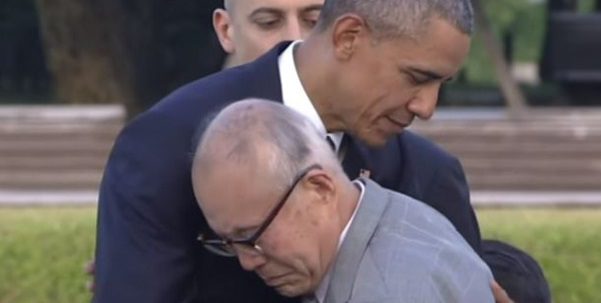
Forgiveness can help us come to grips with the horrors of our wars. The forgiveness our president received in the embrace of a hibakusha, a survivor of the atomic blast that destroyed over 100,000 lives at Hiroshima, is the grace of God gently weaning us away from our need to cling to the deception of war. Those we once considered enemies are full of great love. We are full of great evil, but we are redeemable, capable of building love out of ashes. We should have no fear of making an apology, which is the outward symbol of an inward change of heart acknowledging and renouncing our violence. We should apologize not only in Hiroshima, but in Nagasaki, Vietnam, Fallujah, Kunduz, around the world and upon our own shores with reparations to Native and African Americans. Repentance from our own violence is the acknowledgement of deep, systemic victimization and the reorientation of our values so that privilege is replaced with equality and friendship-building.
We should remember our wars with contrition and repentance, and remember our soldiers as those with infinite potential beyond their ability to obey and kill. Soldiers willing to put their lives on the line for the safety and freedom of others deserve to be free from the lie that some must die so that others may live. We need the love, discipline, and strength of our soldiers as well as our citizenry applied to the tasks of reconciliation, reparation for the destruction of human violence, and rebuilding a world on the foundation of cooperation, mercy and love.
This Memorial Day, let us honor fallen soldiers by ensuring that the horror in which they died is never repeated. Let us honor living soldiers by proclaiming that the best they have to offer is ahead, not behind, them, as we reorient ourselves toward peace. Let us change, forever, our mind about war.
Image: Screenshot from Youtube: Obama hugs Hiroshima survivor by AFP news agency.
Stay in the loop! Like Teaching Nonviolent Atonement of Facebook!
Previous Post

May 27, 2016
Build a Wall! – Tearing Down Barriers at High School
Next Post
June 1, 2016 Wednesday Sermon: Gospel Versus Religion
Browse Our Archives
Select a Category Atonement and Current Events Curriculum Faith and Families Interviews Jesus the Forgiving Victim Lent Montessori politics Reviews The Bible Explained Uncategorized Valentine's Day Wednesday Sermon Who is God?
Select a Month July 2020 November 2019 October 2019 September 2019 August 2019 July 2019 June 2019 May 2019 April 2019 March 2019 February 2019 January 2019 December 2018 November 2018 October 2018 September 2018 August 2018 July 2018 June 2018 May 2018 April 2018 March 2018 February 2018 January 2018 December 2017 November 2017 October 2017 September 2017 August 2017 July 2017 June 2017 May 2017 April 2017 March 2017 February 2017 January 2017 December 2016 November 2016 October 2016 September 2016 August 2016 June 2016 May 2016 April 2016 March 2016 February 2016 January 2016 December 2015 November 2015 October 2015 September 2015 August 2015 July 2015 June 2015 May 2015 April 2015 March 2015 February 2015 January 2015 December 2014 November 2014 October 2014 September 2014 August 2014 July 2014 June 2014 May 2014 April 2014 March 2014 January 2014 December 2013 September 2013 August 2013 July 2013
Follow Us!
TAKE THE
Religious Wisdom Quiz
How was the New Covenant different from the Old Covenant?
Select your answer to see how you score.
It required more sacrifices It abolished God’s law It would be written on their hearts It was only for priests
Related posts from Teaching Nonviolent Atonement

How Forgiveness Can Transform Our Violence and Build...

The Chosen One Chooses Love Over Fear [VIDEO]

Jesus Unmasked: Jesus Brings the Fire!

St. Francis Preaches on Violence
TRENDING AT PATHEOS Progressive Christian

What Being a Modern-Day Apostle Means to Me
In my last column, I discussed the ins and outs of modern-day...

Did Ancient China Once Worship the God of...
Across human history, a common thread weaves through the origins of the...

Love Your Neighbor – Including Earth-Kin: Lev. 19,...
God’s command to love your neighbor means acting in an ethical and...

Lead a Church Study of “Jesus and Lao...
Guest writer Jack Thomas (The Irreverent Reverend) reflects on leading his church...

Pastoral Wisdom for Responding to Sermon Pushback
Getting sermon pushback on your social justice sermon? Learn practical, Proverbs-based strategies...

Principles for Understanding the Apostolic Ministry Today
Whenever people discover that my formal ministry title is "apostle," as in...
view all Progressive Christian blogs
Ad-Free & Subscriber Log-In Subscription Support
- About Us
- 2026 Calendar
- Videos
- Podcasts
- Library of World Religions
- Faith In Media Tracker
- Advertise With Us
- Write for Us
- Privacy Policy
- Terms of Service
- Do Not Sell My Data
- Contact Us
- Radiant Digital
- Manage Newsletter Subscriptions
- Unsubscribe From Notifications
- Sitemap
Copyright 2008-2026, Patheos. All rights reserved.
Subscription Support Ad-Free & Subscriber Log-In
Follow Patheos