
BuddhistCatholicContemplativeEvangelicalGeneral ChristianHinduJewishLatter-day SaintMuslimNew VisionsProgressive Christian
Beliefs
- Buddhist
- Catholic
- Contemplative
- Evangelical
- General Christian
- Hindu
- Jewish
- Latter-day Saint
- More Voices
- Muslim
- New Visions
- Pagan
- Progressive Christian
Topics
- Religion News
- Food and Religion
- Sports and Religion
- Religious Art
- Religious Music and Entertainment
- Religious Events
- History and Religion
- Style and Religion
- Politics and Religion
- Women in Religion
- Recreation Outdoors and Religion
- Business Finance and Religion
- Careers Workplace and Religion
- Education and Religion
- Family Parenting and Religion
- Health Fitness and Religion
- Home and Religion
- Relationships and Religion
- Technology and Religion
- Travel and Religion
Columnists
- Buddhist Columnists
- Business Finance and Religion Columnists
- Careers Workplace and Religion Columnists
- Catholic Columnists
- Contemplative Columnists
- Education and Religion Columnists
- Evangelists Columnists
- Family Parenting and Religion Columnists
- General Christian Columnists
- Health Fitness and Religion Columnists
- Hindu Columnists
- History and Religion Columnists
- Home and Religion Columnists
- Jewish Columnists
- More Voices Columnists
- Latter Day Columnists
- Muslim Columnists
- New Visions Columnists
- Nonreligious Columnists
- Pagan Columnists
- Politics and Religion Columnists
- Progressive Columnists
- Recreation Outdoors and Religion Columnists
- Relationships and Religion Columnists
- Religion News Columnists
- Religious Art Columnists
- Religious Events Columnists
- Religious Music and Entertainment Columnists
- Sports and Religion Columnists
- Style and Religion Columnists
- Technology and Religion Columnists
- Travel and Religion Columnists
- Women in Religion Columnists
Resource Library
- 2026 Calendar
- Library of World Religions
- The 100 Most Holy Places on Earth
- Patheos Answers
- Podcasts
- Videos
- Faith Leaders Database
- Anglican Episcopalian
- Bahai
- Baptist
- Buddhism
- Christianity
- Confucianism
- Eastern Orthodoxy
- Hinduism
- Holiness and Pentecostal
- ISKCON
- Islam
- Judaism
- Lutheran
- Methodist
- The Church of Jesus Christ of Latter-day Saints
- New Age
- Paganism
- Presbytarian and Reformed
- Protestantism
- Religion Behind the Scenes
- Roman Catholic
- Scientology
- Shia Islam
- Sikhism
- Sufism
- Sunni Islam
- Taoism
- Zen
- See all religions
Research Tools
 Ad-Free & Subscriber Log-In Subscription Support
Ad-Free & Subscriber Log-In Subscription Support
Follow Patheos 

- Trending:
- Forgiveness
- |
- Marriage
- |
- Consciousness
- |
- Death Penalty
- |
- Election
- |
- Halloween
 Teaching Nonviolent Atonement
- Home
- Progressive Christian
- Wednesday Sermon: We are “People of the Way”
Wednesday Sermon: We are “People of the Way”
Last updated on: April 13, 2016 at 12:58 pm by Tom Truby
Wednesday Sermon: We are “People of the Way” 2016-04-13T12:58:42-05:00 Tom Truby
Patheos Explore the world's faith through different perspectives on religion and spirituality! Patheos has the views of the prevalent religions and spiritualities of the world.
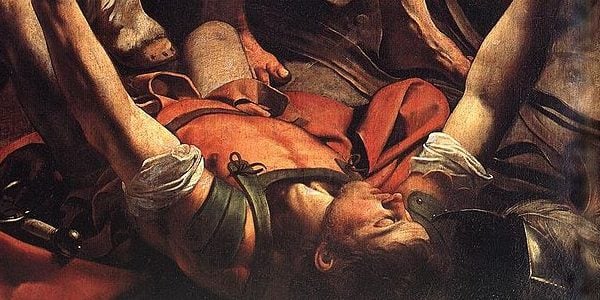
Saul on the Road to Damascus (Caravaggio, 1600, Public Domain, Wikimedia Commons, some changes made)

Pastors have a frequent question when they begin to discover mimetic theory. “That’s great. But how does it preach?”
Reverend Tom Truby shows that mimetic theory is a powerful tool that enables pastors to preach the Gospel in a way that is meaningful and refreshing to the modern world. Each Wednesday, Teaching Nonviolent Atonement will highlight his sermons as an example of preaching the Gospel through mimetic theory.
In this sermon, Tom reflects on the conversion of Saul. Tom’s insightful use of mimetic theory helps us understand that conversion “starts with an awareness of our participation human violence … and ends with a path of deliverance for the whole world where humans die to their own submersion in violence and find deliverance in baptism.” That pattern of awareness and deliverance is the hope for our world.
Year C, Easter 3
April 10th, 2016
Thomas L. Truby
Acts 9:1-6 (7-20)
We are “People of the Way”
The tension gets set from the beginning. Saul, who later changes his name to Paul, is breathing threats and murder against “the people of the Way”. He requests the high priest authorize him to arrest and return bound to Jerusalem any man or woman he discovers to be a follower of Jesus. Permission is granted.
Before the crucifixion the authorities had expected the death of Jesus to put an end to this new movement but now it seemed to be bursting into life with more energy than before. His followers were speaking with a boldness they had never exhibited while he was alive. The movement was getting out of hand and someone smart enough to see the dangers needed to step forward.
Saul, a brilliant and well educated Pharisee of the most conservative branch of the Pharisees, who had grown up in Tarsus, a city in present day Turkey, had traveled widely and understood both Rome and Jerusalem, stepped forward. He would take responsibility to stamp out this grass fire before it could further endanger their culture and traditions. Already the fire had spread to Damascus.
These followers of Jesus didn’t have a name. They weren’t called Christians. Luke describes them simply as those who belong to “the Way.” “The Way,” what an interesting term! How did people on “the Way” differ from those who weren’t on the way? What is Jesus’ Way? If Jesus is leading them on “the Way” what is he leading away from and toward what is he moving that set them apart?
Today’s text beginning with Saul “breathing threats and murder” and ending with Paul’s baptism, give us a clue. As always “the Way” starts with an awareness of our participation in human violence, in this case Paul breathing threats and murder, and ends with a path of deliverance for the whole world where humans die to their own submersion in violence and find deliverance in baptism. This is the deeper meaning of baptism to which I am coming. You remember in baptism we go under the water as in death and rise through the water to new life. This has become a largely meaningless sacrament to me until I start viewing it as a deliverance from human submersion in violence and a taking on of the capacity for life lived non-violently. Baptism marks that transition though I think the church has largely forgotten that. I’m sure we will be talking more about this in the future.
As Saul moves toward Damascus he travels with certainty that he is doing the right thing. He has authorization from the highest religious authority and he knows Rome won’t care.
The text continues, “During the Journey, as he approached Damascus, suddenly a light from heaven encircled him. He fell to the ground.” The light didn’t knock him to the ground. Light doesn’t have that kind of power. His own fear buckled his knees. Being a man who specialized in the administration of fear, he was full of fear when his defenses were breached.
Luke says the light came from heaven. Heaven is that place outside human control and all the pressure we put on ourselves and others. Heaven is run by love and forgiveness not rivalry and fear. It’s where the transcendent comes from; it’s the place of resurrection on this third Sunday after Easter.
“He heard a voice saying to him, ‘Saul, Saul, why do you persecute me?” The voice doesn’t ask, “Why don’t you believe in me Saul?” No, it’s why are you violent toward me, Saul? Why do you hunt people down and throw them into prison for following me? Saul has divided the world into those he considers good and those he considers bad. He thinks he is wiping out evil by attacking those he thinks are bad but actually he is persecuting Jesus.
Until now he had seen no evil in himself. The voice challenged all that; his entire understanding of himself as God-fearing falls into doubt.
“Who are you, Lord?” Saul asks. “I am Jesus, whom you are persecuting,” comes the reply. Did you hear that! Can you imagine Saul’s shock? The one he has committed his life to eradicating is speaking to him. Everything Saul believes is being contradicted. His world shatters.
Without a hint of retribution Jesus responds with instruction to guide the now lost Saul. “Now get up and enter the city, and you will be told what you are to do.” With Saul’s guidance system run aground, Jesus provides him with direction. First get up, then enter the city, then you will be told what to do.
“Those traveling with him stood there speechless; they heard the voice but saw no one. After they picked Saul up from the ground, he opened his eyes but he couldn’t see.”
Saul’s world has just fallen apart and his blindness is a dramatic way of telling us this. “So they led him by the hand into Damascus.” Saul will need to rethink everything. Later in Paul’s letters, Paul tells us it took him three years to work through and rebuild his world. The new world was built on an utterly different foundation.
Luke’s’ story now picks up another thread.
“In Damascus there was a certain disciple named Ananias. The Lord spoke to him in a vision, ‘Ananias!’ He answered, ‘Yes, Lord.’ The Lord instructed him, ‘Go to Judas’ house on Straight Street and ask for a man from Tarsus named Saul. He is praying. In a vision he has seen a man named Ananias enter and put his hands on him to restore his sight.’
“Ananias countered, ‘Lord, I have heard many reports about this man. People say he has done horrible things to your holy people in Jerusalem. He’s here with authority from the chief priests to arrest everyone who calls on your name.’”
The Lord replied, “Go! This man is the agent I have chosen to carry my name before Gentiles, kings, and Israelites. I will show him how much he must suffer for the sake of my name.
That last phrase “how much Saul must suffer for the sake of my name” struck me as never before. Is Luke saying the Lord is going to show Saul; this man so driven by rivalry and so comfortable with violence, how to live in another way? Does it mean Saul must learn to suffer violence rather than inflict it? Could this be “the Way” and how people of “the Way” live?
“Ananias went to the house. He placed his hands on Saul and said, “Brother Saul, the Lord sent me—Jesus, who appeared to you on the way as you were coming here. He sent me so that you could see again and be filled with the Holy Spirit.”
When do you think Paul was converted to “the way?” Was it when he was surrounded by the light and fell to the ground? Was it when Jesus asked him the question about why he persecutes him? Was it while he was blind and being led by the hand toward Damascus?
I think it was when Ananias placed his hands on Saul and said, “Brother Saul, the Lord sent me so that you could see again and be filled with the Holy Spirit.” Ananias called him “Brother Saul”. He touched him. Ananias could have extracted revenge on Saul who stood blind and helpless before him. Saul probably expected that. But Ananias acted in forgiveness and gave him the Spirit of Forgiveness that Luke calls the Holy Spirit. That was the moment of Paul’s conversion. The community in the name of Jesus forgave Saul and he became Paul.
It’s the way of Jesus, it’s the way of peace, it’s what Luke calls “the Way.” Like Saul, we are in the process of being struck blind with light; we are rethinking everything and finding a new path. It’s a path illumined by the Holy Spirit, centered in forgiveness, and lived out as suffering violence rather than inflicting it. This new path is the hope of the world. Being on it makes us “people of the Way”. Amen.
Previous Post

April 12, 2016
Dead to Me – Shark Tank and the Miracle of Resurrection
Next Post
April 14, 2016 The Vessel: God Wears a Pink Dress
Browse Our Archives
Select a Category Atonement and Current Events Curriculum Faith and Families Interviews Jesus the Forgiving Victim Lent Montessori politics Reviews The Bible Explained Uncategorized Valentine's Day Wednesday Sermon Who is God?
Select a Month July 2020 November 2019 October 2019 September 2019 August 2019 July 2019 June 2019 May 2019 April 2019 March 2019 February 2019 January 2019 December 2018 November 2018 October 2018 September 2018 August 2018 July 2018 June 2018 May 2018 April 2018 March 2018 February 2018 January 2018 December 2017 November 2017 October 2017 September 2017 August 2017 July 2017 June 2017 May 2017 April 2017 March 2017 February 2017 January 2017 December 2016 November 2016 October 2016 September 2016 August 2016 June 2016 May 2016 April 2016 March 2016 February 2016 January 2016 December 2015 November 2015 October 2015 September 2015 August 2015 July 2015 June 2015 May 2015 April 2015 March 2015 February 2015 January 2015 December 2014 November 2014 October 2014 September 2014 August 2014 July 2014 June 2014 May 2014 April 2014 March 2014 January 2014 December 2013 September 2013 August 2013 July 2013
Follow Us!
TAKE THE
Religious Wisdom Quiz
What did Daniel's three friends refuse to worship, resulting in their persecution?
Select your answer to see how you score.
A bronze snake A golden image A Persian king A cedar pole
Related posts from Teaching Nonviolent Atonement

The Secret of Life: An Interview with Audrey...

Forgiveness in the Time of COVID-19 by Julia...

Reflections on Indigenous Wisdom For Healing A Wounded...

How Forgiveness Can Transform Our Violence and Build...
TRENDING AT PATHEOS Progressive Christian

What Being a Modern-Day Apostle Means to Me
In my last column, I discussed the ins and outs of modern-day...

Did Ancient China Once Worship the God of...
Across human history, a common thread weaves through the origins of the...

Love Your Neighbor – Including Earth-Kin: Lev. 19,...
God’s command to love your neighbor means acting in an ethical and...

Lead a Church Study of “Jesus and Lao...
Guest writer Jack Thomas (The Irreverent Reverend) reflects on leading his church...

Pastoral Wisdom for Responding to Sermon Pushback
Getting sermon pushback on your social justice sermon? Learn practical, Proverbs-based strategies...

Principles for Understanding the Apostolic Ministry Today
Whenever people discover that my formal ministry title is "apostle," as in...
view all Progressive Christian blogs
Ad-Free & Subscriber Log-In Subscription Support
- About Us
- 2026 Calendar
- Videos
- Podcasts
- Library of World Religions
- Faith In Media Tracker
- Advertise With Us
- Write for Us
- Privacy Policy
- Terms of Service
- Do Not Sell My Data
- Contact Us
- Radiant Digital
- Manage Newsletter Subscriptions
- Unsubscribe From Notifications
- Sitemap
Copyright 2008-2026, Patheos. All rights reserved.
Subscription Support Ad-Free & Subscriber Log-In
Follow Patheos