
BuddhistCatholicContemplativeEvangelicalGeneral ChristianHinduJewishLatter-day SaintMuslimNew VisionsProgressive Christian
Beliefs
- Buddhist
- Catholic
- Contemplative
- Evangelical
- General Christian
- Hindu
- Jewish
- Latter-day Saint
- More Voices
- Muslim
- New Visions
- Pagan
- Progressive Christian
Topics
- Religion News
- Food and Religion
- Sports and Religion
- Religious Art
- Religious Music and Entertainment
- Religious Events
- History and Religion
- Style and Religion
- Politics and Religion
- Women in Religion
- Recreation Outdoors and Religion
- Business Finance and Religion
- Careers Workplace and Religion
- Education and Religion
- Family Parenting and Religion
- Health Fitness and Religion
- Home and Religion
- Relationships and Religion
- Technology and Religion
- Travel and Religion
Columnists
- Buddhist Columnists
- Business Finance and Religion Columnists
- Careers Workplace and Religion Columnists
- Catholic Columnists
- Contemplative Columnists
- Education and Religion Columnists
- Evangelists Columnists
- Family Parenting and Religion Columnists
- General Christian Columnists
- Health Fitness and Religion Columnists
- Hindu Columnists
- History and Religion Columnists
- Home and Religion Columnists
- Jewish Columnists
- More Voices Columnists
- Latter Day Columnists
- Muslim Columnists
- New Visions Columnists
- Nonreligious Columnists
- Pagan Columnists
- Politics and Religion Columnists
- Progressive Columnists
- Recreation Outdoors and Religion Columnists
- Relationships and Religion Columnists
- Religion News Columnists
- Religious Art Columnists
- Religious Events Columnists
- Religious Music and Entertainment Columnists
- Sports and Religion Columnists
- Style and Religion Columnists
- Technology and Religion Columnists
- Travel and Religion Columnists
- Women in Religion Columnists
Resource Library
- 2026 Calendar
- Library of World Religions
- The 100 Most Holy Places on Earth
- Patheos Answers
- Podcasts
- Videos
- Faith Leaders Database
- Anglican Episcopalian
- Bahai
- Baptist
- Buddhism
- Christianity
- Confucianism
- Eastern Orthodoxy
- Hinduism
- Holiness and Pentecostal
- ISKCON
- Islam
- Judaism
- Lutheran
- Methodist
- The Church of Jesus Christ of Latter-day Saints
- New Age
- Paganism
- Presbytarian and Reformed
- Protestantism
- Religion Behind the Scenes
- Roman Catholic
- Scientology
- Shia Islam
- Sikhism
- Sufism
- Sunni Islam
- Taoism
- Zen
- See all religions
Research Tools
 Ad-Free & Subscriber Log-In Subscription Support
Ad-Free & Subscriber Log-In Subscription Support
Follow Patheos 

- Trending:
- Forgiveness
- |
- Marriage
- |
- Consciousness
- |
- Death Penalty
- |
- Election
- |
- Halloween
 Teaching Nonviolent Atonement
- Home
- Progressive Christian
- Wednesday Sermon: Thomas Believed!
Wednesday Sermon: Thomas Believed!
Last updated on: April 6, 2016 at 4:06 pm by Tom Truby
Wednesday Sermon: Thomas Believed! 2016-04-06T16:06:22-05:00 Tom Truby
Patheos Explore the world's faith through different perspectives on religion and spirituality! Patheos has the views of the prevalent religions and spiritualities of the world.
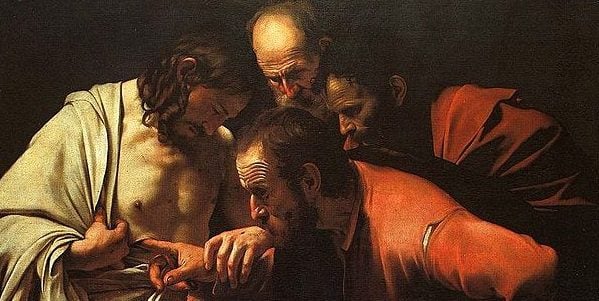
Image: “The Incredulity of Thomas” by Caravaggio, public domain, Wikipedia

Pastors have a frequent question when they begin to discover mimetic theory. “That’s great. But how does it preach?”
Reverend Tom Truby shows that mimetic theory is a powerful tool that enables pastors to preach the Gospel in a way that is meaningful and refreshing to the modern world. Each Wednesday, Teaching Nonviolent Atonement will highlight his sermons as an example of preaching the Gospel through mimetic theory.
In this sermon, Tom reflects on mimetic theory’s notion of “interdividuality,” which claims that the self is a network of our relationships, past and present. The resurrected Jesus transforms his disciples, so that their relationships are oriented around him and the peace he offers. As Tom writes, the disciples new relationship with the resurrected Jesus moves them, “from fearful disciples cowering behind locked doors to intrepid souls the authorities couldn’t shut up.”
Year C, Easter 2
April 3rd, 2016
Thomas L. Truby
John 20:19-31
Thomas Believed!
The writer of John’s gospel wants us to know that it’s still the first day of the week on this second Sunday of Easter. It’s evening on that first day and the disciples are meeting behind closed doors because they are afraid. Suddenly Jesus stands among them and says “Peace be with you.” He shows them his hands and his side. He wants them to know that his suffering had been real and that he is really alive.
The disciples afraid of being on the wrong side of who’s “in” and who’s “out” knew Jesus had fully occupied the “out” position and they had avoided it by running away. Now they feel guilty, confused and afraid. His forgiveness comes in the form of “peace be with you.”
He was fully human; a man who had wounds; painful flesh and blood wounds. He wasn’t a ghost—he was the human One, the One humans’ cast out who now stood before them. They see the evidence of human violence on his body but it was not able to destroy him. His love for us prevented it. He said, “Peace be with you.”
Not only does the victim have a voice pronouncing forgiveness, but this victim, representing all victims, is Jesus, God’s Son. God has occupied the place angels fear to tread. God has inhabited the place of the condemned and emptied it of its power. Now a man or a woman can be cast out of family, country and culture and have everyone against them and still know they are not alone. Their Lord and creator has gone before them. Suddenly the fear of being cast out doesn’t seem so daunting. The power of human systems threatening expulsion has been broken—even death has lost its fearfulness.
When the disciples saw the Lord, they were filled with joy. They thought they had abandoned him, they thought they were cowards and traitors and so they were, but he was back and he wasn’t interested in extracting revenge. When he said “peace be with you” all the horrible feelings within them reversed. Their abandonment and lack of faith hadn’t killed him. While they didn’t understand any of this, when they saw the Lord, they were filled with joy.
When “Jesus said to them again, ‘Peace be with you,’” it wasn’t a perfunctory greeting. He meant it. He wanted them to feel his peace. He wanted them to be at peace. He wanted his peace to spread beginning with them. His life, death and resurrection had all been condensed into this one phrase “Peace be with you.” That is his message, the reason for his coming, the reason he was raised from the dead. This is the message that addresses humanity’s most pressing need and it’s the message that completes creation for now we have a model for what living in peace looks like. It was all completed and revealed on the 1st day of the week at the dawn of a new humanity.
So the disciples are filled with joy as they see the human One standing in their midst. He says, “As the Father sent me, so I am sending you.” He sends them on the same mission as the Father sent him. Yes, the same one of living differently in the midst of a largely indifferent world, probably getting into trouble for it as he did, and then possibly dying as a result but even in that death knowing that next comes the resurrection.
That seems a tall order for mere mortals. Isn’t Jesus setting the bar too high? Maybe, but Jesus knows they can’t do it alone and so we have Jesus’ next move.
“Then he breathed on them and said, ‘Receive the Holy Spirit.’” In John’s gospel Jesus gives them a helper, an assistant, an aid. He calls it the Holy Spirit. I have done some thinking on what I think the Holy Spirit is.
Girard has this notion of the “interdividual” self. He says who we are develops from our network of relationships past and present. Our self is the entity that we put together based on those we have chosen to follow and those we have chosen to reject. Our feelings, thoughts, behaviors, character, desires and ambitions are all based on other people and combinations of other people. Nothing comes from our core, there is no such thing as “finding yourself” inside yourself, like fishing for yourself in an interior pond.
Here’s my question. What happens to one’s self when we decide to believe in a resurrected, forgiving Lord who asks us to forgive as we have been forgiven? If the risen Jesus is the orienting figure in our internal world, wouldn’t that change everything? The fear of retribution and ostracism by our culture would disappear as the risen Christ took on more and more prominence. With Jesus, as we know him in his life, death and resurrection, at the center of life rather than the world’s way of pay back or fear of pay back, wouldn’t the change be huge? In fact, it would not be an exaggeration to say we have received the Holy Spirit. This is what Jesus is trying to get across.
On this first day of a new week the disciples discover a totally new center for their lives. They had been following Jesus who they thought was going to usher in a new political system and liberate them from their enemies. Now they discover he has an utterly different agenda that centers on forgiveness of all humans beginning with them. With Jesus as their Lord their network of relationships shifts and things they once took for granted no longer seem so unnerving. The reading from Acts this morning records their shift in attitude. They have moved from fearful disciples cowering behind locked doors to intrepid souls the authorities couldn’t shut up.
The Holy Spirit is not some mystical presence that Jesus magically breathed into them and they had but is unavailable to us. No, the Holy Spirit is a name for this new constellation of relationships that happens when the risen Lord becomes our orienting center. Every triangle we inhabit changes when the risen Jesus is the third person to that triangle. Paul talks about this constantly when he uses the language of “for me to live is Christ.” It all fits with Girard’s notion of the self as interdividual rather than individual.
St. John didn’t have this language but he gets at the function of the Holy Spirit when he says Jesus’ breath fills the disciples with the capacity to forgive. The Holy Spirit allowed them to let go of their own failures knowing they were forgiven and it allows them to immediately let go of other’s failures in the same way. Can you imagine how it would feel if we lived completely free of self and other reproach? We could live in the moment with each moment leaving no residue. To have the Holy Spirit inside us is to live with a sense of inner freedom, both toward ourselves and others because all rivalry, jealousy and fear of retribution evaporate as soon as it’s generated.
Now, we can choose to not forgive and allow hate, hostility and resentment to build up. But the Holy Spirit makes it possible to live in another way because the resurrected Jesus has breathed his breath of forgiveness on us. We retain the capacity to ignore forgiveness but ignoring it does have real world consequences both for ourselves and those we don’t forgive. They aren’t forgiven and we live with a residue!
You see, God lives in a world of forgiveness since he loves all his children. We are the ones who insist on unforgiveness and suffer the consequences.
Thomas wasn’t there to hear all this that night. Being a practical, sensate man who lived in the tactile world of objects and not ideas, he wasn’t impressed when the rest of the disciples said they had seen the Lord. He said, “Unless I see the nail marks in his hands, put my finger in the wounds left by the nails, and put my hand into his side, I won’t believe.”
Eight days later Jesus again entered their room and again said “Peace be with you.” Then he said to Thomas, ‘Put your finger here. Look at my hands. Put your hand into my side. No more disbelief, Thomas. Believe!
“My Lord and my God!” Thomas responded.
Previous Post

March 31, 2016
Trump, Abortion, and a Better Conversation
Next Post
April 7, 2016 Theology and Sacrifice in Batman v. Superman [SPOILERS]
Browse Our Archives
Select a Category Atonement and Current Events Curriculum Faith and Families Interviews Jesus the Forgiving Victim Lent Montessori politics Reviews The Bible Explained Uncategorized Valentine's Day Wednesday Sermon Who is God?
Select a Month July 2020 November 2019 October 2019 September 2019 August 2019 July 2019 June 2019 May 2019 April 2019 March 2019 February 2019 January 2019 December 2018 November 2018 October 2018 September 2018 August 2018 July 2018 June 2018 May 2018 April 2018 March 2018 February 2018 January 2018 December 2017 November 2017 October 2017 September 2017 August 2017 July 2017 June 2017 May 2017 April 2017 March 2017 February 2017 January 2017 December 2016 November 2016 October 2016 September 2016 August 2016 June 2016 May 2016 April 2016 March 2016 February 2016 January 2016 December 2015 November 2015 October 2015 September 2015 August 2015 July 2015 June 2015 May 2015 April 2015 March 2015 February 2015 January 2015 December 2014 November 2014 October 2014 September 2014 August 2014 July 2014 June 2014 May 2014 April 2014 March 2014 January 2014 December 2013 September 2013 August 2013 July 2013
Follow Us!
TAKE THE
Religious Wisdom Quiz
In the Parable of the Wise and Foolish Virgins, what did the wise bring?
Select your answer to see how you score.
New clothes Extra oil Bread Wine
Related posts from Teaching Nonviolent Atonement

Forgiveness in the Time of COVID-19 by Julia...

Reflections on Indigenous Wisdom For Healing A Wounded...

How Forgiveness Can Transform Our Violence and Build...

Jesus Unmasked: God's Economy and How to Cheat...
TRENDING AT PATHEOS Progressive Christian

What Being a Modern-Day Apostle Means to Me
In my last column, I discussed the ins and outs of modern-day...

Did Ancient China Once Worship the God of...
Across human history, a common thread weaves through the origins of the...

Love Your Neighbor – Including Earth-Kin: Lev. 19,...
God’s command to love your neighbor means acting in an ethical and...

Lead a Church Study of “Jesus and Lao...
Guest writer Jack Thomas (The Irreverent Reverend) reflects on leading his church...

Pastoral Wisdom for Responding to Sermon Pushback
Getting sermon pushback on your social justice sermon? Learn practical, Proverbs-based strategies...

Principles for Understanding the Apostolic Ministry Today
Whenever people discover that my formal ministry title is "apostle," as in...
view all Progressive Christian blogs
Ad-Free & Subscriber Log-In Subscription Support
- About Us
- 2026 Calendar
- Videos
- Podcasts
- Library of World Religions
- Faith In Media Tracker
- Advertise With Us
- Write for Us
- Privacy Policy
- Terms of Service
- Do Not Sell My Data
- Contact Us
- Radiant Digital
- Manage Newsletter Subscriptions
- Unsubscribe From Notifications
- Sitemap
Copyright 2008-2026, Patheos. All rights reserved.
Subscription Support Ad-Free & Subscriber Log-In
Follow Patheos