
BuddhistCatholicContemplativeEvangelicalGeneral ChristianHinduJewishLatter-day SaintMuslimNew VisionsProgressive Christian
Beliefs
- Buddhist
- Catholic
- Contemplative
- Evangelical
- General Christian
- Hindu
- Jewish
- Latter-day Saint
- More Voices
- Muslim
- New Visions
- Pagan
- Progressive Christian
Topics
- Religion News
- Food and Religion
- Sports and Religion
- Religious Art
- Religious Music and Entertainment
- Religious Events
- History and Religion
- Style and Religion
- Politics and Religion
- Women in Religion
- Recreation Outdoors and Religion
- Business Finance and Religion
- Careers Workplace and Religion
- Education and Religion
- Family Parenting and Religion
- Health Fitness and Religion
- Home and Religion
- Relationships and Religion
- Technology and Religion
- Travel and Religion
Columnists
- Buddhist Columnists
- Business Finance and Religion Columnists
- Careers Workplace and Religion Columnists
- Catholic Columnists
- Contemplative Columnists
- Education and Religion Columnists
- Evangelists Columnists
- Family Parenting and Religion Columnists
- General Christian Columnists
- Health Fitness and Religion Columnists
- Hindu Columnists
- History and Religion Columnists
- Home and Religion Columnists
- Jewish Columnists
- More Voices Columnists
- Latter Day Columnists
- Muslim Columnists
- New Visions Columnists
- Nonreligious Columnists
- Pagan Columnists
- Politics and Religion Columnists
- Progressive Columnists
- Recreation Outdoors and Religion Columnists
- Relationships and Religion Columnists
- Religion News Columnists
- Religious Art Columnists
- Religious Events Columnists
- Religious Music and Entertainment Columnists
- Sports and Religion Columnists
- Style and Religion Columnists
- Technology and Religion Columnists
- Travel and Religion Columnists
- Women in Religion Columnists
Resource Library
- 2026 Calendar
- Library of World Religions
- The 100 Most Holy Places on Earth
- Patheos Answers
- Podcasts
- Videos
- Faith Leaders Database
- Anglican Episcopalian
- Bahai
- Baptist
- Buddhism
- Christianity
- Confucianism
- Eastern Orthodoxy
- Hinduism
- Holiness and Pentecostal
- ISKCON
- Islam
- Judaism
- Lutheran
- Methodist
- The Church of Jesus Christ of Latter-day Saints
- New Age
- Paganism
- Presbytarian and Reformed
- Protestantism
- Religion Behind the Scenes
- Roman Catholic
- Scientology
- Shia Islam
- Sikhism
- Sufism
- Sunni Islam
- Taoism
- Zen
- See all religions
Research Tools
 Ad-Free & Subscriber Log-In Subscription Support
Ad-Free & Subscriber Log-In Subscription Support
Follow Patheos 

- Trending:
- Forgiveness
- |
- Marriage
- |
- Consciousness
- |
- Death Penalty
- |
- Election
- |
- Halloween
 Teaching Nonviolent Atonement
- Home
- Progressive Christian
- The Qualifications Quibble: What Do We Require of Our Leaders and Ourselves?
The Qualifications Quibble: What Do We Require of Our Leaders and Ourselves?
Last updated on: April 18, 2016 at 1:10 pm by Lindsey Paris-Lopez
The Qualifications Quibble: What Do We Require of Our Leaders and Ourselves? 2016-04-18T13:10:58-05:00 Lindsey Paris-Lopez
Patheos Explore the world's faith through different perspectives on religion and spirituality! Patheos has the views of the prevalent religions and spiritualities of the world.
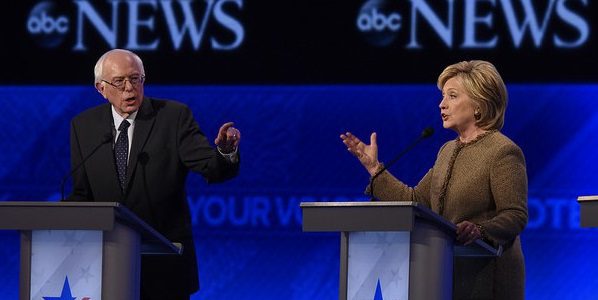
Image: Disney / ABC Television Group’s Photostream. Available on Flickr via Creative Commons Attribution-No Derivs 2.0 Generic license
The Qualifications Quibble
One of the electoral season’s obligatory scandals occupied the media spotlight recently when Democratic candidates Hillary Clinton and Bernie Sanders engaged in mimetic rivalry, accusing (implicitly or explicitly) each other of being “unqualified” to be president.
Briefly, on a segment of Morning Joe, Hillary Clinton expressed concern that Bernie Sanders did not know how to deliver on his central campaign promise, to break up the banks, as an unflattering interview with the New York Daily News had implied. (Actually, Sanders’s assertion that he had the authority to break up the banks via the Dodd-Frank bill and the treasury department was correct, but the interviewer continued to question him, implying that he did not know his own talking points). She asserted that Sanders had “not done his homework.” While stopping short of calling Sanders unqualified, a staffer had leaked the Clinton political strategy to “disqualify” Sanders. In return, Bernie Sanders explicitly called Hillary Clinton “unqualified” to be president based on her vote for the war in Iraq, her millions of dollars in donations from Wall Street, and her support of trade deals that hurt American workers.
Being swept up in mimetic rivalry is par for the course when competing for anything, particularly for the highest office in the nation. For all the heat behind the words, negative campaigning is to be expected to draw contrasts between opposing candidates, and I do not begrudge either Clinton or Sanders for drawing contrasts. However, honesty matters. Clinton’s assertion that Bernie “had not done his homework” is based on a misleading and disingenuous interview that was spun by major media outlets against Sanders. If she had reached her conclusion that Sanders is unprepared based on her own experiences working with him in the Senate, as either a fellow Senator or perhaps as Secretary of State or First Lady, it would behoove her to give better examples. For his part, Sanders’s assertions that Clinton showed poor judgment on the Iraq war and trade deals, and that she has taken significant sums of money from Wall Street, are all true, though if he sincerely believes that these decisions are “disqualifying” he would not continue to pledge endorsement of Clinton should she be the Democratic nominee. In the heat of the campaign, both candidates may have been too loose with their rhetoric. But I do not think it benefits us to dwell on the scandal of he said/she said. This episode has brought up deeper issues, however. What, exactly, are the qualifications we demand of a leader? And what qualifications do we have when it comes to our role in building a better nation, a better world, a better future?
What Qualifies A Leader?
The media tends to frame elections in terms of candidates running against each other. That makes sense, of course, as elections are essentially competitions. But they are also an opportunity for candidates to tell the people what they are for. Likewise, when we think about what qualities we desire in a leader, it helps to ask, “What do we want for our people, our country, and our world?”
The most fundamental thing I want for our world – the one thing on which everything else depends – is a healthy and sustainable planet. Global warming is a threat to all life, far beyond American life, far beyond even human life. I believe we need a leader who takes the threat of global warming seriously and would be willing to take substantial action to reduce our carbon footprint.
Reducing our carbon footprint necessarily means reducing military action worldwide, as the United States military is one of the biggest consumers of fossil fuels on the planet. Of course, I wish for a reduction of our military action and our military budget not primarily for the sake of the land but for the sake of all people, as living in peace and security is a fundamental human right. But to speak of reducing our military action makes many people uncomfortable when we are convinced that our military actions are for our protection. If we view our protection as a priority over and against the welfare of others, we will be reluctant to reduce our military action or funding. But if we consider our welfare interconnected to that of others, and recognize that our violence perpetuates a cycle of violence, then we can understand that a leader can be for the security of our nation and for the replacement of violence with diplomacy and reconciliation at the same time. In fact, there is no way to be truly for security without being for peace, as violence will always perpetuate itself.
Finally, I want a leader who shows concern for the health, welfare, and prosperity of all people, particularly the marginalized. The quality of someone with much power can, I believe, be measured in his or her treatment of someone with little or no power. This means I want someone who is humble enough to listen when called out on privilege, and someone who can recognize and push to correct systemic injustice in its myriad forms, from racism to sexism to ableism to heteronormativity and more.
What Qualifies Us?
These are a few very broad areas that form the values I employ when considering candidates for a leader. But no leader can work alone, and the people most in need of a more just, more compassionate, more peaceful world, those who currently suffer the most from marginalization, poverty, environmental degradation and violence, theirs are the voices that need to be heard the most. Whether leaders ensconce themselves in circles of power and shut out other voices or strive to their utmost ability to be true public servants, no leader, no administration, no government, can tackle the problems of our world without a vocal and active citizenry making demands and contributing time, ideas, and resources to solutions.
So when we consider what “qualifies” a leader, it is incumbent upon us to consider the goals we wish our leaders to work toward, and ask how we might work toward those goals ourselves, independently of election cycles, regardless of whomever occupies the Oval Office or any office.
If I want a healthy and sustainable planet, I must do my part to reduce my carbon footprint – from recycling to public or “green” transportation (biking, walking when possible), reducing packaging, being aware of energy and water consumption, and more.
If I want peace, I must strive for peace in my own relationships. I must humble myself to hear the criticism of others, be willing to do right by others even at the expense of my pride, replace enmity with empathy. I must also strive for peace among my children by modeling peaceful conflict resolution. I must continue to speak and work and occasionally take to the streets for peace in the community and the world. I must remind myself and everyone else that to be against a war is to be for the people, for the planet, for the future, even for the leaders who may wish for war in the first place, as our well-being is deeply and intimately interconnected.
If I want a more just, equitable and compassionate nation, I must embody solidarity with people on the social, cultural and economic margins. I must strive to understand my own privilege and listen to discover how to turn such privilege into equality. I must listen, learn, and act… in that order, or rather, in that order over and over again in a continuing cycle.
Conclusion
During election season, the horse race of who’s up and who’s down and the “scandals” of who said what latest “outrage” can drown out important issues. A negative tone permeates the atmosphere as we define ourselves not only against candidates, but against their supporters (who could be our neighbors!) Even when we agree on what we seek in a leader, we may disagree on which candidate best fulfills those qualities, and set ourselves up against even those who would normally be our allies. Campaign season, so interminably long in the United States, can bring out the worst in all of us.
But the changes required to heal our nation and our world require us working with each other and for each other, independently of the election cycle. They require that we recognize what we have to give beyond our vote. They do not require agreement on a particular decision, like whom to vote for, but they do require cooperation, listening in the midst of disagreement, and recognizing the value of the contributions of others.
As we consider what we require in a leader, let us ask what is required of us? This question was posed in scripture by the prophet Micah, and (separation of church and state notwithstanding), the answer is one that, with slight modification, serves us well as citizens: justice, kindness, and humility.
Previous Post

April 14, 2016
The Vessel: God Wears a Pink Dress
Next Post
April 20, 2016 Wednesday Sermon: Earth Day - Do We Hear His Voice?
Browse Our Archives
Select a Category Atonement and Current Events Curriculum Faith and Families Interviews Jesus the Forgiving Victim Lent Montessori politics Reviews The Bible Explained Uncategorized Valentine's Day Wednesday Sermon Who is God?
Select a Month July 2020 November 2019 October 2019 September 2019 August 2019 July 2019 June 2019 May 2019 April 2019 March 2019 February 2019 January 2019 December 2018 November 2018 October 2018 September 2018 August 2018 July 2018 June 2018 May 2018 April 2018 March 2018 February 2018 January 2018 December 2017 November 2017 October 2017 September 2017 August 2017 July 2017 June 2017 May 2017 April 2017 March 2017 February 2017 January 2017 December 2016 November 2016 October 2016 September 2016 August 2016 June 2016 May 2016 April 2016 March 2016 February 2016 January 2016 December 2015 November 2015 October 2015 September 2015 August 2015 July 2015 June 2015 May 2015 April 2015 March 2015 February 2015 January 2015 December 2014 November 2014 October 2014 September 2014 August 2014 July 2014 June 2014 May 2014 April 2014 March 2014 January 2014 December 2013 September 2013 August 2013 July 2013
Follow Us!
TAKE THE
Religious Wisdom Quiz
For the wages of sin is death, but the gift of God is ____ in Christ Jesus our Lord.
Select your answer to see how you score.
Love Grace Redemption Eternal Life
Related posts from Teaching Nonviolent Atonement


Jesus Unmasked: Jesus Brings the Fire!

"I Do Not Give As The World Gives"...

Doubt, Faith, And The God Who Holds Us...
TRENDING AT PATHEOS Progressive Christian

What Being a Modern-Day Apostle Means to Me
In my last column, I discussed the ins and outs of modern-day...

Did Ancient China Once Worship the God of...
Across human history, a common thread weaves through the origins of the...

Love Your Neighbor – Including Earth-Kin: Lev. 19,...
God’s command to love your neighbor means acting in an ethical and...

Lead a Church Study of “Jesus and Lao...
Guest writer Jack Thomas (The Irreverent Reverend) reflects on leading his church...

Pastoral Wisdom for Responding to Sermon Pushback
Getting sermon pushback on your social justice sermon? Learn practical, Proverbs-based strategies...

Principles for Understanding the Apostolic Ministry Today
Whenever people discover that my formal ministry title is "apostle," as in...
view all Progressive Christian blogs
Ad-Free & Subscriber Log-In Subscription Support
- About Us
- 2026 Calendar
- Videos
- Podcasts
- Library of World Religions
- Faith In Media Tracker
- Advertise With Us
- Write for Us
- Privacy Policy
- Terms of Service
- Do Not Sell My Data
- Contact Us
- Radiant Digital
- Manage Newsletter Subscriptions
- Unsubscribe From Notifications
- Sitemap
Copyright 2008-2026, Patheos. All rights reserved.
Subscription Support Ad-Free & Subscriber Log-In
Follow Patheos