
BuddhistCatholicContemplativeEvangelicalGeneral ChristianHinduJewishLatter-day SaintMuslimNew VisionsProgressive Christian
Beliefs
- Buddhist
- Catholic
- Contemplative
- Evangelical
- General Christian
- Hindu
- Jewish
- Latter-day Saint
- More Voices
- Muslim
- New Visions
- Pagan
- Progressive Christian
Topics
- Religion News
- Food and Religion
- Sports and Religion
- Religious Art
- Religious Music and Entertainment
- Religious Events
- History and Religion
- Style and Religion
- Politics and Religion
- Women in Religion
- Recreation Outdoors and Religion
- Business Finance and Religion
- Careers Workplace and Religion
- Education and Religion
- Family Parenting and Religion
- Health Fitness and Religion
- Home and Religion
- Relationships and Religion
- Technology and Religion
- Travel and Religion
Columnists
- Buddhist Columnists
- Business Finance and Religion Columnists
- Careers Workplace and Religion Columnists
- Catholic Columnists
- Contemplative Columnists
- Education and Religion Columnists
- Evangelists Columnists
- Family Parenting and Religion Columnists
- General Christian Columnists
- Health Fitness and Religion Columnists
- Hindu Columnists
- History and Religion Columnists
- Home and Religion Columnists
- Jewish Columnists
- More Voices Columnists
- Latter Day Columnists
- Muslim Columnists
- New Visions Columnists
- Nonreligious Columnists
- Pagan Columnists
- Politics and Religion Columnists
- Progressive Columnists
- Recreation Outdoors and Religion Columnists
- Relationships and Religion Columnists
- Religion News Columnists
- Religious Art Columnists
- Religious Events Columnists
- Religious Music and Entertainment Columnists
- Sports and Religion Columnists
- Style and Religion Columnists
- Technology and Religion Columnists
- Travel and Religion Columnists
- Women in Religion Columnists
Resource Library
- 2026 Calendar
- Library of World Religions
- The 100 Most Holy Places on Earth
- Patheos Answers
- Podcasts
- Videos
- Faith Leaders Database
- Anglican Episcopalian
- Bahai
- Baptist
- Buddhism
- Christianity
- Confucianism
- Eastern Orthodoxy
- Hinduism
- Holiness and Pentecostal
- ISKCON
- Islam
- Judaism
- Lutheran
- Methodist
- The Church of Jesus Christ of Latter-day Saints
- New Age
- Paganism
- Presbytarian and Reformed
- Protestantism
- Religion Behind the Scenes
- Roman Catholic
- Scientology
- Shia Islam
- Sikhism
- Sufism
- Sunni Islam
- Taoism
- Zen
- See all religions
Research Tools
 Ad-Free & Subscriber Log-In Subscription Support
Ad-Free & Subscriber Log-In Subscription Support
Follow Patheos 

- Trending:
- Forgiveness
- |
- Marriage
- |
- Consciousness
- |
- Death Penalty
- |
- Election
- |
- Halloween
 Teaching Nonviolent Atonement
- Home
- Progressive Christian
- Zootopia: How To Make the World a Better Place
Zootopia: How To Make the World a Better Place
Last updated on: March 17, 2016 at 1:08 pm by Adam Ericksen
Zootopia: How To Make the World a Better Place 2016-03-17T13:08:51-05:00 Adam Ericksen
Patheos Explore the world's faith through different perspectives on religion and spirituality! Patheos has the views of the prevalent religions and spiritualities of the world.
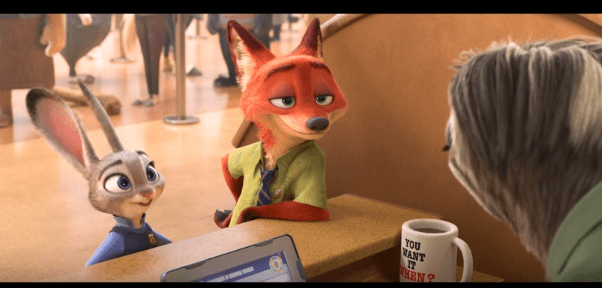 Zootopia is the story of a large, metropolitan city where everyone lives in peace and harmony. Tolerance and diversity are hallmarks of this great city. Hope abounds in this land of talking animals because it’s a place where, “You can be anything!” Zootopia is peaceful because after thousands of years of evolution, carnivores no longer eat other animals. Everyone lives in peace. The prophet Isaiah’s vision that “The wolf will live with the lamb, and the leopard will lie down with the goat” seems to be fulfilled in Disney’s latest movie.
But utopias are never what they seem. Conflicts boil underneath the surface of Zootopia. Despite Zootopia’s optimistic message, Zootopians have to deal with very real problems of stereotypes and scapegoating. Identity in Zootopia is formed in a manner all too familiar to us humans. Largely through stereotyping, the animals in Zootopia create identity in opposition to other animals.
For example, the hero of the movie, Judy Hopps, dreams of being a police officer so that she can “make the world a better places.” But Judy has a problem: she’s a cute little bunny – definitely not the stereotypical police material of Zootopia. That job is reserved for larger male animals like lions, elephants, and buffalo. No bunny has ever joined the police force of Zootopia. Judy is different from her male counterparts in almost every way.
But Judy has an even bigger problem. Immediately as she joins the force, she learns that despite looking for weeks, the police have failed to find 13 animals who were kidnapped. The police became frustrated. Their identity as good police officers was in question. The longer the search dragged on, the longer they risked being viewed as failures at their job. Their frustration needed an outlet, so it was channeled onto Judy. Within her first day on the job, she became their scapegoat. They humiliated her and tore her down emotionally, making her question why she ever thought she could be a police officer.
Why did the police act this way? Not because they were evil, but because in the world of Zootopia, animals act in very human ways. When internal frustration threatens our group identity and cohesion, our frustration finds an outlet in the form of a scapegoat, who is marked by stereotypical differences. Judy didn’t fit the “norm” of the police department, so she was a convenient scapegoat for the larger group. The anthropologist René Girard claims in his book The Scapegoat that, “The further one is from normal social status of whatever kind, the greater the risk of persecution. This is easy to see in relation to those at the bottom of the social ladder.”
Judy’s problems are a microcosm of the bigger issues facing Zootopia. Ninety percent of Zootopians are herbivores, leaving carnivores with just ten percent of the population. Judy is at the bottom of the social ladder in the police department, so she became their scapegoat. In a similar way, when it comes to the total population, carnivores are at the bottom of the social ladder, so they are easy targets for becoming cultural scapegoats.
The villain of Zootopia is a high ranking politician who manipulates the conflicts already present among herbivore Zootopians by channeling their fears against the innocent carnivores. The villain explicitly describes the essence of scapegoating by stating that her people need to “unite against a common enemy.”
Zootopia exposes the process of scapegoating, but more importantly, it reveals the solution to scapegoating. The solution begins with awareness that it’s not only evil, nasty villains who scapegoat; good people scapegoat, too.
At one point, Judy Hopps, the great hero of Zootopia, unintentionally gets caught up in the fearful scapegoating fervor that permeates the city. She gives a speech that emboldens those fears by supporting the idea that carnivores have become a threat to Zootopia’s peace, security, and way of life.
Judy shows that good people, even our greatest heroes, can easily participate in scapegoating. Whenever good people try to make the world a better place by blaming, marginalizing, or excluding another group of people, we are caught up in the evil act of scapegoating.
After her speech, Judy looked into the face of one of her potential scapegoats, and in that face she saw the pain that her speech caused to this innocent animal. What makes Judy a true hero is that she became aware that she had become a scapegoater.
That’s when Judy began the spiritual practice of repentance. She discovered that in trying to make the world a better place, she got lured into an act of scapegoating. Judy felt a sense of shame and guilt, but she didn’t get stuck there. True repentance comes from changing the way we relate to others. True repentance moves us away from scapegoating others towards acts of reconciliation and love.
Near the end of Zootopia, Judy implies that love overcame the evil of scapegoating. Love moved Judy beyond stereotypes and scapegoating to accepting others just as they are.
Zootopia has been criticized as a movie that promotes stereotyping, but I don’t think that criticism is fair. Zootopia doesn’t promote stereotyping or scapegoating; rather, shows the ways in which even good people can stereotype and scapegoat others.
And in doing so, it reveals the way that love can make the world a better place.
Image: Screenshot from YouTube: Zootopia Official US Sloth Trailer, Walt Disney Animation Studios
Previous Post

March 16, 2016
Wednesday Sermon: The Scent of Love
Browse Our Archives
Select a Category Atonement and Current Events Curriculum Faith and Families Interviews Jesus the Forgiving Victim Lent Montessori politics Reviews The Bible Explained Uncategorized Valentine's Day Wednesday Sermon Who is God?
Select a Month July 2020 November 2019 October 2019 September 2019 August 2019 July 2019 June 2019 May 2019 April 2019 March 2019 February 2019 January 2019 December 2018 November 2018 October 2018 September 2018 August 2018 July 2018 June 2018 May 2018 April 2018 March 2018 February 2018 January 2018 December 2017 November 2017 October 2017 September 2017 August 2017 July 2017 June 2017 May 2017 April 2017 March 2017 February 2017 January 2017 December 2016 November 2016 October 2016 September 2016 August 2016 June 2016 May 2016 April 2016 March 2016 February 2016 January 2016 December 2015 November 2015 October 2015 September 2015 August 2015 July 2015 June 2015 May 2015 April 2015 March 2015 February 2015 January 2015 December 2014 November 2014 October 2014 September 2014 August 2014 July 2014 June 2014 May 2014 April 2014 March 2014 January 2014 December 2013 September 2013 August 2013 July 2013
Follow Us!
TAKE THE
Religious Wisdom Quiz
What does "Shiloh" mean in Hebrew?
Select your answer to see how you score.
The chosen one He whose it is God’s dwelling Prince of peace
Related posts from Teaching Nonviolent Atonement

How Forgiveness Can Transform Our Violence and Build...

Perfect Love Casts Out Fear, But Can It...

How My Atheist Father Helps Me Appreciate The...

The Unity of All Things: How to Be...
TRENDING AT PATHEOS Progressive Christian

What Being a Modern-Day Apostle Means to Me
In my last column, I discussed the ins and outs of modern-day...

Did Ancient China Once Worship the God of...
Across human history, a common thread weaves through the origins of the...

Love Your Neighbor – Including Earth-Kin: Lev. 19,...
God’s command to love your neighbor means acting in an ethical and...

Lead a Church Study of “Jesus and Lao...
Guest writer Jack Thomas (The Irreverent Reverend) reflects on leading his church...

Pastoral Wisdom for Responding to Sermon Pushback
Getting sermon pushback on your social justice sermon? Learn practical, Proverbs-based strategies...

Principles for Understanding the Apostolic Ministry Today
Whenever people discover that my formal ministry title is "apostle," as in...
view all Progressive Christian blogs
Ad-Free & Subscriber Log-In Subscription Support
- About Us
- 2026 Calendar
- Videos
- Podcasts
- Library of World Religions
- Faith In Media Tracker
- Advertise With Us
- Write for Us
- Privacy Policy
- Terms of Service
- Do Not Sell My Data
- Contact Us
- Radiant Digital
- Manage Newsletter Subscriptions
- Unsubscribe From Notifications
- Sitemap
Copyright 2008-2026, Patheos. All rights reserved.
Subscription Support Ad-Free & Subscriber Log-In
Follow Patheos