
BuddhistCatholicContemplativeEvangelicalGeneral ChristianHinduJewishLatter-day SaintMuslimNew VisionsProgressive Christian
Beliefs
- Buddhist
- Catholic
- Contemplative
- Evangelical
- General Christian
- Hindu
- Jewish
- Latter-day Saint
- More Voices
- Muslim
- New Visions
- Pagan
- Progressive Christian
Topics
- Religion News
- Food and Religion
- Sports and Religion
- Religious Art
- Religious Music and Entertainment
- Religious Events
- History and Religion
- Style and Religion
- Politics and Religion
- Women in Religion
- Recreation Outdoors and Religion
- Business Finance and Religion
- Careers Workplace and Religion
- Education and Religion
- Family Parenting and Religion
- Health Fitness and Religion
- Home and Religion
- Relationships and Religion
- Technology and Religion
- Travel and Religion
Columnists
- Buddhist Columnists
- Business Finance and Religion Columnists
- Careers Workplace and Religion Columnists
- Catholic Columnists
- Contemplative Columnists
- Education and Religion Columnists
- Evangelists Columnists
- Family Parenting and Religion Columnists
- General Christian Columnists
- Health Fitness and Religion Columnists
- Hindu Columnists
- History and Religion Columnists
- Home and Religion Columnists
- Jewish Columnists
- More Voices Columnists
- Latter Day Columnists
- Muslim Columnists
- New Visions Columnists
- Nonreligious Columnists
- Pagan Columnists
- Politics and Religion Columnists
- Progressive Columnists
- Recreation Outdoors and Religion Columnists
- Relationships and Religion Columnists
- Religion News Columnists
- Religious Art Columnists
- Religious Events Columnists
- Religious Music and Entertainment Columnists
- Sports and Religion Columnists
- Style and Religion Columnists
- Technology and Religion Columnists
- Travel and Religion Columnists
- Women in Religion Columnists
Resource Library
- 2026 Calendar
- Library of World Religions
- The 100 Most Holy Places on Earth
- Patheos Answers
- Podcasts
- Videos
- Faith Leaders Database
- Anglican Episcopalian
- Bahai
- Baptist
- Buddhism
- Christianity
- Confucianism
- Eastern Orthodoxy
- Hinduism
- Holiness and Pentecostal
- ISKCON
- Islam
- Judaism
- Lutheran
- Methodist
- The Church of Jesus Christ of Latter-day Saints
- New Age
- Paganism
- Presbytarian and Reformed
- Protestantism
- Religion Behind the Scenes
- Roman Catholic
- Scientology
- Shia Islam
- Sikhism
- Sufism
- Sunni Islam
- Taoism
- Zen
- See all religions
Research Tools
 Ad-Free & Subscriber Log-In Subscription Support
Ad-Free & Subscriber Log-In Subscription Support
Follow Patheos 

- Trending:
- Forgiveness
- |
- Marriage
- |
- Consciousness
- |
- Death Penalty
- |
- Election
- |
- Halloween
 Teaching Nonviolent Atonement
- Home
- Progressive Christian
- Wednesday Sermon: Washing Feet or Threatening Violence
Wednesday Sermon: Washing Feet or Threatening Violence
Last updated on: March 23, 2016 at 5:32 pm by Adam Ericksen
Wednesday Sermon: Washing Feet or Threatening Violence 2016-03-23T17:32:52-05:00 Adam Ericksen
Patheos Explore the world's faith through different perspectives on religion and spirituality! Patheos has the views of the prevalent religions and spiritualities of the world.
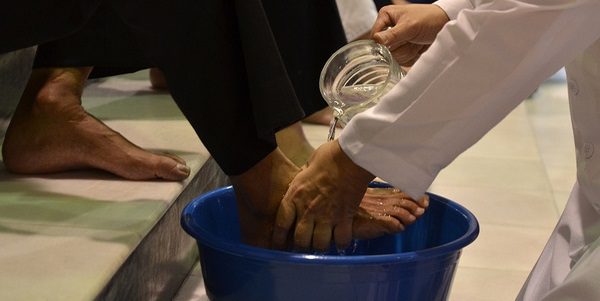
Photo: Flickr, “Washing of Foot” by John Ragal, Creative Commons License, some changes made.
Pastors have a frequent question when they begin to discover mimetic theory. “That’s great. But how does it preach?”
Reverend Tom Truby shows that mimetic theory is a powerful tool that enables pastors to preach the Gospel in a way that is meaningful and refreshing to the modern world. Each Wednesday, Teaching Nonviolent Atonement will highlight his sermons as an example of preaching the Gospel through mimetic theory.
In this sermon, Tom reflects on the events of Maundy Thursday. Jesus the Messiah transforms our understanding of the messiah, or the king. Far from being a violent political ruler, Jesus is the king who serves. His last act of service was to wash his disciples’ feet. In that act, Jesus modeled the politics of the Kingdom of Heaven, as Tom says, “If they are to follow him this is how they will do it. They are to wash each other’s feet.”
Maundy Thursday
March 24th, 2016
Thomas L. Truby
John 13:1-17, 31b-35
Washing Feet or Threatening Violence
(On Maundy Thursday a reader will read each passage and then the preacher will reflect on the passage just read.)
13 Before the Festival of Passover, Jesus knew that his time had come to leave this world and go to the Father. Having loved his own who were in the world, he loved them fully.
Jesus knew what was before him and had deliberately chosen it. It had all been leading up to this and now the time had arrived. It was time to leave this world and go to the Father. He had a real relationship with his disciples. They would not be able to go with him. The next part was for Jesus to go through alone. They would remain in the world and he would go on. But he loved them fully. Saying good bye was hard. It was a real ending and Jesus knew that what the disciples had ahead of them was the hardest thing they would ever endure. I think saying “he loved them fully” is John’s way of saying this meal was deeply important to Jesus because they had been together through so much and Jesus would miss them.
2 Jesus and his disciples were sharing the evening meal. The devil had already provoked Judas, Simon Iscariot’s son, to betray Jesus.
The mechanism by which evil comes had already been triggered. I don’t see the mechanism as a red figure with horns and a tail entering Judas’ heart causing him to betray Jesus. I see it as Judas, under the power of the same forces that we all face, yielding to his own jealousy of Jesus and his rivalry with him. He didn’t think the direction Jesus was going would work and so took action to move Jesus in a different direction.
3 Jesus knew the Father had given everything into his hands and that he had come from God and was returning to God.
Jesus, on the other hand, was quite clear that he was on track. He knew that everything depended on him and that he was in perfect accord with God’s plan. Jesus was certain that he had come from God and was now returning to God and that this was how it had to happen. No other way would work. Humans had to kill God to see what we do to our enemy and our neighbor.
4 So he got up from the table and took off his robes. Picking up a linen towel, he tied it around his waist. 5 Then he poured water into a washbasin and began to wash the disciples’ feet, drying them with the towel he was wearing.
Jesus is giving his disciples a living demonstration of serving their neighbor. He wanted this action to be remembered as one of the last things he did with them. He, their leader, about to leave them and return to God, serves them by washing their feet. If they are to follow him this is how they will do it. They are to wash each other’s feet.
Why is the idea so hard for us? Why do I resist it so and I know you do to. Are we embarrassed by our feet? Is it the stooping down we recoil from? Does it violate some purity code or personal space prohibition we maintain around ourselves? Whatever it is, when Jesus washes the disciple’s feet it makes a deep impression on us and demonstrates how deeply Jesus wants us to serve each other. Jesus washed the feet of each of his disciples.
6 When Jesus came to Simon Peter, Peter said to him, “Lord, are you going to wash my feet?”
Peter expresses the same discomfort we feel. I am still not sure what it is that makes me so uncomfortable. Peter doesn’t understand why Jesus is doing this. Maybe he still held out hope that Jesus would be the forceful leader type who took charge and kicked butt, getting rid of evil, and changing the world. But no, Jesus washes their feet. He bows before them, humbles himself and serves them rather than taking charge and marching them forward into battle against the world’s evil.
7 Jesus replied, “You don’t understand what I’m doing now, but you will understand later.”
It’s before the crucifixion and resurrection so Peter can’t possibly understand but he will understand later. He can’t see how God serves us by allowing us to kill him and then forgives us and this is the way he leads us to peace and gets rid of evil. He gets rid of evil through gentleness and self-sacrifice rather than power and the sacrifice of the other.
8 “No!” Peter said. “You will never wash my feet!”
I need you to be a kick butt leader Jesus, not a weak-kneed servant. If you wash my feet how can I look up to you and respect you as commander-in-chief. No! You will never wash my feet! Isn’t that what our political leaders do? They convince us that they can and will kick butt so that we can feel secure.
Jesus replied, “Unless I wash you, you won’t have a place with me.”
Some powerful ideas needed to be washed away in Peter. He is infected with the same disease as all of humanity. He thinks the way forward is through power, through getting rid of evil with good violence, through the sword, through the way of the world. Jesus knows that this is what needs washing. This has to be removed for Peter to have a place with Jesus. “Unless I wash you, you won’t have a place with me.”
9 Simon Peter said, “Lord, not only my feet but also my hands and my head!”
Do you think Peter understands what Jesus is saying? I think Peter’s response is impulsive and reveals that he still doesn’t understand. He can’t as he is on the wrong side of the crucifixion/resurrection but that will be changing very soon. Peter massively submits to Jesus, like a good soldier pledging to do what his commander asks even if it makes no sense to him. Jesus gently sets him straight but it is more for the record than for Peter who we know can’t understand just yet.
10 Jesus responded, “Those who have bathed need only to have their feet washed, because they are completely clean. You disciples are clean, but not every one of you.” 11 He knew who would betray him. That’s why he said, “Not every one of you is clean.”
It’s only your feet Peter that need washing, the rest of you is clean. Your feet have picked up the dust that it is impossible to avoid when walking as a human being. What is this dust that we all pick up? The mystery is clarified when he says “You disciples are clean, but not every one of you.” Who is unclean? The one who betrayed him. What did the one who betrayed him do? He turned to violence. He left the way of Jesus, the way of the servant leader, the gentle way and he turned toward the sword. This is what made him unclean.
12 After he washed the disciples’ feet, he put on his robes and returned to his place at the table. He said to them, “Do you know what I’ve done for you?
Of course they don’t. They have no idea that he has just modeled for them the way out of the problem that has plagued human kind from the beginning. Instead of rivaling the other person and being subdued by them or subduing them, you serve them. And you never seek to destroy them even when they present themselves as your enemy. Soon Jesus’ model for what service means will take him to the cross where he will lay down his life for his friends and so called enemies because all God’s children are God’s beloved.
13 You call me ‘Teacher’ and ‘Lord,’ and you speak correctly, because I am. 14 If I, your Lord and teacher, have washed your feet, you too must wash each other’s feet.
I think I am coming to a deeper understanding of why I have resisted the Maundy Thursday foot washing service. It has seemed too trite to me, demeaning somehow and not quite adjusted to the realities of the world. But if we see foot washing as opposed to getting rid of evil through the use of the sword then the frame is expanded and suddenly washing feet as opposed to cutting off heads no longer seems so trite. It now seems to respond to the world’s deepest need. And I really think these are the alternatives the writer of the Gospel of John is putting before us. We have seldom viewed it from this angle because we, years ago, lost touch with God’s peace and human violence as the central issues Jesus addresses.
15 I have given you an example: Just as I have done, you also must do.
Does this apply to our global conflicts or does this only work when we think of individuals? How do we corporately serve our global neighbors and enemies? How about washing the feet of our neighbor to the south, what form would that take? Can you be a kick-butt leader and still follow Jesus? Would putting the emphasis on washing feet rather than threatening with sword reduce the tension in the world? “I have given you an example: Just as I have done, you also must do.”
16 I assure you, servants aren’t greater than their master, nor are those who are sent greater than the one who sent them. 17 Since you know these things, you will be happy if you do them.
This is the master’s way and you are not greater than the master. If the master does them, you can too. Now you know this. I have modeled it before you. You know the way toward peace. You will be happy if you do it. Happiness is in your power.
John 13:31b-35
31 “Now the Human One has been glorified, and God has been glorified in him.
In the Gospel of John, Jesus is the Human One and the glorification is the crucifixion and resurrection event. This event also glorifies God for it shows the way God serves us by allowing us to kill him so that he can then forgive us and lead us on our road toward forgiveness of those who have offended us.
32 If God has been glorified in him, God will also glorify the Human One in himself and will glorify him immediately.
At this point we suddenly discover the immensity of the Human One, who shows us the glory of God, who is the One in whom God’s glory resides. We see him as he is just before he leaves us.
33 Little children, I’m with you for a little while longer. You will look for me—but, just as I told the Jewish leaders, I also tell you now—‘Where I’m going, you can’t come.’
Having seen the immensity of the Human One we can now understand why Jesus calls us little children. Like little children we have a lot of growing to do. Jesus’ mission is about to be completed and he will soon return to the place from whence he came. Being at the right hand of God is a place we can’t go but he is there and represents us. As he leaves us he gives us a new commandment.
34 “I give you a new commandment: Love each other. Just as I have loved you, so you also must love each other. 35 This is how everyone will know that you are my disciples, when you love each other.”
Previous Post

March 21, 2016
Victory Over Death
Next Post
March 24, 2016 In Remembrance Of Me
Browse Our Archives
Select a Category Atonement and Current Events Curriculum Faith and Families Interviews Jesus the Forgiving Victim Lent Montessori politics Reviews The Bible Explained Uncategorized Valentine's Day Wednesday Sermon Who is God?
Select a Month July 2020 November 2019 October 2019 September 2019 August 2019 July 2019 June 2019 May 2019 April 2019 March 2019 February 2019 January 2019 December 2018 November 2018 October 2018 September 2018 August 2018 July 2018 June 2018 May 2018 April 2018 March 2018 February 2018 January 2018 December 2017 November 2017 October 2017 September 2017 August 2017 July 2017 June 2017 May 2017 April 2017 March 2017 February 2017 January 2017 December 2016 November 2016 October 2016 September 2016 August 2016 June 2016 May 2016 April 2016 March 2016 February 2016 January 2016 December 2015 November 2015 October 2015 September 2015 August 2015 July 2015 June 2015 May 2015 April 2015 March 2015 February 2015 January 2015 December 2014 November 2014 October 2014 September 2014 August 2014 July 2014 June 2014 May 2014 April 2014 March 2014 January 2014 December 2013 September 2013 August 2013 July 2013
Follow Us!
TAKE THE
Religious Wisdom Quiz
Which king of Babylon saw the handwriting on the wall?
Select your answer to see how you score.
Darius Cyrus Nebuchadnezzar Belshazzar
Related posts from Teaching Nonviolent Atonement

Forgiveness in the Time of COVID-19 by Julia...

Reflections on Indigenous Wisdom For Healing A Wounded...

How Forgiveness Can Transform Our Violence and Build...

Jesus Unmasked: God's Economy and How to Cheat...
TRENDING AT PATHEOS Progressive Christian

What Being a Modern-Day Apostle Means to Me
In my last column, I discussed the ins and outs of modern-day...

Did Ancient China Once Worship the God of...
Across human history, a common thread weaves through the origins of the...

Love Your Neighbor – Including Earth-Kin: Lev. 19,...
God’s command to love your neighbor means acting in an ethical and...

Lead a Church Study of “Jesus and Lao...
Guest writer Jack Thomas (The Irreverent Reverend) reflects on leading his church...

Pastoral Wisdom for Responding to Sermon Pushback
Getting sermon pushback on your social justice sermon? Learn practical, Proverbs-based strategies...

Principles for Understanding the Apostolic Ministry Today
Whenever people discover that my formal ministry title is "apostle," as in...
view all Progressive Christian blogs
Ad-Free & Subscriber Log-In Subscription Support
- About Us
- 2026 Calendar
- Videos
- Podcasts
- Library of World Religions
- Faith In Media Tracker
- Advertise With Us
- Write for Us
- Privacy Policy
- Terms of Service
- Do Not Sell My Data
- Contact Us
- Radiant Digital
- Manage Newsletter Subscriptions
- Unsubscribe From Notifications
- Sitemap
Copyright 2008-2026, Patheos. All rights reserved.
Subscription Support Ad-Free & Subscriber Log-In
Follow Patheos