
BuddhistCatholicContemplativeEvangelicalGeneral ChristianHinduJewishLatter-day SaintMuslimNew VisionsProgressive Christian
Beliefs
- Buddhist
- Catholic
- Contemplative
- Evangelical
- General Christian
- Hindu
- Jewish
- Latter-day Saint
- More Voices
- Muslim
- New Visions
- Pagan
- Progressive Christian
Topics
- Religion News
- Food and Religion
- Sports and Religion
- Religious Art
- Religious Music and Entertainment
- Religious Events
- History and Religion
- Style and Religion
- Politics and Religion
- Women in Religion
- Recreation Outdoors and Religion
- Business Finance and Religion
- Careers Workplace and Religion
- Education and Religion
- Family Parenting and Religion
- Health Fitness and Religion
- Home and Religion
- Relationships and Religion
- Technology and Religion
- Travel and Religion
Columnists
- Buddhist Columnists
- Business Finance and Religion Columnists
- Careers Workplace and Religion Columnists
- Catholic Columnists
- Contemplative Columnists
- Education and Religion Columnists
- Evangelists Columnists
- Family Parenting and Religion Columnists
- General Christian Columnists
- Health Fitness and Religion Columnists
- Hindu Columnists
- History and Religion Columnists
- Home and Religion Columnists
- Jewish Columnists
- More Voices Columnists
- Latter Day Columnists
- Muslim Columnists
- New Visions Columnists
- Nonreligious Columnists
- Pagan Columnists
- Politics and Religion Columnists
- Progressive Columnists
- Recreation Outdoors and Religion Columnists
- Relationships and Religion Columnists
- Religion News Columnists
- Religious Art Columnists
- Religious Events Columnists
- Religious Music and Entertainment Columnists
- Sports and Religion Columnists
- Style and Religion Columnists
- Technology and Religion Columnists
- Travel and Religion Columnists
- Women in Religion Columnists
Resource Library
- 2026 Calendar
- Library of World Religions
- The 100 Most Holy Places on Earth
- Patheos Answers
- Podcasts
- Videos
- Faith Leaders Database
- Anglican Episcopalian
- Bahai
- Baptist
- Buddhism
- Christianity
- Confucianism
- Eastern Orthodoxy
- Hinduism
- Holiness and Pentecostal
- ISKCON
- Islam
- Judaism
- Lutheran
- Methodist
- The Church of Jesus Christ of Latter-day Saints
- New Age
- Paganism
- Presbytarian and Reformed
- Protestantism
- Religion Behind the Scenes
- Roman Catholic
- Scientology
- Shia Islam
- Sikhism
- Sufism
- Sunni Islam
- Taoism
- Zen
- See all religions
Research Tools
 Ad-Free & Subscriber Log-In Subscription Support
Ad-Free & Subscriber Log-In Subscription Support
Follow Patheos 

- Trending:
- Forgiveness
- |
- Marriage
- |
- Consciousness
- |
- Death Penalty
- |
- Election
- |
- Halloween
 Teaching Nonviolent Atonement
- Home
- Progressive Christian
- Wednesday Sermon: Resurrected!
Wednesday Sermon: Resurrected!
Last updated on: March 30, 2016 at 5:00 pm by Tom Truby
Wednesday Sermon: Resurrected! 2016-03-30T17:00:21-05:00 Tom Truby
Patheos Explore the world's faith through different perspectives on religion and spirituality! Patheos has the views of the prevalent religions and spiritualities of the world.
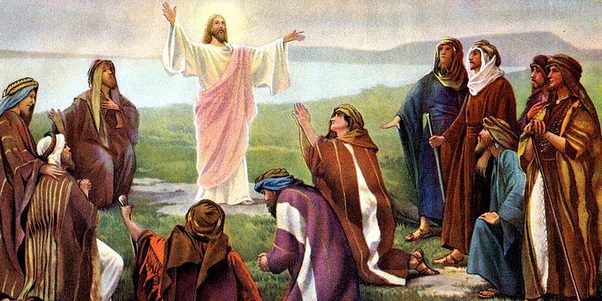
Flickr, Jesus’s Ascension by Waiting for the Word, Creative Commons License, some changes made
Pastors have a frequent question when they begin to discover mimetic theory. “That’s great. But how does it preach?”
Reverend Tom Truby shows that mimetic theory is a powerful tool that enables pastors to preach the Gospel in a way that is meaningful and refreshing to the modern world. Each Wednesday, Teaching Nonviolent Atonement will highlight his sermons as an example of preaching the Gospel through mimetic theory.
In this sermon, Tom reflects on the resurrection of Jesus. In the resurrection we discover that God has nothing to do with violence, but everything to do with forgiveness. This changes history by offering us a new way to be human. As Tom states, “The Resurrection reveals Jesus as the victim who forgives, making forgiveness, not violence, the driving force in history.”
Easter Sunday
March 27th, 2016
Luke 24:1-12
By Thomas L. Truby
Resurrected!
Do you remember how many times and in how many ways Luke’s Gospel asserts that Jesus is innocent? Pilate twice tells the crowd that Jesus has done nothing that deserves death and says Herod agrees with him. But the crowd insists and Pilate gives in. After it’s all over the Centurion says “It’s really true: this man was righteous.”
The difference between myth and gospel is that in myth the accused is always guilty, the crowd always right and the condemnation seen as just and appropriate. In Greek mythology everyone believes Oedipus did kill his father and marry his mother and this is why it is right to condemn him. Both the story of Oedipus and the story of Jesus end with the condemnation of a man but in one story that man is understood to be guilty but in the other he is understood to be innocent. In the story of Jesus, unlike the story of Oedipus, we know the crowd is wrong and the condemnation totally unjust. Thinking they were doing the will of God, on Good Friday the mob participates in lynching an innocent man and the gospels recognize that innocent man as the Son of God, the human One, the one who represents us all, the new Adam.
On Easter morning we discover this innocent man is resurrected! God has returned him to life. What we killed in our quest for identity through exclusion and violence God raised back to life.
What humans got wrong, God fixed and in the process communicates with all humanity about our biggest problem, a problem we still don’t know how to resolve and whose effects we felt again this week in Belgium. I am talking about the problem of human violence that the resurrection of Jesus speaks to by giving the murdered One a voice. The Resurrection contradicts our human way of forming unity through casting-out by giving life and voice to the one cast out.
“On the first day of the week, at early dawn,” some women “came to the tomb.” They found the stone rolled away but they did not find the body. The condemned body was not there! It had been raised! This morning I want us to think about the Resurrection.
I am not a Biblical literalist but I believe in a literal resurrection. I believe God did raise the man, Jesus, from the dead. This actually happened in history and caused a reform movement impacting all religions and cultures, all of which are based on inclusion/exclusion and ritual blood sacrifices. The Resurrection set lose a powerful virus toward health that needed a literal resurrection to energize it. If religion and culture are built on exclusion (some being “in” while the rest are “out”) and yet the One we excluded did not stay excluded but instead rose triumphant, that strikes me as a significant communication.
It was not a psychological or symbolic change in the disciples that happened because of Jesus’ teaching or because of his death. No, it was his resurrection that changed them as they rethought his life, his teachings and his death in view of it.
I believe the Resurrection of Christ is a unique event in history. The Easter Story took place not only literally at dawn, but also at the dawn of a new creation, the first day of a new week. “Jesus was offering a new way to be human that transforms our religion and culture from Division-into-Many to Unity-in-Diversity”, to quote Paul Neuchterlein in an essay published this week.
He writes, “Jesus begins by replacing sacrificial killing on altars with remembrance of a divine self-sacrifice to human sacrifice at a table—which is also a fundamental conversion from gods who command sacrifice, to a God who sacrifices the divine self in compassion and solidarity with all sacrificial victims.” In other words, we don’t have a victim, either human or animal on our altar this morning. We have bread and wine. They remind us that God sacrificed himself to our need to sacrifice someone else’s blood. It also signifies that God is with all those we sacrifice. They are not lost but profoundly loved.
Jesus rising from the grave wasn’t just resuscitation from the dead; it was the completion of creation. For the first time it opened a way for God to reach us with the truth about ourselves and about God that we had not been able to see before. For this to work God needed a Son who would imitate the Father’s desire to show us his love in a way we could understand. This meant the Son had to go all the way, even to dying on the cross. Otherwise we would not get what we do. We had to see it play out on the body of Christ.
Even so, most humans don’t “get it”, for we’ve banished millions of scapegoats fully believing they were guilty and that we were doing God’s will. We do it today in this country through our disproportionate incarceration of people of color and in the way we disregard people of other religions in our drone strikes around the world. No, the Cross alone wouldn’t break through the barrier of our denial, something more would have to be done. God would have to raise Jesus from the dead. Otherwise we would dismiss him.
The Resurrection of Jesus is vindication of Jesus’ work: his life, teaching and death. It is God’s exclamation point that tells all “Jesus got it right”. Jesus does speak for God and tells the world what God is like. Jesus reveals God’s heart and mind. Not the words of the Bible but Jesus himself.
The Resurrection reveals a power superior to violent contagion—that mob power which moves through us so invisibly. The events of Holy Week trace the power of the crowd as it moves from “hosanna” on Palm Sunday “to crucify him” on Good Friday. Even Pilate yields to it and the disciples could not resist this force when they scattered into the night thinking that Jesus was a deluded prophet. The power of wanting to be like everybody else is nearly irresistible. After the resurrection we discover the excluded One has a voice and this voice speaks more powerfully than the crowd by revealing the crowd’s secret.
The Resurrection reveals Jesus as the victim who forgives, making forgiveness, not violence, the driving force in history. Before the Resurrection, the victim’s voice was lost when the story of history was told. History was the story of the winners – the losers had no voice for their voice was almost always silenced. The voice of Oedipus was not heard and there was no resurrection to amend the crowd’s decision. But in Jesus the victim’s voice finds expression and cannot be silenced. It speaks for the powerless throughout the world.
The Resurrection reveals that Jesus is speaking for God in forgiving us. Jesus had allowed himself to become a victim so that he could speak forgiveness to us in a way that we could hear. With the Resurrection, “forgiveness is raised from the tomb,” as St. John Chrysostom so eloquently declares. In the Cross we learn about ourselves but in the Resurrection we learn about God.
The Resurrection reveals that God is nothing but love. Not just that God desires love, but that God is love. The God who could have been sovereign chose to be love. And love never forces itself on others!
Alleluia! Christ is risen!
Previous Post

March 29, 2016
The Resurrection is No Myth, But It Is Dangerous
Next Post
March 31, 2016 Trump, Abortion, and a Better Conversation
Browse Our Archives
Select a Category Atonement and Current Events Curriculum Faith and Families Interviews Jesus the Forgiving Victim Lent Montessori politics Reviews The Bible Explained Uncategorized Valentine's Day Wednesday Sermon Who is God?
Select a Month July 2020 November 2019 October 2019 September 2019 August 2019 July 2019 June 2019 May 2019 April 2019 March 2019 February 2019 January 2019 December 2018 November 2018 October 2018 September 2018 August 2018 July 2018 June 2018 May 2018 April 2018 March 2018 February 2018 January 2018 December 2017 November 2017 October 2017 September 2017 August 2017 July 2017 June 2017 May 2017 April 2017 March 2017 February 2017 January 2017 December 2016 November 2016 October 2016 September 2016 August 2016 June 2016 May 2016 April 2016 March 2016 February 2016 January 2016 December 2015 November 2015 October 2015 September 2015 August 2015 July 2015 June 2015 May 2015 April 2015 March 2015 February 2015 January 2015 December 2014 November 2014 October 2014 September 2014 August 2014 July 2014 June 2014 May 2014 April 2014 March 2014 January 2014 December 2013 September 2013 August 2013 July 2013
Follow Us!
TAKE THE
Religious Wisdom Quiz
How many chapters are in Proverbs?
Select your answer to see how you score.
50 27 22 31
Related posts from Teaching Nonviolent Atonement

Forgiveness in the Time of COVID-19 by Julia...

Reflections on Indigenous Wisdom For Healing A Wounded...

How Forgiveness Can Transform Our Violence and Build...

Jesus Unmasked: God's Economy and How to Cheat...
TRENDING AT PATHEOS Progressive Christian

What Being a Modern-Day Apostle Means to Me
In my last column, I discussed the ins and outs of modern-day...

Did Ancient China Once Worship the God of...
Across human history, a common thread weaves through the origins of the...

Love Your Neighbor – Including Earth-Kin: Lev. 19,...
God’s command to love your neighbor means acting in an ethical and...

Lead a Church Study of “Jesus and Lao...
Guest writer Jack Thomas (The Irreverent Reverend) reflects on leading his church...

Pastoral Wisdom for Responding to Sermon Pushback
Getting sermon pushback on your social justice sermon? Learn practical, Proverbs-based strategies...

Principles for Understanding the Apostolic Ministry Today
Whenever people discover that my formal ministry title is "apostle," as in...
view all Progressive Christian blogs
Ad-Free & Subscriber Log-In Subscription Support
- About Us
- 2026 Calendar
- Videos
- Podcasts
- Library of World Religions
- Faith In Media Tracker
- Advertise With Us
- Write for Us
- Privacy Policy
- Terms of Service
- Do Not Sell My Data
- Contact Us
- Radiant Digital
- Manage Newsletter Subscriptions
- Unsubscribe From Notifications
- Sitemap
Copyright 2008-2026, Patheos. All rights reserved.
Subscription Support Ad-Free & Subscriber Log-In
Follow Patheos