
BuddhistCatholicContemplativeEvangelicalGeneral ChristianHinduJewishLatter-day SaintMuslimNew VisionsProgressive Christian
Beliefs
- Buddhist
- Catholic
- Contemplative
- Evangelical
- General Christian
- Hindu
- Jewish
- Latter-day Saint
- More Voices
- Muslim
- New Visions
- Pagan
- Progressive Christian
Topics
- Religion News
- Food and Religion
- Sports and Religion
- Religious Art
- Religious Music and Entertainment
- Religious Events
- History and Religion
- Style and Religion
- Politics and Religion
- Women in Religion
- Recreation Outdoors and Religion
- Business Finance and Religion
- Careers Workplace and Religion
- Education and Religion
- Family Parenting and Religion
- Health Fitness and Religion
- Home and Religion
- Relationships and Religion
- Technology and Religion
- Travel and Religion
Columnists
- Buddhist Columnists
- Business Finance and Religion Columnists
- Careers Workplace and Religion Columnists
- Catholic Columnists
- Contemplative Columnists
- Education and Religion Columnists
- Evangelists Columnists
- Family Parenting and Religion Columnists
- General Christian Columnists
- Health Fitness and Religion Columnists
- Hindu Columnists
- History and Religion Columnists
- Home and Religion Columnists
- Jewish Columnists
- More Voices Columnists
- Latter Day Columnists
- Muslim Columnists
- New Visions Columnists
- Nonreligious Columnists
- Pagan Columnists
- Politics and Religion Columnists
- Progressive Columnists
- Recreation Outdoors and Religion Columnists
- Relationships and Religion Columnists
- Religion News Columnists
- Religious Art Columnists
- Religious Events Columnists
- Religious Music and Entertainment Columnists
- Sports and Religion Columnists
- Style and Religion Columnists
- Technology and Religion Columnists
- Travel and Religion Columnists
- Women in Religion Columnists
Resource Library
- 2026 Calendar
- Library of World Religions
- The 100 Most Holy Places on Earth
- Patheos Answers
- Podcasts
- Videos
- Faith Leaders Database
- Anglican Episcopalian
- Bahai
- Baptist
- Buddhism
- Christianity
- Confucianism
- Eastern Orthodoxy
- Hinduism
- Holiness and Pentecostal
- ISKCON
- Islam
- Judaism
- Lutheran
- Methodist
- The Church of Jesus Christ of Latter-day Saints
- New Age
- Paganism
- Presbytarian and Reformed
- Protestantism
- Religion Behind the Scenes
- Roman Catholic
- Scientology
- Shia Islam
- Sikhism
- Sufism
- Sunni Islam
- Taoism
- Zen
- See all religions
Research Tools
 Ad-Free & Subscriber Log-In Subscription Support
Ad-Free & Subscriber Log-In Subscription Support
Follow Patheos 

- Trending:
- Forgiveness
- |
- Marriage
- |
- Consciousness
- |
- Death Penalty
- |
- Election
- |
- Halloween
 Teaching Nonviolent Atonement
- Home
- Progressive Christian
- Jesus Was Killed For National Security Reasons: Good Friday, Fear, and Muslim Surveillance
Jesus Was Killed For National Security Reasons: Good Friday, Fear, and Muslim Surveillance
Last updated on: March 26, 2016 at 12:51 am by Adam Ericksen
Jesus Was Killed For National Security Reasons: Good Friday, Fear, and Muslim Surveillance 2016-03-26T00:51:10-05:00 Adam Ericksen
Patheos Explore the world's faith through different perspectives on religion and spirituality! Patheos has the views of the prevalent religions and spiritualities of the world.
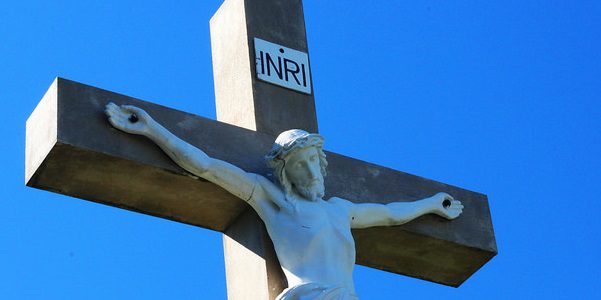
Flick: Patrick Keller, Crucifixion INRI – St. Peter’s Cemetery, St. Charles, MO, Creative Commons Licence, some changes made
Why was Jesus killed?
There is no more important question to ask on this Good Friday. Christians have come up with many answers throughout the last 2,000 years. Some of those answers claim that Jesus was killed by the Father to assuage His wrath or reclaim His honor in the face of human sin.
But that’s the wrong answer. Jesus wasn’t killed to appease God. Jesus was killed because he was a threat to national security.
That’s the answer that the Gospels give. The great religious and political leader of the day, the high priest Caiaphas, explained why Jesus had to die. During a debate among other leaders, Caiaphas said,
You do not understand that it is better for you to have one man die for the people than to have the whole nation destroyed.
Caiaphas was right about one thing – Jesus was a national security threat. That’s why the political and religious elite killed him.
But let’s be clear – Jesus was not a threat to Israel’s national security because he was a violent revolutionary. No, Jesus was a threat because he challenged the whole political system of violence and death. Jesus preached a different way of life that he called the Kingdom of God. It wasn’t based on fear, death, or violence. Rather, it was based on faith, hope, and nonviolent love.
Caiaphas was a keen politician. Politics has always been based on the expediency of keeping people safe for national security. That’s their primary job. But in order to keep us safe, there has to be a threat, some enemy that has to be exiled or killed in order for us to be safe – lest the whole nation be destroyed!
Caiaphas wasn’t particularly evil. He was simply doing what humans have always done. He was channeling national fears and anxieties against a scapegoat. Two thousand years ago it was Jesus, but we continue the practice of political scapegoating today. Currently in the United States, we have presidential candidates who are channeling our cultural fears and anxieties against Muslims. In the wake of the Jihadist terror attacks in Brussels, leading candidates are suggesting that police need to patrol “Muslim neighborhoods,” because, you know, all Muslims are a threat to our national security…
Did you know that during the 15 years since 9/11, Jihadists have attacked the United States nine times, killing 45 people? My Muslims friends agree that those terrorist attacks are tragedies that never should have happened. But do those statistics reveal that Jihadists, let alone peaceful, law abiding Muslims citizens, are such a massive threat to our safety and security that police need to spend extra time and resources patrolling Muslim neighborhoods?
In comparison, “There are nearly 12,000 gun murders a year in the US.” American gun violence is a far bigger threat to us than Jihadists. But there’s an even bigger threat to our safety and security than guns. Every year more than 30,000 people are killed by car accidents.
If something killed 30,000 Americans a year, would we call it a national security threat? Of course we would! We would demand that police spend more time and resources patrolling neighborhoods, making sure people were safe from such a threat.
So, are Jihadist the great threat we are making them out to be? If so, the Obama Administration is doing a damn good job keeping us safe! But personally, I don’t think they are. After all, you have far more reason to fear the car coming down the street than any Jihadist, let alone peaceful Muslims.
Of course, it would be irrational for you to fear every car that came down the street. And it is just as irrational for you to fear your Muslim neighbor.
What do Caiaphas and our political leaders have in common? They attempt to channel our fears against a common enemy in the name of national security. But ultimately, they distract us from bigger problems. Our biggest problem is the cycle of scapegoating. Caiaphas blamed Jesus. Our politicians are blaming Muslims. And Christians should know better than to fall for the fearful suspicion directed against Muslims. Good Friday teaches us that when we live by fear, even fearing for our national security, we end up channeling our fear, anxiety, and violence against a scapegoat. In other words, we participate in the violent logic that killed Jesus.
On Good Friday, Jesus reveals that we don’t have to live by fear. In fact, he frees us from fear, even the fear of death. Faith in Jesus means that we no longer have to kill or exclude others for the sake of national security. Rather, faith means trusting in Jesus, the one who calls us to love and forgive our neighbors, including those we call our enemies.
Previous Post

March 24, 2016
Jesus is our Brother, But What About Judas?
Next Post
March 29, 2016 The Resurrection is No Myth, But It Is Dangerous
Browse Our Archives
Select a Category Atonement and Current Events Curriculum Faith and Families Interviews Jesus the Forgiving Victim Lent Montessori politics Reviews The Bible Explained Uncategorized Valentine's Day Wednesday Sermon Who is God?
Select a Month July 2020 November 2019 October 2019 September 2019 August 2019 July 2019 June 2019 May 2019 April 2019 March 2019 February 2019 January 2019 December 2018 November 2018 October 2018 September 2018 August 2018 July 2018 June 2018 May 2018 April 2018 March 2018 February 2018 January 2018 December 2017 November 2017 October 2017 September 2017 August 2017 July 2017 June 2017 May 2017 April 2017 March 2017 February 2017 January 2017 December 2016 November 2016 October 2016 September 2016 August 2016 June 2016 May 2016 April 2016 March 2016 February 2016 January 2016 December 2015 November 2015 October 2015 September 2015 August 2015 July 2015 June 2015 May 2015 April 2015 March 2015 February 2015 January 2015 December 2014 November 2014 October 2014 September 2014 August 2014 July 2014 June 2014 May 2014 April 2014 March 2014 January 2014 December 2013 September 2013 August 2013 July 2013
Follow Us!
TAKE THE
Religious Wisdom Quiz
What does "Capernaum" mean?
Select your answer to see how you score.
Village of comfort City of trade Place of water Port of peace
Related posts from Teaching Nonviolent Atonement

Forgiveness in the Time of COVID-19 by Julia...

Reflections on Indigenous Wisdom For Healing A Wounded...

How Forgiveness Can Transform Our Violence and Build...

Jesus Unmasked: God's Economy and How to Cheat...
TRENDING AT PATHEOS Progressive Christian

What Being a Modern-Day Apostle Means to Me
In my last column, I discussed the ins and outs of modern-day...

Did Ancient China Once Worship the God of...
Across human history, a common thread weaves through the origins of the...

Love Your Neighbor – Including Earth-Kin: Lev. 19,...
God’s command to love your neighbor means acting in an ethical and...

Lead a Church Study of “Jesus and Lao...
Guest writer Jack Thomas (The Irreverent Reverend) reflects on leading his church...

Pastoral Wisdom for Responding to Sermon Pushback
Getting sermon pushback on your social justice sermon? Learn practical, Proverbs-based strategies...

Principles for Understanding the Apostolic Ministry Today
Whenever people discover that my formal ministry title is "apostle," as in...
view all Progressive Christian blogs
Ad-Free & Subscriber Log-In Subscription Support
- About Us
- 2026 Calendar
- Videos
- Podcasts
- Library of World Religions
- Faith In Media Tracker
- Advertise With Us
- Write for Us
- Privacy Policy
- Terms of Service
- Do Not Sell My Data
- Contact Us
- Radiant Digital
- Manage Newsletter Subscriptions
- Unsubscribe From Notifications
- Sitemap
Copyright 2008-2026, Patheos. All rights reserved.
Subscription Support Ad-Free & Subscriber Log-In
Follow Patheos