
BuddhistCatholicContemplativeEvangelicalGeneral ChristianHinduJewishLatter-day SaintMuslimNew VisionsProgressive Christian
Beliefs
- Buddhist
- Catholic
- Contemplative
- Evangelical
- General Christian
- Hindu
- Jewish
- Latter-day Saint
- More Voices
- Muslim
- New Visions
- Pagan
- Progressive Christian
Topics
- Religion News
- Food and Religion
- Sports and Religion
- Religious Art
- Religious Music and Entertainment
- Religious Events
- History and Religion
- Style and Religion
- Politics and Religion
- Women in Religion
- Recreation Outdoors and Religion
- Business Finance and Religion
- Careers Workplace and Religion
- Education and Religion
- Family Parenting and Religion
- Health Fitness and Religion
- Home and Religion
- Relationships and Religion
- Technology and Religion
- Travel and Religion
Columnists
- Buddhist Columnists
- Business Finance and Religion Columnists
- Careers Workplace and Religion Columnists
- Catholic Columnists
- Contemplative Columnists
- Education and Religion Columnists
- Evangelists Columnists
- Family Parenting and Religion Columnists
- General Christian Columnists
- Health Fitness and Religion Columnists
- Hindu Columnists
- History and Religion Columnists
- Home and Religion Columnists
- Jewish Columnists
- More Voices Columnists
- Latter Day Columnists
- Muslim Columnists
- New Visions Columnists
- Nonreligious Columnists
- Pagan Columnists
- Politics and Religion Columnists
- Progressive Columnists
- Recreation Outdoors and Religion Columnists
- Relationships and Religion Columnists
- Religion News Columnists
- Religious Art Columnists
- Religious Events Columnists
- Religious Music and Entertainment Columnists
- Sports and Religion Columnists
- Style and Religion Columnists
- Technology and Religion Columnists
- Travel and Religion Columnists
- Women in Religion Columnists
Resource Library
- 2026 Calendar
- Library of World Religions
- The 100 Most Holy Places on Earth
- Patheos Answers
- Podcasts
- Videos
- Faith Leaders Database
- Anglican Episcopalian
- Bahai
- Baptist
- Buddhism
- Christianity
- Confucianism
- Eastern Orthodoxy
- Hinduism
- Holiness and Pentecostal
- ISKCON
- Islam
- Judaism
- Lutheran
- Methodist
- The Church of Jesus Christ of Latter-day Saints
- New Age
- Paganism
- Presbytarian and Reformed
- Protestantism
- Religion Behind the Scenes
- Roman Catholic
- Scientology
- Shia Islam
- Sikhism
- Sufism
- Sunni Islam
- Taoism
- Zen
- See all religions
Research Tools
 Ad-Free & Subscriber Log-In Subscription Support
Ad-Free & Subscriber Log-In Subscription Support
Follow Patheos 

- Trending:
- Forgiveness
- |
- Marriage
- |
- Consciousness
- |
- Death Penalty
- |
- Election
- |
- Halloween
 Teaching Nonviolent Atonement
- Home
- Progressive Christian
- Jesus is our Brother, But What About Judas?
Jesus is our Brother, But What About Judas?
Last updated on: March 24, 2016 at 8:44 am by Adam Ericksen
Jesus is our Brother, But What About Judas? 2016-03-24T08:44:01-05:00 Adam Ericksen
Patheos Explore the world's faith through different perspectives on religion and spirituality! Patheos has the views of the prevalent religions and spiritualities of the world.
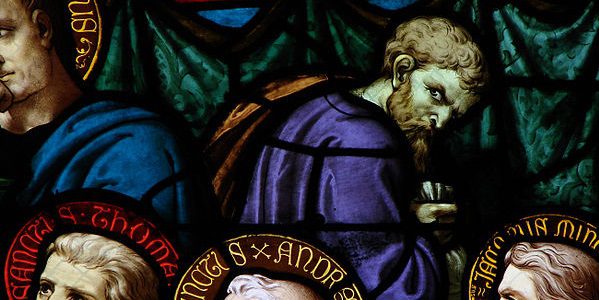
By Vassil – Own work, Public Domain, https://commons.wikimedia.org/w/index.php?curid=7231034
One of the many things that I love about being a progressive Christian is the frequent emphasis that Jesus is our brother. He’s one of us. He took on the fullness of humanity.
The joy and the hope and the friendship and the love.
But also the pain and the anger and the grief and the suffering.
Jesus, the One who was fully divine was fully human. Our brother. Our friend. It’s a beautiful thing.
Indeed, Jesus is our brother, but what about Judas? This Maundy Thursday, let us acknowledge that Judas is our brother, too.
Judas has been demonized throughout Christian history. He’s been called the devil. Judas is a favorite scapegoat among Christians. For 2,000 years we’ve demonized Judas, which allows us to think that we are so much better than that wretched excuse for a human being who betrayed our Lord.
But truth is that Judas is one of us. He is our brother.
Yes, Judas betrayed Jesus, but so did the other disciples, including Peter. They all betrayed and abandoned Jesus to his Passion, to his death. During the Last Supper, as Jesus symbolized his death by breaking bread and pouring wine for his disciples, Jesus told them, “The one who betrays me is with me, and his hand is on the table. For the Son of Man is going as it has been determined, but woe to that one by whom he is betrayed.” The disciples were confused and “began to ask one another which one of them it could be who would do this.”
Here’s my question: Why didn’t the disciples just look to see whose hands were on the table? They would have known right away that Judas was the culprit! I think the reason that none of them looked is because they all had their hands on the table. By looking at the table they would realize that none of their hands were clean. They each knew the answer to the question “Who would do this?” They all would.
If Judas is typically presented as a failed disciple, Peter is typically presented as the “rock,” the ideal disciple. But in his book The Scapegoat, Rene Girard states that “In understanding the Passion we come to understand the temporary removal of any difference … between … Judas and Peter.”
When it comes to the betrayal of Jesus, there is no real difference between Judas and Peter. They both betrayed and abandoned their friend, their brother, in his time of need. Luke tells us that before he betrayed Jesus, “Satan entered into Judas.” But Peter had it worse. Jesus himself once rebuked Peter, saying, “Get behind me Satan!”
Ouch.
Judas and Peter were brothers because they had a lot in common, including being influenced by Satan. Don’t think of Satan as a red figure with horns and a pitch fork. Rather, think of Satan as the principle of accusation, betrayal, and abandoning others during their time of need.
Peter and Judas were a mixed bag of faith and doubt, good and evil, truth and falsehood. And so are we, which means they are our brothers.
James Alison puts it like this in his adult education curriculum, Jesus the Forgiving Victim:
This I think is vital for us to remember: the presupposition of this course is that we who are gathering together, I who am attempting to pass it on, are, however well we may veil it, liars, fantasists, thieves, self-publicists, manipulators, addicts to phony reputations, to emotional blackmail, deeply self-deceived, muddled and sometimes quite vicious. The presupposition of this course is that it is people of this sort, the self-deceived, ones wedded to our self-deception and our deception of others, people of this sort who are being spoken to. It is as such that we are on the receiving end of an act of communication from someone who knows all that about us, is not taken in by us, is not concerned by how little good we are, and yet, even so, wants to take us to another place.
Jesus, our brother, knows all of this about us. He knew it about our brother Peter and he knew it about our brother Judas. And he doesn’t hold it against us. He knows it, and he wants to take us to another place. He takes us there not by punishing us when we fall short, but by loving us, just as we are, and inviting us to love one another just as he loves us.
In the end, there is one difference between Peter and Judas. During the Last Supper, Jesus said that his blood was poured out for “the forgiveness of sins.” The difference between Peter and Judas was that Peter could accept Christ’s forgiveness. We are all in the same boat a Peter and Judas. At some point, we have all betrayed and abandoned our brothers and sisters in humanity. We are all sinners. But that’s only part of the truth, because we are also also forgiven. We are also loved.
The question to ask this Maundy Thursday is: Are we prepared to be forgiven by Christ on Easter morning?
For more on Judas, read David Henson’s wonderful article, The Descent: Short, Short Fiction for Holy Week
Previous Post

March 24, 2016
In Remembrance Of Me
Browse Our Archives
Select a Category Atonement and Current Events Curriculum Faith and Families Interviews Jesus the Forgiving Victim Lent Montessori politics Reviews The Bible Explained Uncategorized Valentine's Day Wednesday Sermon Who is God?
Select a Month July 2020 November 2019 October 2019 September 2019 August 2019 July 2019 June 2019 May 2019 April 2019 March 2019 February 2019 January 2019 December 2018 November 2018 October 2018 September 2018 August 2018 July 2018 June 2018 May 2018 April 2018 March 2018 February 2018 January 2018 December 2017 November 2017 October 2017 September 2017 August 2017 July 2017 June 2017 May 2017 April 2017 March 2017 February 2017 January 2017 December 2016 November 2016 October 2016 September 2016 August 2016 June 2016 May 2016 April 2016 March 2016 February 2016 January 2016 December 2015 November 2015 October 2015 September 2015 August 2015 July 2015 June 2015 May 2015 April 2015 March 2015 February 2015 January 2015 December 2014 November 2014 October 2014 September 2014 August 2014 July 2014 June 2014 May 2014 April 2014 March 2014 January 2014 December 2013 September 2013 August 2013 July 2013
Follow Us!
TAKE THE
Religious Wisdom Quiz
Who was the first woman created by God?
Select your answer to see how you score.
Eve Sarah Mary Rebekah
Related posts from Teaching Nonviolent Atonement

Forgiveness in the Time of COVID-19 by Julia...

Reflections on Indigenous Wisdom For Healing A Wounded...

How Forgiveness Can Transform Our Violence and Build...

Jesus Unmasked: God's Economy and How to Cheat...
TRENDING AT PATHEOS Progressive Christian

Why Christians Have a Sacred Duty to Vote:...
The Bible offers strong support for the sacred duty to vote. Here...

What Being a Modern-Day Apostle Means to Me
In my last column, I discussed the ins and outs of modern-day...

Did Ancient China Once Worship the God of...
Across human history, a common thread weaves through the origins of the...

Love Your Neighbor – Including Earth-Kin: Lev. 19,...
God’s command to love your neighbor means acting in an ethical and...

Lead a Church Study of “Jesus and Lao...
Guest writer Jack Thomas (The Irreverent Reverend) reflects on leading his church...

Principles for Understanding the Apostolic Ministry Today
Whenever people discover that my formal ministry title is "apostle," as in...
view all Progressive Christian blogs
Ad-Free & Subscriber Log-In Subscription Support
- About Us
- 2026 Calendar
- Videos
- Podcasts
- Library of World Religions
- Faith In Media Tracker
- Advertise With Us
- Write for Us
- Privacy Policy
- Terms of Service
- Do Not Sell My Data
- Contact Us
- Radiant Digital
- Manage Newsletter Subscriptions
- Unsubscribe From Notifications
- Sitemap
Copyright 2008-2026, Patheos. All rights reserved.
Subscription Support Ad-Free & Subscriber Log-In
Follow Patheos