
BuddhistCatholicContemplativeEvangelicalGeneral ChristianHinduJewishLatter-day SaintMuslimNew VisionsProgressive Christian
Beliefs
- Buddhist
- Catholic
- Contemplative
- Evangelical
- General Christian
- Hindu
- Jewish
- Latter-day Saint
- More Voices
- Muslim
- New Visions
- Pagan
- Progressive Christian
Topics
- Religion News
- Food and Religion
- Sports and Religion
- Religious Art
- Religious Music and Entertainment
- Religious Events
- History and Religion
- Style and Religion
- Politics and Religion
- Women in Religion
- Recreation Outdoors and Religion
- Business Finance and Religion
- Careers Workplace and Religion
- Education and Religion
- Family Parenting and Religion
- Health Fitness and Religion
- Home and Religion
- Relationships and Religion
- Technology and Religion
- Travel and Religion
Columnists
- Buddhist Columnists
- Business Finance and Religion Columnists
- Careers Workplace and Religion Columnists
- Catholic Columnists
- Contemplative Columnists
- Education and Religion Columnists
- Evangelists Columnists
- Family Parenting and Religion Columnists
- General Christian Columnists
- Health Fitness and Religion Columnists
- Hindu Columnists
- History and Religion Columnists
- Home and Religion Columnists
- Jewish Columnists
- More Voices Columnists
- Latter Day Columnists
- Muslim Columnists
- New Visions Columnists
- Nonreligious Columnists
- Pagan Columnists
- Politics and Religion Columnists
- Progressive Columnists
- Recreation Outdoors and Religion Columnists
- Relationships and Religion Columnists
- Religion News Columnists
- Religious Art Columnists
- Religious Events Columnists
- Religious Music and Entertainment Columnists
- Sports and Religion Columnists
- Style and Religion Columnists
- Technology and Religion Columnists
- Travel and Religion Columnists
- Women in Religion Columnists
Resource Library
- 2026 Calendar
- Library of World Religions
- The 100 Most Holy Places on Earth
- Patheos Answers
- Podcasts
- Videos
- Faith Leaders Database
- Anglican Episcopalian
- Bahai
- Baptist
- Buddhism
- Christianity
- Confucianism
- Eastern Orthodoxy
- Hinduism
- Holiness and Pentecostal
- ISKCON
- Islam
- Judaism
- Lutheran
- Methodist
- The Church of Jesus Christ of Latter-day Saints
- New Age
- Paganism
- Presbytarian and Reformed
- Protestantism
- Religion Behind the Scenes
- Roman Catholic
- Scientology
- Shia Islam
- Sikhism
- Sufism
- Sunni Islam
- Taoism
- Zen
- See all religions
Research Tools
 Ad-Free & Subscriber Log-In Subscription Support
Ad-Free & Subscriber Log-In Subscription Support
Follow Patheos 

- Trending:
- Forgiveness
- |
- Marriage
- |
- Consciousness
- |
- Death Penalty
- |
- Election
- |
- Halloween
 Teaching Nonviolent Atonement
- Home
- Progressive Christian
- Islam Does Not Hate Us. Muslims Want To Be Our Friends.
Islam Does Not Hate Us. Muslims Want To Be Our Friends.
Last updated on: March 11, 2016 at 9:49 pm by Lindsey Paris-Lopez
Islam Does Not Hate Us. Muslims Want To Be Our Friends. 2016-03-11T21:49:35-05:00 Lindsey Paris-Lopez
Patheos Explore the world's faith through different perspectives on religion and spirituality! Patheos has the views of the prevalent religions and spiritualities of the world.
 I can’t help but feel sorry for Donald Trump. But he’s not the only one for whom I feel sorry.
Donald Trump may be the loudest voice in politics right now, but his recent bombastic quip, “I think Islam hates us,” no doubt ineloquently utters what many others must think. For all the talk about the need to separate terrorists and extremists from the vast majority of Muslims, untold numbers of whom are active peacemakers, United States policy toward Muslims has been marked by suspicion at home and genocide abroad. Surveillance of mosques, closing Muslim charities on “secret evidence,” and racially profiling Muslims are regular courses of action here at home. And in at least 8 predominantly Muslim countries, drone strikes based on “patterns of behavior” — without even knowing the identities of the targets — obliterate human life. Up to 90 percent of the strike victims are not the intended targets, but, as long as they are military-aged males, they are obscenely deemed guilty unless posthumously proven innocent. Drone strikes are just part of a military policy that prioritizes profit over human life and is genocidal at heart, as it demonizes and denies the humanity of its victims. The treatment of Muslims as enemies must lead many people to believe that Muslims hate us. After all, if we wish to see our violence as noble, honorable and righteous, we must believe our enemies to be malicious, evil, and filled with hatred. And if United States policy does not make more than a lip-service effort to distinguish between most Muslims and terrorists (drones and missiles are certainly incapable of making such a distinction), then it stands to reason that many must believe the delusion Donald Trump himself seems to be under, that there is something about Islam that engenders enmity.
And I can’t help but feel sorry for anyone under such a delusion, because it is clear that anyone who believes that “Muslims hate us” is not blessed, as I and many others are, with wonderful, compassionate, inspirational Muslim friends.
To know Muslims like the dear sisters who have been among my closest friends for over 20 years is to know that Islam at its best is a faith that brings out compassion, mercy, thirst for justice, and love in its adherents. It is a faith that encourages kindness and respect, one that seeks peace and forbids compulsion. It has pacifist as well as militant interpretations, with most believers falling within the middle of the spectrum, but the vast majority of Muslims site the Qur’anic prohibition of war except in matters of self-defense. To know Muslims is to know that they are just like everyone else, and to understand that there is nothing about Islam that renders it incompatible or hostile to modernity. And to have good Muslim friends, for whom faith is an essential part of their identity, is to have friends who value mercy and compassion, as these are the two attributes of God most frequently cited in the Qur’an. Friendships like those I have with my Muslim friends are rare, nurtured by values we share generated by the same God, worshipped differently but mutually understood to be the author of compassion, forgiveness, and love.
To have good Muslim friends is to understand not only how wrong Donald Trump is, but also how very much he is missing out upon when he mistakenly says that “Islam hates us.”
And to have good Muslim friends is to understand that there are now unprecedented levels of Islamophobia sweeping the nation, higher levels than there have been in the 14 and a half years since the September 11th attacks. To have good Muslim friends is to be unable to ignore the devastation being wrought against Muslims at home and abroad. It is to understand the tragic counter-productivity of our violence, which, in the name of defeating terror, creates more terrorists out of desperate, drone-orphaned children or grieving, enraged parents. And it is to recognize the counter-productivity in policies and rhetoric and bullying and vigilante violence here at home that play directly into the hands of the leaders of ISIS.
ISIS uses the chaos and desperation wrote by over a decade of war to convince Muslims that the world is against them and spur violence. Islamophobic attitudes and policies that isolate Muslims do far more to help than harm ISIS, which feeds off of the isolation such policies engender. For the frontrunner of a political party to claim that there is something inherently hateful about Islam is to further marginalize and isolate Muslims. And the message that America hates Islam will be easier for ISIS to sell to Muslims who are shunned, insulted, and assaulted, as well as Muslims who have lost their dreams, their futures, and their loved ones. As Donald Trump expresses desire to mirror the tactics of ISIS to fight ISIS, he ironically mirrors the recruiting techniques of ISIS – spreading fear and hatred which will result in individual violence and support for institutionalized violence. And while he recruits against Muslims, he also recruits for the very extremists he wishes to defeat.
And in spite of all of this, the majority of Muslims in the United States and worldwide shun the recruitment efforts of ISIS and other extremist organizations using the veneer of religion to claim legitimacy for their violence. The majority of Muslims do not hate America, because they distinguish between the people and the policies, value our common humanity, and wish above all for peace. Muslims make an effort to distinguish American citizens from the leaders who call for indiscriminant bans on immigration, heartless deportation of refugees, and “making sand glow in the dark” from bombs that will kill civilians along with ISIS. (Yes, I know that was Cruz, not Trump. The point is that multiple leaders are ratcheting up the violent rhetoric.) Claims that it is hard to distinguish between peaceful Muslims and those with hostile intentions are as dangerous as they are lazy, because Muslims are among those who must be most vigilant against hate crimes, and they are still willing and able to befriend their non-Muslim neighbors.
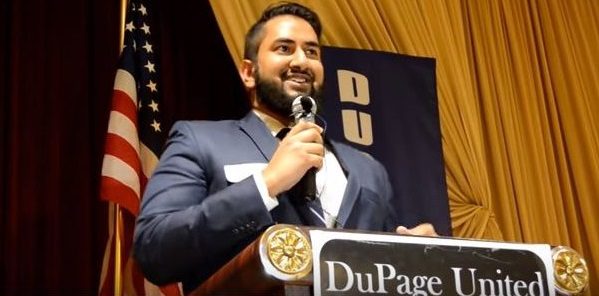
In fact, Muslims around the nation are actively reaching out to befriend us all, in an effort to quell Islamophobia, show hospitality, and build bridges to peace and mutual understanding. I recently attended an event in DuPage County, IL, “Know Your Muslim Neighbor” which drew a crowd of over 1000 people, nearly evenly divided between Muslims and non-Muslims. Speakers included Dr. Larycia Hawkins, who spoke of the need for human solidarity across division. Illinois Institute of Technology Muslim Student Association president Moshin Ishaq (pictured above) expressed the love his parents had for the United States and their faith in the American dream when they immigrated from India before he was born. And Rev. James Honig of Faith Lutheran Church exuded gratitude to the many Muslim friends who prayed for his newborn grandchild. Muslims and non-Muslims were seated side-by-side in order to come to know each other, just as the Qur’an stipulates (49:13). The event was a testimony to solidarity and peacemaking. And it is just the beginning. In my county alone there are at least 6 upcoming “open mosque events” to foster interfaith friendship. It is worth looking to see what kinds of similar events may be taking place in your area.
I hope Donald Trump and anyone who has yet to experience the joys of friendship with Muslims will take advantage of such events. Friends of all faiths and no faith at all are blessings. Friends who open us to new perspectives, through a different race or religion or culture or ideology, are treasures. Freedom from fear of the “other”—freedom to realize that there is no “other,” is the beginning of peace.
Muslims do not hate us. They are a part of us. May we all come together in our common humanity, for the sake of this fragile world so desperate for love.
Image: Screenshot from Youtube: “We the People: Stand Together With Your Muslim Neighbor” by s khalil.
Next Post

March 15, 2016 Defenses Disarmed: Art, Islam, and Breaking the Silence
Browse Our Archives
Select a Category Atonement and Current Events Curriculum Faith and Families Interviews Jesus the Forgiving Victim Lent Montessori politics Reviews The Bible Explained Uncategorized Valentine's Day Wednesday Sermon Who is God?
Select a Month July 2020 November 2019 October 2019 September 2019 August 2019 July 2019 June 2019 May 2019 April 2019 March 2019 February 2019 January 2019 December 2018 November 2018 October 2018 September 2018 August 2018 July 2018 June 2018 May 2018 April 2018 March 2018 February 2018 January 2018 December 2017 November 2017 October 2017 September 2017 August 2017 July 2017 June 2017 May 2017 April 2017 March 2017 February 2017 January 2017 December 2016 November 2016 October 2016 September 2016 August 2016 June 2016 May 2016 April 2016 March 2016 February 2016 January 2016 December 2015 November 2015 October 2015 September 2015 August 2015 July 2015 June 2015 May 2015 April 2015 March 2015 February 2015 January 2015 December 2014 November 2014 October 2014 September 2014 August 2014 July 2014 June 2014 May 2014 April 2014 March 2014 January 2014 December 2013 September 2013 August 2013 July 2013
Follow Us!
TAKE THE
Religious Wisdom Quiz
How old was Abraham when he died?
Select your answer to see how you score.
150 years 200 years 175 years 125 years
Related posts from Teaching Nonviolent Atonement

Doubt, Faith, And The God Who Holds Us...
Jesus, the Qur’an, and Donald Trump: How to...

Politics After Truth: Trump, Lies, Climate Change and...
God in the Qur'an: a discussion with Jack...
TRENDING AT PATHEOS Progressive Christian

What Being a Modern-Day Apostle Means to Me
In my last column, I discussed the ins and outs of modern-day...

Did Ancient China Once Worship the God of...
Across human history, a common thread weaves through the origins of the...

Love Your Neighbor – Including Earth-Kin: Lev. 19,...
God’s command to love your neighbor means acting in an ethical and...

Lead a Church Study of “Jesus and Lao...
Guest writer Jack Thomas (The Irreverent Reverend) reflects on leading his church...

Pastoral Wisdom for Responding to Sermon Pushback
Getting sermon pushback on your social justice sermon? Learn practical, Proverbs-based strategies...

Principles for Understanding the Apostolic Ministry Today
Whenever people discover that my formal ministry title is "apostle," as in...
view all Progressive Christian blogs
Ad-Free & Subscriber Log-In Subscription Support
- About Us
- 2026 Calendar
- Videos
- Podcasts
- Library of World Religions
- Faith In Media Tracker
- Advertise With Us
- Write for Us
- Privacy Policy
- Terms of Service
- Do Not Sell My Data
- Contact Us
- Radiant Digital
- Manage Newsletter Subscriptions
- Unsubscribe From Notifications
- Sitemap
Copyright 2008-2026, Patheos. All rights reserved.
Subscription Support Ad-Free & Subscriber Log-In
Follow Patheos