
BuddhistCatholicContemplativeEvangelicalGeneral ChristianHinduJewishLatter-day SaintMuslimNew VisionsProgressive Christian
Beliefs
- Buddhist
- Catholic
- Contemplative
- Evangelical
- General Christian
- Hindu
- Jewish
- Latter-day Saint
- More Voices
- Muslim
- New Visions
- Pagan
- Progressive Christian
Topics
- Religion News
- Food and Religion
- Sports and Religion
- Religious Art
- Religious Music and Entertainment
- Religious Events
- History and Religion
- Style and Religion
- Politics and Religion
- Women in Religion
- Recreation Outdoors and Religion
- Business Finance and Religion
- Careers Workplace and Religion
- Education and Religion
- Family Parenting and Religion
- Health Fitness and Religion
- Home and Religion
- Relationships and Religion
- Technology and Religion
- Travel and Religion
Columnists
- Buddhist Columnists
- Business Finance and Religion Columnists
- Careers Workplace and Religion Columnists
- Catholic Columnists
- Contemplative Columnists
- Education and Religion Columnists
- Evangelists Columnists
- Family Parenting and Religion Columnists
- General Christian Columnists
- Health Fitness and Religion Columnists
- Hindu Columnists
- History and Religion Columnists
- Home and Religion Columnists
- Jewish Columnists
- More Voices Columnists
- Latter Day Columnists
- Muslim Columnists
- New Visions Columnists
- Nonreligious Columnists
- Pagan Columnists
- Politics and Religion Columnists
- Progressive Columnists
- Recreation Outdoors and Religion Columnists
- Relationships and Religion Columnists
- Religion News Columnists
- Religious Art Columnists
- Religious Events Columnists
- Religious Music and Entertainment Columnists
- Sports and Religion Columnists
- Style and Religion Columnists
- Technology and Religion Columnists
- Travel and Religion Columnists
- Women in Religion Columnists
Resource Library
- 2026 Calendar
- Library of World Religions
- The 100 Most Holy Places on Earth
- Patheos Answers
- Podcasts
- Videos
- Faith Leaders Database
- Anglican Episcopalian
- Bahai
- Baptist
- Buddhism
- Christianity
- Confucianism
- Eastern Orthodoxy
- Hinduism
- Holiness and Pentecostal
- ISKCON
- Islam
- Judaism
- Lutheran
- Methodist
- The Church of Jesus Christ of Latter-day Saints
- New Age
- Paganism
- Presbytarian and Reformed
- Protestantism
- Religion Behind the Scenes
- Roman Catholic
- Scientology
- Shia Islam
- Sikhism
- Sufism
- Sunni Islam
- Taoism
- Zen
- See all religions
Research Tools
 Ad-Free & Subscriber Log-In Subscription Support
Ad-Free & Subscriber Log-In Subscription Support
Follow Patheos 

- Trending:
- Forgiveness
- |
- Marriage
- |
- Consciousness
- |
- Death Penalty
- |
- Election
- |
- Halloween
 Teaching Nonviolent Atonement
- Home
- Progressive Christian
- Wednesday Sermon: Overwhelmed by God’s Greatness
Wednesday Sermon: Overwhelmed by God’s Greatness
Last updated on: February 10, 2016 at 9:44 am by Tom Truby
Wednesday Sermon: Overwhelmed by God’s Greatness 2016-02-10T09:44:41-05:00 Tom Truby
Patheos Explore the world's faith through different perspectives on religion and spirituality! Patheos has the views of the prevalent religions and spiritualities of the world.
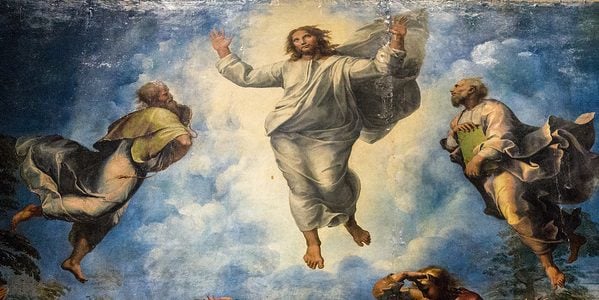
The Transfiguration of Jesus. (Photo: Flickr, Drew Maust, Rafael’s Transfiguration, Creative Commons License, some changes made)
Pastors have a frequent question when they begin to discover mimetic theory. “That’s great. But how does it preach?”
Reverend Tom Truby shows that mimetic theory is a powerful tool that enables pastors to preach the Gospel in a way that is meaningful and refreshing to the modern world. Each Wednesday, Teaching Nonviolent Atonement will highlight his sermons as an example of preaching the Gospel through mimetic theory.
In this sermon, Tom explores the Transfiguration of Jesus and provides a fresh understanding of demon possession. God’s voice told the disciples that Jesus is his Son and they should listen to his voice of love. But what about about conflicting voices in our culture? They can often possess us with a harmful messages. Using mimetic theory, Tom shows the way to distinguish between the voices so that we are overcome with joy by God’s greatness.
5th Sunday after the Epiphany – The Transfiguration of the Lord
February 7th, 2016
Luke 9:28-43
Overwhelmed by God’s Greatness
I want you to picture this scene. “As Jesus was praying, the appearance of his face changed and his clothes flashed white like lightning. Two men, Moses and Elijah, were talking with him. They were clothed with heavenly splendor and spoke about Jesus’ departure, which he would achieve in Jerusalem.”
So do you have that scene firmly in mind? Now I want to read the next sentence. “Peter and those with him were almost overcome by sleep, but they managed to stay awake and saw his glory as well as the two men with him.”
Does that strike you as a little strange? Jesus’ whole body is flashing with light, Moses and Elijah, both long dead and both heroes of the faith, suddenly appear with Jesus and they’re clothed with heavenly splendor. All three of them, Jesus, Moses and Elijah, are talking about Jesus’ up-coming and final trip to Jerusalem and what Jesus will achieve by it. Meanwhile, Peter and the two disciples can barely keep their eyes open. They’re so sleepy they almost miss the whole thing.
This could be a comedy routine for Saturday Night live. It reminds me of going to the symphony where I am primed to hear the world’s greatest music and find myself nodding off, much to my wife’s and my embarrassment. She keeps poking me hoping it will prevent me from falling out of my chair or snoring. How do I account for this?
I can think of several possibilities. My true nature as an uncultured barbarian has finally shown through my carefully-crafted veneer and I can no longer disguise it. Applied to Peter and the rest, this theory would suggest that they are fishermen, after all, and all this high-powered splendor has fallen on inert soil, so to speak. They can’t take in the majesty, complexity, simplicity and sheer breadth of what is happening before them and so just shut down.
Or maybe climbing this mountain with Jesus has utterly exhausted them and they can’t keep themselves from collapsing now that they have made it to the top. But what would be Luke’s intention in mentioning that? We go on.
“As the two men were about to leave Jesus, Peter said to him, ‘Master, it’s good that we’re here. We should construct three shrines: one for you, one for Moses, and one for Elijah.” At this point the commentator inserts, “but he didn’t know what he was saying.” So first, the disciples can’t stay awake during the Transfiguration and now Peter wants to build three shrines to the men he sees before him and then the commentator says Peter is blowing smoke.
“At that very moment, while Peter is still speaking, a cloud overshadowed them. As they entered the cloud, they were overcome with awe.” They aren’t sleepy now! Adrenalin is pouring into their bodies and everything in them wants to run. They are encountering the cloud Moses went into. They are on the mountain that shook under Elijah before God told Elijah to listen to the still small voice; the quiet voice of majesty, mercy and love.
“Then a voice from the cloud said, ‘This is my Son, my chosen one. Listen to him!’” The experience has broken through the disciple’s sleepiness defense and they are forced to feel the powerful self-disclosure of God. “This is my Son!” the voice says. Can there be any doubt about whom he is talking? “My chosen One,” the one chosen to reveal the character of God, chosen to go to Jerusalem, chosen to show us a way out of our self-destroying dilemma. “Listen to him!” the voice commands. Can it be any clearer as to whom we are to listen to?
“Even as the voice spoke, Jesus was found alone.” Moses and Elijah have vanished and the disciples are left with Jesus alone. No tabernacles, no shrines, no distractions that point back to great men and what those men did to achieve greatness, often veiling the truth. Only Jesus who eight days earlier had told his disciples for the first time that he would be going to Jerusalem where he would suffer, be rejected, killed and on the third day raised.
“The disciples were speechless and at the time told no one what they had seen.” They were like me listening to simple, complex and beautiful classical music with no way to process it. They are like Paul encountering Jesus on the road to Damascus and then taking three years to think through what it meant. Back to the text.
“The next day, when Jesus, Peter, John, and James had come down from the mountain, a large crowd met Jesus. A man from the crowd shouted, ‘Teacher, I beg you to take a look at my son, my only child. Look, a spirit seizes him and, without any warning, he screams. It shakes him and causes him to foam at the mouth. It tortures him and rarely leaves him alone. I begged your disciples to throw it out, but they couldn’t.”
What is the spirit that seizes the boy? Why aren’t the disciples able to cast it out? When Luke speaks of evil spirits or a demon that possesses, it’s his way of pointing to the influence of other people’s voices active in the possessed. We are a network of relationships; some past, some present, that live inside us, each with their own voice. These voices begin outside us as the voices of other people and groups but we forgot their origin and think they came from within. The voices are multiple, differing and often speaking at the same time. They present a cacophony of sound making it impossible for us to decide what to think or do. If the conflict is severe as it was with this boy, this spirit tortures him and rarely leaves him alone. Luke and the gospels, being pre-scientific, know something that modern science is only beginning to discover. They correctly intuit a connection between our bodies and our relationships.
“Jesus answered ‘You faithless and crooked generation, how long will I be with you and put up with you?’” Jesus addresses the whole crowd, disciples included, calling them “faithless” and “crooked”. He calls them “faithless” because they don’t have a center to their faith. If who I am is my relationship with you and all the others that form me; my family, my peers, my history, my enemies, my country and my God or whatever substitutes for that; how do I organize the conflicting voices? How do I determine which voice takes precedence? When we are “faithless” we are at the whim of whatever voice screams the loudest since we have no way to sort it out. The voice from the cloud says “This is my Son, my chosen one. Listen to him!” This gives us the missing center. When a community listens to the Lord of Life, they have a way to sort.
Why then does Jesus say this generation is crooked? Somehow that boy with the demon serves as a scapegoat. Humans have always hidden their scapegoats from themselves and that’s why Jesus describes them as “crooked”. We don’t want to see the way everything is built on someone being excluded. This is the veil Paul speaks of when he writes “a veil lies over their hearts. But whenever someone turns back to the Lord, the veil is removed.” The crucifixion removed the veil revealing the mechanism that before that had been entirely hidden. Jesus asks “how long will I be with you and put up with you?” The answer is he will be with them and have to put up with this until after the crucifixion. We continue.
“’Bring your son here.’” While he was coming, the demon threw him down and shook him violently.” A voice inside the boy, a voice that came from some source in the boy’s network of relationships, a voice that was at odds with what was best for the boy, took possession of his body, threw him down and shook him violently.*
“Jesus spoke harshly to the unclean spirit.” Voices that do not want what is best for us are deeply embedded. They don’t take kindly to being exposed and so Jesus speaks harshly. It’s a harshness to match the harshness revealed by the cross. Jesus healed the child and gave him back to his father. “Everyone was overwhelmed by God’s greatness.”
* I am not saying all mental illness has its source here. There definitely is an organic and genetic component to some mental illness. St. Luke would not have been able to distinguish which was what.
Want more on mimetic theory? Subscribe to email updates from our parent website Raven Foundation now through Valentine’s Day and receive Suzanne Ross’s e-book, The Wicked Truth About Love, a $9.99 value, as our free gift.
Previous Post

February 9, 2016
Thank You, Dr. Hawkins
Next Post
February 11, 2016 How Beyoncé Slayed the Super Bowl and Fox News
Browse Our Archives
Select a Category Atonement and Current Events Curriculum Faith and Families Interviews Jesus the Forgiving Victim Lent Montessori politics Reviews The Bible Explained Uncategorized Valentine's Day Wednesday Sermon Who is God?
Select a Month July 2020 November 2019 October 2019 September 2019 August 2019 July 2019 June 2019 May 2019 April 2019 March 2019 February 2019 January 2019 December 2018 November 2018 October 2018 September 2018 August 2018 July 2018 June 2018 May 2018 April 2018 March 2018 February 2018 January 2018 December 2017 November 2017 October 2017 September 2017 August 2017 July 2017 June 2017 May 2017 April 2017 March 2017 February 2017 January 2017 December 2016 November 2016 October 2016 September 2016 August 2016 June 2016 May 2016 April 2016 March 2016 February 2016 January 2016 December 2015 November 2015 October 2015 September 2015 August 2015 July 2015 June 2015 May 2015 April 2015 March 2015 February 2015 January 2015 December 2014 November 2014 October 2014 September 2014 August 2014 July 2014 June 2014 May 2014 April 2014 March 2014 January 2014 December 2013 September 2013 August 2013 July 2013
Follow Us!
TAKE THE
Religious Wisdom Quiz
What is the first book of the New Testament?
Select your answer to see how you score.
Mark John Luke Matthew
Related posts from Teaching Nonviolent Atonement

Forgiveness in the Time of COVID-19 by Julia...

Reflections on Indigenous Wisdom For Healing A Wounded...

How Forgiveness Can Transform Our Violence and Build...

Jesus Unmasked: God's Economy and How to Cheat...
TRENDING AT PATHEOS Progressive Christian

What Being a Modern-Day Apostle Means to Me
In my last column, I discussed the ins and outs of modern-day...

Did Ancient China Once Worship the God of...
Across human history, a common thread weaves through the origins of the...

Love Your Neighbor – Including Earth-Kin: Lev. 19,...
God’s command to love your neighbor means acting in an ethical and...

Lead a Church Study of “Jesus and Lao...
Guest writer Jack Thomas (The Irreverent Reverend) reflects on leading his church...

Pastoral Wisdom for Responding to Sermon Pushback
Getting sermon pushback on your social justice sermon? Learn practical, Proverbs-based strategies...

Principles for Understanding the Apostolic Ministry Today
Whenever people discover that my formal ministry title is "apostle," as in...
view all Progressive Christian blogs
Ad-Free & Subscriber Log-In Subscription Support
- About Us
- 2026 Calendar
- Videos
- Podcasts
- Library of World Religions
- Faith In Media Tracker
- Advertise With Us
- Write for Us
- Privacy Policy
- Terms of Service
- Do Not Sell My Data
- Contact Us
- Radiant Digital
- Manage Newsletter Subscriptions
- Unsubscribe From Notifications
- Sitemap
Copyright 2008-2026, Patheos. All rights reserved.
Subscription Support Ad-Free & Subscriber Log-In
Follow Patheos