
BuddhistCatholicContemplativeEvangelicalGeneral ChristianHinduJewishLatter-day SaintMuslimNew VisionsProgressive Christian
Beliefs
- Buddhist
- Catholic
- Contemplative
- Evangelical
- General Christian
- Hindu
- Jewish
- Latter-day Saint
- More Voices
- Muslim
- New Visions
- Pagan
- Progressive Christian
Topics
- Religion News
- Food and Religion
- Sports and Religion
- Religious Art
- Religious Music and Entertainment
- Religious Events
- History and Religion
- Style and Religion
- Politics and Religion
- Women in Religion
- Recreation Outdoors and Religion
- Business Finance and Religion
- Careers Workplace and Religion
- Education and Religion
- Family Parenting and Religion
- Health Fitness and Religion
- Home and Religion
- Relationships and Religion
- Technology and Religion
- Travel and Religion
Columnists
- Buddhist Columnists
- Business Finance and Religion Columnists
- Careers Workplace and Religion Columnists
- Catholic Columnists
- Contemplative Columnists
- Education and Religion Columnists
- Evangelists Columnists
- Family Parenting and Religion Columnists
- General Christian Columnists
- Health Fitness and Religion Columnists
- Hindu Columnists
- History and Religion Columnists
- Home and Religion Columnists
- Jewish Columnists
- More Voices Columnists
- Latter Day Columnists
- Muslim Columnists
- New Visions Columnists
- Nonreligious Columnists
- Pagan Columnists
- Politics and Religion Columnists
- Progressive Columnists
- Recreation Outdoors and Religion Columnists
- Relationships and Religion Columnists
- Religion News Columnists
- Religious Art Columnists
- Religious Events Columnists
- Religious Music and Entertainment Columnists
- Sports and Religion Columnists
- Style and Religion Columnists
- Technology and Religion Columnists
- Travel and Religion Columnists
- Women in Religion Columnists
Resource Library
- 2026 Calendar
- Library of World Religions
- The 100 Most Holy Places on Earth
- Patheos Answers
- Podcasts
- Videos
- Faith Leaders Database
- Anglican Episcopalian
- Bahai
- Baptist
- Buddhism
- Christianity
- Confucianism
- Eastern Orthodoxy
- Hinduism
- Holiness and Pentecostal
- ISKCON
- Islam
- Judaism
- Lutheran
- Methodist
- The Church of Jesus Christ of Latter-day Saints
- New Age
- Paganism
- Presbytarian and Reformed
- Protestantism
- Religion Behind the Scenes
- Roman Catholic
- Scientology
- Shia Islam
- Sikhism
- Sufism
- Sunni Islam
- Taoism
- Zen
- See all religions
Research Tools
 Ad-Free & Subscriber Log-In Subscription Support
Ad-Free & Subscriber Log-In Subscription Support
Follow Patheos 

- Trending:
- Forgiveness
- |
- Marriage
- |
- Consciousness
- |
- Death Penalty
- |
- Election
- |
- Halloween
 Teaching Nonviolent Atonement
- Home
- Progressive Christian
- Tears for Girard
Tears for Girard
Last updated on: November 10, 2015 at 1:32 pm by Suzanne Ross
Tears for Girard 2015-11-10T13:32:50-05:00 Suzanne Ross
Patheos Explore the world's faith through different perspectives on religion and spirituality! Patheos has the views of the prevalent religions and spiritualities of the world.
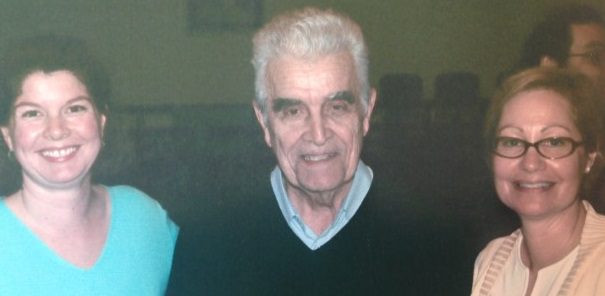
Stephanie VanSlyke, Rene Girard, and Suzanne Ross
René Girard, the great scholar of scapegoating, passed away on November 4, 2015. He was born in Avignon, France in 1923 but my thoughts keep drifting to Rome, 1907, fourteen years before Girard was born. Because that was the year that Dr. Maria Montessori made a remarkable discovery that seems, in hindsight, to anticipate Girard’s work by fifty years. What Girard discovered was the scapegoating mechanism; what the good doctor discovered was a scapegoat who quite literally could not speak for itself.
Montessori and Girard each sparked a worldwide “awakening of conscience” (her words) with broad implications for human flourishing. Yet each exhibited a modesty that belied their remarkable insights. Montessori, like Girard, called her discovery “a simple observation and accessible to all”. If you doubt their conclusions, each urged that we need only “go and observe” for ourselves.
Though Montessori preceded Girard, her work could easily be described as a practical application of his. She became keenly aware that children were not only misunderstood by adults; they were victims of adult oppression. No matter that adults defended their parenting and educational methods as demonstrations of love; the Dottoressa could see the suffering such love, blind to the particular needs of childhood, caused. Listen to her describe her aims with ears tuned by Girard:
This is the cause. Not great institutions, not someone endeavoring to spread an idea, only a faint child’s voice, echoing plaintively in every corner of the earth. (The 1913 Rome Lectures, 3)
Like Girard, her work caused adults to undergo profound personal transformations. With a growing sense of guilt, parents and teachers learned that they had been insensitive to the most fragile, dependent and trusting of God’s creatures. She begged that we look with new eyes at common childhood behavior: Why do children move slowly, delight in repetition, prize process over product, privilege meandering over efficiency, and delight in the mundane? This is not evidence of disobedience, disrespect or petulance as adults so often assume. This is evidence of children behaving normally. When we blame or punish them for failing to behave like miniature adults, we have become their oppressors without knowing it.
What Montessori saw so clearly is that children were highly susceptible to being scapegoated because they are weak and defenseless, without adequate language to express themselves. Fits of anger, tantrums, crying and outright disobedience were explained by Montessori as a nonverbal communication of pain and suffering. What happens when you begin to see childhood tantrums as a victim’s cry for help? Montessori describes the impact during her first teacher training class in 1909:
In this course, for the first time, I expounded the facts related to what is called my method. It happened that during these lectures that many of those present wept so that it seemed a sad course. So I said, “What is so melancholic in what I am telling you?” They answered, “We feel the birth of our conscience within us.” Many wept for the faults of which they were until then unaware.
What Montessori awakened in these first student-teachers was the realization that they had been scapegoating children without knowing it. What caused them to weep was that until their encounter with the Dottoressa, they honestly believed that they loved children. Their aim had been to do what was best, and yet they had done terrible harm. Many who study Girard’s work, myself included, find ourselves implicated in his description of the scapegoater. To have a scapegoat, he warned us, is to not to know you have one. What he awakened in so many people around the world is the terrible realization that we were not so good, peaceful or harmless as we believed. We have wept like those students of Montessori, as our souls were stretched and our conscience born.
As we mourn Girard’s passing, we find ourselves grateful as never before for those tears. He enabled us to see ourselves as obstacles to peace, an awareness both devastating and oddly hopeful. For it puts the key to peace within reach and in our power. Our scapegoats await our tears, often with tears of their own. Let us not make them wait too long.
Next Post

November 10, 2015 RavenCast: Episode 3 with Matthew Distefano - All Set Free
Browse Our Archives
Select a Category Atonement and Current Events Curriculum Faith and Families Interviews Jesus the Forgiving Victim Lent Montessori politics Reviews The Bible Explained Uncategorized Valentine's Day Wednesday Sermon Who is God?
Select a Month July 2020 November 2019 October 2019 September 2019 August 2019 July 2019 June 2019 May 2019 April 2019 March 2019 February 2019 January 2019 December 2018 November 2018 October 2018 September 2018 August 2018 July 2018 June 2018 May 2018 April 2018 March 2018 February 2018 January 2018 December 2017 November 2017 October 2017 September 2017 August 2017 July 2017 June 2017 May 2017 April 2017 March 2017 February 2017 January 2017 December 2016 November 2016 October 2016 September 2016 August 2016 June 2016 May 2016 April 2016 March 2016 February 2016 January 2016 December 2015 November 2015 October 2015 September 2015 August 2015 July 2015 June 2015 May 2015 April 2015 March 2015 February 2015 January 2015 December 2014 November 2014 October 2014 September 2014 August 2014 July 2014 June 2014 May 2014 April 2014 March 2014 January 2014 December 2013 September 2013 August 2013 July 2013
Follow Us!
TAKE THE
Religious Wisdom Quiz
Who said: "I have much to write to you, but I do not want to use paper and ink. Instead, I hope to visit you"?
Select your answer to see how you score.
Paul Peter James John (the elder)
Related posts from Teaching Nonviolent Atonement

How Forgiveness Can Transform Our Violence and Build...

How My Atheist Father Helps Me Appreciate The...

The Unity of All Things: How to Be...
We Are One: Unity in Christ with Victims,...
TRENDING AT PATHEOS Progressive Christian

What Being a Modern-Day Apostle Means to Me
In my last column, I discussed the ins and outs of modern-day...

Did Ancient China Once Worship the God of...
Across human history, a common thread weaves through the origins of the...

Love Your Neighbor – Including Earth-Kin: Lev. 19,...
God’s command to love your neighbor means acting in an ethical and...

Lead a Church Study of “Jesus and Lao...
Guest writer Jack Thomas (The Irreverent Reverend) reflects on leading his church...

Pastoral Wisdom for Responding to Sermon Pushback
Getting sermon pushback on your social justice sermon? Learn practical, Proverbs-based strategies...

Principles for Understanding the Apostolic Ministry Today
Whenever people discover that my formal ministry title is "apostle," as in...
view all Progressive Christian blogs
Ad-Free & Subscriber Log-In Subscription Support
- About Us
- 2026 Calendar
- Videos
- Podcasts
- Library of World Religions
- Faith In Media Tracker
- Advertise With Us
- Write for Us
- Privacy Policy
- Terms of Service
- Do Not Sell My Data
- Contact Us
- Radiant Digital
- Manage Newsletter Subscriptions
- Unsubscribe From Notifications
- Sitemap
Copyright 2008-2026, Patheos. All rights reserved.
Subscription Support Ad-Free & Subscriber Log-In
Follow Patheos