
BuddhistCatholicContemplativeEvangelicalGeneral ChristianHinduJewishLatter-day SaintMuslimNew VisionsProgressive Christian
Beliefs
- Buddhist
- Catholic
- Contemplative
- Evangelical
- General Christian
- Hindu
- Jewish
- Latter-day Saint
- More Voices
- Muslim
- New Visions
- Pagan
- Progressive Christian
Topics
- Religion News
- Food and Religion
- Sports and Religion
- Religious Art
- Religious Music and Entertainment
- Religious Events
- History and Religion
- Style and Religion
- Politics and Religion
- Women in Religion
- Recreation Outdoors and Religion
- Business Finance and Religion
- Careers Workplace and Religion
- Education and Religion
- Family Parenting and Religion
- Health Fitness and Religion
- Home and Religion
- Relationships and Religion
- Technology and Religion
- Travel and Religion
Columnists
- Buddhist Columnists
- Business Finance and Religion Columnists
- Careers Workplace and Religion Columnists
- Catholic Columnists
- Contemplative Columnists
- Education and Religion Columnists
- Evangelists Columnists
- Family Parenting and Religion Columnists
- General Christian Columnists
- Health Fitness and Religion Columnists
- Hindu Columnists
- History and Religion Columnists
- Home and Religion Columnists
- Jewish Columnists
- More Voices Columnists
- Latter Day Columnists
- Muslim Columnists
- New Visions Columnists
- Nonreligious Columnists
- Pagan Columnists
- Politics and Religion Columnists
- Progressive Columnists
- Recreation Outdoors and Religion Columnists
- Relationships and Religion Columnists
- Religion News Columnists
- Religious Art Columnists
- Religious Events Columnists
- Religious Music and Entertainment Columnists
- Sports and Religion Columnists
- Style and Religion Columnists
- Technology and Religion Columnists
- Travel and Religion Columnists
- Women in Religion Columnists
Resource Library
- 2026 Calendar
- Library of World Religions
- The 100 Most Holy Places on Earth
- Patheos Answers
- Podcasts
- Videos
- Faith Leaders Database
- Anglican Episcopalian
- Bahai
- Baptist
- Buddhism
- Christianity
- Confucianism
- Eastern Orthodoxy
- Hinduism
- Holiness and Pentecostal
- ISKCON
- Islam
- Judaism
- Lutheran
- Methodist
- The Church of Jesus Christ of Latter-day Saints
- New Age
- Paganism
- Presbytarian and Reformed
- Protestantism
- Religion Behind the Scenes
- Roman Catholic
- Scientology
- Shia Islam
- Sikhism
- Sufism
- Sunni Islam
- Taoism
- Zen
- See all religions
Research Tools
 Ad-Free & Subscriber Log-In Subscription Support
Ad-Free & Subscriber Log-In Subscription Support
Follow Patheos 

- Trending:
- Forgiveness
- |
- Marriage
- |
- Consciousness
- |
- Death Penalty
- |
- Election
- |
- Halloween
 Teaching Nonviolent Atonement
- Home
- Progressive Christian
- Special Wednesday Sermon: In Memory of René Girard
Special Wednesday Sermon: In Memory of René Girard
Last updated on: November 11, 2015 at 12:17 pm by Tom Truby
Special Wednesday Sermon: In Memory of René Girard 2015-11-11T12:17:32-05:00 Tom Truby
Patheos Explore the world's faith through different perspectives on religion and spirituality! Patheos has the views of the prevalent religions and spiritualities of the world.
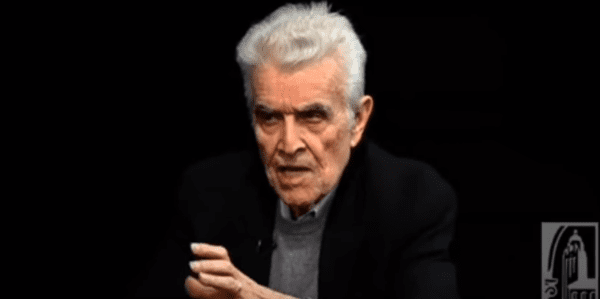
Photo: Screenshot of Rene Girard from YouTube.
Pastors have a frequent question when they begin to discover mimetic theory. “That’s great. But how does it preach?”
Reverend Tom Truby show that mimetic theory is a powerful tool that enables pastors to preach the Gospel in a way that is meaningful and refreshing to the modern world. Each Wednesday, Teaching Nonviolent Atonement will highlight Tom’s sermons as an example of preaching the Gospel through mimetic theory.
In this sermon, Tom reflects upon the life and death of René Girard. He powerfully connects Girard’s theory about sacrifice to the economic exploitation of the homeless widow found in the Gospel reading and how the story of the homeless widow relates to the sacrificial economic exploitation of our modern world.
Year B. Pentecost 24
November 8th, 2015
Thomas L. Truby
Mark 12:38-44
In Memory of René Girard
On Wednesday of this week, at 2:30 in the morning, René Girard died peacefully at his home in Stanford, California. My Facebook has been filled with remembrances, eulogies, and comments on his life from around the world. I posted a picture of him on my page and wrote that he has had a huge impact on my life and I am so grateful for him.
This morning I want to read some of those statements to you. I justify going in this direction because René was just the opposite of the legal experts Jesus warns us against in Mark 12 who loved to be the center of attention and yet cheated widows out of their homes.
Girard’s thinking has made us more aware of the poor widow sacrificed on the altar of exploitive religion and culture and of how she and all those at the bottom are actually the hidden and unjust foundations upon which everything else is built. In this sense the homeless widow and the majority she represents did put in more, with her two coppers worth less than a penny, than everyone combined who put money in the treasury that day. Her contributions to the economy keeps it going, sustains those who proudly parade and remains largely hidden.
Think of all the people in the world who make our clothes, raise our food, build our computers, and prepare our meals while being paid a less-than-living wage. The elite scoff at them and yet they sustain the whole system that supports those at the top. Those on the top develop clever schemes that deprive the vulnerable of their houses and hide it all with long prayers. This is what this passage is really about. It’s not about the “hopeless widow” having more faith and therefore being better than those who could give out of their abundance and if you want to be good you have to do this too—the usual stewardship season interpretation.
Jesus saw how culture works as he sat opposite the offering box at the temple. To expose the truth of this Jesus became the vulnerable widow lifted up on the cross and there he allowed our species to do what we always do. And then, while we were doing it, he forgave us. Jesus observed this in a nutshell in the temple and René Girard explains how it works.
Adam Ericksen wrote:
Many scholars have claimed that René Girard’s mimetic theory is one of the most important insights of the 20th century. But those of us who have been highly influenced by René know better. For us, it is not an overstatement to state that René’s explanation of mimetic theory is the most important discovery of human nature in the last 2,000 years. That is, since the Gospels.
This morning brought the news that René has passed away at age 91. “Girardians,” as we are called, have been on social media sharing our sorrow at his passing, but also our profound sense of gratitude for this giant among human beings. We stand on his shoulders. And our vision is all the clearer for it.
As I reflected upon the news, I was struck by the fact that René taught us so much about death. Specifically, about the scapegoat mechanism… René confronted us with the truth about being human. We all have a propensity to manage our conflicts by blaming someone else for them. We find unity against a common enemy. In good sacrificial formula, all of our conflicts and sins against one another are washed away as we unite in expelling or sacrificing our scapegoat. Temporary reconciliation and peace descends upon the community, but it is only temporary. For the expulsion or murder of our scapegoat never actually solves our problems. Our conflicts re-emerge and the scapegoating mechanism continues.
But if René taught us about death, he also taught us about life. The solution to our natural inclination toward scapegoating is found in the Judeo-Christian tradition, specifically in the Gospels’ portrayal of Jesus’ death. “Christ agrees to die,” wrote René in his book Things Hidden Since the Foundation of the World, “so that [hu]mankind will live.”
Many progressive Christians who do not know René’s work will bristle at that statement. Indeed, without reading René’s books, it could sound like a form of penal substitutionary atonement theory that claims Jesus allows humanity to live by saving us from the violent wrath of God.
But nothing could be further from the truth. The truth that René revealed throughout his career is that wrath doesn’t belong to God. It belongs solely to humans. In anthropological terms, what was revealed by the death of Jesus was the human scapegoat mechanism. Once you read René’s works, you realize how obvious it is that the violence at the cross had nothing to do with God, but everything to do with the human propensity to scapegoat.
Still, at this point, we should warn ourselves not to scapegoat penal substitutionary atonement theory. After all, if René taught us anything it’s that humans have been projecting our own violence onto God since the foundation of the world. We justify our violence and hatred against our scapegoats in the name of God or peace or justice or whatever we deem to be important to our well-being.
René taught us that to truly live is to stop scapegoating our enemies, and to stop justifying it in the name of God. Once at a conference, René was asked what would happen if mimetic theory became wildly successful. He answered, “There would be no more scapegoating.”
To end scapegoating and to truly live we need to follow Jesus by turning away from violence and turning toward our neighbors, including those we call our enemies, in the spirit of love and nonviolence.
René not only taught us that truth, he lived into it. I met him once at a conference for young Girardian scholars. I was struck by the fact that René wasn’t interested in teaching us, or making sure we had his theory “right.” What he wanted more than anything was to talk with us. He wanted to learn about our lives and what interested us. He had a special humility about him – instead of taking glory for himself, he gave glory to others. For example, I remember sitting across the table from him. He smiled as he looked me in the eyes and said, “I’ve watched your Mimetic Theory 101 videos. They’re good.” That’s the way he was. He affirmed all of us and encouraged us to follow the truth, no matter where it led.
René always gave the last word to the Gospels. It’s where he found the truth about life and death. It’s only fitting that I end with this quote that sums up René’s theory about God, violence, and love,
The following is the basic text, in my opinion, that shows us a God who is alien to all violence and who wishes in consequence to see humanity abandon violence:
“You have heard that it was said, ‘You shall love your neighbor and hate your enemy.’ But I say to you, Love your enemies and pray for those who persecute you, so that you may be children of your Father who is in heaven; for he makes his sun rise on the evil and on the good, and sends rain on the just and the unjust.” (Matthew 5:43-45, Things Hidden, 183)
May our brother René Girard rest in peace, and rise in the glorious love of God.
Abbot Andrew Marr wrote: In Memoriam: René Girard 1923-2014
It has been a couple of bittersweet days of memories since getting the news of René Girard’s death. I have the feeling that many of us are cybernetically sitting around the fire sharing memories. Here are some of mine.
For many years, pretty much ever since I became a Benedictine monk in 1972, I fretted about the close proximity of religion and violence. Given the teachings of Buddha, Jesus, Lao Tzu and others, it didn’t make sense. Thomas Merton’s polemics against violence written from his hermitage at Gethsemane Abbey in Kentucky inspired me and assured me I was fretting about something worth fretting about.
This concern eventually led me to René Girard. It took a few years and the help of others to realize that Girard provides the most cogent hermeneutic for understanding scripture as the unveiling of a loving, nonviolent God. More important, his anthropological insights impressed me with their explanatory power as to why religion had been connected with violence from the start and why it still is…. A couple of times, I heard Girard tell… deconstructionist type thinkers that the solid reality under the deconstructive flux is the reality of the victim. (The widow with the two coppers—that is what’s at the bottom of hierarchy and culture. There is something there and it’s not all relative. The victim is the solid reality at the core. That’s why Jesus says she has given more than all the rest. T.T.)
Inspired by Girard and my Benedictine tradition, I wrote a book called Tools for Peace: The Spiritual Craft of St. Benedict and René Girard. I sent an advanced draft in manuscript to him for comments. When I received a letter a month later, I thought it was an amazingly prompt response. Yet René apologized for the delay, explaining that he had just gotten home from Avignon and he read the manuscript first thing. His comments were generous and helpful.
I came to see, not surprisingly, that there was nothing unique in the way he treated me; it’s the way I’ve seen him treat everybody. I have seen him encourage everybody who works with his ideas whether or not he is personally sympathetic to their direction. I get the feeling that he knew his theory was much greater than him and it wasn’t anything he “owned” by a long shot. Along the way, I realized that Girard does not have followers; he has colleagues. That’s how he treated people. And not only colleagues, but friends.
Dear Friends of Imitatio,
…Today we mourn the passing of a thinker who combined an utter lack of self-importance with the boldest intellectual risk-taking. And we remain as committed as ever to the ongoing development of his mimetic theory, which is as ambitious in scope and as unsparing in its critique of our illusions as its inventor was modest, witty, and kind…
Rosemary Hamerton-Kelly wrote: (Wife of Robert Hamerton-Kelly and close friends with Rene and Martha.)
It was a great privilege to have known Rene, to have sipped Lap sang tea with him and Martha, and listened to his conversations with Bob. He changed the way we all think about life: what a legacy! And he was a wonderful human being, full of grace.
Rosemary
Laura and I met Rene and Martha Girard at a seminar put together my Michael Harden entitled “Compassionate Eschatology” at San Francisco Theological Seminary in 2008. Laura, bless her heart, became our group photographer. We experienced Rene as kind, gentle and patient with us as we took turns having our picture taken with him. We could feel the spirit of Christ in him. I am so grateful that happened to us. Rene’s thinking has changed my life and given me a way of understanding Jesus and the way the world works. Amen.
Previous Post

November 10, 2015
RavenCast: Episode 3 with Matthew Distefano - All Set Free
Next Post
November 12, 2015 Girardian Wisdom For Turning Veteran's Day Back Into Armistice Day
Browse Our Archives
Select a Category Atonement and Current Events Curriculum Faith and Families Interviews Jesus the Forgiving Victim Lent Montessori politics Reviews The Bible Explained Uncategorized Valentine's Day Wednesday Sermon Who is God?
Select a Month July 2020 November 2019 October 2019 September 2019 August 2019 July 2019 June 2019 May 2019 April 2019 March 2019 February 2019 January 2019 December 2018 November 2018 October 2018 September 2018 August 2018 July 2018 June 2018 May 2018 April 2018 March 2018 February 2018 January 2018 December 2017 November 2017 October 2017 September 2017 August 2017 July 2017 June 2017 May 2017 April 2017 March 2017 February 2017 January 2017 December 2016 November 2016 October 2016 September 2016 August 2016 June 2016 May 2016 April 2016 March 2016 February 2016 January 2016 December 2015 November 2015 October 2015 September 2015 August 2015 July 2015 June 2015 May 2015 April 2015 March 2015 February 2015 January 2015 December 2014 November 2014 October 2014 September 2014 August 2014 July 2014 June 2014 May 2014 April 2014 March 2014 January 2014 December 2013 September 2013 August 2013 July 2013
Follow Us!
TAKE THE
Religious Wisdom Quiz
Who said: "Little children, keep yourselves from idols"?
Select your answer to see how you score.
Paul John Peter James
Related posts from Teaching Nonviolent Atonement

Toxic Christianity: 3 Things We Can Do That...

The Secret of Life: An Interview with Audrey...

Forgiveness in the Time of COVID-19 by Julia...

TRENDING AT PATHEOS Progressive Christian

Why Christians Have a Sacred Duty to Vote:...
The Bible offers strong support for the sacred duty to vote. Here...

What Being a Modern-Day Apostle Means to Me
In my last column, I discussed the ins and outs of modern-day...

Did Ancient China Once Worship the God of...
Across human history, a common thread weaves through the origins of the...

Love Your Neighbor – Including Earth-Kin: Lev. 19,...
God’s command to love your neighbor means acting in an ethical and...

Lead a Church Study of “Jesus and Lao...
Guest writer Jack Thomas (The Irreverent Reverend) reflects on leading his church...

Principles for Understanding the Apostolic Ministry Today
Whenever people discover that my formal ministry title is "apostle," as in...
view all Progressive Christian blogs
Ad-Free & Subscriber Log-In Subscription Support
- About Us
- 2026 Calendar
- Videos
- Podcasts
- Library of World Religions
- Faith In Media Tracker
- Advertise With Us
- Write for Us
- Privacy Policy
- Terms of Service
- Do Not Sell My Data
- Contact Us
- Radiant Digital
- Manage Newsletter Subscriptions
- Unsubscribe From Notifications
- Sitemap
Copyright 2008-2026, Patheos. All rights reserved.
Subscription Support Ad-Free & Subscriber Log-In
Follow Patheos