
BuddhistCatholicContemplativeEvangelicalGeneral ChristianHinduJewishLatter-day SaintMuslimNew VisionsProgressive Christian
Beliefs
- Buddhist
- Catholic
- Contemplative
- Evangelical
- General Christian
- Hindu
- Jewish
- Latter-day Saint
- More Voices
- Muslim
- New Visions
- Pagan
- Progressive Christian
Topics
- Religion News
- Food and Religion
- Sports and Religion
- Religious Art
- Religious Music and Entertainment
- Religious Events
- History and Religion
- Style and Religion
- Politics and Religion
- Women in Religion
- Recreation Outdoors and Religion
- Business Finance and Religion
- Careers Workplace and Religion
- Education and Religion
- Family Parenting and Religion
- Health Fitness and Religion
- Home and Religion
- Relationships and Religion
- Technology and Religion
- Travel and Religion
Columnists
- Buddhist Columnists
- Business Finance and Religion Columnists
- Careers Workplace and Religion Columnists
- Catholic Columnists
- Contemplative Columnists
- Education and Religion Columnists
- Evangelists Columnists
- Family Parenting and Religion Columnists
- General Christian Columnists
- Health Fitness and Religion Columnists
- Hindu Columnists
- History and Religion Columnists
- Home and Religion Columnists
- Jewish Columnists
- More Voices Columnists
- Latter Day Columnists
- Muslim Columnists
- New Visions Columnists
- Nonreligious Columnists
- Pagan Columnists
- Politics and Religion Columnists
- Progressive Columnists
- Recreation Outdoors and Religion Columnists
- Relationships and Religion Columnists
- Religion News Columnists
- Religious Art Columnists
- Religious Events Columnists
- Religious Music and Entertainment Columnists
- Sports and Religion Columnists
- Style and Religion Columnists
- Technology and Religion Columnists
- Travel and Religion Columnists
- Women in Religion Columnists
Resource Library
- 2026 Calendar
- Library of World Religions
- The 100 Most Holy Places on Earth
- Patheos Answers
- Podcasts
- Videos
- Faith Leaders Database
- Anglican Episcopalian
- Bahai
- Baptist
- Buddhism
- Christianity
- Confucianism
- Eastern Orthodoxy
- Hinduism
- Holiness and Pentecostal
- ISKCON
- Islam
- Judaism
- Lutheran
- Methodist
- The Church of Jesus Christ of Latter-day Saints
- New Age
- Paganism
- Presbytarian and Reformed
- Protestantism
- Religion Behind the Scenes
- Roman Catholic
- Scientology
- Shia Islam
- Sikhism
- Sufism
- Sunni Islam
- Taoism
- Zen
- See all religions
Research Tools
 Ad-Free & Subscriber Log-In Subscription Support
Ad-Free & Subscriber Log-In Subscription Support
Follow Patheos 

- Trending:
- Forgiveness
- |
- Marriage
- |
- Consciousness
- |
- Death Penalty
- |
- Election
- |
- Halloween
 Teaching Nonviolent Atonement
- Home
- Progressive Christian
- To the “Penal Substitutionary” God:
To the “Penal Substitutionary” God:
Last updated on: September 28, 2015 at 7:00 pm by Adam Ericksen
To the “Penal Substitutionary” God: 2015-09-28T19:00:37-05:00 Adam Ericksen
Patheos Explore the world's faith through different perspectives on religion and spirituality! Patheos has the views of the prevalent religions and spiritualities of the world.
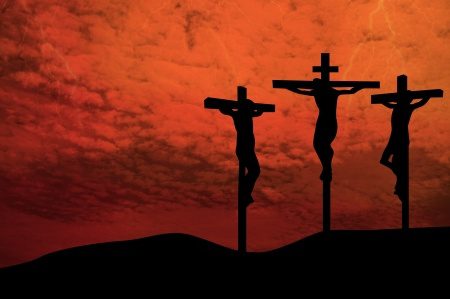
Copyright: gracel21 / 123RF Stock Photo
This is a guest post by Matthew Distefano. It is part 2 of a series. Part 1, Dear Dispensationalist God, can be read at Unfundamentalist Christians. Matthew’s forthcoming book “All Set Free” will be published by Wipf and Stock. Read more of Matthew’s excellent work at his website All Set Free and at the Raven Foundation.
To the “Penal Substitutionary” God:
As you know, I am not one to mince words and I don’t plan on starting now. So I will begin this letter by being really frank. First of all, if you really did send Jesus to us because you needed his blood to be spilled, then you, sir, are a monster. Any mere human who did this would be considered one. And if we are made in your image, and we recognize that this sort of behavior would get one institutionalized, shouldn’t we demand the same for you? A parent who beats the hell out of one of their children to show the others how much they are loved needs intense psychiatric help. Child abusers have no business being called “divine.”[1]
Now, before you become too tempted to smite me for that introduction, please read on because I am going to offer some potentially helpful thoughts on where I believe this whole thing went wrong—thoughts regarding the practice that made you feel that you needed your Son to be so brutally murdered. I know, I know—we sinned and “fell” and should be held accountable for our actions. I get that! I write plenty of articles and essays on how disgusting humanity can behave at times. In fact, I charge humanity 100 percent guilty for Jesus’ murder so if it were up to me, you would be off the hook entirely. But, because many Christians argue tooth and nail for your complicity in the crime, I feel I must respond. I don’t care if you are a god—I will critique your violence just like I do mine and others’. All that being said: let me get to my first main point, which is that I take major issue with your desire for humanity to engage in sacrifice. I believe not only is it the foundational problem with seemingly all the gods that people believe in, but tragically, that it eventually leads to the death of your own precious child.
It’s about time more people question this. It is not, after all, the middle ages any longer.[2]
If we are going to understand the notion of sacrifice, I think we should start with the book you entitled “Genesis,” since the first mention of sacrifice comes from Genesis 4:3. But, what is interesting is that your desire for sacrifice is presupposed entirely. Verse 3 reads: “In the course of time, Cain brought to the Lord an offering of the fruit of the ground.” Did you give Adam and Eve or Cain and Abel secret instructions that you would only later tell Moses to write down in the Bible? Or did they just assume you wanted it? Well, either way, because of this, Cain killed Abel. You cannot deny that the competition for your favor directly led to bloodshed. Perhaps setting yourself apart[3] from the other gods vis-à-vis sacrifice would have helped keep Abel alive. And later on, you know who . . .
Now, I would like to focus on your book Leviticus where you really lay out how the sacrificial system is going to run. Right off the bat, you make it clear that you want the best of what we have to be slaughtered for your glory.[4] Somehow, someway, killing one of the animals from the flock will atone for sin.[5] How did that work, really? And why in the world did you command for the priest to dash the blood against the tent?[6]
Honestly, that sounds disgusting!
But, perhaps, you do not find it disgusting but rather, “pleasing to the nostrils.”[7] Perhaps, even, the sacrificial aspects of Levitical Law are to be read as a clue for how to eventually think about the Atonement. It seems like an easy place where people could look to justify your desire for Jesus to die. I can see the similarities, really. From the start and like I already said, you clearly wanted the finest of sacrifices—unblemished males in fact.
Before I focus my attention on Jesus—don’t worry, I will get to him—I would like to mention one thing I don’t really understand. Namely, that if you wrote the Bible, why did you later tell the prophet Jeremiah that when you took his forefathers (Moses) out of Egypt that you did not speak to them vis-à-vis burnt offerings and sacrifices? Moses was pretty clear about your desire for sacrifice—even the NRSV translators entitle Leviticus 1 “The Burnt Offering.” So, which is it because it can’t be both. That would be contradictory.
Okay—now changing gears a bit—I will discuss the “perfect sacrifice” that finally satisfied your wrath . . . well, sort of. Most will experience it in the afterlife now won’t they? The specific passage I want to ask you about is from Hebrews 10. Verses 5 – 8 read as a conversation between you and Jesus. It is as if, prior to entering the world, Christ says to you:
“Sacrifices and offerings you have not desired, but a body you have prepared for me; in burnt offerings and sin offerings you have taken no please [ . . . ] see, God, I have come to do your will, O God.”
So, if Jesus did only did what you willed, was that will for him to be tortured, humiliated, and eventually murdered? Which part was your will, specifically? And speaking of your will, what is even more perplexing is that verse 8 goes on to say that the sacrifices and offerings that you did not desire were offered even though they are required per the Law. Isn’t this the very same Law you dictated to Moses? Wasn’t the Law your will? So, again, which is it? Did you desire sacrifice and burnt offerings, or did you not, as you told the writer of Hebrews—quoting what you said in Psalm 40:6—to suggest?
If the proper hermeneutic is to “plainly” read all these books you wrote, then I am going to need some answers because I cannot square this for the life of me.
The way I see it—and I’ve been saying this for a while now—is that we sacrificed Jesus because we are the pissed off ones. It seems to me that you offered Jesus to us—that he was given over to us[8]—to propitiate our wrath.[9] Over and over, in Acts of the Apostles, it is written that we killed Jesus (2:23, 3:14—15, 4:10) but you yourself raised him up (2:24, 3:15, 4:10). But I thought you wanted him to die? Did you collude with humanity or something? Again, things seem about as clear as mud. You remind me of the Dispensationalist God—the god of creation and destruction—the Western version of Shiva. My friend Michael Hardin introduced me to the phrase, “The Janus-faced god” and it has been quite an apt description of you and most of the elohiym you associate with.
Honestly, all in all, you should be thanking me. I’ve been spending a ton of energy in an attempt to exonerate you from the most infamous murder in history (albeit by saying the type of god that you are does not exist). Furthermore, I think I offered a couple things to chew on with regards to your demand for sacrifice.
- It leads to rivalry and conflict (Cain and Abel). It also leads to scapegoats and lots of them!
- If you really did write the Bible, then you seem to have questioned yourself about it over the years. It is as if you had second thoughts (you should have trusted those . . . really). Perhaps, since you do seem rather transmutable[10], you could change your mind (metánoia*[11]***) about all this sacrifice stuff. It would go a long way in helping you start to look like Jesus.
I would like to conclude by asking that you remove my name from that of the “elect”—as if I had a choice after this letter! I know that I would have stood with the mob and yelled “crucify him[12],” so I am not innocent. In fact, none of us are. However, knowing what I know now, I cannot find it within me to worship you if you are no better than us. You are a tyrant just like every tyrant that ever existed. And you are petty, not set apart from either humanity or the countless gods we’ve created.
I bid you adieu,
Matthew J. Distefano
[1] Feminist theologians label the penal substitutionary atonement theory as “divine child abuse.”
[2] The Penal Substitution Atonement Theory was fully developed by John Calvin, who lived in the 16th century.
[3] The Greek word for holy is hágios, and translates to “set apart.”
[4] Leviticus 1:3.
[5] Leviticus 1:4.
[6] Leviticus 1:5.
[7] Numbers 28:27.
[8] Acts 2:23
[9] Romans 3:25. I touch on this passage in All Set Free, 54 – 55.
[10] Transmutable: to change from one nature to another.
[11] Metánoia: “repent.”
[12] John 19:15.
penal substitutionary atonement
Previous Post

September 24, 2015
An Eid Prayer For Pilgrims In A Violent World
Next Post
September 29, 2015 Doing Good, Becoming Evil: The Pope, Elijah and Moses
Browse Our Archives
Select a Category Atonement and Current Events Curriculum Faith and Families Interviews Jesus the Forgiving Victim Lent Montessori politics Reviews The Bible Explained Uncategorized Valentine's Day Wednesday Sermon Who is God?
Select a Month July 2020 November 2019 October 2019 September 2019 August 2019 July 2019 June 2019 May 2019 April 2019 March 2019 February 2019 January 2019 December 2018 November 2018 October 2018 September 2018 August 2018 July 2018 June 2018 May 2018 April 2018 March 2018 February 2018 January 2018 December 2017 November 2017 October 2017 September 2017 August 2017 July 2017 June 2017 May 2017 April 2017 March 2017 February 2017 January 2017 December 2016 November 2016 October 2016 September 2016 August 2016 June 2016 May 2016 April 2016 March 2016 February 2016 January 2016 December 2015 November 2015 October 2015 September 2015 August 2015 July 2015 June 2015 May 2015 April 2015 March 2015 February 2015 January 2015 December 2014 November 2014 October 2014 September 2014 August 2014 July 2014 June 2014 May 2014 April 2014 March 2014 January 2014 December 2013 September 2013 August 2013 July 2013
Follow Us!
TAKE THE
Religious Wisdom Quiz
What is the name of the tree whose fruit Adam and Eve were forbidden to eat?
Select your answer to see how you score.
Tree of Life Olive Tree Tree of the Knowledge of Good and Evil Fig Tree
Related posts from Teaching Nonviolent Atonement

Forgiveness in the Time of COVID-19 by Julia...

Reflections on Indigenous Wisdom For Healing A Wounded...

How Forgiveness Can Transform Our Violence and Build...

Jesus Unmasked: God's Economy and How to Cheat...
TRENDING AT PATHEOS Progressive Christian

What Being a Modern-Day Apostle Means to Me
In my last column, I discussed the ins and outs of modern-day...

Did Ancient China Once Worship the God of...
Across human history, a common thread weaves through the origins of the...

Love Your Neighbor – Including Earth-Kin: Lev. 19,...
God’s command to love your neighbor means acting in an ethical and...

Lead a Church Study of “Jesus and Lao...
Guest writer Jack Thomas (The Irreverent Reverend) reflects on leading his church...

Pastoral Wisdom for Responding to Sermon Pushback
Getting sermon pushback on your social justice sermon? Learn practical, Proverbs-based strategies...

Principles for Understanding the Apostolic Ministry Today
Whenever people discover that my formal ministry title is "apostle," as in...
view all Progressive Christian blogs
Ad-Free & Subscriber Log-In Subscription Support
- About Us
- 2026 Calendar
- Videos
- Podcasts
- Library of World Religions
- Faith In Media Tracker
- Advertise With Us
- Write for Us
- Privacy Policy
- Terms of Service
- Do Not Sell My Data
- Contact Us
- Radiant Digital
- Manage Newsletter Subscriptions
- Unsubscribe From Notifications
- Sitemap
Copyright 2008-2026, Patheos. All rights reserved.
Subscription Support Ad-Free & Subscriber Log-In
Follow Patheos