
BuddhistCatholicContemplativeEvangelicalGeneral ChristianHinduJewishLatter-day SaintMuslimNew VisionsProgressive Christian
Beliefs
- Buddhist
- Catholic
- Contemplative
- Evangelical
- General Christian
- Hindu
- Jewish
- Latter-day Saint
- More Voices
- Muslim
- New Visions
- Pagan
- Progressive Christian
Topics
- Religion News
- Food and Religion
- Sports and Religion
- Religious Art
- Religious Music and Entertainment
- Religious Events
- History and Religion
- Style and Religion
- Politics and Religion
- Women in Religion
- Recreation Outdoors and Religion
- Business Finance and Religion
- Careers Workplace and Religion
- Education and Religion
- Family Parenting and Religion
- Health Fitness and Religion
- Home and Religion
- Relationships and Religion
- Technology and Religion
- Travel and Religion
Columnists
- Buddhist Columnists
- Business Finance and Religion Columnists
- Careers Workplace and Religion Columnists
- Catholic Columnists
- Contemplative Columnists
- Education and Religion Columnists
- Evangelists Columnists
- Family Parenting and Religion Columnists
- General Christian Columnists
- Health Fitness and Religion Columnists
- Hindu Columnists
- History and Religion Columnists
- Home and Religion Columnists
- Jewish Columnists
- More Voices Columnists
- Latter Day Columnists
- Muslim Columnists
- New Visions Columnists
- Nonreligious Columnists
- Pagan Columnists
- Politics and Religion Columnists
- Progressive Columnists
- Recreation Outdoors and Religion Columnists
- Relationships and Religion Columnists
- Religion News Columnists
- Religious Art Columnists
- Religious Events Columnists
- Religious Music and Entertainment Columnists
- Sports and Religion Columnists
- Style and Religion Columnists
- Technology and Religion Columnists
- Travel and Religion Columnists
- Women in Religion Columnists
Resource Library
- 2026 Calendar
- Library of World Religions
- The 100 Most Holy Places on Earth
- Patheos Answers
- Podcasts
- Videos
- Faith Leaders Database
- Anglican Episcopalian
- Bahai
- Baptist
- Buddhism
- Christianity
- Confucianism
- Eastern Orthodoxy
- Hinduism
- Holiness and Pentecostal
- ISKCON
- Islam
- Judaism
- Lutheran
- Methodist
- The Church of Jesus Christ of Latter-day Saints
- New Age
- Paganism
- Presbytarian and Reformed
- Protestantism
- Religion Behind the Scenes
- Roman Catholic
- Scientology
- Shia Islam
- Sikhism
- Sufism
- Sunni Islam
- Taoism
- Zen
- See all religions
Research Tools
 Ad-Free & Subscriber Log-In Subscription Support
Ad-Free & Subscriber Log-In Subscription Support
Follow Patheos 

- Trending:
- Forgiveness
- |
- Marriage
- |
- Consciousness
- |
- Death Penalty
- |
- Election
- |
- Halloween
 Teaching Nonviolent Atonement
- Home
- Progressive Christian
- Wednesday Sermon: Four Questions
Wednesday Sermon: Four Questions
Last updated on: August 26, 2015 at 10:15 am by Tom Truby
Wednesday Sermon: Four Questions 2015-08-26T10:15:31-05:00 Tom Truby
Patheos Explore the world's faith through different perspectives on religion and spirituality! Patheos has the views of the prevalent religions and spiritualities of the world.
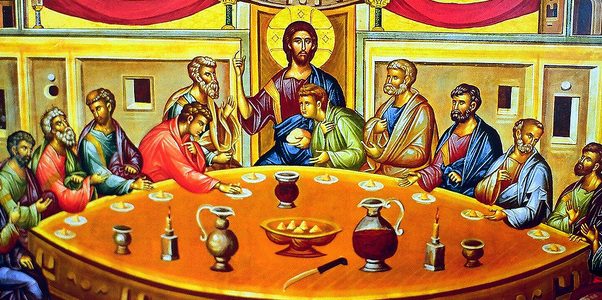
Photo: Flickr, Steve Snodgrass, Last Supper, Creative Commons License, some changes made
Pastors have a frequent question when they begin to discover mimetic theory. “That’s great. But how does it preach?”
Reverends Tom and Laura Truby shows that mimetic theory is a powerful tool that enables pastors to preach the Gospel in a way that is meaningful and refreshing to the modern world. Each Wednesday, Teaching Nonviolent Atonement will highlight Tom and Laura’s sermons as an example of preaching the Gospel through mimetic theory.
Year B, Pentecost 13 (Sunday between August 21 and 27 inclusive)
August 23rd, 2015
By Thomas L. and Laura C. Truby
John 6:56-69 (Common English Bible, copyright 2011)
Four Questions
Four weeks ago we read in the Gospel that Jesus took the bread, gave thanks and distributed it to a large crowd. The next Sunday we read that Jesus said “I am the bread of life”. The Sunday after that he said “I am the living bread….the bread that I will give for the life of the world is my flesh.” Last week he said “I assure you, unless you eat the flesh of the Human One and drink his blood, you have no life in you.” Why are we going on and on about this? What more is there to say about bread and Eucharist? John’s message seems so simple it’s hardly worth talking about.
So today we begin with “Whoever eats my flesh and drinks my blood remains in me and I in them.” Boring! Why are we going over this again? We know about communion and how important it is.
But what if I share something so strange you will be tempted to turn away by the time we finish today? What if Jesus is using the image of eating his flesh and drinking his blood to shock us on purpose and that when we hook it to the Eucharist too quickly*;* we tame it, domesticate it, and pull its teeth to where it no longer has the bite it had for the disciples. Could this passage be offensive drama, a necessary jolt to half-asleep souls?
In the original Greek the word “eat” could better be translated as “gnaw” like a dog gnaws on a bone. Jesus is saying “whoever gnaws on my flesh” remains in me. To gnaw on something is to have to work it, like chewing on a rib. It takes time and effort and cannot be done casually or quickly. Isn’t that the way it is with Jesus? In gnawing on him we take him seriously thinking about what he said and why he might have said it.
And remember in Jewish law Jews were forbidden to drink blood. How do you think his disciples feel when Jesus tells them that if they want to be connected to him they have to drink his blood? Do you think they are offended? Jesus’ teaching brings his audience to an encounter and a crisis and it brings us to the first of four questions.
Our text reads “Many of his disciples who heard this said, ‘This message is harsh. Who can hear it?” “Who can hear it?” our first question. The disciples are offended and think other people will be too. How can they follow someone who says things like this? “Gnaw on my flesh and drink my blood!” Are you kidding! Its offensive and the disciples don’t want to listen. If we imagine the scene, we find ourselves a long way from a gentle Eucharist in the sanctuary of a church.
Jesus asks “Does this offend you?” This is the second of our four questions. “Does this offend you?” I imagine the disciples thinking, “Yes it does! It offends me! I am very offended. I don’t like the idea of gnawing on anybody’s flesh or drinking anybody’s blood, particularly yours. If that’s what it takes to be connected to you I am not sure I want to. Jesus goes on; if this offends you “What if you were to see the Human One going up where he had been before.” Jesus seems to be saying if they are offended now they would be even more offended if they knew who Jesus is and where he came from. He doesn’t back down for he knows they must face into the offense. It is the message! Can they believe in someone who says something both offensive but true or will they stumble and turn away in revulsion. This is the alternative they face. Believe in him or be offended by him. That’s the choice the gospels always present us.
Jesus then said, “The Spirit is the one who gives life and the flesh doesn’t help at all.” The Spirit is the carrier of forgiveness and mercy. Forgiveness and mercy give life. Forgiveness and mercy is the spirit of Jesus. The flesh doesn’t help because it subsists on consuming human flesh and drinking human blood. This is not an empty metaphor. It’s the way the world works. We talk about our dog-eat-dog world and this is what we mean. We talk about how we divide the world between the haves and have nots and keep it divided through violence and rules hidden in systems of power that give some the advantage and make it nearly impossible for others. Examples that we are currently talking about are racism and the shrinking of the middle class. This is what the writer of Ephesians meant when he tells us, “We aren’t fighting against human enemies but against rulers, authorities, forces of cosmic darkness, and spiritual powers of evil in the heavens.”
“The words I have spoken to you are spirit and life” he says. They come from another place; a place John identifies as heaven; that restful place outside the force-field of human striving and ambition that we generate in our rivalry with each other. By contrast, Jesus’ words come from a place of self-sacrifice not human sacrifice. We tend to sacrifice the other and not ourselves. We gnaw on each other’s flesh and drink each other’s blood in our wars and economic systems designed to maintain the current distribution of wealth. Jesus sacrifices himself saying gnaw on my flesh and drink my blood instead of your neighbors. I give you my own flesh for you to gnaw on. Does that offend you?
Jesus knows some of them are offended and don’t believe. They don’t believe what he says is life-giving. They don’t believe that he and his father are one. They don’t believe he is the bread sent from heaven. The prologue to John says “he came to his own and his own people did not accept him.”
Knowing this he continues, “For this reason I said to you that none can come to me unless the Father enables them to do so.” He implies that he and God are working together and he makes this clear so that they will have to decide whether they believe him or are offended by him. They can’t have it both ways. He has deliberately presented them with a choice between belief and offense. Jesus is a stumbling block and the gospels know this. They tell us about Jesus hoping we won’t stumble.
The text says, “At this, many of his disciples turned away and no longer accompanied him.” This was a turning point for many and they stumbled.
“Jesus asked the Twelve, ‘Do you also want to leave?” We have come to the third question and Jesus asks it. “Do you also want to leave?” Are you also going to be offended by me or are you going to stay and believe in me? Am I a stumbling block to you or the Human One come down from heaven, the bread of life?
In response Simon Peter asks the fourth question and it is full of pathos. ‘Lord, where would we go? You have the words of eternal life.” There is no other place to go. We may not like what you are showing us but we know it’s true. We can’t escape it and you have shown us a way out.
We are on this earth and we have begun to face the truth about ourselves. We are the ones destroying this planet with our strivings and fear but you have the words that lead to lasting peace. We will either consume each other or eat the forgiving and merciful flesh of Jesus. When we take him in he gradually changes our desires and gives us life that does not end.
At least for now Simon Peter has decided to believe in Jesus. Speaking for the twelve disciples who remain after all the others have left he declares, “We believe and know that you are God’s holy one.” Amen.
Previous Post

August 25, 2015
The Ashley Madison Sex Scandal, Josh Duggar, and the Place of Shame
Next Post
August 27, 2015 The One Thing: God, Faith, and a City Slicker
Browse Our Archives
Select a Category Atonement and Current Events Curriculum Faith and Families Interviews Jesus the Forgiving Victim Lent Montessori politics Reviews The Bible Explained Uncategorized Valentine's Day Wednesday Sermon Who is God?
Select a Month July 2020 November 2019 October 2019 September 2019 August 2019 July 2019 June 2019 May 2019 April 2019 March 2019 February 2019 January 2019 December 2018 November 2018 October 2018 September 2018 August 2018 July 2018 June 2018 May 2018 April 2018 March 2018 February 2018 January 2018 December 2017 November 2017 October 2017 September 2017 August 2017 July 2017 June 2017 May 2017 April 2017 March 2017 February 2017 January 2017 December 2016 November 2016 October 2016 September 2016 August 2016 June 2016 May 2016 April 2016 March 2016 February 2016 January 2016 December 2015 November 2015 October 2015 September 2015 August 2015 July 2015 June 2015 May 2015 April 2015 March 2015 February 2015 January 2015 December 2014 November 2014 October 2014 September 2014 August 2014 July 2014 June 2014 May 2014 April 2014 March 2014 January 2014 December 2013 September 2013 August 2013 July 2013
Follow Us!
TAKE THE
Religious Wisdom Quiz
At a well in Samaria, I asked a woman for a drink and told her about living water. How many husbands had she had?
Select your answer to see how you score.
Two Seven Five Three
Related posts from Teaching Nonviolent Atonement

How Forgiveness Can Transform Our Violence and Build...

How My Atheist Father Helps Me Appreciate The...

Naked and Known: Danielle Kingstrom and Matthew Distefano...

Joseph, Jesus, and Solving a National Emergency with...
TRENDING AT PATHEOS Progressive Christian

What Being a Modern-Day Apostle Means to Me
In my last column, I discussed the ins and outs of modern-day...

Did Ancient China Once Worship the God of...
Across human history, a common thread weaves through the origins of the...

Love Your Neighbor – Including Earth-Kin: Lev. 19,...
God’s command to love your neighbor means acting in an ethical and...

Lead a Church Study of “Jesus and Lao...
Guest writer Jack Thomas (The Irreverent Reverend) reflects on leading his church...

Pastoral Wisdom for Responding to Sermon Pushback
Getting sermon pushback on your social justice sermon? Learn practical, Proverbs-based strategies...

Principles for Understanding the Apostolic Ministry Today
Whenever people discover that my formal ministry title is "apostle," as in...
view all Progressive Christian blogs
Ad-Free & Subscriber Log-In Subscription Support
- About Us
- 2026 Calendar
- Videos
- Podcasts
- Library of World Religions
- Faith In Media Tracker
- Advertise With Us
- Write for Us
- Privacy Policy
- Terms of Service
- Do Not Sell My Data
- Contact Us
- Radiant Digital
- Manage Newsletter Subscriptions
- Unsubscribe From Notifications
- Sitemap
Copyright 2008-2026, Patheos. All rights reserved.
Subscription Support Ad-Free & Subscriber Log-In
Follow Patheos