
BuddhistCatholicContemplativeEvangelicalGeneral ChristianHinduJewishLatter-day SaintMuslimNew VisionsProgressive Christian
Beliefs
- Buddhist
- Catholic
- Contemplative
- Evangelical
- General Christian
- Hindu
- Jewish
- Latter-day Saint
- More Voices
- Muslim
- New Visions
- Pagan
- Progressive Christian
Topics
- Religion News
- Food and Religion
- Sports and Religion
- Religious Art
- Religious Music and Entertainment
- Religious Events
- History and Religion
- Style and Religion
- Politics and Religion
- Women in Religion
- Recreation Outdoors and Religion
- Business Finance and Religion
- Careers Workplace and Religion
- Education and Religion
- Family Parenting and Religion
- Health Fitness and Religion
- Home and Religion
- Relationships and Religion
- Technology and Religion
- Travel and Religion
Columnists
- Buddhist Columnists
- Business Finance and Religion Columnists
- Careers Workplace and Religion Columnists
- Catholic Columnists
- Contemplative Columnists
- Education and Religion Columnists
- Evangelists Columnists
- Family Parenting and Religion Columnists
- General Christian Columnists
- Health Fitness and Religion Columnists
- Hindu Columnists
- History and Religion Columnists
- Home and Religion Columnists
- Jewish Columnists
- More Voices Columnists
- Latter Day Columnists
- Muslim Columnists
- New Visions Columnists
- Nonreligious Columnists
- Pagan Columnists
- Politics and Religion Columnists
- Progressive Columnists
- Recreation Outdoors and Religion Columnists
- Relationships and Religion Columnists
- Religion News Columnists
- Religious Art Columnists
- Religious Events Columnists
- Religious Music and Entertainment Columnists
- Sports and Religion Columnists
- Style and Religion Columnists
- Technology and Religion Columnists
- Travel and Religion Columnists
- Women in Religion Columnists
Resource Library
- 2026 Calendar
- Library of World Religions
- The 100 Most Holy Places on Earth
- Patheos Answers
- Podcasts
- Videos
- Faith Leaders Database
- Anglican Episcopalian
- Bahai
- Baptist
- Buddhism
- Christianity
- Confucianism
- Eastern Orthodoxy
- Hinduism
- Holiness and Pentecostal
- ISKCON
- Islam
- Judaism
- Lutheran
- Methodist
- The Church of Jesus Christ of Latter-day Saints
- New Age
- Paganism
- Presbytarian and Reformed
- Protestantism
- Religion Behind the Scenes
- Roman Catholic
- Scientology
- Shia Islam
- Sikhism
- Sufism
- Sunni Islam
- Taoism
- Zen
- See all religions
Research Tools
 Ad-Free & Subscriber Log-In Subscription Support
Ad-Free & Subscriber Log-In Subscription Support
Follow Patheos 

- Trending:
- Forgiveness
- |
- Marriage
- |
- Consciousness
- |
- Death Penalty
- |
- Election
- |
- Halloween
 Teaching Nonviolent Atonement
- Home
- Progressive Christian
- If Jesus is the Forgiving Victim, Then What Am I?
If Jesus is the Forgiving Victim, Then What Am I?
Last updated on: September 18, 2015 at 5:39 pm by Suzanne Ross
If Jesus is the Forgiving Victim, Then What Am I? 2015-09-18T17:39:23-05:00 Suzanne Ross
Patheos Explore the world's faith through different perspectives on religion and spirituality! Patheos has the views of the prevalent religions and spiritualities of the world.
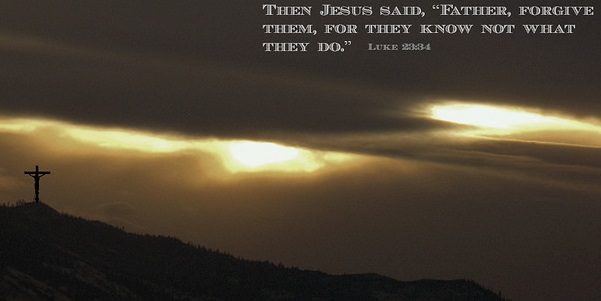
Photo: Flickr, Trish Hamme, Good Friday, Creative Commons License, some changes made
This article is part of my blog series inspired by Jesus the Forgiving Victim: Listening for the Unheard Voice by James Alison.*
Lots of Christians get tied up in knots about forgiveness. When we’ve been hurt or abused, we understand that it’s our Christian duty to forgive the ones who have wronged us. But what about perpetrators who show no remorse? The nation was stunned by the forgiveness the families of the victims of the massacre at Mother Emmanuel AME Church in Charleston offered Dylann Roof because he clearly wasn’t sorry in the least bit. Did he deserve to be forgiven? What about you? Have you ever forgiven someone who didn’t apologize?
Lots of folks who recommend forgiving perpetrators who show no signs of repentance do so for psychological reasons. They rightly explain that forgiveness frees the victim from being tied emotionally to the perpetrator so that healing can begin. That reasoning makes a lot of sense, but it is not necessarily the reason behind the Christian call to forgive. It’s a nice side benefit, but it is not the primary reason.
To Forgive or Be Forgiven: That’s the Question!
Because before forgiving someone else comes something even more important to Christian life: learning how to be forgiven. In other words, receiving forgiveness is step one when it comes to following Jesus. Because in the Christian forgiveness scenario, we are not the ones doing the forgiving. The Christian revelation is simply this: Jesus is the forgiving victim and we are the ones who need forgiving.
In James Alison’s course, he addresses this reversal directly by undoing our thinking about atonement. Essay 6, Undergoing Atonement: the reverse flow of sacrifice is, I think, the heart of the course. It’s there that we begin to understand the consequences of how we have gone about being good, which is by comparing ourselves favorably to others. James talks about it as constructing our sense of ourselves as good over against someone who we think is bad. The consequence is that we come to depend on having enemies to keep reassuring ourselves that we are good people. James points out that this is false or fake goodness, not the real thing.
It’s easy to see this at play in a racist murderer. In fact, all forms of prejudice are examples of over against identities: I know myself to be good because I’m not black, or an immigrant, out of work, rich, or poor or whatever your bias is. You can even feel good about your own lack of racism by being over against racists! What’s worse is that we can come to know ourselves as guiltless by being over against a guilty murderer like Roof.
Sometimes It’s Bad to Be Good
It’s not that Roof isn’t a murderer, not at all. It’s just that by using his guilt as a foil for our goodness, we never imagine ways in which we may be participating in actions as terrible as Roof’s. Just to take one example, our government’s invasion of Iraq and pursuit of American interests in the Middle East since then has contributed to a devastating refugee crisis disproportionately affecting women and children with starvation and disease. While Roof’s crime deserves our condemnation and moral outrage, perhaps our own government stands condemned by the same standard. If so, how can we continue to celebrate ourselves as a good nation?
What I’m trying to point out is that constructing goodness this way is a tricky slippery slope. Because when we divide the world up into good and bad people – us vs. them – we come to believe that we could never do anything bad. We even defend policies that destroy neighborhoods or condemn people to death by starvation or disease, as justifiable and good. We can get so addicted to this way of being good that we need to keep finding people to play the role of bad guy for us. Unfortunately, we end up putting a lot of innocent people into very bad roles without ever realizing it.
Remember Jesus’ prayer from the cross? “Father, forgive them, for they know not what they do.” It’s not just that the authorities and the crowd on that day, in that place two thousand years ago didn’t know what they were doing. It’s that human beings have a way of not knowing what we are doing most of the time! We believe so completely in our own goodness that we never wonder if our actions, as good and right as they feel, may in fact be something that needs forgiving.
Goodness Comes from God
James ends the chapter on atonement by imagining Jesus’ speaking to us about how much God loves us and just how hard it is to communicate that to us! It’s so difficult, in fact, that God had to come up with a way to show us “that he really is for us, actually likes us, loves and wants to be on our side.” By going to his death the way he did, Jesus was trying to shake us free from being good the fake way so that we could discover a new way, a better way, to be good. James writes that Jesus might be trying to say to us:
“… the only way I can get it across to you that I like you is by occupying the very worst space that any of you can come up with, a place which you typically think I like to put people in. I don’t. It’s you who put people there, you at your very worst. I’ll occupy that place to show that I’m not out to get you, that I really do like you. The moment you see that, then you can relax, and trust my goodness. Then you need no longer engage in that awful business of making yourselves good over against, or by comparison with each other. Instead you can relax about being good, and as you relax you will find yourselves becoming something much better, much richer in humanity than you can possibly imagine.” (298)
When Jesus forgave humanity from the cross, he was saying, “I know that you are better than this. I want you to know it, too.” What we will discover, if we can believe in God’s goodness rather than in our own, is that repentance flows from being forgiven and that forgiveness is best offered by repentant sinners. If Jesus is the forgiving victim, then we are the repentant sinners learning to trust in the goodness of God.
*Years ago, just when I was about to give up on Christianity as irrelevant to my life, I stumbled across the work of James Alison. He helped me encounter a God of mercy who loved me more than I could imagine – what a gift! So when he asked for help to produce his course of introduction to Christianity, Jesus the Forgiving Victim: Listening for the Unheard Voice, I jumped at the chance. All proceeds from sales of the course go to support the website, translations, promotion, and James’ living and travel expenses. James is an independent scholar and itinerant preacher and is very grateful for your support. James and I both pray that this blog series and the course itself will be a meaningful part of your journey toward a deeper faith and fuller life in Christ. You can learn more about the course and purchase it at our store.
For other parts of this series see:
Jesus the Forgiving Victim: Huh?
Listening for the Unheard Voice
Authentically Boring: The Case for Praying by Rote
If Jesus is the Forgiving Victim, Then What Am I?
Trump, Biden, and the Search for Authenticity
Stay in the loop! Like Teaching Nonviolent Atonement on Facebook!
Previous Post

August 17, 2015
ISIS’s Anti-Islamic Theology of Rape
Next Post
August 19, 2015 Wednesday Sermon: Jonah's Disappointment
Browse Our Archives
Select a Category Atonement and Current Events Curriculum Faith and Families Interviews Jesus the Forgiving Victim Lent Montessori politics Reviews The Bible Explained Uncategorized Valentine's Day Wednesday Sermon Who is God?
Select a Month July 2020 November 2019 October 2019 September 2019 August 2019 July 2019 June 2019 May 2019 April 2019 March 2019 February 2019 January 2019 December 2018 November 2018 October 2018 September 2018 August 2018 July 2018 June 2018 May 2018 April 2018 March 2018 February 2018 January 2018 December 2017 November 2017 October 2017 September 2017 August 2017 July 2017 June 2017 May 2017 April 2017 March 2017 February 2017 January 2017 December 2016 November 2016 October 2016 September 2016 August 2016 June 2016 May 2016 April 2016 March 2016 February 2016 January 2016 December 2015 November 2015 October 2015 September 2015 August 2015 July 2015 June 2015 May 2015 April 2015 March 2015 February 2015 January 2015 December 2014 November 2014 October 2014 September 2014 August 2014 July 2014 June 2014 May 2014 April 2014 March 2014 January 2014 December 2013 September 2013 August 2013 July 2013
Follow Us!
TAKE THE
Religious Wisdom Quiz
Which Christian group is known for not celebrating holidays or birthdays?
Select your answer to see how you score.
Methodists Orthodox Episcopalians Jehovah's Witnesses
Related posts from Teaching Nonviolent Atonement

Forgiveness in the Time of COVID-19 by Julia...

Reflections on Indigenous Wisdom For Healing A Wounded...

How Forgiveness Can Transform Our Violence and Build...

Jesus Unmasked: God's Economy and How to Cheat...
TRENDING AT PATHEOS Progressive Christian

What Being a Modern-Day Apostle Means to Me
In my last column, I discussed the ins and outs of modern-day...

Did Ancient China Once Worship the God of...
Across human history, a common thread weaves through the origins of the...

Love Your Neighbor – Including Earth-Kin: Lev. 19,...
God’s command to love your neighbor means acting in an ethical and...

Lead a Church Study of “Jesus and Lao...
Guest writer Jack Thomas (The Irreverent Reverend) reflects on leading his church...

Pastoral Wisdom for Responding to Sermon Pushback
Getting sermon pushback on your social justice sermon? Learn practical, Proverbs-based strategies...

Principles for Understanding the Apostolic Ministry Today
Whenever people discover that my formal ministry title is "apostle," as in...
view all Progressive Christian blogs
Ad-Free & Subscriber Log-In Subscription Support
- About Us
- 2026 Calendar
- Videos
- Podcasts
- Library of World Religions
- Faith In Media Tracker
- Advertise With Us
- Write for Us
- Privacy Policy
- Terms of Service
- Do Not Sell My Data
- Contact Us
- Radiant Digital
- Manage Newsletter Subscriptions
- Unsubscribe From Notifications
- Sitemap
Copyright 2008-2026, Patheos. All rights reserved.
Subscription Support Ad-Free & Subscriber Log-In
Follow Patheos