
BuddhistCatholicContemplativeEvangelicalGeneral ChristianHinduJewishLatter-day SaintMuslimNew VisionsProgressive Christian
Beliefs
- Buddhist
- Catholic
- Contemplative
- Evangelical
- General Christian
- Hindu
- Jewish
- Latter-day Saint
- More Voices
- Muslim
- New Visions
- Pagan
- Progressive Christian
Topics
- Religion News
- Food and Religion
- Sports and Religion
- Religious Art
- Religious Music and Entertainment
- Religious Events
- History and Religion
- Style and Religion
- Politics and Religion
- Women in Religion
- Recreation Outdoors and Religion
- Business Finance and Religion
- Careers Workplace and Religion
- Education and Religion
- Family Parenting and Religion
- Health Fitness and Religion
- Home and Religion
- Relationships and Religion
- Technology and Religion
- Travel and Religion
Columnists
- Buddhist Columnists
- Business Finance and Religion Columnists
- Careers Workplace and Religion Columnists
- Catholic Columnists
- Contemplative Columnists
- Education and Religion Columnists
- Evangelists Columnists
- Family Parenting and Religion Columnists
- General Christian Columnists
- Health Fitness and Religion Columnists
- Hindu Columnists
- History and Religion Columnists
- Home and Religion Columnists
- Jewish Columnists
- More Voices Columnists
- Latter Day Columnists
- Muslim Columnists
- New Visions Columnists
- Nonreligious Columnists
- Pagan Columnists
- Politics and Religion Columnists
- Progressive Columnists
- Recreation Outdoors and Religion Columnists
- Relationships and Religion Columnists
- Religion News Columnists
- Religious Art Columnists
- Religious Events Columnists
- Religious Music and Entertainment Columnists
- Sports and Religion Columnists
- Style and Religion Columnists
- Technology and Religion Columnists
- Travel and Religion Columnists
- Women in Religion Columnists
Resource Library
- 2026 Calendar
- Library of World Religions
- The 100 Most Holy Places on Earth
- Patheos Answers
- Podcasts
- Videos
- Faith Leaders Database
- Anglican Episcopalian
- Bahai
- Baptist
- Buddhism
- Christianity
- Confucianism
- Eastern Orthodoxy
- Hinduism
- Holiness and Pentecostal
- ISKCON
- Islam
- Judaism
- Lutheran
- Methodist
- The Church of Jesus Christ of Latter-day Saints
- New Age
- Paganism
- Presbytarian and Reformed
- Protestantism
- Religion Behind the Scenes
- Roman Catholic
- Scientology
- Shia Islam
- Sikhism
- Sufism
- Sunni Islam
- Taoism
- Zen
- See all religions
Research Tools
 Ad-Free & Subscriber Log-In Subscription Support
Ad-Free & Subscriber Log-In Subscription Support
Follow Patheos 

- Trending:
- Forgiveness
- |
- Marriage
- |
- Consciousness
- |
- Death Penalty
- |
- Election
- |
- Halloween
 Teaching Nonviolent Atonement
- Home
- Progressive Christian
- From Japan To Ferguson: Sacrificing Our Justifications For Violence
From Japan To Ferguson: Sacrificing Our Justifications For Violence
Last updated on: August 13, 2015 at 8:35 pm by Lindsey Paris-Lopez
From Japan To Ferguson: Sacrificing Our Justifications For Violence 2015-08-13T20:35:31-05:00 Lindsey Paris-Lopez
Patheos Explore the world's faith through different perspectives on religion and spirituality! Patheos has the views of the prevalent religions and spiritualities of the world.
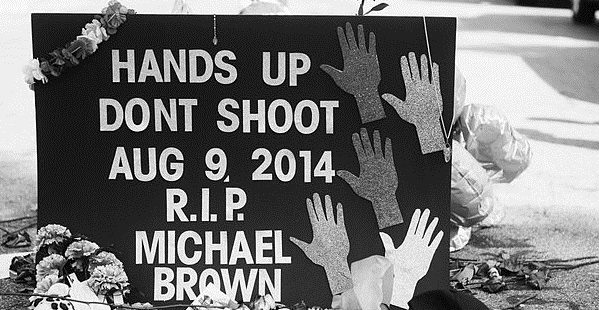
Photo by Jamelle Bouie. Available through Wikimedia via Creative Commons Attribution 2.0 Generic license. Some changes made.

It has been a year since the death of Michael Brown, and seventy years since the dropping of the atomic bombs on Hiroshima and Nagasaki.
I am in mourning. I am in rage. I am struggling to plow through with hope and faith in the God of Love who can redeem all of this suffering and senseless murder. I am struggling to live into that hope by learning and shouting the truth and acting upon it.
Michael Brown and the people of Nagasaki are connected by more than just their dates of death. They were murdered by authorities charged to serve and protect. They were sacrificed to a myth of American exceptionalism mingled with a false ideology of white supremacy. Fears were projected onto them. They were dehumanized. Their killings are justified by people who insist that they had to die for others to live.
It is our national faith in sacrifice, in the righteousness of violence, in self-justification and its mirror twin – other-demonization – that most fills me with despair, but also with determination to keep up the struggle to drown out the violence and oppression of the world with rivers of compassion and justice.
Moving forward sometimes feels like swimming through mud, a slow and arduous process, because we are steeped so deeply in a culture, a religion, of violence, overt and insidious. This past year has been a wake-up call to the systemic racial violence on our very own soil, which must be confronted concurrently with the racist, Islamophobic, greed-and-power-driven violence exported overseas. Recognizing the interconnection of these violences, their common roots and the way they feed each other, is essential to the work of rebuilding a new social order on the foundation of love and compassion.
The murders of Michael Brown and the people of Japan were hundreds, even thousands, of years in the making. A single finger pulled a trigger, a single finger pressed a button, but the blood is on an entire world order structured on a profound, but deadly misguided, belief in the salvific power of violence. René Girard teaches us how civilization was founded in murder, as people purged their rivalries over mutual desires by coming together against a scapegoat or enemy, the communal killing of whom produced the cooperation and emotional bonding necessary to form a society. Our own nation was certainly born in the blood of others, as settlers slaughtered Natives and lashes drew the blood of slaves who cultivated the land and became a backbone of the economy. Today, our military and police forces are portrayed by the predominant culture as critical to our safety and survival. Wars and police shootings are deemed necessary, even noble, by the powers that be. Those who “put their lives on the line” to serve and protect are honored and glorified by our culture. Yet the blood of the victims of our state and our military, washing over all of us, does not redeem; it convicts.
Ultimately, these murders can be traced in large part to racism and self-justification, both intimately tied to the scapegoating mechanism. Racism is a type of scapegoating that is deeply embedded in the social structure of the United States. Distinctively American racism can be traced back to the early days of settlement before independence. As Matthew Cooke tells us in this video, natural alliances between African slaves and white indentured servants threatened the elite, who restructured laws to give poor whites slightly more rights and thereby redrew alliances along racial lines. Order was thus enforced not by distributing justice, but by redirecting hostility to a new enemy – the black race – in such a way that preserved slavery, kept wealth in the hands of the few, and placated the poor whites with token privileges. The myth of white supremacy was reinforced by segregation, and it influenced theological interpretation, social science, and even the understanding of biology. Everything about white American culture was set up to portray blacks as inferior, and this myth was believed and passed along as truth. The entrenched racism integral to the foundation of the United States has not been fully uprooted to this day.
The moral pseudo-superiority inherent in racism is a hallmark of scapegoating violence. Righteous self-justification has evolved since the days of slavery and lynchings, but it is still not only a persistent human trait but also very much a part of the American cultural psyche. Overt racism was once considered by some a moral position, to the point where preachers could draw on stereotypes of hypersexualized, bestial black men to incite mobs to murder “righteously” in broad daylight. Now that racism has been exposed as immoral, denial of racial prejudice is necessary to maintain a sense of morality. But the tendency to define one’s self over and against others persists. De facto segregation, a large wealth gap favoring whites, a mass incarceration system disproportionately targeting African Americans, and more, divide the experience of life in America along racial lines, keeping prejudices alive but insidious. Moral superiority felt against those imprisoned, impoverished, or negatively portrayed in the media, often (not always) falls along racial lines.
The concept of superiority encompasses but also transcends race in American culture. “American exceptionalism” is drilled into our cultural consciousness from an early age. Our desire to see ourselves as noble and heroic is nurtured by an understanding of history that portrays the mistakes of the past as long gone, lessons learned. We are a people ever perfecting our union, with liberty and justice for all, we are told. Our self-glorifying culture resists reflection on the systems that enforce order and the order they enforce, at home and abroad. The violence of our military, with bases in over 70 countries, conducting operations both covert and open, is portrayed as a tool for establishing freedom and a “global force for good.”
Racism and pseudo-righteousness cloak murder in the mantle of morality. Centuries of demonization of black males ultimately guided Darren Wilson’s finger on the trigger as he shot Michael Brown multiple times. His irrational fear, that a man already injured was a threat to his life, was deeply conditioned. While he should have been held accountable for his actions, his actions must also be examined in a larger context of the racism that makes the devaluation of black lives a fact of American life. Justification for Darren Wilson’s actions, however, is not just a product of unrecognized racism. It is also the product of faith in the goodness of the system of American law enforcement and American order in general. Officers who enforce order in a nation of liberty and justice for all are good guys; those they kill are bad guys. Thankfully this narrative is being challenged now, but for far too long it went largely unquestioned. The system of policing and law enforcement, while accomplishing good, is designed to uphold an order that is far more corrupt and inherently unjust than we have been conditioned to believe. This order protects the wealthy and hurts the poor and racial minorities in particular. The system can be redesigned, the noble desires to serve and protect can be exercised, but not without extracting the poisons of racism, greed, and resistance to self-reflection.
Faith in the military as a force for good also goes largely unquestioned. The myth of white supremacy is intermingled within foreign policies that seek to manipulate and exploit nations with darker-skinned people and lucrative resources. The myth of heroic violence, reinforced by conditioned belief in American exceptionalism, serves to mask racism, greed, and evil justification of brutality. The comingling of racism with unquestioned self-righteousness manifested itself egregiously in the release of the atomic bombs over Hiroshima and Nagasaki. Would this murder of hundreds of thousands of civilians have been justified in the minds of so many without the demonization of the Japanese, who of all the Axis powers were portrayed as the most ruthless and animal-like of enemies? Seventy years later, the lie that such an action was necessary to end the war persists despite evidence that the Japanese were on the verge of surrender before the bombs were dropped. Our reluctance to deal honestly with our historical atrocities enables those atrocities to continue. Death tolls of the war on terror are estimated in the millions. The threat of nuclear annihilation hangs over our heads while we ignore our commitment to disarm and make war all over the world under the pretense of protection, even as military experts (among others) have conceded that our wars have created new enemies, like ISIS, and ultimately make us and those we claim to protect less safe.
Our national order, our world order, is built on the sacrifice of devalued lives. At Raven, we preach mercy, not sacrifice. But in order to have mercy on the victims of our violence at home and abroad, it’s time to make some sacrifices that will alter our self-perception. We must sacrifice the myth of our unshakeable goodness. We must sacrifice our self-justifications. For white Americans particularly, we must sacrifice the denial of our racial prejudices and examine the ways laws and attitudes have continually marginalized black and brown people. The devaluation of black lives has proven deadly and rendered African Americans unsafe in their own nation. For all of us, we must sacrifice our complacency and our distraction that keeps us from seeing the devastation continually being waged in our name. We must sacrifice the myth of righteous violence and truly see the horror of families burying their dead, or fleeing with no time for burials, maimed bodies, birth defects, shattered cities, forfeited futures.
It is terrifying to renounce self-justification and let the truth of our scapegoating violence in all of its forms permeate our consciousness. It is terrifying to allow the notion that evil is not the exclusive property of the “other,” that it resides within our own hearts. But here is the Good News: we are already, infinitely and unconditionally, loved and cherished. We don’t need to define our worth against anyone else. We don’t need to redeem ourselves by finding someone “worse,” perpetuating cycles of violence. Instead, we need to look to the one who became our victim to expose our needless sacrifice of other victims. We need to live into the Love of our Heavenly Father who also loves our victims and our enemies.
What will the world look like when it is structured on all-embracing love rather than the over-and-against violence we see today? It will look like, and be, the Kingdom of God.
Previous Post

August 11, 2015
My Daughter, the Star Wars Myth, and Jesus – How to Defeat Evil
Next Post
August 14, 2015 The Imitation Game: US-Iran Relations
Browse Our Archives
Select a Category Atonement and Current Events Curriculum Faith and Families Interviews Jesus the Forgiving Victim Lent Montessori politics Reviews The Bible Explained Uncategorized Valentine's Day Wednesday Sermon Who is God?
Select a Month July 2020 November 2019 October 2019 September 2019 August 2019 July 2019 June 2019 May 2019 April 2019 March 2019 February 2019 January 2019 December 2018 November 2018 October 2018 September 2018 August 2018 July 2018 June 2018 May 2018 April 2018 March 2018 February 2018 January 2018 December 2017 November 2017 October 2017 September 2017 August 2017 July 2017 June 2017 May 2017 April 2017 March 2017 February 2017 January 2017 December 2016 November 2016 October 2016 September 2016 August 2016 June 2016 May 2016 April 2016 March 2016 February 2016 January 2016 December 2015 November 2015 October 2015 September 2015 August 2015 July 2015 June 2015 May 2015 April 2015 March 2015 February 2015 January 2015 December 2014 November 2014 October 2014 September 2014 August 2014 July 2014 June 2014 May 2014 April 2014 March 2014 January 2014 December 2013 September 2013 August 2013 July 2013
Follow Us!
TAKE THE
Religious Wisdom Quiz
I carried a letter from the king giving me authority and resources to rebuild Jerusalem. Who am I?
Select your answer to see how you score.
Zerubbabel Artaxerxes Ezra Nehemiah
Related posts from Teaching Nonviolent Atonement

Toxic Christianity: 3 Things We Can Do That...

The Secret of Life: An Interview with Audrey...

Forgiveness in the Time of COVID-19 by Julia...

TRENDING AT PATHEOS Progressive Christian

Why Christians Have a Sacred Duty to Vote:...
The Bible offers strong support for the sacred duty to vote. Here...

What Being a Modern-Day Apostle Means to Me
In my last column, I discussed the ins and outs of modern-day...

Did Ancient China Once Worship the God of...
Across human history, a common thread weaves through the origins of the...

Love Your Neighbor – Including Earth-Kin: Lev. 19,...
God’s command to love your neighbor means acting in an ethical and...

Lead a Church Study of “Jesus and Lao...
Guest writer Jack Thomas (The Irreverent Reverend) reflects on leading his church...

Principles for Understanding the Apostolic Ministry Today
Whenever people discover that my formal ministry title is "apostle," as in...
view all Progressive Christian blogs
Ad-Free & Subscriber Log-In Subscription Support
- About Us
- 2026 Calendar
- Videos
- Podcasts
- Library of World Religions
- Faith In Media Tracker
- Advertise With Us
- Write for Us
- Privacy Policy
- Terms of Service
- Do Not Sell My Data
- Contact Us
- Radiant Digital
- Manage Newsletter Subscriptions
- Unsubscribe From Notifications
- Sitemap
Copyright 2008-2026, Patheos. All rights reserved.
Subscription Support Ad-Free & Subscriber Log-In
Follow Patheos