
BuddhistCatholicContemplativeEvangelicalGeneral ChristianHinduJewishLatter-day SaintMuslimNew VisionsProgressive Christian
Beliefs
- Buddhist
- Catholic
- Contemplative
- Evangelical
- General Christian
- Hindu
- Jewish
- Latter-day Saint
- More Voices
- Muslim
- New Visions
- Pagan
- Progressive Christian
Topics
- Religion News
- Food and Religion
- Sports and Religion
- Religious Art
- Religious Music and Entertainment
- Religious Events
- History and Religion
- Style and Religion
- Politics and Religion
- Women in Religion
- Recreation Outdoors and Religion
- Business Finance and Religion
- Careers Workplace and Religion
- Education and Religion
- Family Parenting and Religion
- Health Fitness and Religion
- Home and Religion
- Relationships and Religion
- Technology and Religion
- Travel and Religion
Columnists
- Buddhist Columnists
- Business Finance and Religion Columnists
- Careers Workplace and Religion Columnists
- Catholic Columnists
- Contemplative Columnists
- Education and Religion Columnists
- Evangelists Columnists
- Family Parenting and Religion Columnists
- General Christian Columnists
- Health Fitness and Religion Columnists
- Hindu Columnists
- History and Religion Columnists
- Home and Religion Columnists
- Jewish Columnists
- More Voices Columnists
- Latter Day Columnists
- Muslim Columnists
- New Visions Columnists
- Nonreligious Columnists
- Pagan Columnists
- Politics and Religion Columnists
- Progressive Columnists
- Recreation Outdoors and Religion Columnists
- Relationships and Religion Columnists
- Religion News Columnists
- Religious Art Columnists
- Religious Events Columnists
- Religious Music and Entertainment Columnists
- Sports and Religion Columnists
- Style and Religion Columnists
- Technology and Religion Columnists
- Travel and Religion Columnists
- Women in Religion Columnists
Resource Library
- 2026 Calendar
- Library of World Religions
- The 100 Most Holy Places on Earth
- Patheos Answers
- Podcasts
- Videos
- Faith Leaders Database
- Anglican Episcopalian
- Bahai
- Baptist
- Buddhism
- Christianity
- Confucianism
- Eastern Orthodoxy
- Hinduism
- Holiness and Pentecostal
- ISKCON
- Islam
- Judaism
- Lutheran
- Methodist
- The Church of Jesus Christ of Latter-day Saints
- New Age
- Paganism
- Presbytarian and Reformed
- Protestantism
- Religion Behind the Scenes
- Roman Catholic
- Scientology
- Shia Islam
- Sikhism
- Sufism
- Sunni Islam
- Taoism
- Zen
- See all religions
Research Tools
 Ad-Free & Subscriber Log-In Subscription Support
Ad-Free & Subscriber Log-In Subscription Support
Follow Patheos 

- Trending:
- Forgiveness
- |
- Marriage
- |
- Consciousness
- |
- Death Penalty
- |
- Election
- |
- Halloween
 Teaching Nonviolent Atonement
- Home
- Progressive Christian
- Wednesday Sermon: Jesus Feeds Five Thousand and Avoids the Draft!
Wednesday Sermon: Jesus Feeds Five Thousand and Avoids the Draft!
Last updated on: July 29, 2015 at 10:19 am by Tom Truby
Wednesday Sermon: Jesus Feeds Five Thousand and Avoids the Draft! 2015-07-29T10:19:04-05:00 Tom Truby
Patheos Explore the world's faith through different perspectives on religion and spirituality! Patheos has the views of the prevalent religions and spiritualities of the world.
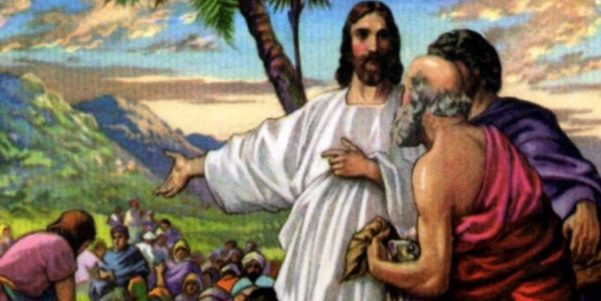
Jesus feeds 5,000 (Photo: Flickr, pcstratman, Creative Commons License, some modifications)
Pastors have a frequent question when they begin to discover mimetic theory. “That’s great. But how does it preach?”
Reverends Tom and Laura Truby shows that mimetic theory is a powerful tool that enables pastors to preach the Gospel in a way that is meaningful and refreshing to the modern world. Each Wednesday, Teaching Nonviolent Atonement will highlight Tom and Laura’s sermons as an example of preaching the Gospel through mimetic theory.
In this sermon they explore the abundance of God. “Plenty of grass” turns into plenty of food for everyone. How will we respond to God’s abundance?
Year B, Proper 12 (July 24-30 inclusive)
July 26, 2015
By Thomas L. Truby
John 6:1-21 (Common English Bible, copyright 2011)
Jesus Feeds Five Thousand and Avoids the Draft!
The crowds following Jesus aren’t there because they believe in him or think he is the Son of God. They follow him because his miraculous signs fascinate them and beg for an explanation. John wants us to know this as he begins his story.
Jesus and the disciples have just crossed the sea, climbed a mountain, and sat down. The sea is the Galilee Sea also known as The Tiberius Sea, renamed in honor of Tiberius Caesar. Is this John’s clue that something international and universal is going on here? It is very near Passover, the Jewish festival celebrating the way the angel of death passed over Hebrew families but visited the families of all others in the account of the Exodus. Will Jesus be a Passover for everyone?
Jesus looks up and sees the large crowd coming up the mountain toward them. He asks Philip “Where will we buy food to feed these people?” It’s a test question since Jesus already knows what he is going to do.
In code he’s asking “What will nurture humanity; satisfy their restlessness and calm their warring spirit? Where will we buy the food that feeds them so that they aren’t on the take; blaming and fighting each other over food, water and energy resources?” He knows the answer.
Philip replies, “More than a half year’s salary worth of food wouldn’t be enough for each person to have even a little bit.” There isn’t enough for everyone. Some will need to be excluded.
“One of his disciples, Andrew, Simon Peter’s brother, said, ‘A youth here has five barley loaves and two fish. But what good is that with a crowd like this?’”
Is it significant that Peter’s brother says there isn’t enough for everybody? This was the issue around which the early church was polarized. Is the bread of Jesus for everyone or is it just for those who embrace the Jewish faith? Peter and his brothers say all people must embrace the Jewish faith in order to be the followers of Jesus. Is Jesus a reformer within the Jewish tradition or is he a reformer of all religions including Christianity?
I believe this story can be understood best in the context of this conflict. Is what Jesus does for everyone or is Jesus’ food limited and meant for “only people who are saved.” Is Jesus’ food universal or are there filters filtering out other religions, races, ethnic groups and peoples? Do you see how contemporary this debate is?
Your thinking, I thought they got that resolved. Isn’t that the content of the Book of Acts where Peter has this vision that no animal is unclean and the gentiles receive the Holy Spirit proving they are not outsiders anymore?
Yes, that’s what the book says but many think the Book of Acts was written to paper over the conflict between Peter and the Jerusalem church and Paul and his followers. St. Luke writes the Book of Acts to make it seem that Peter had a change of heart. But maybe Peter was never able to go that far. He couldn’t imagine Jesus being food for all and meeting the need of the entire world.
The early Christians weren’t of one mind on how far Jesus was food for the world. It’s an issue that’s still unresolved and a majority of Christians don’t think Jesus does feed the whole crowd coming up the mountain toward him. So it makes sense that the writer of John would have Andrew, Simon Peter’s brother, announce the limit on how many the three loaves and two fish can feed.
With the context in place we are ready to hear how Jesus responds. “Jesus said, ‘Have the people sit down.’ There was plenty of grass there.” Notice the phrase “plenty of grass.” John wants us to feel a sense of abundance, and more-than-enough-ness.
“They sat down, about five thousand of them. Then Jesus took the bread. When he had given thanks, he distributed it to those who were sitting there.” Of course, we know the bread looks forward to communion and is his body broken by us and for us. Symbolically he is feeding us himself. And when he gives thanks to God he is thanking God for sending him on this mission where he is bread for the world. God and he are in absolute unity on the necessity of his doing this and their love for humanity is so deep they both want it. They know it is the only way to meet the profound restlessness of humanity.
“He (Jesus) did the same with the fish, each getting as much as they wanted.” As much as they wanted! The crowd does not need to worry about running out. Jesus has enough for all.
“When they had plenty to eat, he said to his disciples, ‘Gather up the leftover pieces, so that nothing will be wasted.” Could this mean no human being is wasted? All are salvaged! So they gathered them and filled twelve baskets with the pieces of the five barley loaves that had been left over by those who had eaten.”
Why do you suppose they gather twelve baskets after everyone has had their fill? How many tribes composed the original Jewish people? Twelve! Is Jesus saying “Don’t worry people of Israel; there is enough for you?” There is enough for everyone. Jesus is bread for all and there is plenty.
The scene, now so full of light, darkens as the crowd misunderstands Jesus’ sign. We know the bread he gives is himself sacrificed to our violence but they think he is proving his power to them so that he can lead them in a campaign of violence against their enemies. The text says, “When the people saw that he had done a miraculous sign, they said, ‘This is truly the prophet who is coming into the world!”
Remember how at the beginning of the story John tells us the crowds follow him because his miraculous signs fascinate them and beg for an explanation. Well, they have found their explanation. They think Jesus is trying to prove to them that he is equipped to be their leader. That’s how they interpret his miraculous signs he had done among the sick. “Jesus understood that they were about to come and force him to be their king, so he took refuge again, alone on a mountain.”
Did you hear that? Did you hear what Jesus did in response to their intention to force him to be king? He hides! He dodged the draft!
“When evening came, Jesus’ disciples went down to the lake.” They don’t know where Jesus is. The crowd can’t enlist him if they can’t find him.
“They (the disciples) got into a boat and were crossing the lake to Capernaum, (their home and headquarters). It was already getting dark and Jesus hadn’t come to them yet. The water was getting rough because a strong wind was blowing. When the wind had driven them out for about three or four miles, they saw Jesus walking on the water.”
What is John saying about Jesus with all this? Is he saying that Jesus will give his body to be broken by human violence and will feed us with it to redeem us, he will walk on water to demonstrate his unique relationship with his Abba but he will not be enlisted into our efforts to use him to kill? Is this a way of demonstrating Jesus’ non-violence? Does this mean that Jesus will give his life to our violence but he will not inflict violence on us?
Walking on water Jesus approaches the boat and the disciples are afraid. They don’t understand Jesus at all. There isn’t a violent bone in him but they think there is. “He (Jesus) said to them, ‘I am. Don’t be afraid.” “I am” is the ancient name for God. St John sees Jesus as the revelation of God and I tells us we don’t need to be afraid of him.
When they heard that “they wanted to take him into the boat, and just then the boat reached the land where they had been heading.” Simultaneously they take him in and arrive home. Thanks be to God. Amen.
Next Post

July 31, 2015 Franklin Graham, Islam, and the Future of Progressive Christianity
Browse Our Archives
Select a Category Atonement and Current Events Curriculum Faith and Families Interviews Jesus the Forgiving Victim Lent Montessori politics Reviews The Bible Explained Uncategorized Valentine's Day Wednesday Sermon Who is God?
Select a Month July 2020 November 2019 October 2019 September 2019 August 2019 July 2019 June 2019 May 2019 April 2019 March 2019 February 2019 January 2019 December 2018 November 2018 October 2018 September 2018 August 2018 July 2018 June 2018 May 2018 April 2018 March 2018 February 2018 January 2018 December 2017 November 2017 October 2017 September 2017 August 2017 July 2017 June 2017 May 2017 April 2017 March 2017 February 2017 January 2017 December 2016 November 2016 October 2016 September 2016 August 2016 June 2016 May 2016 April 2016 March 2016 February 2016 January 2016 December 2015 November 2015 October 2015 September 2015 August 2015 July 2015 June 2015 May 2015 April 2015 March 2015 February 2015 January 2015 December 2014 November 2014 October 2014 September 2014 August 2014 July 2014 June 2014 May 2014 April 2014 March 2014 January 2014 December 2013 September 2013 August 2013 July 2013
Follow Us!
TAKE THE
Religious Wisdom Quiz
How old was Noah when flood began?
Select your answer to see how you score.
550 years 450 years 600 years 500 years
Related posts from Teaching Nonviolent Atonement

Forgiveness in the Time of COVID-19 by Julia...

Reflections on Indigenous Wisdom For Healing A Wounded...

How Forgiveness Can Transform Our Violence and Build...

Jesus Unmasked: God's Economy and How to Cheat...
TRENDING AT PATHEOS Progressive Christian

What Being a Modern-Day Apostle Means to Me
In my last column, I discussed the ins and outs of modern-day...

Did Ancient China Once Worship the God of...
Across human history, a common thread weaves through the origins of the...

Love Your Neighbor – Including Earth-Kin: Lev. 19,...
God’s command to love your neighbor means acting in an ethical and...

Lead a Church Study of “Jesus and Lao...
Guest writer Jack Thomas (The Irreverent Reverend) reflects on leading his church...

Pastoral Wisdom for Responding to Sermon Pushback
Getting sermon pushback on your social justice sermon? Learn practical, Proverbs-based strategies...

Principles for Understanding the Apostolic Ministry Today
Whenever people discover that my formal ministry title is "apostle," as in...
view all Progressive Christian blogs
Ad-Free & Subscriber Log-In Subscription Support
- About Us
- 2026 Calendar
- Videos
- Podcasts
- Library of World Religions
- Faith In Media Tracker
- Advertise With Us
- Write for Us
- Privacy Policy
- Terms of Service
- Do Not Sell My Data
- Contact Us
- Radiant Digital
- Manage Newsletter Subscriptions
- Unsubscribe From Notifications
- Sitemap
Copyright 2008-2026, Patheos. All rights reserved.
Subscription Support Ad-Free & Subscriber Log-In
Follow Patheos