
BuddhistCatholicContemplativeEvangelicalGeneral ChristianHinduJewishLatter-day SaintMuslimNew VisionsProgressive Christian
Beliefs
- Buddhist
- Catholic
- Contemplative
- Evangelical
- General Christian
- Hindu
- Jewish
- Latter-day Saint
- More Voices
- Muslim
- New Visions
- Pagan
- Progressive Christian
Topics
- Religion News
- Food and Religion
- Sports and Religion
- Religious Art
- Religious Music and Entertainment
- Religious Events
- History and Religion
- Style and Religion
- Politics and Religion
- Women in Religion
- Recreation Outdoors and Religion
- Business Finance and Religion
- Careers Workplace and Religion
- Education and Religion
- Family Parenting and Religion
- Health Fitness and Religion
- Home and Religion
- Relationships and Religion
- Technology and Religion
- Travel and Religion
Columnists
- Buddhist Columnists
- Business Finance and Religion Columnists
- Careers Workplace and Religion Columnists
- Catholic Columnists
- Contemplative Columnists
- Education and Religion Columnists
- Evangelists Columnists
- Family Parenting and Religion Columnists
- General Christian Columnists
- Health Fitness and Religion Columnists
- Hindu Columnists
- History and Religion Columnists
- Home and Religion Columnists
- Jewish Columnists
- More Voices Columnists
- Latter Day Columnists
- Muslim Columnists
- New Visions Columnists
- Nonreligious Columnists
- Pagan Columnists
- Politics and Religion Columnists
- Progressive Columnists
- Recreation Outdoors and Religion Columnists
- Relationships and Religion Columnists
- Religion News Columnists
- Religious Art Columnists
- Religious Events Columnists
- Religious Music and Entertainment Columnists
- Sports and Religion Columnists
- Style and Religion Columnists
- Technology and Religion Columnists
- Travel and Religion Columnists
- Women in Religion Columnists
Resource Library
- 2026 Calendar
- Library of World Religions
- The 100 Most Holy Places on Earth
- Patheos Answers
- Podcasts
- Videos
- Faith Leaders Database
- Anglican Episcopalian
- Bahai
- Baptist
- Buddhism
- Christianity
- Confucianism
- Eastern Orthodoxy
- Hinduism
- Holiness and Pentecostal
- ISKCON
- Islam
- Judaism
- Lutheran
- Methodist
- The Church of Jesus Christ of Latter-day Saints
- New Age
- Paganism
- Presbytarian and Reformed
- Protestantism
- Religion Behind the Scenes
- Roman Catholic
- Scientology
- Shia Islam
- Sikhism
- Sufism
- Sunni Islam
- Taoism
- Zen
- See all religions
Research Tools
 Ad-Free & Subscriber Log-In Subscription Support
Ad-Free & Subscriber Log-In Subscription Support
Follow Patheos 

- Trending:
- Forgiveness
- |
- Marriage
- |
- Consciousness
- |
- Death Penalty
- |
- Election
- |
- Halloween
 Teaching Nonviolent Atonement
- Home
- Progressive Christian
- Wednesday Sermon: Is Faith Stepping Out of the Crowd? – Mimetic Theory and the Gospel
Wednesday Sermon: Is Faith Stepping Out of the Crowd? – Mimetic Theory and the Gospel
Last updated on: July 1, 2015 at 4:24 pm by Guest Contributor
Wednesday Sermon: Is Faith Stepping Out of the Crowd? – Mimetic Theory and the Gospel 2015-07-01T16:24:55-05:00 Guest Contributor
Patheos Explore the world's faith through different perspectives on religion and spirituality! Patheos has the views of the prevalent religions and spiritualities of the world.
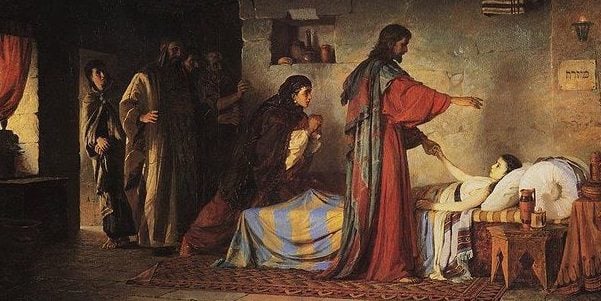
The Resurrection of Jairus’s Daughter, by Vasily Polenov, Wikimedia Commons, Public Domain Tag

Pastors have a frequent question when they begin to discover mimetic theory. “That’s great. But how does it preach?”
Reverends Tom and Laura Truby shows that mimetic theory is a powerful tool that enables pastors to preach the Gospel in a way that is meaningful and refreshing to the modern world. Each Wednesday, Teaching Nonviolent Atonement will highlight Tom and Laura’s sermons as an example of preaching the Gospel through mimetic theory.
In this sermon they explore crowd behavior and mimesis. Tom and Laura’s explanation that Jairus led the crowd in a concern of compassion as opposed to an accusation shows the power of mimesis to engage a crowd for good or for ill. Fortunately, in this case, it was for good. Tom and Laura show that Jairus and the hemorrhaging woman provide compassionate models of faith for our modern world.
Year B, Pentecost 5
June 28th, 2015
By Thomas L. Truby
Mark 5:21-43 (The Common English Bible, copyright 2011)
Is Faith Stepping Out of the Crowd?
Our gospel begins with “Jesus crosses the lake again, and on the other side a large crowd gathered around him on shore.” He left to get away from a crowd. Now he is back.
I used to regard these large crowds as Jesus’ admirers and therefore benign. Now I see them as unpredictable and potentially dangerous. They are not crowds at the fair. They are highly charged crowds and volatile. Such crowds have a mind of their own, or more accurately, no mind at all. Terrible things have been done by such crowds.
But something surprising happens in this crowd. It moves in a positive direction. “Jairus, one of the synagogue leaders, came forward. When Jairus saw Jesus, he fell at his feet and pleaded with him, ‘My daughter is about to die. Please, come and place your hands on her so that she can be healed and live.’” Jairus steps out of the crowd and pleads from his heart. A friend of mine (Robert Hamerton-Kelly) says “faith is stepping out of the crowd.” Is that true? Is faith stepping out of the crowd?
After Jairus steps out everyone in the crowd is now concerned for the dying daughter and hoping Jesus will go. They are all for the one who is in trouble. The one who is in trouble has given them a shape and a direction. The crowd now has a focus.
Jairus could have moved in the opposite direction. He could have pointed an accusing finger and they would have found unity in being against someone. Unity can be found in excluding and destroying or reconciling and healing. We see examples of both in the modern church. Often we don’t realize there is a huge abyss between the two. Jesus and his followers are about the latter. They think the church finds its’ unity in being for those whose life is threatened; whether it is one person, a whole race, or even a nation. Think of the implications for the church in our accusing world.
When the leader steps out, Jesus immediately “went with him.” Jairus, willing to be dependent and ask for help, becomes the one leading Jesus to his daughter. When we take leadership from our heart and dare ask for what we want, Jesus responds.
They aren’t alone as they move toward the dying daughter. “A swarm of people were following Jesus crowding in on him.” A dangerous feel returns to the narrative. Wasps swarm and people crowding in on us cause us to feel claustrophobic. Get me out of here!
In the midst of the crowd a woman who has been bleeding internally for twelve years hopes to touch Jesus and be healed. She has been to every doctor and spent all her money but the bleeding has gotten worse. Her suffering is secret and shameful. Being untouchable in her condition she shouldn’t even be in the crowd. She is desperate but dares not declare it publicly. She is poor, alone and at the outer edges of her culture. She is like many in our culture that we fail to see. (This is tangential but shows how President Obama’s funeral speech has impacted me. This scene reminds me of how we have failed to see the effect of flying the confederate flag on those whose ancestry has been as slaves.)
“Because she had heard about Jesus, she came up behind him in the crowd and touched his clothes. She was thinking, If I can just touch his clothes, I’ll be healed. Her bleeding stopped immediately, and she sensed in her body that her illness had been healed. At that very moment, Jesus recognized that power had gone out of him. He turned around in the crowd and said, ‘who touched my clothes?’”
Is she a poor woman, like our poor on welfare or without, caught in the act of stealing power from the powerful? Has she taken something she should not take? Why does Jesus insist on exposing whoever did this? Do I read it right in thinking it a demand for full disclosure or should I read it more softly and as coming from a place of love and gentleness; a request for information? How I read this may say more about me than I care to admit.
His disciples respond with a quizzical look and sharp tongues. They talk back. “Don’t you see the crowd is pressing against you? Yet you ask, ‘Who touched me?’ But Jesus looked around carefully to see who had done it.”
The word “carefully” suggests Jesus wants to know who drew power from him not because his power meter had just surged but because he wants to know who has been in trouble. He cares about the person into whom power has surged.
The woman also experienced Jesus’ question as accusing as in “who stole power from me?” Her feeling is colored by her experience in the world where she finds herself pushed to the bottom and stripped of all power. People always monitor power and in the world no one gives it away freely. There are always strings attached and quid-pro-quos expected.
“The woman, full of fear and trembling, came forward. Knowing what had happened to her she fell down in front of Jesus and told him the whole truth.” When you are poor, desperate and caught stealing what your culture says you have no right to, what do you do? You fall down in fear and trembling and confess all, hoping that the powerful one will not crush you.
But it was all unnecessary and revealed the fear and subjugation in which this woman had lived her life. She had lived in the kingdom of humans governed by Caesars, hierarchy and fear but the one who stood before her was from another kingdom. His kingdom operated out of a different system of governance that saw all as worthy of love and respect.
With the woman kneeling before him, he says, “Daughter, your faith has healed you.” A daughter doesn’t have to kneel before someone who loves her. Fathers want their daughters to stand tall. That’s why Jesus had insisted that the woman declare herself. He wanted her to claim her place as a daughter.
“Your faith has healed you,” he says. “Go in peace, healed from your disease.” You did it! he says. In your own secret way you dared step out of the crowd, think your own thoughts and do what you knew would heal you. Is faith stepping out of the crowd?
“While Jesus was still speaking with her, messengers came from the synagogue leader’s house, saying to Jairus, ‘Your daughter has died. Why bother the teacher any longer?”
The action now moves from the penniless woman twelve years ostracized to the daughter of the culture’s leader who has just died at the age of twelve. Is St. Mark suggesting that until the least and overlooked are included and treated as daughters the whole culture is sick and dying? Is what Jesus does next Jesus’ way of saying that he has come to heal the divisions in all human culture?
“Jesus overheard their report and said to the synagogue leader, ‘Don’t be afraid; just keep trusting.’” He then dismisses the crowd who has been following them. I think he is excluding them lest they recruit him as their heroic leader.
“They came to the synagogue leader’s house, and he saw a commotion, with people crying and wailing loudly. He went in and said to them, ‘What’s all this commotion and crying about? The child isn’t dead. She is only sleeping.’”
The mourners laugh at him. The thing Jesus did next surprises me. “He threw them all out.” That’s right. He threw them out! This isn’t the only place he throws people out. In the temple he later throws out the money changers signaling that religion based on sacrifice is over. Here he throws out the mourners. Is he announcing that the reign of death has come to an end?
Only the child’s parents, his disciples and Jesus remain in the room with the child. “Taking her hand, he said to her, ‘Talitha Koum,’ which means, “Young woman, get up.” Suddenly the young woman got up and began to walk around.”
“They were shocked! He gave them strict orders that no one should know what had happened.” Why did Jesus impose his gag order? Maybe he didn’t want people to misunderstand power. They would think power was the capacity to impose your will on another and miss the part that real power is driven by love. Until they see love demonstrated in the crucifixion they can’t possibly understand power. Best keep it under wraps for now!
“He told them to give her something to eat.” Was it the bread of life? Amen.
Stay in the loop! Like Teaching Nonviolent Atonement on Facebook.
Previous Post

June 30, 2015
Demons of War: A Silent Killer of Soldiers: Moral Injury
Next Post
July 2, 2015 Hemorrhaging Black Blood: Telling the Truth About Racism and White Privilege
Browse Our Archives
Select a Category Atonement and Current Events Curriculum Faith and Families Interviews Jesus the Forgiving Victim Lent Montessori politics Reviews The Bible Explained Uncategorized Valentine's Day Wednesday Sermon Who is God?
Select a Month July 2020 November 2019 October 2019 September 2019 August 2019 July 2019 June 2019 May 2019 April 2019 March 2019 February 2019 January 2019 December 2018 November 2018 October 2018 September 2018 August 2018 July 2018 June 2018 May 2018 April 2018 March 2018 February 2018 January 2018 December 2017 November 2017 October 2017 September 2017 August 2017 July 2017 June 2017 May 2017 April 2017 March 2017 February 2017 January 2017 December 2016 November 2016 October 2016 September 2016 August 2016 June 2016 May 2016 April 2016 March 2016 February 2016 January 2016 December 2015 November 2015 October 2015 September 2015 August 2015 July 2015 June 2015 May 2015 April 2015 March 2015 February 2015 January 2015 December 2014 November 2014 October 2014 September 2014 August 2014 July 2014 June 2014 May 2014 April 2014 March 2014 January 2014 December 2013 September 2013 August 2013 July 2013
Follow Us!
TAKE THE
Religious Wisdom Quiz
What sea bordered the land of Canaan to the west?
Select your answer to see how you score.
Dead Sea Mediterranean Sea Red Sea Sea of Galilee
Related posts from Teaching Nonviolent Atonement

Forgiveness in the Time of COVID-19 by Julia...

Reflections on Indigenous Wisdom For Healing A Wounded...

How Forgiveness Can Transform Our Violence and Build...

Jesus Unmasked: God's Economy and How to Cheat...
TRENDING AT PATHEOS Progressive Christian

What Being a Modern-Day Apostle Means to Me
In my last column, I discussed the ins and outs of modern-day...

Did Ancient China Once Worship the God of...
Across human history, a common thread weaves through the origins of the...

Love Your Neighbor – Including Earth-Kin: Lev. 19,...
God’s command to love your neighbor means acting in an ethical and...

Lead a Church Study of “Jesus and Lao...
Guest writer Jack Thomas (The Irreverent Reverend) reflects on leading his church...

Pastoral Wisdom for Responding to Sermon Pushback
Getting sermon pushback on your social justice sermon? Learn practical, Proverbs-based strategies...

Principles for Understanding the Apostolic Ministry Today
Whenever people discover that my formal ministry title is "apostle," as in...
view all Progressive Christian blogs
Ad-Free & Subscriber Log-In Subscription Support
- About Us
- 2026 Calendar
- Videos
- Podcasts
- Library of World Religions
- Faith In Media Tracker
- Advertise With Us
- Write for Us
- Privacy Policy
- Terms of Service
- Do Not Sell My Data
- Contact Us
- Radiant Digital
- Manage Newsletter Subscriptions
- Unsubscribe From Notifications
- Sitemap
Copyright 2008-2026, Patheos. All rights reserved.
Subscription Support Ad-Free & Subscriber Log-In
Follow Patheos