
BuddhistCatholicContemplativeEvangelicalGeneral ChristianHinduJewishLatter-day SaintMuslimNew VisionsProgressive Christian
Beliefs
- Buddhist
- Catholic
- Contemplative
- Evangelical
- General Christian
- Hindu
- Jewish
- Latter-day Saint
- More Voices
- Muslim
- New Visions
- Pagan
- Progressive Christian
Topics
- Religion News
- Food and Religion
- Sports and Religion
- Religious Art
- Religious Music and Entertainment
- Religious Events
- History and Religion
- Style and Religion
- Politics and Religion
- Women in Religion
- Recreation Outdoors and Religion
- Business Finance and Religion
- Careers Workplace and Religion
- Education and Religion
- Family Parenting and Religion
- Health Fitness and Religion
- Home and Religion
- Relationships and Religion
- Technology and Religion
- Travel and Religion
Columnists
- Buddhist Columnists
- Business Finance and Religion Columnists
- Careers Workplace and Religion Columnists
- Catholic Columnists
- Contemplative Columnists
- Education and Religion Columnists
- Evangelists Columnists
- Family Parenting and Religion Columnists
- General Christian Columnists
- Health Fitness and Religion Columnists
- Hindu Columnists
- History and Religion Columnists
- Home and Religion Columnists
- Jewish Columnists
- More Voices Columnists
- Latter Day Columnists
- Muslim Columnists
- New Visions Columnists
- Nonreligious Columnists
- Pagan Columnists
- Politics and Religion Columnists
- Progressive Columnists
- Recreation Outdoors and Religion Columnists
- Relationships and Religion Columnists
- Religion News Columnists
- Religious Art Columnists
- Religious Events Columnists
- Religious Music and Entertainment Columnists
- Sports and Religion Columnists
- Style and Religion Columnists
- Technology and Religion Columnists
- Travel and Religion Columnists
- Women in Religion Columnists
Resource Library
- 2026 Calendar
- Library of World Religions
- The 100 Most Holy Places on Earth
- Patheos Answers
- Podcasts
- Videos
- Faith Leaders Database
- Anglican Episcopalian
- Bahai
- Baptist
- Buddhism
- Christianity
- Confucianism
- Eastern Orthodoxy
- Hinduism
- Holiness and Pentecostal
- ISKCON
- Islam
- Judaism
- Lutheran
- Methodist
- The Church of Jesus Christ of Latter-day Saints
- New Age
- Paganism
- Presbytarian and Reformed
- Protestantism
- Religion Behind the Scenes
- Roman Catholic
- Scientology
- Shia Islam
- Sikhism
- Sufism
- Sunni Islam
- Taoism
- Zen
- See all religions
Research Tools
 Ad-Free & Subscriber Log-In Subscription Support
Ad-Free & Subscriber Log-In Subscription Support
Follow Patheos 

- Trending:
- Forgiveness
- |
- Marriage
- |
- Consciousness
- |
- Death Penalty
- |
- Election
- |
- Halloween
 Teaching Nonviolent Atonement
- Home
- Progressive Christian
- My Baccalaureate Address: A Life Worth Living: On Tragedy, Revenge, and Love
My Baccalaureate Address: A Life Worth Living: On Tragedy, Revenge, and Love
Last updated on: June 1, 2015 at 4:14 pm by Adam Ericksen
My Baccalaureate Address: A Life Worth Living: On Tragedy, Revenge, and Love 2015-06-01T16:14:53-05:00 Adam Ericksen
Patheos Explore the world's faith through different perspectives on religion and spirituality! Patheos has the views of the prevalent religions and spiritualities of the world.
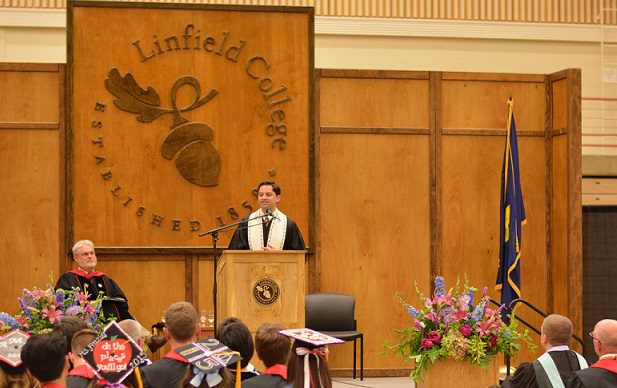 I was invited by Linfield College, my alma mater, to deliver the Baccalaureate Address to the graduating class of 2015. The text was based on Leviticus 19:18 and Matthew 5:43-48. This was a great honor for me and I wanted to share the text with you –
My soon to be fellow Linfield graduates, it’s an honor to be with you tonight. It feels great to be back on this beautiful campus. I’m biased, but I deliver lectures on campuses throughout the country and I think this is the most beautiful campus in the US. The buildings, the grass, the trees, the flowers…The ground keepers do an amazing job keeping Linfield beautiful. I want to thank Chaplain David Massey and President Hellie for inviting me to talk with you tonight.
Tomorrow you will be a Linfield College graduate. And I want us to take a deep breath, step back, and acknowledge this accomplishment in your life. Your family, friends, and loved ones have come to help you celebrate. Professors, staff, and administrators who have walked with you through your Linfield experience are here to continue the journey with you.
Here’s an important stat for you – Do you realize that only 7 percent of people in the world have a college degree?
Let that sink in for a moment. 7 percent. Congratulate yourself. And give your neighbor a high five. Say to your neighbor, “You are the 7 percent.”
I recently had a conversation with a Linfield graduate’s father. This man’s daughter didn’t actually want to go to Linfield. She was enticed by some other schools. He said something that rang true with my Linfield experience. He said that when he met with the administration at those other schools, they boasted about how great their school was. They each claimed to be well respected colleges and they bragged about the famous people on their Board of Trustees.
But when he met with the administration at Linfield, they didn’t talk about how great Linfield was. Rather, they talked about how great their students were and how much Linfield cared about them. The Dean of Students gave concrete details about how Linfield cares about its students and wants them to succeed in college and in life. This man was sold by a sense that Linfield genuinely cares about its students and with some persuading, his daughter attended Linfield. And I’m glad she did because during my junior year I asked her if she’d like to go to Taco Bell and then do some shopping at Walmart with me – because that’s how I show people a good time. Surprisingly, she said yes. I knew then that she was the one. Three years later I asked her to marry me. Surprisingly, she said yes again. I’ve been married to my Linfield sweetheart for 13 years. We still love Taco Bell, but now Carrie and I do most of our shopping at Costco.
But my father-in-law’s statement that Linfield cares about its students was proved true by my experience. I first walked onto Linfield’s campus as a student 18 years ago. If you are like me, the four years I spent at Linfield went by so fast. My freshman year I moved into Campbell Hall – did anyone here live in Campbell? – yeah, give it up for Campbell Hall everyone…My sophomore year I became a Resident Advisor. Any RA’s here? If you were an RA give yourselves a round of applause. Okay, the rest of you can boo. Please know that we RAs hated writing you up. It hurt us much more than it hurt you…
God, Suffering, and Answers that Matter
I began Linfield as a history major. I enjoyed history, but at the end of my sophomore year I experienced a personal tragedy. My mother died after a 10 year battle with cancer. I began to ask questions about God, suffering, and death. If God is good, then why is there so much evil in the world? Does God even care? Why is there cancer? Why do people suffer? And what, if anything, am I supposed to do about it?
Linfield didn’t so much offer me intellectual answers to those questions about my mother’s death. It offered me something so much more important. It offered me care. It offered me love.
I remember telling my friends at the Fellowship of Christian Athletes when she died. There must have been 80 of us in that small living room. People gasped as I reported her death from earlier in the day. Then there were hugs. I needed those hugs.
My junior year I switched my major to religious studies. My professors Bill Apel, Bill Millar, David Massey, and Stephen Snyder were much more than professors. They were caring guides who offered a compassionate presence. They walked with me as I struggled through the emotions of processing my mother’s death. They allowed space for me to ask my questions, but they didn’t force answers on me. They cared. And that was the most important answer that they could have given.
My professors taught me how to care for others during our classes, too. For example, I took World Religions with Bill Apel. We got to the section on Buddhism and Bill said to the class, “Here’s what Buddhism is like.” He then stood up, left our classroom, and shut the door. That, in and of itself is very Buddhist, but after a few seconds, he reentered, looked at us, and said, “Hi. How are you doing today?”
I remember thinking in that moment, “Oh, that’s cool. Buddhism is awesome. I want to become a Buddhist. I think I’ll convert…” But I was too lazy.
My professors were very important to me, and staff members were just as important in being a compassionate presence during this time. Delaine Hein, Dan Fergueson, Dan Preston, Jeff Mackay, and so many others offered caring words and a shoulder to cry on. Even the president at the time, Vivian Bull, spent extra time with me as I grieved.
As I continued struggling through my personal tragedy, a national tragedy struck our nation. At the beginning of my senior year, on 9/11/2001, a group of religious fanatics flew a plane into the World Trade Center. I remember waking up on that horrific morning in our HP apartment and walking to the living room. My three roommates were already there with their eyes glued to the television screen as the tragedy unfolded.
Once again, in the face of tragedy, I witnessed Linfield’s care for students. David Massey performed a memorial service on the Oak Grove. Many students, faculty, and professors came to mourn. During the ceremony, David asked if anyone would like to make any comments. A commuter student from Newberg stepped forward. She was visibly shaken and in tears as she told us about a family member who moved to New York to work in the towers. He was killed as the towers fell. I remember her weeping in front of us. Her pain was so real and there was nothing we could do to take her pain away. And so we tried to care for her the best way we knew how – we listened to her story and tried to offer her a compassionate presence.
A few days later there was an all campus meeting in the basement of Melrose Hall to talk about religion and reconciliation. There were Muslim students there. They expressed deep sorrow that people hijacked their religion and caused such destruction and death. The grief on their faces was palpable. They were in pain. And in the midst of their pain my Muslim classmates didn’t need any condemnation or hostility. They needed care. They needed love. They needed acceptance. They needed a compassionate presence. And that’s what we tried to give them.
Life’s Most Important Lessons
It was at Linfield where I learned my most important lessons in life. It’s where I learned how to care about myself and others. It’s where I learned how to deal with tragedy. And you have learned that, too. You have gone through personal tragedies and tragedies that have struck this community. And in the face of that tragedy, Linfield has taught you one of its most important life lessons: how to care for yourself and others by offering a compassionate presence.
Since graduating from Linfield, I’ve learned that it’s not a matter of *if* tragedy will strike again. It’s a matter of *when.* For example, during the last year, I have worked as a hospital chaplain in Eugene. My first call to our Emergency Department was for a 23 year old patient who had a massive heart attack during a Ducks football game.
Unfortunately, he died. At age 23. My job in that moment, was to put into action what Linfield taught me – my job was not to come up with answers, but to be a compassionate presence and journey with his girlfriend, his family, and his friends as they grieved his death.
Listen, I don’t tell you that story to scare you. I’m telling you that story because life is fragile. Life is a precious gift.
As far as I know, we only have this one precious life. Your mission is to make this one precious life you have a life worth living. This is the wisdom I’ve learned from my elderly patients at the hospital who are nearing death. They don’t fear death. Instead, many of them fear that they haven’t lived a life worth living. By the phrase “life worth living,” none of these elderly patients mean such things as: Did I make enough money? Could I have bought a bigger house? Could I have exerted more political influences? Could I have won more arguments during my life?
No, what they mean by a “life worth living” is did they care enough for people. Did they love others enough? Have they reconciled with family and friends?
Because, you see, a life worth living isn’t based on worldly standards of success. I know many rich people who are consumed with their money. They’re unhappy people. They are isolated and lonely because they have alienated themselves from family and friends. They are bitter and angry because they live in fear of losing their worldly success.
And I know a lot of rich people who aren’t consumed with their money. They are generous people. They don’t live in fear of losing anything. Rather, they give their time, money, and talent to help make their community a better place.
A Life Worth Living
So, please hear this: The world doesn’t need any more bitter, fearful, and angry people in it. The world doesn’t need any more people who define themselves by their money, cars, houses or other material goods. Rather, the world needs more people to live a life worth living by being what Linfield has taught us to be: a compassionate presence as we care for ourselves and others.
Our Hebrew Scripture text this evening puts it like this: “Do not seek revenge or bear a grudge against any of your people, but you shall love your neighbor as yourself.”
We tend to rush to the second part of the verse that commands us to love your neighbor as you love yourself. That’s a crucial statement, but notice the first part of the verse – “Do not seek revenge or bear a grudge.” That’s so important because seeking revenge and bearing a grudge is what we humans tend to do. It is our natural default position. It’s often hard to be a compassionate presence because we tend to be reactionary when we feel someone has done us wrong. When someone insults us, we want to return the insult. When someone hits us, we want to hit back. Just look at the news. We see this reaction of revenge on a personal, national, and international scale every day.
Now, I don’t know from personal experience, but I’ve heard that even married couples get into bitter cycles of revenge. At least, I’ve seen it on television. One person might say something in the morning that the other person finds insulting. Then for the rest of the day, the person who felt insulted will think of ways to get revenge, usually by bringing up old wounds. She might bring up his ex-girlfriend. Or he might bring up how she got fired from her previous job. This cycle of revenge can consume any relationship, but especially a marriage, with a spirit of bitterness and hostility, as opposed to a spirit of love and compassion.
We know from human history that this cycle of revenge easily escalates on a personal, communal, national, and international level until real damage is done resulting in horrific violence and tragedy. But it doesn’t have to escalate. Someone can be courageous enough to stop the cycle of revenge.
And the world needs you to stop the cycle. The world needs you to live out the phrase, “Do not seek revenge or bear a grudge.” We’ve been seeking revenge and bearing grudges since the beginning of human history. The human reactionary position is to blame someone else for our problems. We scapegoat others thinking that if we get rid of them our problems will be solved. Unfortunately, when we defeat one enemy, another one emerges to take its place.
That’s the nature of revenge and the wisdom behind our scriptural passage. Revenge never solves our problems; it only creates more problems and tragedies in the world. A life of revenge and grudges is not a life worth living.
Which is why the second part of our passage is so important. Instead of seeking revenge and bearing a grudge, the Judeo-Christian tradition teaches us to love our neighbor as we love ourselves. Jesus even extends this message by saying, “Love your enemies.” I’m convinced that the world would be a much better place if a group of people actually decided that they would stop seeking revenge and instead seek to be a compassionate presence in the world as they love others as they love themselves. Whether your next step in life is a job, graduate school, travel the world, or move back in with your parents, to love your neighbor as you love yourself is your basic life mission.
Now, I’m not trying to tell you to solve the world’s problems. God knows we have some serious and complicated problems. If we try to solve the world’s problems we can begin to feel overwhelmed and hopeless about them.
Don’t begin by trying to solve the world’s problems. A life worth living begins by managing your own problems. You can’t control how others will react to you. The only person you can control is yourself. So, when you find yourself reacting by seeking revenge or bearing a grudge, stop. Don’t project your own problems onto others. Don’t scapegoat. Don’t blame someone else. Instead, remember what Linfield and our scriptural passages have taught you. Put down your verbal bullets and bombs. There are enough bullets and bombs in the world. We don’t need any more.
What we need are people who care. The world needs the 7 percent of people with college degrees to use our brains to find creative ways to love our neighbors as we love ourselves. That’s what the world needs from you because the world’s transformation starts with each of us managing our own impulse to revenge and learning how to respond to tragedy and violence with love and care.
So, may you take your Linfield experience with you knowing that you have a mission. May you move forward with your life, refusing to participate in the ugly cycle of revenge and scapegoating. And in the face of tragedy and violence that you will experience, may you live a life worth living as you participate in the spiritual tradition that calls us to love our neighbors as we love ourselves.
Amen
Previous Post

May 29, 2015
Buddhism and Christianity - On Loss, Grief, and Atonement
Next Post
June 4, 2015 A Natural Peace: Evidence for the Abnormality of Violence
Browse Our Archives
Select a Category Atonement and Current Events Curriculum Faith and Families Interviews Jesus the Forgiving Victim Lent Montessori politics Reviews The Bible Explained Uncategorized Valentine's Day Wednesday Sermon Who is God?
Select a Month July 2020 November 2019 October 2019 September 2019 August 2019 July 2019 June 2019 May 2019 April 2019 March 2019 February 2019 January 2019 December 2018 November 2018 October 2018 September 2018 August 2018 July 2018 June 2018 May 2018 April 2018 March 2018 February 2018 January 2018 December 2017 November 2017 October 2017 September 2017 August 2017 July 2017 June 2017 May 2017 April 2017 March 2017 February 2017 January 2017 December 2016 November 2016 October 2016 September 2016 August 2016 June 2016 May 2016 April 2016 March 2016 February 2016 January 2016 December 2015 November 2015 October 2015 September 2015 August 2015 July 2015 June 2015 May 2015 April 2015 March 2015 February 2015 January 2015 December 2014 November 2014 October 2014 September 2014 August 2014 July 2014 June 2014 May 2014 April 2014 March 2014 January 2014 December 2013 September 2013 August 2013 July 2013
Follow Us!
TAKE THE
Religious Wisdom Quiz
How beautiful on the mountains are the feet of those who bring good news and proclaim what?
Select your answer to see how you score.
Deliverance Peace Salvation Victory
Related posts from Teaching Nonviolent Atonement

Forgiveness in the Time of COVID-19 by Julia...

Jesus Unmasked: On Being Lost And Found: Sheep,...

Jesus Unmasked: Humility Is Not A Competition [Video]

Jesus Unmasked: Jesus Brings the Fire!
TRENDING AT PATHEOS Progressive Christian

What Being a Modern-Day Apostle Means to Me
In my last column, I discussed the ins and outs of modern-day...

Did Ancient China Once Worship the God of...
Across human history, a common thread weaves through the origins of the...

Love Your Neighbor – Including Earth-Kin: Lev. 19,...
God’s command to love your neighbor means acting in an ethical and...

Lead a Church Study of “Jesus and Lao...
Guest writer Jack Thomas (The Irreverent Reverend) reflects on leading his church...

Pastoral Wisdom for Responding to Sermon Pushback
Getting sermon pushback on your social justice sermon? Learn practical, Proverbs-based strategies...

Principles for Understanding the Apostolic Ministry Today
Whenever people discover that my formal ministry title is "apostle," as in...
view all Progressive Christian blogs
Ad-Free & Subscriber Log-In Subscription Support
- About Us
- 2026 Calendar
- Videos
- Podcasts
- Library of World Religions
- Faith In Media Tracker
- Advertise With Us
- Write for Us
- Privacy Policy
- Terms of Service
- Do Not Sell My Data
- Contact Us
- Radiant Digital
- Manage Newsletter Subscriptions
- Unsubscribe From Notifications
- Sitemap
Copyright 2008-2026, Patheos. All rights reserved.
Subscription Support Ad-Free & Subscriber Log-In
Follow Patheos