
BuddhistCatholicContemplativeEvangelicalGeneral ChristianHinduJewishLatter-day SaintMuslimNew VisionsProgressive Christian
Beliefs
- Buddhist
- Catholic
- Contemplative
- Evangelical
- General Christian
- Hindu
- Jewish
- Latter-day Saint
- More Voices
- Muslim
- New Visions
- Pagan
- Progressive Christian
Topics
- Religion News
- Food and Religion
- Sports and Religion
- Religious Art
- Religious Music and Entertainment
- Religious Events
- History and Religion
- Style and Religion
- Politics and Religion
- Women in Religion
- Recreation Outdoors and Religion
- Business Finance and Religion
- Careers Workplace and Religion
- Education and Religion
- Family Parenting and Religion
- Health Fitness and Religion
- Home and Religion
- Relationships and Religion
- Technology and Religion
- Travel and Religion
Columnists
- Buddhist Columnists
- Business Finance and Religion Columnists
- Careers Workplace and Religion Columnists
- Catholic Columnists
- Contemplative Columnists
- Education and Religion Columnists
- Evangelists Columnists
- Family Parenting and Religion Columnists
- General Christian Columnists
- Health Fitness and Religion Columnists
- Hindu Columnists
- History and Religion Columnists
- Home and Religion Columnists
- Jewish Columnists
- More Voices Columnists
- Latter Day Columnists
- Muslim Columnists
- New Visions Columnists
- Nonreligious Columnists
- Pagan Columnists
- Politics and Religion Columnists
- Progressive Columnists
- Recreation Outdoors and Religion Columnists
- Relationships and Religion Columnists
- Religion News Columnists
- Religious Art Columnists
- Religious Events Columnists
- Religious Music and Entertainment Columnists
- Sports and Religion Columnists
- Style and Religion Columnists
- Technology and Religion Columnists
- Travel and Religion Columnists
- Women in Religion Columnists
Resource Library
- 2026 Calendar
- Library of World Religions
- The 100 Most Holy Places on Earth
- Patheos Answers
- Podcasts
- Videos
- Faith Leaders Database
- Anglican Episcopalian
- Bahai
- Baptist
- Buddhism
- Christianity
- Confucianism
- Eastern Orthodoxy
- Hinduism
- Holiness and Pentecostal
- ISKCON
- Islam
- Judaism
- Lutheran
- Methodist
- The Church of Jesus Christ of Latter-day Saints
- New Age
- Paganism
- Presbytarian and Reformed
- Protestantism
- Religion Behind the Scenes
- Roman Catholic
- Scientology
- Shia Islam
- Sikhism
- Sufism
- Sunni Islam
- Taoism
- Zen
- See all religions
Research Tools
 Ad-Free & Subscriber Log-In Subscription Support
Ad-Free & Subscriber Log-In Subscription Support
Follow Patheos 

- Trending:
- Forgiveness
- |
- Marriage
- |
- Consciousness
- |
- Death Penalty
- |
- Election
- |
- Halloween
 Teaching Nonviolent Atonement
- Home
- Progressive Christian
- What about the Canaanites?: On the Bible, Violence, and Genocide
What about the Canaanites?: On the Bible, Violence, and Genocide
Last updated on: May 6, 2015 at 12:20 am by Adam Ericksen
What about the Canaanites?: On the Bible, Violence, and Genocide 2015-05-06T00:20:09-05:00 Adam Ericksen
Patheos Explore the world's faith through different perspectives on religion and spirituality! Patheos has the views of the prevalent religions and spiritualities of the world.
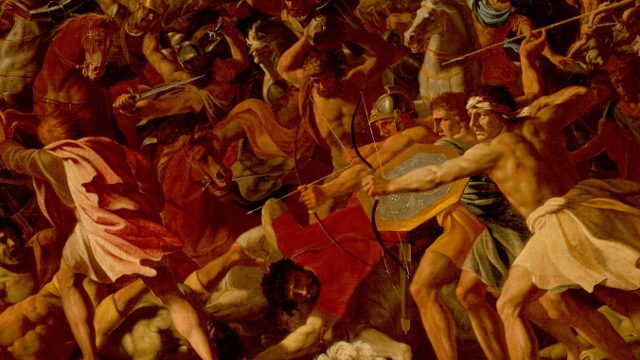
Nicolas Poussin, The Victory of Joshua Over the Amalekites (Public Domain: Wikimedia Commons)

Suzanne and I recently delivered a workshop on the Bible and violence at the Faith Forward conference in Chicago. We highlighted the differences between the Roman myth of Romulus and Remus and the biblical story of Cain and Abel.
You can read the description of our workshop here, but to summarize, in the Roman myth, Romulus kills his brother Remus, founds the city of Rome, and the god Mars vindicates Romulus by welcoming him to heaven and divinizing him as the god Quirinus. The biblical account is similar, but has important differences. Cain kills his brother Abel, founds a city, but God doesn’t vindicate the murderer. Rather, God actually vindicates the victim by hearing Abel’s blood crying out from the earth.
In the Roman myth, the god vindicates the persecutor’s violence and ignores the victim. In the biblical account, God hears the voice of the victim and seeks to heal and protect the repentant persecutor from a cycle of violence that might turn against him.
The differences couldn’t be more profound.
But as we talked about those difference, someone asked an important question, “You are telling us about the compassionate God of the Bible, but what about the Canaanites?”
It is the most troubling story in the Bible. As they enter the Promised Land, God commands the Israelites to kill everything that breathes – including women, children, men, and animals. As if God wasn’t clear enough, God instructs Israel to kill more than just the Canaanites. God says to “annihilate them—the Hittites and the Amorites, the Canaanites and the Perrizites, the Hivites and the Jebusites—just as the Lord your God commanded, so that they may not teach you to do abhorrent things that they do for their gods, and you do thus sin against the Lord your God.”
Our questioner was right. How can we talk about a biblical God of compassion in the face of genocide and Holy War? What about the Canaanites, Hittites, Amorites, Perrizites, Hivites, and Jebusites?
Great question.
Peter Enns does a remarkable job exploring some answers in his masterful book The Bible Tells Me So: Why Defending Scripture Has Made Us Unable to Read It. Peter discusses the various answers historically offered to justify God’s demand for genocide, but there are two answers in particular that interest me.
Did God Actually Command Genocide?
First, it’s important to note that while the Bible tells a horrific story of the conquest of Canaan, there is no evidence outside of the Bible that the conquest actually happened. Generations of scholars have known that there are no textual sources to corroborate the conquest. So, scholars looked to archeology to support the biblical claim. But archeology has come up empty, too. Peter states,
Biblical archeologists are about as certain as you can be about these things that the conquest of Canaan as the Bible describes it did not happen: no mass invasion from the outside by an Israelite army, and no extermination of Canaanites as God commanded.
Archeologists could be wrong, of course. Maybe archeological evidence of a conquest will emerge. Still, with such a massive conquest, you would expect archeological evidence to be easy to find. The lack of archeological evidence sheds serious doubt on the historical facts of the conquest. But if we claim that the conquest never happened, we’re still left with an important question – Why is the genocide in the Bible? Peter postulates,
It seems that, as time went on and Israel became a nation (after 1,000 BCE) stories of these earlier skirmishes grew and turned into exaggerated stories of Israel’s wars against the Canaanites in days of old…What most everyone is certain about, however, is that the Bible’s version of events is not what happened. And that puts the question, “How could God have all those Canaanites put to death?” in a different light indeed. He didn’t.
In a similar vein, James Alison talks about the “conquest” of Canaan in his book Jesus the Forgiving Victim. James also highlights the lack of archeological evidence and provides another explanation for the violent story. He states that the story as we have it was finally solidified by the ancient Jews, known as Judeans, who were returning from the Babylonian exile. As they entered into the Promised Land, they told the story to those who remained in the land during the exile. Understandably, those who remained in the land feared those who were returning from exile. James states that the story’s purpose,
[W]ould have been a way of letting the current occupiers of the land know, among other things: “You needn’t fear us returning Judeans from Babylon, for, as our text shows, so completely did Joshua extirpate the former occupiers of the land, many centuries ago, that if you are there now, you must in fact really be part of us already.” In other words…the account of the ancient conquest becomes a backdrop to a modern co-opting without conquest.
If Peter and James are right, God didn’t call for genocide. Nor was the point of the story to strike fear in Israel’s enemies. Rather, the point was to alleviate the fears of those who were left behind in Judea during the Babylonian Exile.
Jesus and the Canaanites
Which leads me to Peter’s second point – Jesus and the Canaanites. Interestingly, there were no Canaanites in the first century. They were long gone as a people. And yet, in the Gospel of Matthew, Jesus met a Canaanite woman. Peter claims this “Is the only time Israel’s ancient foes are mentioned in the New Testament.”
The woman wasn’t actually a Canaanite. In fact, Mark and Luke claim she was a Syro-Phoenician. But Matthew intentionally called her a Canaanite, not because he was lying, but because he had a point to make about their “ancient foes” – that the Canaanites might actually have been exemplars of faith.
The Canaanite woman begged Jesus to heal her daughter, but Jesus refused by saying, “I was sent only to the lost sheep of the house of Israel.” She persisted and Jesus refused again, “It is not fair to take the children’s food and throw it to the dogs.”
Dogs?!? Ouch, Jesus. That wasn’t nice.
But the Canaanite woman softened Jesus’ heart, “Yes, Lord, yet even the dogs eat the crumbs that fall from their master’s table.”
Like Joshua destroyed the walls around Jericho to defeat the Canaanites, this Canaanite woman destroyed the wall around Jesus’ heart. “Woman,” Jesus replied, “great is your faith. Let it be done as you wish.”
What about the Canaanites?
In the end, I don’t know if these answers are satisfying. Whether or not it actually happened, the story of Israel’s conquest over the Canaanites is horrific. But the last word in the Bible about the Canaanites belongs to Jesus, and it’s a positive one. Peter claims that Jesus was fully immersed in his Jewish context when he healed the Canaanite woman’s daughter. Jesus and the Hebrew prophets lead us to a different view of, and a different ethic toward, our enemies:
Jesus, taking a page from some Old Testament prophets (like Isaiah) would complicate things. God’s people are a light that shines into dark places, or salt that makes the whole meal taste good, or a pinch of yeast that makes the entire loaf rise. Wherever God’s people are, it makes a difference—for better, and without violence.
Previous Post

May 4, 2015
Tell Me About Eternity
Next Post
May 7, 2015 Maria’s Choice: Dr. Montessori’s Struggle to Balance Career and Motherhood
Browse Our Archives
Select a Category Atonement and Current Events Curriculum Faith and Families Interviews Jesus the Forgiving Victim Lent Montessori politics Reviews The Bible Explained Uncategorized Valentine's Day Wednesday Sermon Who is God?
Select a Month July 2020 November 2019 October 2019 September 2019 August 2019 July 2019 June 2019 May 2019 April 2019 March 2019 February 2019 January 2019 December 2018 November 2018 October 2018 September 2018 August 2018 July 2018 June 2018 May 2018 April 2018 March 2018 February 2018 January 2018 December 2017 November 2017 October 2017 September 2017 August 2017 July 2017 June 2017 May 2017 April 2017 March 2017 February 2017 January 2017 December 2016 November 2016 October 2016 September 2016 August 2016 June 2016 May 2016 April 2016 March 2016 February 2016 January 2016 December 2015 November 2015 October 2015 September 2015 August 2015 July 2015 June 2015 May 2015 April 2015 March 2015 February 2015 January 2015 December 2014 November 2014 October 2014 September 2014 August 2014 July 2014 June 2014 May 2014 April 2014 March 2014 January 2014 December 2013 September 2013 August 2013 July 2013
Follow Us!
TAKE THE
Religious Wisdom Quiz
What year was the King James Bible first published?
Select your answer to see how you score.
1611 1492 1701 1517
Related posts from Teaching Nonviolent Atonement

Forgiveness in the Time of COVID-19 by Julia...

Reflections on Indigenous Wisdom For Healing A Wounded...

How Forgiveness Can Transform Our Violence and Build...

Jesus Unmasked: God's Economy and How to Cheat...
TRENDING AT PATHEOS Progressive Christian

Why Christians Have a Sacred Duty to Vote:...
The Bible offers strong support for the sacred duty to vote. Here...

What Being a Modern-Day Apostle Means to Me
In my last column, I discussed the ins and outs of modern-day...

Did Ancient China Once Worship the God of...
Across human history, a common thread weaves through the origins of the...

Love Your Neighbor – Including Earth-Kin: Lev. 19,...
God’s command to love your neighbor means acting in an ethical and...

Lead a Church Study of “Jesus and Lao...
Guest writer Jack Thomas (The Irreverent Reverend) reflects on leading his church...

Principles for Understanding the Apostolic Ministry Today
Whenever people discover that my formal ministry title is "apostle," as in...
view all Progressive Christian blogs
Ad-Free & Subscriber Log-In Subscription Support
- About Us
- 2026 Calendar
- Videos
- Podcasts
- Library of World Religions
- Faith In Media Tracker
- Advertise With Us
- Write for Us
- Privacy Policy
- Terms of Service
- Do Not Sell My Data
- Contact Us
- Radiant Digital
- Manage Newsletter Subscriptions
- Unsubscribe From Notifications
- Sitemap
Copyright 2008-2026, Patheos. All rights reserved.
Subscription Support Ad-Free & Subscriber Log-In
Follow Patheos