
BuddhistCatholicContemplativeEvangelicalGeneral ChristianHinduJewishLatter-day SaintMuslimNew VisionsProgressive Christian
Beliefs
- Buddhist
- Catholic
- Contemplative
- Evangelical
- General Christian
- Hindu
- Jewish
- Latter-day Saint
- More Voices
- Muslim
- New Visions
- Pagan
- Progressive Christian
Topics
- Religion News
- Food and Religion
- Sports and Religion
- Religious Art
- Religious Music and Entertainment
- Religious Events
- History and Religion
- Style and Religion
- Politics and Religion
- Women in Religion
- Recreation Outdoors and Religion
- Business Finance and Religion
- Careers Workplace and Religion
- Education and Religion
- Family Parenting and Religion
- Health Fitness and Religion
- Home and Religion
- Relationships and Religion
- Technology and Religion
- Travel and Religion
Columnists
- Buddhist Columnists
- Business Finance and Religion Columnists
- Careers Workplace and Religion Columnists
- Catholic Columnists
- Contemplative Columnists
- Education and Religion Columnists
- Evangelists Columnists
- Family Parenting and Religion Columnists
- General Christian Columnists
- Health Fitness and Religion Columnists
- Hindu Columnists
- History and Religion Columnists
- Home and Religion Columnists
- Jewish Columnists
- More Voices Columnists
- Latter Day Columnists
- Muslim Columnists
- New Visions Columnists
- Nonreligious Columnists
- Pagan Columnists
- Politics and Religion Columnists
- Progressive Columnists
- Recreation Outdoors and Religion Columnists
- Relationships and Religion Columnists
- Religion News Columnists
- Religious Art Columnists
- Religious Events Columnists
- Religious Music and Entertainment Columnists
- Sports and Religion Columnists
- Style and Religion Columnists
- Technology and Religion Columnists
- Travel and Religion Columnists
- Women in Religion Columnists
Resource Library
- 2026 Calendar
- Library of World Religions
- The 100 Most Holy Places on Earth
- Patheos Answers
- Podcasts
- Videos
- Faith Leaders Database
- Anglican Episcopalian
- Bahai
- Baptist
- Buddhism
- Christianity
- Confucianism
- Eastern Orthodoxy
- Hinduism
- Holiness and Pentecostal
- ISKCON
- Islam
- Judaism
- Lutheran
- Methodist
- The Church of Jesus Christ of Latter-day Saints
- New Age
- Paganism
- Presbytarian and Reformed
- Protestantism
- Religion Behind the Scenes
- Roman Catholic
- Scientology
- Shia Islam
- Sikhism
- Sufism
- Sunni Islam
- Taoism
- Zen
- See all religions
Research Tools
 Ad-Free & Subscriber Log-In Subscription Support
Ad-Free & Subscriber Log-In Subscription Support
Follow Patheos 

- Trending:
- Forgiveness
- |
- Marriage
- |
- Consciousness
- |
- Death Penalty
- |
- Election
- |
- Halloween
 Teaching Nonviolent Atonement
- Home
- Progressive Christian
- Why Biblical Violence is Good for Your Kids
Why Biblical Violence is Good for Your Kids
Last updated on: April 23, 2015 at 8:18 am by Adam Ericksen
Why Biblical Violence is Good for Your Kids 2015-04-23T08:18:16-05:00 Adam Ericksen
Patheos Explore the world's faith through different perspectives on religion and spirituality! Patheos has the views of the prevalent religions and spiritualities of the world.
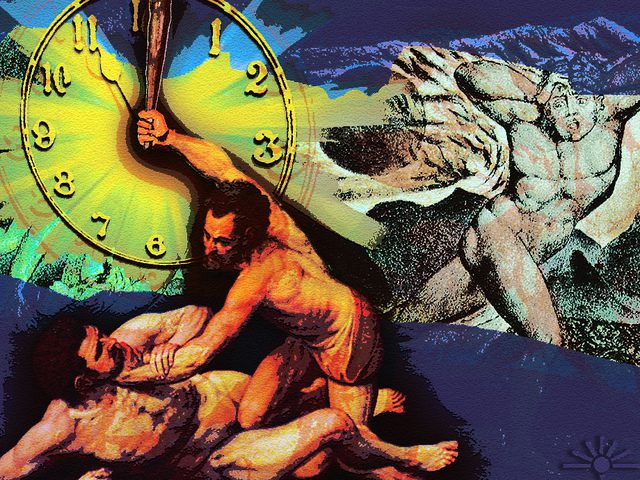
Flilckr: Cain and Abel by AK Rockefeller
What’s all that violence doing in the Bible? Does it make you uncomfortable? How are we supposed to teach these stories to children?
I mean, the first family was marked by violence. Cain killed his brother Abel. How’s that for a dysfunctional family system?
Just two chapters later, God floods the earth, killing everyone and everything on the planet except for one family and two of every animal…And somehow we’ve made that a cute children’s story?
A boy named David kills a mean, nasty giant named Goliath. Hey, kids! You know that bully at your school? Go ahead and fight that jerk! You may think you’re weaker, but God’s on your side. You got this!
And then there’s Abraham’s near-sacrifice of his son Isaac. It takes years of therapy to recover from that one.
But here’s the thing. Violence doesn’t just happen in the Bible. Children see violence all the time on the news, in cartoons, and in video games. Unless children are growing up in a bubble, we can’t stop them from witnessing violence.
Nor should we want to. Violence happens. It happened in biblical times and it happens in our time. The problem isn’t that there’s violence in the Bible. If there wasn’t violence in the Bible we would accuse it of naively hiding the truth that humans have a tendency to be violent.
The problem is how we interpret that violence. Children and adults shouldn’t avoid those violent texts. Rather, we need to learn how deal with them.
Yesterday, Suzanne and I delivered a presentation on biblical violence at the Faith Forward conference. We specifically examined the murder that started it all – Cain and Abel.
We began by explaining that mimetic theory claims that the Bible is a “text in travail.” It struggles with two competing forces. One force seeks to hide the voice of the victim. It tells us the story from the point of view of the perpetrator. The victim is silenced in these stories, which are known as myths. Interestingly, the word “Myth” comes from the Greek root “muo,” which means “to close eyes or mouth” or “to keep secret.” By closing the mouth of the victim and our eyes to the victim’s suffering, myths keep the victim’s story a secret.
The competing force in the biblical narrative keeps our eyes open and listens to the unheard voice of the victim. Generally speaking, victims get to tell their side of the story in the biblical account. I say “generally” because there are plenty of mythical stories in the Bible, but we also frequently hear the voice of the victim. That’s what makes the Bible a text in travail.
To highlight the difference between myths and Bible, we compared the two ancient stories of sibling murder. First, the Roman myth of Romulus and Remus and then the Bible’s story of Cain and Abel. Romulus and Remus were sons of the Roman god of war, Mars. Together, they killed their great uncle, who was a threat to their rule. Then they decided to build a city. Romulus built walls to protect the city, but Remus thought the walls were too short. To prove his point, he jumped over them. Romulus was enraged, so he killed his brother. Romulus continued building the city and named it Rome, after himself. He populated with city with outlaws and fugitives, all of whom were men. Without any women around, what was Rome to do? Romulus came up with a plan. He kidnapped Sabine women. How romantic! Well, the Sabines didn’t like that, so they went to war with Rome. Romulus defeated the Sabines and the Sabines accepted him as their king. When Romulus died, Mars looked with favor upon his beloved son of war and welcomed him to the heavens. Romulus was then deified as the god Quirinus.
The Bible tells a similar story. The founding of the first city was also based on a murder, but this time God doesn’t approve.
Cain became jealous of his brother Abel. God responded to Cain’s jealousy by saying, “Why are you angry? Why is your face downcast? If you do what is right, will you not be accepted? But if you do not do what is right, sin is crouching at your door; it desires to have you, but you must master it.”
From the very beginning of the story, God doesn’t condone violence. Later, Jesus would say, “You have heard it that it was said to those of ancient times, ‘You shall not murder’; and ‘whoever murders will be liable to judgment.’ But I say to you that if you are angry with a brother or sister, you will be liable to judgment.” The Cain and Abel story is a warning against anger, for anger leads to murder.
But Cain didn’t master the sinful anger that was crouching at his door. He was consumed by it. He invited his brother to the field, where he killed Able. God came to Abel and said, “Where is your brother?…What have you done? Listen! Your brother’s blood cries out to me from the ground.”
In the myth, we never hear from Remus after his death. The mythical gods don’t care about Remus. But the Biblical God listens for the voice of the victim, whose blood cries out from the earth. God not only hears the voice of the victim, but disapproves of the murder. God holds the perpetrator of violence accountable. Whereas the myth endorses violence, the Bible disapproves of it.
Cain then freaks out. He has an anxiety fest as he worries that he has unleashed a cycle of violence and cries out, “whoever finds me may kill me.”
Interestingly, God also hears the cry of the perpetrator of violence. God’s purpose for human life isn’t a cycle of violence, but to end violence with nonviolence. So, God “put a mark on Cain so that no one who found him would kill him.”
Cain then built the first city and named it after his son. Romulus named his city after himself – after a murderer – thus locking Rome into a pattern of pride and violence. Cain, on the other hand, named the city after his son, Enoch. In doing so, Cain offered a new pattern of being in the world – one based on humility, repentance, and new beginnings.
Both stories attribute the founding of cities to a murder. In the myth, the murder is condoned, the victim silenced, and the murderer is vindicated in his violence by being elevated to divine status. In the Bible, God disapproves of the murder, speaks for the victim and reveals the truth of the utter nonviolence of God.
But what about those other stories? You know, Noah and the Flood, Abraham and Isaac, and David and Goliath?
The violence is critiqued in all three stories. God actually repents of violence in the flood story. It is the gods (Elohim is the Hebrew word for gods) who call Abraham to sacrifice Isaac. But it is the specific Hebrew God Yahweh who stops the sacrifice. While it seems that God endorses David’s violence and wars, do you remember why David wasn’t allowed to build God’s Temple. He had blood on his hands. It was his son Solomon, whose name comes from the Hebrew word for peace (shalom), who built the Temple.
Biblical violence is good to teach our children because in virtually every biblical story that seems to endorse violence, even God sanctioned violence, there is a critique of that violence. If Christianity is to have any credibility moving forward into the 21st century, it is that critique of violence that we need to teach our children.
The future of Christianity, indeed, the future of the human race, depends on it.
Previous Post

April 14, 2015
Monica Lewinsky and Jesus Christ: How to Overcome the Place of Shame
Next Post
April 25, 2015 Bruce Jenner and God’s Response to Transgendered People
Browse Our Archives
Select a Category Atonement and Current Events Curriculum Faith and Families Interviews Jesus the Forgiving Victim Lent Montessori politics Reviews The Bible Explained Uncategorized Valentine's Day Wednesday Sermon Who is God?
Select a Month July 2020 November 2019 October 2019 September 2019 August 2019 July 2019 June 2019 May 2019 April 2019 March 2019 February 2019 January 2019 December 2018 November 2018 October 2018 September 2018 August 2018 July 2018 June 2018 May 2018 April 2018 March 2018 February 2018 January 2018 December 2017 November 2017 October 2017 September 2017 August 2017 July 2017 June 2017 May 2017 April 2017 March 2017 February 2017 January 2017 December 2016 November 2016 October 2016 September 2016 August 2016 June 2016 May 2016 April 2016 March 2016 February 2016 January 2016 December 2015 November 2015 October 2015 September 2015 August 2015 July 2015 June 2015 May 2015 April 2015 March 2015 February 2015 January 2015 December 2014 November 2014 October 2014 September 2014 August 2014 July 2014 June 2014 May 2014 April 2014 March 2014 January 2014 December 2013 September 2013 August 2013 July 2013
Follow Us!
TAKE THE
Religious Wisdom Quiz
What did God create on the first day?
Select your answer to see how you score.
Plants Land Animals Light
Related posts from Teaching Nonviolent Atonement

How Forgiveness Can Transform Our Violence and Build...

Jesus Unmasked: Jesus Brings the Fire!

St. Francis Preaches on Violence

Building God's Kingdom or Destroying Ourselves? Sodom, The...
TRENDING AT PATHEOS Progressive Christian

Why Christians Have a Sacred Duty to Vote:...
The Bible offers strong support for the sacred duty to vote. Here...

What Being a Modern-Day Apostle Means to Me
In my last column, I discussed the ins and outs of modern-day...

Did Ancient China Once Worship the God of...
Across human history, a common thread weaves through the origins of the...

Love Your Neighbor – Including Earth-Kin: Lev. 19,...
God’s command to love your neighbor means acting in an ethical and...

Lead a Church Study of “Jesus and Lao...
Guest writer Jack Thomas (The Irreverent Reverend) reflects on leading his church...

Principles for Understanding the Apostolic Ministry Today
Whenever people discover that my formal ministry title is "apostle," as in...
view all Progressive Christian blogs
Ad-Free & Subscriber Log-In Subscription Support
- About Us
- 2026 Calendar
- Videos
- Podcasts
- Library of World Religions
- Faith In Media Tracker
- Advertise With Us
- Write for Us
- Privacy Policy
- Terms of Service
- Do Not Sell My Data
- Contact Us
- Radiant Digital
- Manage Newsletter Subscriptions
- Unsubscribe From Notifications
- Sitemap
Copyright 2008-2026, Patheos. All rights reserved.
Subscription Support Ad-Free & Subscriber Log-In
Follow Patheos