
BuddhistCatholicContemplativeEvangelicalGeneral ChristianHinduJewishLatter-day SaintMuslimNew VisionsProgressive Christian
Beliefs
- Buddhist
- Catholic
- Contemplative
- Evangelical
- General Christian
- Hindu
- Jewish
- Latter-day Saint
- More Voices
- Muslim
- New Visions
- Pagan
- Progressive Christian
Topics
- Religion News
- Food and Religion
- Sports and Religion
- Religious Art
- Religious Music and Entertainment
- Religious Events
- History and Religion
- Style and Religion
- Politics and Religion
- Women in Religion
- Recreation Outdoors and Religion
- Business Finance and Religion
- Careers Workplace and Religion
- Education and Religion
- Family Parenting and Religion
- Health Fitness and Religion
- Home and Religion
- Relationships and Religion
- Technology and Religion
- Travel and Religion
Columnists
- Buddhist Columnists
- Business Finance and Religion Columnists
- Careers Workplace and Religion Columnists
- Catholic Columnists
- Contemplative Columnists
- Education and Religion Columnists
- Evangelists Columnists
- Family Parenting and Religion Columnists
- General Christian Columnists
- Health Fitness and Religion Columnists
- Hindu Columnists
- History and Religion Columnists
- Home and Religion Columnists
- Jewish Columnists
- More Voices Columnists
- Latter Day Columnists
- Muslim Columnists
- New Visions Columnists
- Nonreligious Columnists
- Pagan Columnists
- Politics and Religion Columnists
- Progressive Columnists
- Recreation Outdoors and Religion Columnists
- Relationships and Religion Columnists
- Religion News Columnists
- Religious Art Columnists
- Religious Events Columnists
- Religious Music and Entertainment Columnists
- Sports and Religion Columnists
- Style and Religion Columnists
- Technology and Religion Columnists
- Travel and Religion Columnists
- Women in Religion Columnists
Resource Library
- 2026 Calendar
- Library of World Religions
- The 100 Most Holy Places on Earth
- Patheos Answers
- Podcasts
- Videos
- Faith Leaders Database
- Anglican Episcopalian
- Bahai
- Baptist
- Buddhism
- Christianity
- Confucianism
- Eastern Orthodoxy
- Hinduism
- Holiness and Pentecostal
- ISKCON
- Islam
- Judaism
- Lutheran
- Methodist
- The Church of Jesus Christ of Latter-day Saints
- New Age
- Paganism
- Presbytarian and Reformed
- Protestantism
- Religion Behind the Scenes
- Roman Catholic
- Scientology
- Shia Islam
- Sikhism
- Sufism
- Sunni Islam
- Taoism
- Zen
- See all religions
Research Tools
 Ad-Free & Subscriber Log-In Subscription Support
Ad-Free & Subscriber Log-In Subscription Support
Follow Patheos 

- Trending:
- Forgiveness
- |
- Marriage
- |
- Consciousness
- |
- Death Penalty
- |
- Election
- |
- Halloween
 Teaching Nonviolent Atonement
- Home
- Progressive Christian
- Why Was Jesus Crucified? Curriculum Writers Discuss Their Answers, Part 3
Why Was Jesus Crucified? Curriculum Writers Discuss Their Answers, Part 3
Last updated on: March 18, 2015 at 1:37 pm by Suzanne Ross
Why Was Jesus Crucified? Curriculum Writers Discuss Their Answers, Part 3 2015-03-18T13:37:53-05:00 Suzanne Ross
Patheos Explore the world's faith through different perspectives on religion and spirituality! Patheos has the views of the prevalent religions and spiritualities of the world.
Two years ago at the Faith Forward conference in Nashville, I met the amazing Rose Stutzman. She is the project director for Shine: Living in God’s Light, a Sunday school curriculum I wish I’d known about when I was directing the Christian education program at my church. Shine is an amazing resource for anyone looking to teach the nonviolence of God no matter how violent the biblical story gets. Which, of course, is the perennial challenge we all face during Holy Week.
In this series, we are inviting curriculum writers to share how they approach the story of Jesus crucifixion, and I am so pleased that Rose has offered us her reflections. She gives excellent advice for preschool and elementary classes but the real nugget in her article is her story of how the violence of Jesus death revealed the depth of God’s nonviolent love to her, deepening her faith and informing her work with children.
With Easter around the corner, many of you are no doubt turning your thoughts to summer programs. I asked Rose for her recommendation for summer camp materials and she recommended MennoMedia vacation Bible school materials which has plans for 5 days for a number of age levels. Also, the Mennonite Church Manitoba offers a summer camp curriculum and they ask only for a $50 donation. You can get more information by contacting Rianna Isaac at [email protected].
And this is the third installment in our series: check out the previous posts by Catherine Maresca and John Stonecypher. And continue the conversation with me and Adam at this year’s Faith Forward gathering of Christian educators in Chicago, April 20-23. Let us know when you register and we’ll be sure to look for you there!
Gospel of Peace: Telling the story of Jesus’ crucifixion to children
by Rose Stutzman
Easter basket stuffings are on the shelves of every store these days. What shall we tell the children about this season? We can hardly explain Easter without talking about Jesus’ death. Yet, it’s hard to talk about death to children, especially when it’s a torturous public execution. And then, of course, the story of Jesus’ crucifixion is laden with centuries of theology or perhaps better said, with theological overlays that are centuries old. Are we really going to tell this story to children? Or should we just give them the Easter candy and forget the story?
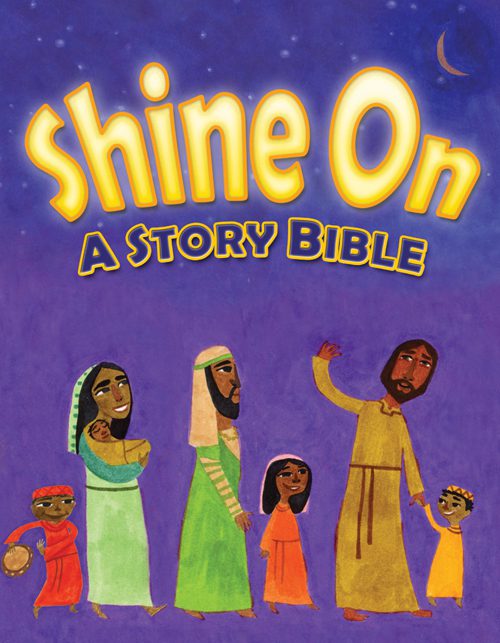 As the project director for Shine: Living in God’s Light, a Sunday school curriculum for children, each year I think carefully about how to tell this story. As you might guess we don’t have the option of not telling the story. But at Shine, we do want to tell it wisely and well. I think we honor children’s innate spirituality best by telling the Good Friday story as well as the Easter morning story. We give their longing for meaning short shrift when we hand out Easter eggs without the full Easter story.
Let me begin, however, with my own life and how I am shaped by a commitment to Jesus and to Jesus’ story as the gospel of peace. In Jesus we see most fully what God is like and in Jesus we become reconciled to God and each other. A number of years ago I memorized Mark 15 as a part of my congregation’s presentation on the gospel of Mark. I shook with the horror of Jesus death. I wept as I memorized this text. The pain of Jesus’ journey to the cross became all too real. In memorizing, I was profoundly moved by Jesus’ love, humility, and courage. I became more sensitized to the world’s suffering and injustice. It was as though Jesus’ presence with me became more real and opened my heart to God’s reconciling love. Two years ago I was at a Tenebrae service where I heard passage after passage of the passion story. “I want to follow Jesus, the Messiah, with all of my heart and soul” I thought in the quiet that followed. Again and again, I am profoundly moved by Jesus’ nonviolent love. Here is a story that has the power to transform me and all of us. A story that can turn the world upside down. Here is deep and powerful story of God’s love that had and continues to have cosmic consequences.
The story of Jesus’ crucifixion is quite different than hearing that Jesus died because he was satisfying God’s need for a sacrificial death. One Bible storybook for toddlers frames the crucifixion story like this: “See the crosses. Men put Jesus on a cross to die but when they did that God did something wonderful. God put on Jesus the bad things we do, and He died for us.” Theories of substitutionary atonement have been articulated in various forms since the time of Origen in the third century. Theories can cause us to lose the power of the story by neatly removing the very real suffering of Jesus and turning Jesus’ death into a formula. It leaves me feeling alienated from a God who needed Jesus’ blood as a ransom or penance. What if, instead, Jesus’ crucifixion turned the whole system of sacrificial killing upside down? What if instead God is saying, “Enough with violence. My way is the way of suffering love?” What if Jesus the Messiah brings the gospel of peace; God’s vision for a world free of redemptive violence?
So how does the Shine Sunday school curriculum tell the crucifixion story? For one, we stick with the gospel stories without a lot of theological overlay. We also ask wondering questions to help children make meaning of the story.
Here is a simple retelling excerpted from Shine curriculum, Early Childhood (for ages 3 through 5), Spring 2015:
Jesus knew bad things were about to happen. He prayed, asking God for help. And then the hard times came. People took Jesus away. They asked him many questions and told lies about him. Later, they nailed Jesus on a cross and he died. Jesus was not alone when he died. God was with him. Some of his friends were nearby. (Based on Mark 14 and 15)
The next excerpt is from Shine On: A Story Bible which is the source for Primary, Middler, and Multiage Bible stories (elementary school ages) in the Shine curriculum. It is a blending of the passion story from all four gospels.
Pilate’s soldiers beat Jesus and mocked him. Then the soldiers put Jesus on a cross between two bandits. Jesus forgave those who were crucifying him, saying, ‘Father, forgive them for they do not know what they are doing.’ As Jesus was dying he cried out, ‘Where are you, God? Are you there? Are you still with me?’ Then Jesus died.
When Jesus breathed his last breath the sun went dark from noon to three. A Roman soldier stood there watching and hearing everything. He said, ‘Certainly this man was innocent.’
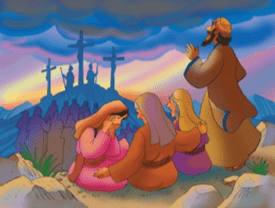
Shine On: A Story Bible, page 268; Art, by Nancy Munger, © Shine Curriculum.
The story is followed by this question:
All Christians in the past and around the world remember the sad story of the crucifixion. I wonder why we tell this story. Look for signs that Jesus reached out in love despite this painful and shameful death.
The Shine plan for junior high youth is to read sections of Mark 14 and 15 directly from the Bible—and to do so prayerfully. They stop at designated spots along a prayer path to read. After each section of the reading they extinguish a candle. At the end of the reading they ponder these and other questions:
Why do you think it was only a few women who stayed with Jesus to the end?
I wonder what Peter did when he stopped weeping.
Imagine being the women watching Jesus die and be buried. What questions would you be asking?
How we tell Bible stories matters because it affects how children will understand God and the Bible. Dr. Kathy Meyer Reimer, professor of education at Goshen (Ind.) College, has collected many children’s Bible storybooks. She compares both text and art. She points out that theological perspective is especially noticeable in retellings for the very young. When Bible stories are simplified they expose the theology of the re-teller. This is especially true in retelling the story of the crucifixion.
I wonder how you would tell this story to the children in your life.
 Rose Stutzman is the project director for Shine: Living in God’s Light a Sunday school curriculum jointly published by Brethren Press and MennoMedia.
telling the Easter story for children
Next Post

March 19, 2015 My Biggest Concern for My Gay Son is Religion: On Being Catholic and Gay
Browse Our Archives
Select a Category Atonement and Current Events Curriculum Faith and Families Interviews Jesus the Forgiving Victim Lent Montessori politics Reviews The Bible Explained Uncategorized Valentine's Day Wednesday Sermon Who is God?
Select a Month July 2020 November 2019 October 2019 September 2019 August 2019 July 2019 June 2019 May 2019 April 2019 March 2019 February 2019 January 2019 December 2018 November 2018 October 2018 September 2018 August 2018 July 2018 June 2018 May 2018 April 2018 March 2018 February 2018 January 2018 December 2017 November 2017 October 2017 September 2017 August 2017 July 2017 June 2017 May 2017 April 2017 March 2017 February 2017 January 2017 December 2016 November 2016 October 2016 September 2016 August 2016 June 2016 May 2016 April 2016 March 2016 February 2016 January 2016 December 2015 November 2015 October 2015 September 2015 August 2015 July 2015 June 2015 May 2015 April 2015 March 2015 February 2015 January 2015 December 2014 November 2014 October 2014 September 2014 August 2014 July 2014 June 2014 May 2014 April 2014 March 2014 January 2014 December 2013 September 2013 August 2013 July 2013
Follow Us!
TAKE THE
Religious Wisdom Quiz
How old was Abraham when Sarah died?
Select your answer to see how you score.
117 years 127 years 147 years 137 years
Related posts from Teaching Nonviolent Atonement

Toxic Christianity: 3 Things We Can Do That...

How Forgiveness Can Transform Our Violence and Build...
Coronation Before Crucifixion: The Ominous, Subversive Politics of...

Thinking Outside The Blocks: How My Daughter And...
TRENDING AT PATHEOS Progressive Christian

What Being a Modern-Day Apostle Means to Me
In my last column, I discussed the ins and outs of modern-day...

Did Ancient China Once Worship the God of...
Across human history, a common thread weaves through the origins of the...

Love Your Neighbor – Including Earth-Kin: Lev. 19,...
God’s command to love your neighbor means acting in an ethical and...

Lead a Church Study of “Jesus and Lao...
Guest writer Jack Thomas (The Irreverent Reverend) reflects on leading his church...

Pastoral Wisdom for Responding to Sermon Pushback
Getting sermon pushback on your social justice sermon? Learn practical, Proverbs-based strategies...

Principles for Understanding the Apostolic Ministry Today
Whenever people discover that my formal ministry title is "apostle," as in...
view all Progressive Christian blogs
Ad-Free & Subscriber Log-In Subscription Support
- About Us
- 2026 Calendar
- Videos
- Podcasts
- Library of World Religions
- Faith In Media Tracker
- Advertise With Us
- Write for Us
- Privacy Policy
- Terms of Service
- Do Not Sell My Data
- Contact Us
- Radiant Digital
- Manage Newsletter Subscriptions
- Unsubscribe From Notifications
- Sitemap
Copyright 2008-2026, Patheos. All rights reserved.
Subscription Support Ad-Free & Subscriber Log-In
Follow Patheos