
BuddhistCatholicContemplativeEvangelicalGeneral ChristianHinduJewishLatter-day SaintMuslimNew VisionsProgressive Christian
Beliefs
- Buddhist
- Catholic
- Contemplative
- Evangelical
- General Christian
- Hindu
- Jewish
- Latter-day Saint
- More Voices
- Muslim
- New Visions
- Pagan
- Progressive Christian
Topics
- Religion News
- Food and Religion
- Sports and Religion
- Religious Art
- Religious Music and Entertainment
- Religious Events
- History and Religion
- Style and Religion
- Politics and Religion
- Women in Religion
- Recreation Outdoors and Religion
- Business Finance and Religion
- Careers Workplace and Religion
- Education and Religion
- Family Parenting and Religion
- Health Fitness and Religion
- Home and Religion
- Relationships and Religion
- Technology and Religion
- Travel and Religion
Columnists
- Buddhist Columnists
- Business Finance and Religion Columnists
- Careers Workplace and Religion Columnists
- Catholic Columnists
- Contemplative Columnists
- Education and Religion Columnists
- Evangelists Columnists
- Family Parenting and Religion Columnists
- General Christian Columnists
- Health Fitness and Religion Columnists
- Hindu Columnists
- History and Religion Columnists
- Home and Religion Columnists
- Jewish Columnists
- More Voices Columnists
- Latter Day Columnists
- Muslim Columnists
- New Visions Columnists
- Nonreligious Columnists
- Pagan Columnists
- Politics and Religion Columnists
- Progressive Columnists
- Recreation Outdoors and Religion Columnists
- Relationships and Religion Columnists
- Religion News Columnists
- Religious Art Columnists
- Religious Events Columnists
- Religious Music and Entertainment Columnists
- Sports and Religion Columnists
- Style and Religion Columnists
- Technology and Religion Columnists
- Travel and Religion Columnists
- Women in Religion Columnists
Resource Library
- 2026 Calendar
- Library of World Religions
- The 100 Most Holy Places on Earth
- Patheos Answers
- Podcasts
- Videos
- Faith Leaders Database
- Anglican Episcopalian
- Bahai
- Baptist
- Buddhism
- Christianity
- Confucianism
- Eastern Orthodoxy
- Hinduism
- Holiness and Pentecostal
- ISKCON
- Islam
- Judaism
- Lutheran
- Methodist
- The Church of Jesus Christ of Latter-day Saints
- New Age
- Paganism
- Presbytarian and Reformed
- Protestantism
- Religion Behind the Scenes
- Roman Catholic
- Scientology
- Shia Islam
- Sikhism
- Sufism
- Sunni Islam
- Taoism
- Zen
- See all religions
Research Tools
 Ad-Free & Subscriber Log-In Subscription Support
Ad-Free & Subscriber Log-In Subscription Support
Follow Patheos 

- Trending:
- Forgiveness
- |
- Marriage
- |
- Consciousness
- |
- Death Penalty
- |
- Election
- |
- Halloween
 Teaching Nonviolent Atonement
- Home
- Progressive Christian
- Thanksgiving and a Theology of Despair
Thanksgiving and a Theology of Despair
Last updated on: November 26, 2014 at 12:16 am by Adam Ericksen
Thanksgiving and a Theology of Despair 2014-11-26T00:16:34-05:00 Adam Ericksen
Patheos Explore the world's faith through different perspectives on religion and spirituality! Patheos has the views of the prevalent religions and spiritualities of the world.
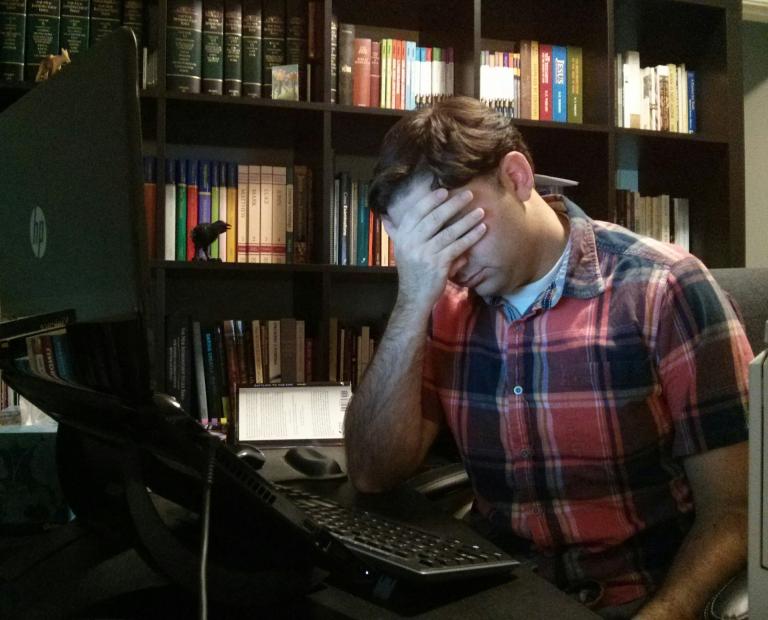
I’m feeling despair.
Are you feeling pressure to be thankful?
We are in the midst of the Thanksgiving season. I’m reminded everywhere I go to “Be thankful!”
Well, call me the Scrooge of Thanksgiving, but I’m just not feeling thankful. The more someone tells me to “Be thankful!” the more I feel a sense of despair.
Be thankful? In the midst of Ferguson, Missouri? Jim Wallis writes over at Sojourners that, “Many black families woke up this morning knowing that the lives of their children are worth less than the lives of white children in America.” And what will white America do about it? Nothing new. One side will continue the status quo of racism by denying that it even exists and then they will blame the victims. I firmly stand in the other side that blames America’s deeply embedded structures of racism, economic injustice, and educational inequality. To make matters worse, America is sharply divided over the shooting in Ferguson. Each side of the division blames the other for tragic violence. Sunday’s heated debate on Meet the Press between former New York Mayor Rudy Giuliani and Georgetown Professor Michael Eric Dyson is indicative of the deep racial tensions underlying not only Ferguson, but every city in the United States.
My Facebook news feed and the media are telling me how I’m supposed to feel about Ferguson. Outraged. Hurt. Anxious. Guilt. Anger. Bitter. But certainly not thankful.
A Theology of Despair
I’m feeling despair more than any other emotion. Why despair? Because each side believes they are right and the other is to blame. I feel despair because we humans have been addicted to the blame game from the very beginning. My therapist has encouraged me to have a “bird’s eye view” of current events in order to see the bigger picture.
Let me tell you, that view isn’t helpful.
When I take that view, I see the human propensity to blame and scapegoat others. Who’s to blame? White people? Black people? The police? The Politicians? We see this scapegoating dynamic happening in Ferguson, but we also see it in family systems. I have friends who dread Thanksgiving because of their broken family system that inevitably alleviates tensions by finding a scapegoat.
My therapist has also encouraged me to look for God in these situations. Where is God? We tend to think that God is all-powerful. That’s a dangerous theology that legitimates power. And you know what they say about power – it corrupts. An all-powerful god is a corrupt god that we use for our own corrupt purposes.
Thankfully, the true God isn’t a God of power, but a God of nonviolent love who meets us where we are. God doesn’t force us to be thankful in times of grief and despair. Rather, God meets us in our honest and raw emotions.
A theology of despair claims that God meets us in our grief and hopelessness. God meets us as we walk through the valley of the shadow of death. There is evil in the world, but we don’t need to fear it because God is with us in the despair. Even Jesus, whom Christians will soon proclaim as “Emanuel,” or God is with us, despaired on the cross when he cried, “My God, my God, why have you forsaken me?”
Was that a thankful cry? No. But it was an honest cry of despair. And God met Jesus in that despair, for his next words were, “Into your hands I commend my spirit.”
And I’m left feeling despair. Why do we forsake one another in an endless cycle of blame? We know how to end that cycle. We know how to offer ourselves to one another in the spirit of nonviolent love and forgiveness.
Ending the cycle of blame is the hope for our future. But will we stop that cycle and replace it with sacrificial love and forgiveness?
As I take a bird’s eye view and look into the pit of despair, I have my doubts. The ultimate prophetic warning that Christianity has to offer is that if we keep scapegoating one another, we will destroy ourselves in Apocalyptic violence to which the only alternative is nonviolent love and forgiveness.
Rene Girard put that prophetic warning best in his book Battling to the End, “Saying that chaos is near is not incompatible with hope, quite to the contrary. However, hope has to be seen in relation to an alternative that leaves only the choice between total destruction and the realization of the Kingdom” (119).
The realization of the Kingdom of God will only happen when we stop blaming one another. It will only happen when we realize that God loves all people, whether we think they deserve it or not. And it will only happen when we begin to take responsibility to love our neighbors as we love ourselves.
This Thanksgiving, I’m thankful that God is not a god of power and might. I’m thankful that the one true God is a God who meets us in our despair, who empowers us to stop scapegoating, and who is loving us with reckless abandon.
Previous Post

November 23, 2014
Interview With Frances Fuller, Author of "In Borrowed Houses"
Browse Our Archives
Select a Category Atonement and Current Events Curriculum Faith and Families Interviews Jesus the Forgiving Victim Lent Montessori politics Reviews The Bible Explained Uncategorized Valentine's Day Wednesday Sermon Who is God?
Select a Month July 2020 November 2019 October 2019 September 2019 August 2019 July 2019 June 2019 May 2019 April 2019 March 2019 February 2019 January 2019 December 2018 November 2018 October 2018 September 2018 August 2018 July 2018 June 2018 May 2018 April 2018 March 2018 February 2018 January 2018 December 2017 November 2017 October 2017 September 2017 August 2017 July 2017 June 2017 May 2017 April 2017 March 2017 February 2017 January 2017 December 2016 November 2016 October 2016 September 2016 August 2016 June 2016 May 2016 April 2016 March 2016 February 2016 January 2016 December 2015 November 2015 October 2015 September 2015 August 2015 July 2015 June 2015 May 2015 April 2015 March 2015 February 2015 January 2015 December 2014 November 2014 October 2014 September 2014 August 2014 July 2014 June 2014 May 2014 April 2014 March 2014 January 2014 December 2013 September 2013 August 2013 July 2013
Follow Us!
TAKE THE
Religious Wisdom Quiz
What river did the Israelites cross to enter the Promised Land?
Select your answer to see how you score.
Red Sea Nile River Euphrates River Jordan River
Related posts from Teaching Nonviolent Atonement

Forgiveness in the Time of COVID-19 by Julia...

Reflections on Indigenous Wisdom For Healing A Wounded...

How Forgiveness Can Transform Our Violence and Build...

Jesus Unmasked: God's Economy and How to Cheat...
TRENDING AT PATHEOS Progressive Christian

Why Christians Have a Sacred Duty to Vote:...
The Bible offers strong support for the sacred duty to vote. Here...

What Being a Modern-Day Apostle Means to Me
In my last column, I discussed the ins and outs of modern-day...

Did Ancient China Once Worship the God of...
Across human history, a common thread weaves through the origins of the...

Love Your Neighbor – Including Earth-Kin: Lev. 19,...
God’s command to love your neighbor means acting in an ethical and...

Lead a Church Study of “Jesus and Lao...
Guest writer Jack Thomas (The Irreverent Reverend) reflects on leading his church...

Principles for Understanding the Apostolic Ministry Today
Whenever people discover that my formal ministry title is "apostle," as in...
view all Progressive Christian blogs
Ad-Free & Subscriber Log-In Subscription Support
- About Us
- 2026 Calendar
- Videos
- Podcasts
- Library of World Religions
- Faith In Media Tracker
- Advertise With Us
- Write for Us
- Privacy Policy
- Terms of Service
- Do Not Sell My Data
- Contact Us
- Radiant Digital
- Manage Newsletter Subscriptions
- Unsubscribe From Notifications
- Sitemap
Copyright 2008-2026, Patheos. All rights reserved.
Subscription Support Ad-Free & Subscriber Log-In
Follow Patheos