
BuddhistCatholicContemplativeEvangelicalGeneral ChristianHinduJewishLatter-day SaintMuslimNew VisionsProgressive Christian
Beliefs
- Buddhist
- Catholic
- Contemplative
- Evangelical
- General Christian
- Hindu
- Jewish
- Latter-day Saint
- More Voices
- Muslim
- New Visions
- Pagan
- Progressive Christian
Topics
- Religion News
- Food and Religion
- Sports and Religion
- Religious Art
- Religious Music and Entertainment
- Religious Events
- History and Religion
- Style and Religion
- Politics and Religion
- Women in Religion
- Recreation Outdoors and Religion
- Business Finance and Religion
- Careers Workplace and Religion
- Education and Religion
- Family Parenting and Religion
- Health Fitness and Religion
- Home and Religion
- Relationships and Religion
- Technology and Religion
- Travel and Religion
Columnists
- Buddhist Columnists
- Business Finance and Religion Columnists
- Careers Workplace and Religion Columnists
- Catholic Columnists
- Contemplative Columnists
- Education and Religion Columnists
- Evangelists Columnists
- Family Parenting and Religion Columnists
- General Christian Columnists
- Health Fitness and Religion Columnists
- Hindu Columnists
- History and Religion Columnists
- Home and Religion Columnists
- Jewish Columnists
- More Voices Columnists
- Latter Day Columnists
- Muslim Columnists
- New Visions Columnists
- Nonreligious Columnists
- Pagan Columnists
- Politics and Religion Columnists
- Progressive Columnists
- Recreation Outdoors and Religion Columnists
- Relationships and Religion Columnists
- Religion News Columnists
- Religious Art Columnists
- Religious Events Columnists
- Religious Music and Entertainment Columnists
- Sports and Religion Columnists
- Style and Religion Columnists
- Technology and Religion Columnists
- Travel and Religion Columnists
- Women in Religion Columnists
Resource Library
- 2026 Calendar
- Library of World Religions
- The 100 Most Holy Places on Earth
- Patheos Answers
- Podcasts
- Videos
- Faith Leaders Database
- Anglican Episcopalian
- Bahai
- Baptist
- Buddhism
- Christianity
- Confucianism
- Eastern Orthodoxy
- Hinduism
- Holiness and Pentecostal
- ISKCON
- Islam
- Judaism
- Lutheran
- Methodist
- The Church of Jesus Christ of Latter-day Saints
- New Age
- Paganism
- Presbytarian and Reformed
- Protestantism
- Religion Behind the Scenes
- Roman Catholic
- Scientology
- Shia Islam
- Sikhism
- Sufism
- Sunni Islam
- Taoism
- Zen
- See all religions
Research Tools
 Ad-Free & Subscriber Log-In Subscription Support
Ad-Free & Subscriber Log-In Subscription Support
Follow Patheos 

- Trending:
- Forgiveness
- |
- Marriage
- |
- Consciousness
- |
- Death Penalty
- |
- Election
- |
- Halloween
 Teaching Nonviolent Atonement
- Home
- Progressive Christian
- Parenting Confessions: God, Rivalry, and College Football
Parenting Confessions: God, Rivalry, and College Football
Last updated on: October 22, 2014 at 4:43 am by Adam Ericksen
Parenting Confessions: God, Rivalry, and College Football 2014-10-21T22:44:41-05:00 Adam Ericksen
Patheos Explore the world's faith through different perspectives on religion and spirituality! Patheos has the views of the prevalent religions and spiritualities of the world.
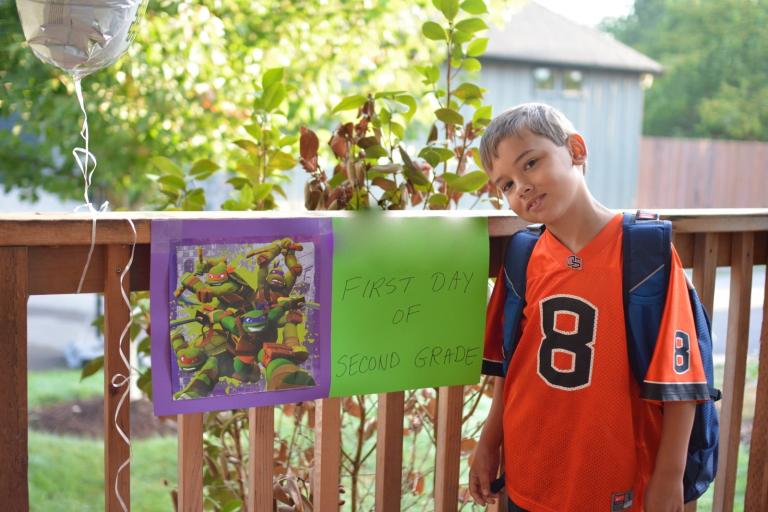
Beavers jersey and Ninja Turtles on the first day of school. Doesn’t get much better than that!
My family recently moved to Eugene, Oregon. Eugene is probably best known for the University of Oregon Ducks football team. Having moved from Chicago, I know that the Ducks are loved throughout the country for their high powered offense and flamboyant football jerseys. Here in Eugene people are obsessed with the Quack Attack. Nearly every car has a University of Oregon bumper sticker, almost everyone wears a green UofO jacket, and the entire city fell into a state of mourning when the Ducks lost to the Arizona Wildcats and plummeted in the national rankings. There can be no doubt that the people of Eugene love their University of Oregon Ducks.
But as for me and my household, we will love the Oregon State Beavers. (That’s a direct quote from the book of Ericksen 12:15.)
I’m a native Oregonian and I’ve always loved the Beavers. My grandpa went to Oregon State, my mother went to Oregon State, and my brother went to Oregon State. I learned to love the Beavers from my family. I must confess that I’m teaching my children well. For his first day of school this year, my oldest son drew a line in the sand with his Duck loving classmates as he proudly wore his Beavers football jersey and his Beavers hat.
The rivalry between the Ducks and the Beavers is insane. In fact, it’s so intense that the annual game that pits the teams against each other is called the CIVIL WAR!
Apparently the most effective way to describe the rivalry between the Beavers and the Ducks is to refer to the most fatal battle ever on American soil.
But my son is right. To be a Beavers fan means that you must draw a line in the sand. Not only must you root for the Beavers, you must root against the Ducks! Of course, there are those lukewarm Beaver fans who want to straddle the line. They root for the Ducks as a sign of loyalty to Oregon, hoping that one team from the state will compete for a National Championship.
Let me say this as smugly as possible with my nose high in the air – They are not true fans of the Beavers! They make me sick. To be an Oregonian means you must pick your loyalties! You must stand either with the Beavers or with the Ducks. Either you’re with us or you’re against us! Either you’re all things Good, Beautiful, and True, thus you root for the Beavers; or you’re a conspirator with the Forces of Evil and you root for the Ducks. Please choose wisely. After all, this is the Civil War!
The Mimetics of Parenting
Okay. So, I’m being cheeky. But I’d like to talk about a danger here. When it comes to parenting, mimetic theory has taught me that we humans learn everything through a process of imitation. As social creatures, we are naturally open to the influence of others in our environment. Soon an imitative pattern of behavior develops. Children learn a pattern of behavior through their parents that is often formed in rivalry. One of the first things children learn from adults is to identify themselves over and against who they are not.
As a child, I learned from the adults in my life that to be an Ericksen is to be a Beavers fan. I also learned that to be an Ericksen meant I had to hate the Ducks.
Civil War language aside, sports rivalries may seem like mere playful fun. I mean, what’s the big deal? While childhood sports rivalries appear to be fairly harmless, they lay the foundation for a lifetime of rivalries. Children may begin to identify themselves in terms of sports rivalries, but this pattern of rivalry can’t be controlled. It spreads like a contagious disease to other areas of our lives. We soon learn to identify ourselves as “in” by identifying who is “out”; who is “good” by who is “bad.”
As we grow, we begin to discover other aspects of our identity that are formed in rivalry over and against others. For example, we learn to identify ourselves as good Democrats because they are evil Republicans; as good progressives because they are regressive fundamentalists; as responsible rich people because they are irresponsible poor people; as good Christians because they are evil Muslims; as smart NPR listening liberals because they are dumb Fox News listening conservatives.
Understanding this pattern of rivalry that children learn through imitating their parents helps me understand a biblical passage that I’ve always found troubling. It’s that verse near the beginning of the Ten Commandments where God is said to punish “children for the iniquity of parents, to the third and fourth generation of those who reject me, but shows steadfast love to the thousandth generation of those who love me and keep my commandments.”
I’m discovering that the “iniquity” of my parenting is setting my children up for a world of rivalry with other. Now, God isn’t actively punishing my children for my poor parenting skills. We do a good enough job of punishing one another in our rivalries.
God isn’t punishing us. Rather, God is trying to free us from our enslavement to rivalry. God is inviting us to re-pattern our lives away from rivalry and toward love. “You shall love your neighbor as yourself,” claims Leviticus. From within his religious tradition, Jesus expanded on that love ethic so that it included even our enemies, “You have heard it was said, ‘You shall love your neighbor and hate your enemy.’ But I say to you, Love your enemies and pray for those who persecute you.”
Beavers and Ducks: Can we share the pond?
Can we be freed from these rivalries? Or are we enslaved to them? Jesus told his followers that they must die to themselves in order that they might truly live. They must die to an identity that is formed in rivalry with others so that they might truly love their neighbors, who include even those they call their enemies…even those who are called *gasp* the Ducks!
Of course, this is bigger than Beavers and Ducks. It’s about rivalry in every aspect of our lives. But here’s the point: Transforming our pattern of rivalry into a pattern of love requires intention and spiritual discipline. It requires a daily, even hourly, refusal to divide the world into “us” versus “them.” It requires parents who will model for their children a desire for love, not a desire for rivalry. It requires a larger community of dedicated people that will gently hold one another accountable. It requires forgiveness. It requires prayer.
And in the game of spiritual football, it requires the nimble spirit of a quarterback to pass with the promise that “in Christ God was reconciling the world to himself, not counting their trespasses against them, and entrusting the message of reconciliation with us.”
Is there hope that Beavers and Ducks can find reconciliation and share the same pond? To quote Jesus completely out of context, “With people this is impossible, but with God all things are possible.”
With God all things are possible, including the possibility that we might die to a self that is formed in rivalry so that we might live the life of love that God calls us into. A new identity that is no longer defined as “us” against “them.” Rather, with this new identity we discover a new pattern of living where Beavers and Ducks, Democrats and Republicans, Progressives and Evangelicals, Christians and Muslims all drop our violent addiction to rivalry so that we can pursue love and reconciliation.
Previous Post

October 21, 2014
Book Review: "In Borrowed Houses" by Frances Fuller
Browse Our Archives
Select a Category Atonement and Current Events Curriculum Faith and Families Interviews Jesus the Forgiving Victim Lent Montessori politics Reviews The Bible Explained Uncategorized Valentine's Day Wednesday Sermon Who is God?
Select a Month July 2020 November 2019 October 2019 September 2019 August 2019 July 2019 June 2019 May 2019 April 2019 March 2019 February 2019 January 2019 December 2018 November 2018 October 2018 September 2018 August 2018 July 2018 June 2018 May 2018 April 2018 March 2018 February 2018 January 2018 December 2017 November 2017 October 2017 September 2017 August 2017 July 2017 June 2017 May 2017 April 2017 March 2017 February 2017 January 2017 December 2016 November 2016 October 2016 September 2016 August 2016 June 2016 May 2016 April 2016 March 2016 February 2016 January 2016 December 2015 November 2015 October 2015 September 2015 August 2015 July 2015 June 2015 May 2015 April 2015 March 2015 February 2015 January 2015 December 2014 November 2014 October 2014 September 2014 August 2014 July 2014 June 2014 May 2014 April 2014 March 2014 January 2014 December 2013 September 2013 August 2013 July 2013
Follow Us!
TAKE THE
Religious Wisdom Quiz
What does the Greek word 'Kurios' mean?
Select your answer to see how you score.
Lord King Redeemer Messiah
Related posts from Teaching Nonviolent Atonement

Forgiveness in the Time of COVID-19 by Julia...

Reflections on Indigenous Wisdom For Healing A Wounded...

How Forgiveness Can Transform Our Violence and Build...

Jesus Unmasked: God's Economy and How to Cheat...
TRENDING AT PATHEOS Progressive Christian

What Being a Modern-Day Apostle Means to Me
In my last column, I discussed the ins and outs of modern-day...

Did Ancient China Once Worship the God of...
Across human history, a common thread weaves through the origins of the...

Love Your Neighbor – Including Earth-Kin: Lev. 19,...
God’s command to love your neighbor means acting in an ethical and...

Lead a Church Study of “Jesus and Lao...
Guest writer Jack Thomas (The Irreverent Reverend) reflects on leading his church...

Pastoral Wisdom for Responding to Sermon Pushback
Getting sermon pushback on your social justice sermon? Learn practical, Proverbs-based strategies...

Principles for Understanding the Apostolic Ministry Today
Whenever people discover that my formal ministry title is "apostle," as in...
view all Progressive Christian blogs
Ad-Free & Subscriber Log-In Subscription Support
- About Us
- 2026 Calendar
- Videos
- Podcasts
- Library of World Religions
- Faith In Media Tracker
- Advertise With Us
- Write for Us
- Privacy Policy
- Terms of Service
- Do Not Sell My Data
- Contact Us
- Radiant Digital
- Manage Newsletter Subscriptions
- Unsubscribe From Notifications
- Sitemap
Copyright 2008-2026, Patheos. All rights reserved.
Subscription Support Ad-Free & Subscriber Log-In
Follow Patheos