
BuddhistCatholicContemplativeEvangelicalGeneral ChristianHinduJewishLatter-day SaintMuslimNew VisionsProgressive Christian
Beliefs
- Buddhist
- Catholic
- Contemplative
- Evangelical
- General Christian
- Hindu
- Jewish
- Latter-day Saint
- More Voices
- Muslim
- New Visions
- Pagan
- Progressive Christian
Topics
- Religion News
- Food and Religion
- Sports and Religion
- Religious Art
- Religious Music and Entertainment
- Religious Events
- History and Religion
- Style and Religion
- Politics and Religion
- Women in Religion
- Recreation Outdoors and Religion
- Business Finance and Religion
- Careers Workplace and Religion
- Education and Religion
- Family Parenting and Religion
- Health Fitness and Religion
- Home and Religion
- Relationships and Religion
- Technology and Religion
- Travel and Religion
Columnists
- Buddhist Columnists
- Business Finance and Religion Columnists
- Careers Workplace and Religion Columnists
- Catholic Columnists
- Contemplative Columnists
- Education and Religion Columnists
- Evangelists Columnists
- Family Parenting and Religion Columnists
- General Christian Columnists
- Health Fitness and Religion Columnists
- Hindu Columnists
- History and Religion Columnists
- Home and Religion Columnists
- Jewish Columnists
- More Voices Columnists
- Latter Day Columnists
- Muslim Columnists
- New Visions Columnists
- Nonreligious Columnists
- Pagan Columnists
- Politics and Religion Columnists
- Progressive Columnists
- Recreation Outdoors and Religion Columnists
- Relationships and Religion Columnists
- Religion News Columnists
- Religious Art Columnists
- Religious Events Columnists
- Religious Music and Entertainment Columnists
- Sports and Religion Columnists
- Style and Religion Columnists
- Technology and Religion Columnists
- Travel and Religion Columnists
- Women in Religion Columnists
Resource Library
- 2026 Calendar
- Library of World Religions
- The 100 Most Holy Places on Earth
- Patheos Answers
- Podcasts
- Videos
- Faith Leaders Database
- Anglican Episcopalian
- Bahai
- Baptist
- Buddhism
- Christianity
- Confucianism
- Eastern Orthodoxy
- Hinduism
- Holiness and Pentecostal
- ISKCON
- Islam
- Judaism
- Lutheran
- Methodist
- The Church of Jesus Christ of Latter-day Saints
- New Age
- Paganism
- Presbytarian and Reformed
- Protestantism
- Religion Behind the Scenes
- Roman Catholic
- Scientology
- Shia Islam
- Sikhism
- Sufism
- Sunni Islam
- Taoism
- Zen
- See all religions
Research Tools
 Ad-Free & Subscriber Log-In Subscription Support
Ad-Free & Subscriber Log-In Subscription Support
Follow Patheos 

- Trending:
- Forgiveness
- |
- Marriage
- |
- Consciousness
- |
- Death Penalty
- |
- Election
- |
- Halloween
 Teaching Nonviolent Atonement
- Home
- Progressive Christian
- Parenting – Book Review: Mickey Mouse, Mimetic Theory, and Saving a Villain
Parenting – Book Review: Mickey Mouse, Mimetic Theory, and Saving a Villain
Last updated on: September 25, 2014 at 4:00 pm by Adam Ericksen
Parenting – Book Review: Mickey Mouse, Mimetic Theory, and Saving a Villain 2014-09-25T16:00:45-05:00 Adam Ericksen
Patheos Explore the world's faith through different perspectives on religion and spirituality! Patheos has the views of the prevalent religions and spiritualities of the world.
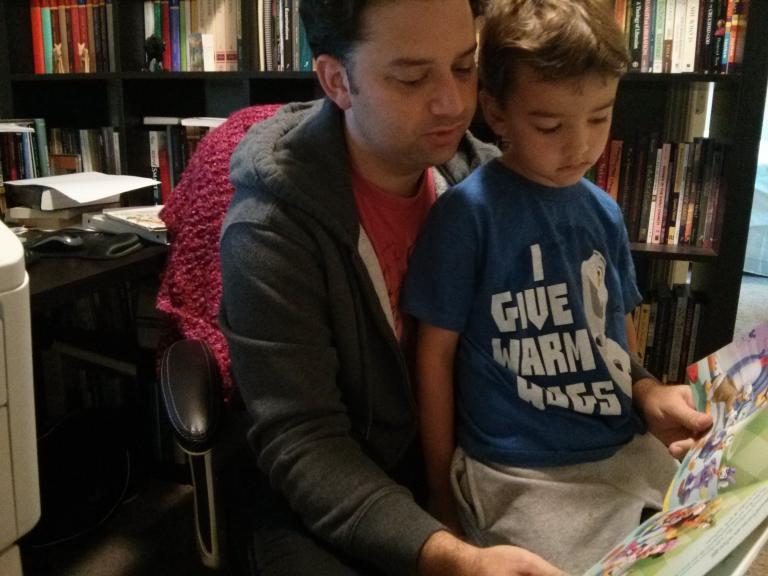
Reading to my boy.
As a parent dedicated to mimetic theory, I know that the stories we tell our children pattern them in certain ways. Children have a remarkable capacity to learn not only reading, writing, and arithmetic, but also how to relate to others. Stories are particularly influential tools that teach children how to do just that. Of course, their learning potential can be patterned in relating to others in violent ways or in nonviolent and loving ways. And like so many parents who want to foster a strong sense of compassion in their children, especially compassion for their enemies, I struggle to find children’s books that tell compelling stories about compassion and reconciliation.
Mythical Stories and the Eternal Return
Children’s stories typically follow the same pattern as every other story. There’s a conflict. The conflict leads to the formation of good guys and bad guys. The good guys work together and, after dramatically losing to the bad guys on multiple occasions, end up winning the day. The bad guys are either killed or expelled and peace is restored.
If you read ancient myths, you will discover that the same story of violence has been told since the beginning of human culture. Human history has seen an eternal return to violence and wars where good battles evil in the hopes to restore peace. And then we mythologize our violence through heroic stories of “good versus evil” that we tell to our children. But achieving peace through violent means never leads to lasting peace. If there’s one thing we should learn about the eternal return to violence in mythical stories, it’s that violence leads to more violence.
But what if we told a different story to our children? What if we told stories about conflict that didn’t end up with killing or expelling the bad guys, but rather ended with relationships being transformed and reconciled? Maybe our children would be patterned in a way that seeks compassion for and reconciliation with our enemies.
Mickey’s Alternative
 Yesterday, my second child brought home a book called Mickey Mouse Clubhouse: Super Adventures! As I began reading it to him, I couldn’t help but feel a twinge of parental angst as the story followed the same violent pattern as nearly every other story. Mickey and his friends turn into superheroes and unite to save the day from the evil villain Megamort, who wants to steal Mickey’s clubhouse by shrinking it with his shrink ray.
Oh the drama!
Of course, in the end Mickey and his team of superhero good guys win the day. But as Megamort attempts to make his escape, his plane springs a leak and zooms out of control. That’s when the ancient script of violence is flipped on its head and a new script of compassion and reconciliation emerges:
“Megamort needs our help!” shouts Mickey.
“But he’s a villain,” says Goofy.
“He still needs saving,” says Mickey.
Despite Goofy’s objection, Mickey and his friends safely bring the plane down and Megamort is transformed by their act of compassion.
“After all I did, I can’t believe you rescued me,” he says. “Thank you.”
“You’re welcome, Mr. Megamort,” says Goofy.
“I’m really Mortimer Mouse,” Megamort reveals. “I’m your new neighbor…I thought that if I took what you had, I’d be happy.”
“The Clubhouse is all about having friends,” says Mickey.
“That’s just it,” Mortimer admits. “I don’t have any friends.”
“You do now,” says Goofy.
This children’s story is revelatory for two reasons. First, the main principle of mimetic theory claims that we “desire according to the desire of another.” In other words, we really do try to “keep up with the Jones’.” As with Mortimer Mouse, we tend to think that if just had what our neighbors have that we would then be happy. But as this story clearly shows, the mimetic aspect of desire more often leads to conflict and resentment than to happiness. That’s why the 10th Commandment warns us against coveting our neighbors stuff – it knows that our natural inclination is to desire according to the desires of another! Of course, underneath it all, it’s never really about our neighbor’s stuff. Like Mortimer, what we really desire is friendship, love, and acceptance. That’s why the Bible says, “You shall love your neighbor as yourself.”
The second aspect of the story that’s revelatory is that the conflict ensuing from “desiring according to the desires of another” often leads to the eternal return of conflict and violence, but it doesn’t have to. We aren’t enslaved to violence. We do have options. For example, Goofy suggests that Megamort should suffer the deathly consequences of his evil actions when he protests rescuing him from his demise by stating, “But he’s a villain.” Fortunately, Mickey provides a refreshing alternative of compassion by saving the villain.
Mickey models an alternative desire to the desire of mythical violence. It’s a desire that transforms us from wanting to kill or exclude our enemies to wanting to bless them and to reconcile with them. It’s the same alternative that we see developing in the Judeo-Christians Story. From Abraham and Sarah, who are called by God to be a blessing to “all the families of the earth,” to Jesus who forgives his enemies who crucified him and who reconciles “the world to himself, [by] not counting their sins against them,” we see that God sends us on a mission of blessing and reconciliation with everyone, but especially with those we call our enemies.
I’m glad to tell that divine story of reconciliation to my children wherever I can find it, even when it comes from Mickey Mouse.
Previous Post

September 23, 2014
How Christians Reject Jesus: On Trying to Outsmart God
Next Post
September 30, 2014 Undiluted: Rediscovering the Radical Message of Jesus
Browse Our Archives
Select a Category Atonement and Current Events Curriculum Faith and Families Interviews Jesus the Forgiving Victim Lent Montessori politics Reviews The Bible Explained Uncategorized Valentine's Day Wednesday Sermon Who is God?
Select a Month July 2020 November 2019 October 2019 September 2019 August 2019 July 2019 June 2019 May 2019 April 2019 March 2019 February 2019 January 2019 December 2018 November 2018 October 2018 September 2018 August 2018 July 2018 June 2018 May 2018 April 2018 March 2018 February 2018 January 2018 December 2017 November 2017 October 2017 September 2017 August 2017 July 2017 June 2017 May 2017 April 2017 March 2017 February 2017 January 2017 December 2016 November 2016 October 2016 September 2016 August 2016 June 2016 May 2016 April 2016 March 2016 February 2016 January 2016 December 2015 November 2015 October 2015 September 2015 August 2015 July 2015 June 2015 May 2015 April 2015 March 2015 February 2015 January 2015 December 2014 November 2014 October 2014 September 2014 August 2014 July 2014 June 2014 May 2014 April 2014 March 2014 January 2014 December 2013 September 2013 August 2013 July 2013
Follow Us!
TAKE THE
Religious Wisdom Quiz
According to Paul, nothing in all creation can separate you from me—not death, not life, not angels or demons. What am I?
Select your answer to see how you score.
God's grace The love of God Salvation God's mercy
Related posts from Teaching Nonviolent Atonement

Forgiveness in the Time of COVID-19 by Julia...

Reflections on Indigenous Wisdom For Healing A Wounded...

How Forgiveness Can Transform Our Violence and Build...

Jesus Unmasked: God's Economy and How to Cheat...
TRENDING AT PATHEOS Progressive Christian

What Being a Modern-Day Apostle Means to Me
In my last column, I discussed the ins and outs of modern-day...

Did Ancient China Once Worship the God of...
Across human history, a common thread weaves through the origins of the...

Love Your Neighbor – Including Earth-Kin: Lev. 19,...
God’s command to love your neighbor means acting in an ethical and...

Lead a Church Study of “Jesus and Lao...
Guest writer Jack Thomas (The Irreverent Reverend) reflects on leading his church...

Pastoral Wisdom for Responding to Sermon Pushback
Getting sermon pushback on your social justice sermon? Learn practical, Proverbs-based strategies...

Principles for Understanding the Apostolic Ministry Today
Whenever people discover that my formal ministry title is "apostle," as in...
view all Progressive Christian blogs
Ad-Free & Subscriber Log-In Subscription Support
- About Us
- 2026 Calendar
- Videos
- Podcasts
- Library of World Religions
- Faith In Media Tracker
- Advertise With Us
- Write for Us
- Privacy Policy
- Terms of Service
- Do Not Sell My Data
- Contact Us
- Radiant Digital
- Manage Newsletter Subscriptions
- Unsubscribe From Notifications
- Sitemap
Copyright 2008-2026, Patheos. All rights reserved.
Subscription Support Ad-Free & Subscriber Log-In
Follow Patheos