
BuddhistCatholicContemplativeEvangelicalGeneral ChristianHinduJewishLatter-day SaintMuslimNew VisionsProgressive Christian
Beliefs
- Buddhist
- Catholic
- Contemplative
- Evangelical
- General Christian
- Hindu
- Jewish
- Latter-day Saint
- More Voices
- Muslim
- New Visions
- Pagan
- Progressive Christian
Topics
- Religion News
- Food and Religion
- Sports and Religion
- Religious Art
- Religious Music and Entertainment
- Religious Events
- History and Religion
- Style and Religion
- Politics and Religion
- Women in Religion
- Recreation Outdoors and Religion
- Business Finance and Religion
- Careers Workplace and Religion
- Education and Religion
- Family Parenting and Religion
- Health Fitness and Religion
- Home and Religion
- Relationships and Religion
- Technology and Religion
- Travel and Religion
Columnists
- Buddhist Columnists
- Business Finance and Religion Columnists
- Careers Workplace and Religion Columnists
- Catholic Columnists
- Contemplative Columnists
- Education and Religion Columnists
- Evangelists Columnists
- Family Parenting and Religion Columnists
- General Christian Columnists
- Health Fitness and Religion Columnists
- Hindu Columnists
- History and Religion Columnists
- Home and Religion Columnists
- Jewish Columnists
- More Voices Columnists
- Latter Day Columnists
- Muslim Columnists
- New Visions Columnists
- Nonreligious Columnists
- Pagan Columnists
- Politics and Religion Columnists
- Progressive Columnists
- Recreation Outdoors and Religion Columnists
- Relationships and Religion Columnists
- Religion News Columnists
- Religious Art Columnists
- Religious Events Columnists
- Religious Music and Entertainment Columnists
- Sports and Religion Columnists
- Style and Religion Columnists
- Technology and Religion Columnists
- Travel and Religion Columnists
- Women in Religion Columnists
Resource Library
- 2026 Calendar
- Library of World Religions
- The 100 Most Holy Places on Earth
- Patheos Answers
- Podcasts
- Videos
- Faith Leaders Database
- Anglican Episcopalian
- Bahai
- Baptist
- Buddhism
- Christianity
- Confucianism
- Eastern Orthodoxy
- Hinduism
- Holiness and Pentecostal
- ISKCON
- Islam
- Judaism
- Lutheran
- Methodist
- The Church of Jesus Christ of Latter-day Saints
- New Age
- Paganism
- Presbytarian and Reformed
- Protestantism
- Religion Behind the Scenes
- Roman Catholic
- Scientology
- Shia Islam
- Sikhism
- Sufism
- Sunni Islam
- Taoism
- Zen
- See all religions
Research Tools
 Ad-Free & Subscriber Log-In Subscription Support
Ad-Free & Subscriber Log-In Subscription Support
Follow Patheos 

- Trending:
- Forgiveness
- |
- Marriage
- |
- Consciousness
- |
- Death Penalty
- |
- Election
- |
- Halloween
 Teaching Nonviolent Atonement
- Home
- Progressive Christian
- Making Friends among the Taliban: A Peacemaker’s Journey in Afghanistan
Making Friends among the Taliban: A Peacemaker’s Journey in Afghanistan
Last updated on: August 22, 2014 at 4:57 am by Adam Ericksen
Making Friends among the Taliban: A Peacemaker’s Journey in Afghanistan 2014-08-21T22:57:41-05:00 Adam Ericksen
Patheos Explore the world's faith through different perspectives on religion and spirituality! Patheos has the views of the prevalent religions and spiritualities of the world.
 The Taliban. Just the name evokes intense emotions of anger and hatred because, for many in the West, the Taliban is known for one thing: terrorism.
How should Christians react to the Taliban? Sometimes the words of Jesus seem like too much to ask. But sometimes I think they are the only hope for our violent world:
You have heard that it was said, “You shall love your neighbor and hate your enemy.” But I say to you, Love your enemies and pray for those who persecute you, so that you may be children of your Father in heaven. (Matthew 5:43-44)
Jesus calls us to love our enemies in the same way he loved his. But it begs the questions: how can we love the Taliban when they are just so…awful? How can we love terrorists when violence seems to be spreading out of control? Isn’t the “love you enemy” ethic just plain crazy? Or does it provide the only hope for peace and reconciliation?
Making Friends with Crazy
Let’s look to the inspirational example of Dan Terry. His story is told in his biography Making Friends among the Taliban: A Peacemaker’s Journey in Afghanistan, written by Jonathan Larson. Dan was driven by his Christian faith to live in Afghanistan as a peacemaker. You might think that his religious identity would be a deterrent to building peaceful relationships with the Taliban, but that was not the case. “Dan was nothing if not a spiritually rooted and persuaded Christian, but that proved no hindrance to finding his place in a deeply Muslim society.” Far from accusing him of being an evil infidel, high-ranking members of the Taliban became friends with Dan and promised him safety as he journeyed throughout Afghanistan’s backcountry.
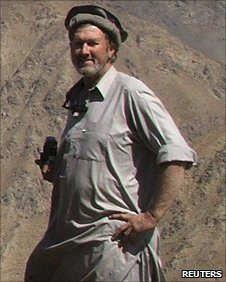
Dan Terry (Photo: Reuters)
Dan’s Afghan friends had two nicknames for him. The first was his Afghan name, Dantri. The second was a bit more colorful: Pagal, which means Crazy. Indeed, “Sometimes people thought Dan was slightly unhinged, because he insisted on the good in all people, often in the face of overwhelming evidence to the contrary.”
Dan had intuited something incredibly important about human nature. When it comes to violence and peace, humans are mimetic. Without realizing it, we instinctively imitate the violence against us, but we also instinctively imitate peaceful actions. Dan’s story reveals the mimetic aspect of human nature and the power of love to transform violence. Once a visiting minister asked Dan how Christians should pray for the Afghan people. Dan responded, “What I can tell you is this. It must be with great love. Above all, we must love them.”
An Unlikely Love
It was that radical love that made Dan friends with nearly everyone he met – even those who sought to persecute him. He was frequently captured by Taliban commanders, yet Larson writes that Dan was convinced “it was possible to conduct reasonable discussions … with the Taliban when differences or difficulties arose.” Dan was once captured while traveling in the Afghan backcountry. The hostile commander who captured him thought he could extort money from him; but Dan had nothing to give. As the hours passed, Dan remained calm and friendly to his captor. Soon, his captor imitated Dan’s peaceful spirit. “They ate together and drank tea as conversation and camaraderie flowered. In time, it dawned on the captor that a strange friendship had sprung between him and his oddly warm hostage.”
Dan’s strange friendship with the Taliban continued to grow. He never carried a weapon to protect himself. He relied on love, kindness, and friendship. Dan “counted among his friends the Taliban commanders of his neighborhood, insisting that they were not the caricatures of evil portrayed in the West. Flint-like in his belief that there was something noble in each neighbor, Dan kept reaching for the humanity of each person he met.”
More Muslim than we Muslims?
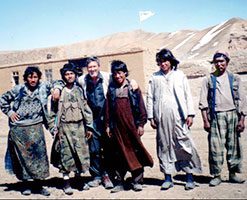
Dan with his friends in the Taliban — to his right, a man who’d tried to stab him several months before. (Photo: The Terry family — www.gbgm-umc.org)
One Afghan stated, “Dantri was more Afghan than we Afghans, and he was more Muslim than we Muslims.” According to this man, Dan was more Afghan than them because of his trustworthiness, loyalty, and sacred hospitality. What made him more Muslim? His Afghan friends claimed, “In the greatest commandments of our scripture–to practice humility; to be generous to widows, the orphans, and the poor; and to be selfless and persevering in the search for justice and peace–Dantri was more Muslim than we Muslims.” The mimetic aspect is obvious; Dan and his Muslim friends inspired and modeled for one another how to become more caring and compassionate. In the words of the Quran, “Good and evil cannot be equal; repel what is evil with what is better and your enemy will become as close as an old and valued friend.” (41:34)
Tragedy
After 30 years of working in Afghanistan, Dan tragically was killed along with a group of other humanitarian workers. They were ambushed and executed by 10 gunmen while delivering medical supplies to villages. Though there were investigations, the murders remain a mystery. The most prominent theory claims that the perpetrators likely were Pakistanis who didn’t know Dan. What we do know is that the Afghan Taliban, who we in the West think are quick to take responsibility for any act of terror, vehemently condemn the murder of their friend and deny any responsibility for the attack.
Still, Dan’s death could make us skeptical about his pursuit of friendship with the Taliban. We may accuse him of being foolish. Indeed, Dan’s life was filled with risk, but the alternative of war in Afghanistan has also been risky, and has only ensured a mimetic cycle of violence along with deeper enmity and distrust between our two nations.
Overcoming Stereotypes
Dan’s strange friendship among the Taliban gives me hope for humanity. Dan believed that the West and the Taliban have distorted images of each other that can only be reconciled through the pursuit of love and friendship. “If that is true,” writes Larson, “then the Taliban and Western societies, as well as diplomats, will need to surmount the caricatures that have been imprinted on the public mind–those cartoon-like distortions of each other that have served the cause of war but that now thwart any path toward lasting peace.”
Dan’s life was based on the crazy, infectious love that Jesus taught. After meeting Dan, some war-weary Afghans in the central highlands responded mimetically to Dan’s peaceful spirit by forming a society called the Hezb-i-Pagal: the Party of Crazies. “The sole condition of membership is a ‘mad’ pledge to seek the good of the community and to disavow fighting and corruption.” Today, the Hezb-i-Pagal is headquartered in a village just west of Kabul. The requirement for membership is to help construct community buildings, including schools, clinics and mosques.
Dan’s story is inspiring, but I’ll be honest, I’m not going to Afghanistan to befriend the Taliban any time soon. Sometimes we can think less of ourselves by comparing our lives to people like Dan. But that’s not the point. Rather, Dan is a model for all of us. His devotion to radical Christian love and commitment to friendship and reconciliation is an important example that can be practiced in our families, neighborhoods, work environment, and religious institutions. The love Dan showed is risky, but it is our hope for a more peaceful world.

Browse Our Archives
Select a Category Atonement and Current Events Curriculum Faith and Families Interviews Jesus the Forgiving Victim Lent Montessori politics Reviews The Bible Explained Uncategorized Valentine's Day Wednesday Sermon Who is God?
Select a Month July 2020 November 2019 October 2019 September 2019 August 2019 July 2019 June 2019 May 2019 April 2019 March 2019 February 2019 January 2019 December 2018 November 2018 October 2018 September 2018 August 2018 July 2018 June 2018 May 2018 April 2018 March 2018 February 2018 January 2018 December 2017 November 2017 October 2017 September 2017 August 2017 July 2017 June 2017 May 2017 April 2017 March 2017 February 2017 January 2017 December 2016 November 2016 October 2016 September 2016 August 2016 June 2016 May 2016 April 2016 March 2016 February 2016 January 2016 December 2015 November 2015 October 2015 September 2015 August 2015 July 2015 June 2015 May 2015 April 2015 March 2015 February 2015 January 2015 December 2014 November 2014 October 2014 September 2014 August 2014 July 2014 June 2014 May 2014 April 2014 March 2014 January 2014 December 2013 September 2013 August 2013 July 2013
Follow Us!
TAKE THE
Religious Wisdom Quiz
I made a rash vow that cost me my only child after a military victory. Who am I?
Select your answer to see how you score.
Gideon Jephthah Samson Barak
Related posts from Teaching Nonviolent Atonement

Toxic Christianity: 3 Things We Can Do That...

The Secret of Life: An Interview with Audrey...

Forgiveness in the Time of COVID-19 by Julia...

TRENDING AT PATHEOS Progressive Christian

Why Christians Have a Sacred Duty to Vote:...
The Bible offers strong support for the sacred duty to vote. Here...

What Being a Modern-Day Apostle Means to Me
In my last column, I discussed the ins and outs of modern-day...

Did Ancient China Once Worship the God of...
Across human history, a common thread weaves through the origins of the...

Love Your Neighbor – Including Earth-Kin: Lev. 19,...
God’s command to love your neighbor means acting in an ethical and...

Lead a Church Study of “Jesus and Lao...
Guest writer Jack Thomas (The Irreverent Reverend) reflects on leading his church...

Principles for Understanding the Apostolic Ministry Today
Whenever people discover that my formal ministry title is "apostle," as in...
view all Progressive Christian blogs
Ad-Free & Subscriber Log-In Subscription Support
- About Us
- 2026 Calendar
- Videos
- Podcasts
- Library of World Religions
- Faith In Media Tracker
- Advertise With Us
- Write for Us
- Privacy Policy
- Terms of Service
- Do Not Sell My Data
- Contact Us
- Radiant Digital
- Manage Newsletter Subscriptions
- Unsubscribe From Notifications
- Sitemap
Copyright 2008-2026, Patheos. All rights reserved.
Subscription Support Ad-Free & Subscriber Log-In
Follow Patheos