
BuddhistCatholicContemplativeEvangelicalGeneral ChristianHinduJewishLatter-day SaintMuslimNew VisionsProgressive Christian
Beliefs
- Buddhist
- Catholic
- Contemplative
- Evangelical
- General Christian
- Hindu
- Jewish
- Latter-day Saint
- More Voices
- Muslim
- New Visions
- Pagan
- Progressive Christian
Topics
- Religion News
- Food and Religion
- Sports and Religion
- Religious Art
- Religious Music and Entertainment
- Religious Events
- History and Religion
- Style and Religion
- Politics and Religion
- Women in Religion
- Recreation Outdoors and Religion
- Business Finance and Religion
- Careers Workplace and Religion
- Education and Religion
- Family Parenting and Religion
- Health Fitness and Religion
- Home and Religion
- Relationships and Religion
- Technology and Religion
- Travel and Religion
Columnists
- Buddhist Columnists
- Business Finance and Religion Columnists
- Careers Workplace and Religion Columnists
- Catholic Columnists
- Contemplative Columnists
- Education and Religion Columnists
- Evangelists Columnists
- Family Parenting and Religion Columnists
- General Christian Columnists
- Health Fitness and Religion Columnists
- Hindu Columnists
- History and Religion Columnists
- Home and Religion Columnists
- Jewish Columnists
- More Voices Columnists
- Latter Day Columnists
- Muslim Columnists
- New Visions Columnists
- Nonreligious Columnists
- Pagan Columnists
- Politics and Religion Columnists
- Progressive Columnists
- Recreation Outdoors and Religion Columnists
- Relationships and Religion Columnists
- Religion News Columnists
- Religious Art Columnists
- Religious Events Columnists
- Religious Music and Entertainment Columnists
- Sports and Religion Columnists
- Style and Religion Columnists
- Technology and Religion Columnists
- Travel and Religion Columnists
- Women in Religion Columnists
Resource Library
- 2026 Calendar
- Library of World Religions
- The 100 Most Holy Places on Earth
- Patheos Answers
- Podcasts
- Videos
- Faith Leaders Database
- Anglican Episcopalian
- Bahai
- Baptist
- Buddhism
- Christianity
- Confucianism
- Eastern Orthodoxy
- Hinduism
- Holiness and Pentecostal
- ISKCON
- Islam
- Judaism
- Lutheran
- Methodist
- The Church of Jesus Christ of Latter-day Saints
- New Age
- Paganism
- Presbytarian and Reformed
- Protestantism
- Religion Behind the Scenes
- Roman Catholic
- Scientology
- Shia Islam
- Sikhism
- Sufism
- Sunni Islam
- Taoism
- Zen
- See all religions
Research Tools
 Ad-Free & Subscriber Log-In Subscription Support
Ad-Free & Subscriber Log-In Subscription Support
Follow Patheos 

- Trending:
- Forgiveness
- |
- Marriage
- |
- Consciousness
- |
- Death Penalty
- |
- Election
- |
- Halloween
 Teaching Nonviolent Atonement
- Home
- Progressive Christian
- A Defense of the Passive Voice
A Defense of the Passive Voice
Last updated on: August 6, 2014 at 10:00 am by Suzanne Ross
A Defense of the Passive Voice 2014-08-01T15:33:52-05:00 Suzanne Ross
Patheos Explore the world's faith through different perspectives on religion and spirituality! Patheos has the views of the prevalent religions and spiritualities of the world.
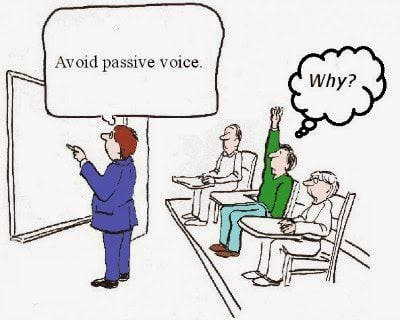
Image from Walden University Writing Center
Would you rather be a noun or an adjective? That was the question a friend asked herself when she decided to be known as Nance instead of Nancy. “Why be an adjective,” she quipped, “when you can be a noun?” I laughed out loud! But hey, I am a writer and literature nerd, so thinking of myself as a part of speech tickled my funny bone. My immediate reaction was to agree with her – a noun is surely much grander and more important than its modifiers, like a Queen surrounded by adoring subjects. But then my mimetic theory antennae started to vibrate – why was the condition of “noun-ness” so attractive to Nance and me?
My first thought was that she, and I, were instantly associating being a noun with being the subject of a sentence in the active voice. In this construction, the noun is the actor, the prime mover, the one who initiates and around whom all the action revolves. A lofty role indeed! Adjectives play their part, of course, but they can only modify the subject, never quite reaching the coveted position of initiator of the action. In my years taking fiction writing classes, the active voice was clearly preferred over the passive voice, in which the action is performed upon the subject. Contemporary fiction seemed to be obsessed with constructing sentences in which the action is performed by the subject (active voice), not upon it.
After a time I became disillusioned with fiction writing. My lack of talent was becoming more apparent to me, of course, but I was also getting a bit peeved by the fanatical promotion of the active voice. Why this insistence on active over passive voice? To answer the question, let’s look at a dramatic example of the difference between active and passive voice:
Active – Nance saved the drowning child.
- Nance is the heroine of this drama; her saving action is emphasized by the active voice construction. The child is almost a prop, conveniently there as a foil to demonstrate the heroism that is part and parcel of Nance’s being.
Passive – The drowning child was saved by Nance.
- Nance is still the heroine, but the subject of the sentence is the child. The focus is less on Nance and more on the child, who received the help offered and so was saved. The emphasis is on the dire situation of the child more than on the nature of Nance’s heroic action.
Do you see how both sentences describe the same scene but from completely different perspectives? Why, I wondered, as a succession of writing teachers extolled the virtues of the active voice, was the perspective of the passive voice being rejected? Because in the passive voice, the subject of the sentence is acted upon by another. A passive subject defies the myth of American, action-oriented, individualism*.* The individual as a self-starter who acts upon his environment with strength of character and determined will is fully expressed by the active voice. The picture of the individual as someone who is acted upon that obtains via the passive voice is therefore banished from the world of fiction.
Which, I think, is what diminishes the power of much of contemporary fiction to reveal the truth to us about ourselves. Much more realistic is the perspective we find in the biblical narrative, of beings who are acted upon by God, who receive calls, admonitions, encouragements, punishments, laws, visitations, visions and salvation and so are shaped and molded into someone new. The bible also warns against idolatry, which is nothing other than receiving calls, admonitions, encouragements, punishments, laws, visitations, visions and salvation from someone or something other than God. We will be called into being by someone other than ourselves, the Bible tells us. The question is not if, but by whom.
I believe this denial of what James Alison calls our “secondariness” is at the heart of the modern plague of anxiety, depression and general ennui which hovers over so many of us. When we insist upon being a noun that is hell bent on initiating the action of our own lives, we fail to recognize the ways in which we are acted upon and constructed by others. We want so desperately to be somebody, we fail to see that “being somebody” is not something we do, but something that is given to us as a gift from God. To use fiction writing terms again, though we are the subject of our own lives, we are not the protagonist of our own stories. God is. We are the passive subject of a sentence in which God is the initiator of all that is, including us.
Undergoing this shift in perspective is the focus of James Alison’s course, Jesus the Forgiving Victim: Listening for the Unheard Voice. Allow me to end this brief reflection on so vast a subject by quoting from Alison’s discussion of the bush that burns but is not consumed. Do you remember the answer God gave when Moses asked for God’s name?
God said to Moses, “I AM WHO I AM.” This, then is the answer of answers, and at the same time, the ultimate non-answer. For the same God who is not in rivalry with anything that is… is refusing to be a “he” or an “it”. “I AM”, or “I WILL BE WHO I WILL BE” (which may well be a less misleading translation of a very mysterious phrase), is something that cannot be grasped, coming towards you, and the “not-being-able-to-be-grasped” is essential to what is going on. “I AM” turns out to be the real protagonist, the one who brings everything into being, and it is thus only in the degree to which anyone stops attempting to be the “I AM” in the face of God, trying to make God an “it” or a “he”, that that person, or that group will start themselves to receive their real “self”, their real but subsidiary “I am” as a group and as individual persons.
God is not a person, place or thing, not a noun at all, as grand as we imagine that to be. God, it seems, is more like a verb than anything we can hold in our hands or point to as being here or there. God is aliveness, energy, causality, creative power – God is that which acts upon us and brings us into being, the energy that allows us to become a noun. Yes, it is glorious to be a noun, but a noun who forgets that he or she is a created being, a creature and not the Creator, has lost touch with reality. To return to ourselves, we need only relax into the presence of I AM, and experience the joy of being acted upon by love.
Previous Post

August 4, 2014
NT Wright and a Genuine Penal Substitutionary Atonement Theory
Next Post
August 8, 2014 David's Sling: Israel and Interpreting Biblical Violence
Browse Our Archives
Select a Category Atonement and Current Events Curriculum Faith and Families Interviews Jesus the Forgiving Victim Lent Montessori politics Reviews The Bible Explained Uncategorized Valentine's Day Wednesday Sermon Who is God?
Select a Month July 2020 November 2019 October 2019 September 2019 August 2019 July 2019 June 2019 May 2019 April 2019 March 2019 February 2019 January 2019 December 2018 November 2018 October 2018 September 2018 August 2018 July 2018 June 2018 May 2018 April 2018 March 2018 February 2018 January 2018 December 2017 November 2017 October 2017 September 2017 August 2017 July 2017 June 2017 May 2017 April 2017 March 2017 February 2017 January 2017 December 2016 November 2016 October 2016 September 2016 August 2016 June 2016 May 2016 April 2016 March 2016 February 2016 January 2016 December 2015 November 2015 October 2015 September 2015 August 2015 July 2015 June 2015 May 2015 April 2015 March 2015 February 2015 January 2015 December 2014 November 2014 October 2014 September 2014 August 2014 July 2014 June 2014 May 2014 April 2014 March 2014 January 2014 December 2013 September 2013 August 2013 July 2013
Follow Us!
TAKE THE
Religious Wisdom Quiz
What does Hebrews define as "confidence in what we hope for"?
Select your answer to see how you score.
Love Righteousness Faith Salvation
Related posts from Teaching Nonviolent Atonement
Jesus Lights The Way To Full Inclusion –...

Welcome to my world: Notes on the reception...

The RavenCast: Thanksgiving and the Apocalypse

St. Patrick, Snakes, and Cosmic Love
TRENDING AT PATHEOS Progressive Christian

Why Christians Have a Sacred Duty to Vote:...
The Bible offers strong support for the sacred duty to vote. Here...

What Being a Modern-Day Apostle Means to Me
In my last column, I discussed the ins and outs of modern-day...

Did Ancient China Once Worship the God of...
Across human history, a common thread weaves through the origins of the...

Love Your Neighbor – Including Earth-Kin: Lev. 19,...
God’s command to love your neighbor means acting in an ethical and...

Lead a Church Study of “Jesus and Lao...
Guest writer Jack Thomas (The Irreverent Reverend) reflects on leading his church...

Principles for Understanding the Apostolic Ministry Today
Whenever people discover that my formal ministry title is "apostle," as in...
view all Progressive Christian blogs
Ad-Free & Subscriber Log-In Subscription Support
- About Us
- 2026 Calendar
- Videos
- Podcasts
- Library of World Religions
- Faith In Media Tracker
- Advertise With Us
- Write for Us
- Privacy Policy
- Terms of Service
- Do Not Sell My Data
- Contact Us
- Radiant Digital
- Manage Newsletter Subscriptions
- Unsubscribe From Notifications
- Sitemap
Copyright 2008-2026, Patheos. All rights reserved.
Subscription Support Ad-Free & Subscriber Log-In
Follow Patheos