
BuddhistCatholicContemplativeEvangelicalGeneral ChristianHinduJewishLatter-day SaintMuslimNew VisionsProgressive Christian
Beliefs
- Buddhist
- Catholic
- Contemplative
- Evangelical
- General Christian
- Hindu
- Jewish
- Latter-day Saint
- More Voices
- Muslim
- New Visions
- Pagan
- Progressive Christian
Topics
- Religion News
- Food and Religion
- Sports and Religion
- Religious Art
- Religious Music and Entertainment
- Religious Events
- History and Religion
- Style and Religion
- Politics and Religion
- Women in Religion
- Recreation Outdoors and Religion
- Business Finance and Religion
- Careers Workplace and Religion
- Education and Religion
- Family Parenting and Religion
- Health Fitness and Religion
- Home and Religion
- Relationships and Religion
- Technology and Religion
- Travel and Religion
Columnists
- Buddhist Columnists
- Business Finance and Religion Columnists
- Careers Workplace and Religion Columnists
- Catholic Columnists
- Contemplative Columnists
- Education and Religion Columnists
- Evangelists Columnists
- Family Parenting and Religion Columnists
- General Christian Columnists
- Health Fitness and Religion Columnists
- Hindu Columnists
- History and Religion Columnists
- Home and Religion Columnists
- Jewish Columnists
- More Voices Columnists
- Latter Day Columnists
- Muslim Columnists
- New Visions Columnists
- Nonreligious Columnists
- Pagan Columnists
- Politics and Religion Columnists
- Progressive Columnists
- Recreation Outdoors and Religion Columnists
- Relationships and Religion Columnists
- Religion News Columnists
- Religious Art Columnists
- Religious Events Columnists
- Religious Music and Entertainment Columnists
- Sports and Religion Columnists
- Style and Religion Columnists
- Technology and Religion Columnists
- Travel and Religion Columnists
- Women in Religion Columnists
Resource Library
- 2026 Calendar
- Library of World Religions
- The 100 Most Holy Places on Earth
- Patheos Answers
- Podcasts
- Videos
- Faith Leaders Database
- Anglican Episcopalian
- Bahai
- Baptist
- Buddhism
- Christianity
- Confucianism
- Eastern Orthodoxy
- Hinduism
- Holiness and Pentecostal
- ISKCON
- Islam
- Judaism
- Lutheran
- Methodist
- The Church of Jesus Christ of Latter-day Saints
- New Age
- Paganism
- Presbytarian and Reformed
- Protestantism
- Religion Behind the Scenes
- Roman Catholic
- Scientology
- Shia Islam
- Sikhism
- Sufism
- Sunni Islam
- Taoism
- Zen
- See all religions
Research Tools
 Ad-Free & Subscriber Log-In Subscription Support
Ad-Free & Subscriber Log-In Subscription Support
Follow Patheos 

- Trending:
- Forgiveness
- |
- Marriage
- |
- Consciousness
- |
- Death Penalty
- |
- Election
- |
- Halloween
 Teaching Nonviolent Atonement
- Home
- Progressive Christian
- Virtually Christian: Finding Atonement on the Internet
Virtually Christian: Finding Atonement on the Internet
Last updated on: May 22, 2014 at 5:13 pm by Adam Ericksen
Virtually Christian: Finding Atonement on the Internet 2014-05-22T17:13:01-05:00 Adam Ericksen
Patheos Explore the world's faith through different perspectives on religion and spirituality! Patheos has the views of the prevalent religions and spiritualities of the world.
 How is technology changing contemporary spirituality?
That’s the question Patheos asked in its recent Public Square conversation. The irony that modern technology is allowing us to have the conversation over the Internet should be apparent to everyone. There is no doubt that technology is changing our spirituality. Humans are able to learn about different cultural, religious, and spiritual practices like never before. For better or worse, there is a deep spiritual aspect to the Internet. Discussing that spirituality in terms of the controversial Christian doctrine of Atonement will help us as we search for Atonement on the Internet.
What is Atonement?
Before we can explore Atonement on the Internet, we need to understand what we mean by “atonement.” In the Christian tradition, Atonement has referred to the way our relationships have been changed through the cross of Christ. Through Christ’s Atonement, we have been reconciled with God, other human beings, and the world. Atonement is about reconciliation.
But a major questions remains for Christianity: How is that Atonement achieved? Christian tradition has offered various answers to that question, including theories known as Ransom, Christus Victor, Satisfaction, and Penal Substitution.
René Girard’s modern theory of religion might be the most helpful in understanding the Atonement. There are two ways that humans have generally found atonement and reconciliation. Girard describes the first way by positing that throughout human history we have found reconciliation through sacrificial violence. Far from being impractical, ancient religions dealt with a very practical problem – violence. The biggest threat to human communities has always been violence from within. Girard posits that human groups have found atonement, or reconciliation, through violent sacrifice. All of the violence that threatened the community was channeled onto a single sacrificial victim, whom Girard calls the “scapegoat.”
Once the victim was sacrificed, the group felt a sense of peace and reconciliation. The violence that threatened the community was washed away by the blood of the sacrificial victim. This peace and reconciliation was so miraculous that it seemed to be a gift from the gods. A theology was born that claimed the wrathful gods demanded the sacrifice of a victim. But the peace and reconciliation brought by the atoning death of the victim was only temporary. Scapegoating never actually solves the problems facing a community, so the same problems reemerge and the cycle of scapegoating continues, along with a theology that claimed that the gods demand the violent sacrifice.
Jesus’ Transformation of Atonement
Jesus came to change our theology, including our theology of Atonement. Unfortunately, many Christians would agree in principle with the theology in the description of atonement above. The only aspect they would change is that instead of the “gods” demanding sacrifice, it is “God” who demands the sacrifice. Specifically, the Father demands the violent sacrifice of the Son to appease His wrath.
But Girard’s theory of ancient religion allows us to understand just how radical Jesus, and the Jewish tradition that formed him, really were because they provide us with the second way of finding atonement, which is through nonviolent love and forgiveness. Indeed, within the Jewish-Christian tradition there is a theme that God demands sacrificial violence, but there is an alternative understanding of the theme of sacrifice. This understanding states that God doesn’t want sacrificial violence that leads to death, but rather a self-sacrifice that leads to life, mercy, and forgiveness.
For example, the Psalmist says of God, “For you have no delight sacrifice; if I were to give a burnt offering, you would not be pleased. The sacrifice acceptable to God is a broken spirit; a broken and contrite heart.” God asked through Isaiah, “What to me is the multitude of your sacrifices? says the Lord. I have had enough of burnt offerings of rams and the fat of beasts. I do not delight in the blood of bulls, or of lambs, or of goats.” God takes the tenor of anti-sacrificial violence a step further in Hosea, “For I desire steadfast love and not sacrifice, the knowledge of God rather than burnt-offerings.”
Christians discover the truth of Hosea’s statement on the atoning cross of Christ. It was not God who desired the sacrificial violence of the cross; we humans desired it. Jesus revealed the steadfast love of God that atones and reconciles not through violence, but through forgiveness when he prayed, “Father, forgive them, for they know not what they do.”
Jesus not only radically changes our theology, but also the way we find reconciliation. God isn’t like the ancient gods who demand violent sacrifice. Rather, God is like Jesus who atoned for our violent ways by bringing reconciliation through nonviolent mercy, forgiveness, and love.
Virtually Christian
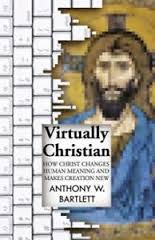 In his masterful book Virtually Christian: How Christ Changes Human Meaning and Makes Creation Anew, Tony Bartlett relates Christ’s transformation of our theology to modern technology. Tony explains that technology can lead to an exponential distribution of Christ’s love and compassion, but within technology also looms the danger of an explosion of sacrificial violence. We tend to emphasize the dangers of technology, but Tony wants to help us see the virtual nature of Christ who comes to us in technology. Tony states, “In movies, on the web, on TV and radio, there is always the possibility of an image of compassion arising from the seminal presence of the Crucified, one that will produce a response of compassion in an individual.”
For Tony the virtuality of Christ means that Christ comes to us through many mediums, including modern technology and the Internet.
Finding Atonement on the Internet
There are countless examples of Christ’s nonviolent Atonement on the Internet, but I’ll highlight one that shows the alternative ways of forming reconciliation. A few years ago, Balpreet Kaur, a Sikh college student, was waiting in a security line at an airport. A man decided to take her picture and post it on his website. He thought it would be funny because Balpreet has facial hair.
The man’s online community united with him in demeaning Balpreet. Clearly, this shows the danger of technology. The Internet allows and opportunity for people throughout the world to find reconciliation by uniting against a scapegoat.
Balpreet has her own spiritual language to describe what she did next, which you can read here, but in Christian terms we might say that through technology Balpreet revealed the virtuality of Christ.

Balpreet Kaur waiting in line at the airport.
When Balpreet discovered her image was being used in such a demeaning way, she chose to respond with nonviolent mercy and forgiveness. She used it as an opportunity to teach her scapegoaters about the sacredness of the human body. She didn’t react to violence with more violence; rather, she reacted with forgiveness.
Balpreet’s gracious response had a reconciling affect with the man who posted the picture. He apologized for posting the picture, saying that he, “Felt the need to apologize to the Sikhs, Balpreet, and anyone else I offended when I posted that picture. Put simply, it was stupid. Making fun of people is funny to some, but incredibly degrading to the people you are making fun of.”
The Internet: Where Grace Abounds
St. Paul wrote that, “Where sin increased, grace abounded all the more.” Technology has increased the destructive power of sin and sacrificial violence, but it has also created an infinite opportunity for grace to abound all the more. Tony’s book Virtually Christian is a stunning analysis of the incarnation of Christ’s atoning nonviolent love and forgiveness through various forms of modern technology. Balpreet provides the greatest example of God’s abundant grace on the Internet.

Browse Our Archives
Select a Category Atonement and Current Events Curriculum Faith and Families Interviews Jesus the Forgiving Victim Lent Montessori politics Reviews The Bible Explained Uncategorized Valentine's Day Wednesday Sermon Who is God?
Select a Month July 2020 November 2019 October 2019 September 2019 August 2019 July 2019 June 2019 May 2019 April 2019 March 2019 February 2019 January 2019 December 2018 November 2018 October 2018 September 2018 August 2018 July 2018 June 2018 May 2018 April 2018 March 2018 February 2018 January 2018 December 2017 November 2017 October 2017 September 2017 August 2017 July 2017 June 2017 May 2017 April 2017 March 2017 February 2017 January 2017 December 2016 November 2016 October 2016 September 2016 August 2016 June 2016 May 2016 April 2016 March 2016 February 2016 January 2016 December 2015 November 2015 October 2015 September 2015 August 2015 July 2015 June 2015 May 2015 April 2015 March 2015 February 2015 January 2015 December 2014 November 2014 October 2014 September 2014 August 2014 July 2014 June 2014 May 2014 April 2014 March 2014 January 2014 December 2013 September 2013 August 2013 July 2013
Follow Us!
TAKE THE
Religious Wisdom Quiz
In which Psalm do we find "Your word is a lamp to my feet..."?
Select your answer to see how you score.
Psalm 90 Psalm 119 Psalm 27 Psalm 23
Related posts from Teaching Nonviolent Atonement

Forgiveness in the Time of COVID-19 by Julia...


Reflections on Indigenous Wisdom For Healing A Wounded...

How Forgiveness Can Transform Our Violence and Build...
TRENDING AT PATHEOS Progressive Christian

What Being a Modern-Day Apostle Means to Me
In my last column, I discussed the ins and outs of modern-day...

Did Ancient China Once Worship the God of...
Across human history, a common thread weaves through the origins of the...

Love Your Neighbor – Including Earth-Kin: Lev. 19,...
God’s command to love your neighbor means acting in an ethical and...

Lead a Church Study of “Jesus and Lao...
Guest writer Jack Thomas (The Irreverent Reverend) reflects on leading his church...

Pastoral Wisdom for Responding to Sermon Pushback
Getting sermon pushback on your social justice sermon? Learn practical, Proverbs-based strategies...

Principles for Understanding the Apostolic Ministry Today
Whenever people discover that my formal ministry title is "apostle," as in...
view all Progressive Christian blogs
Ad-Free & Subscriber Log-In Subscription Support
- About Us
- 2026 Calendar
- Videos
- Podcasts
- Library of World Religions
- Faith In Media Tracker
- Advertise With Us
- Write for Us
- Privacy Policy
- Terms of Service
- Do Not Sell My Data
- Contact Us
- Radiant Digital
- Manage Newsletter Subscriptions
- Unsubscribe From Notifications
- Sitemap
Copyright 2008-2026, Patheos. All rights reserved.
Subscription Support Ad-Free & Subscriber Log-In
Follow Patheos