
BuddhistCatholicContemplativeEvangelicalGeneral ChristianHinduJewishLatter-day SaintMuslimNew VisionsProgressive Christian
Beliefs
- Buddhist
- Catholic
- Contemplative
- Evangelical
- General Christian
- Hindu
- Jewish
- Latter-day Saint
- More Voices
- Muslim
- New Visions
- Pagan
- Progressive Christian
Topics
- Religion News
- Food and Religion
- Sports and Religion
- Religious Art
- Religious Music and Entertainment
- Religious Events
- History and Religion
- Style and Religion
- Politics and Religion
- Women in Religion
- Recreation Outdoors and Religion
- Business Finance and Religion
- Careers Workplace and Religion
- Education and Religion
- Family Parenting and Religion
- Health Fitness and Religion
- Home and Religion
- Relationships and Religion
- Technology and Religion
- Travel and Religion
Columnists
- Buddhist Columnists
- Business Finance and Religion Columnists
- Careers Workplace and Religion Columnists
- Catholic Columnists
- Contemplative Columnists
- Education and Religion Columnists
- Evangelists Columnists
- Family Parenting and Religion Columnists
- General Christian Columnists
- Health Fitness and Religion Columnists
- Hindu Columnists
- History and Religion Columnists
- Home and Religion Columnists
- Jewish Columnists
- More Voices Columnists
- Latter Day Columnists
- Muslim Columnists
- New Visions Columnists
- Nonreligious Columnists
- Pagan Columnists
- Politics and Religion Columnists
- Progressive Columnists
- Recreation Outdoors and Religion Columnists
- Relationships and Religion Columnists
- Religion News Columnists
- Religious Art Columnists
- Religious Events Columnists
- Religious Music and Entertainment Columnists
- Sports and Religion Columnists
- Style and Religion Columnists
- Technology and Religion Columnists
- Travel and Religion Columnists
- Women in Religion Columnists
Resource Library
- 2026 Calendar
- Library of World Religions
- The 100 Most Holy Places on Earth
- Patheos Answers
- Podcasts
- Videos
- Faith Leaders Database
- Anglican Episcopalian
- Bahai
- Baptist
- Buddhism
- Christianity
- Confucianism
- Eastern Orthodoxy
- Hinduism
- Holiness and Pentecostal
- ISKCON
- Islam
- Judaism
- Lutheran
- Methodist
- The Church of Jesus Christ of Latter-day Saints
- New Age
- Paganism
- Presbytarian and Reformed
- Protestantism
- Religion Behind the Scenes
- Roman Catholic
- Scientology
- Shia Islam
- Sikhism
- Sufism
- Sunni Islam
- Taoism
- Zen
- See all religions
Research Tools
 Ad-Free & Subscriber Log-In Subscription Support
Ad-Free & Subscriber Log-In Subscription Support
Follow Patheos 

- Trending:
- Forgiveness
- |
- Marriage
- |
- Consciousness
- |
- Death Penalty
- |
- Election
- |
- Halloween
 Teaching Nonviolent Atonement
- Home
- Progressive Christian
- Atonement and the Gay Christian
Atonement and the Gay Christian
Last updated on: May 28, 2014 at 11:37 am by Adam Ericksen
Atonement and the Gay Christian 2014-05-28T11:37:12-05:00 Adam Ericksen
Patheos Explore the world's faith through different perspectives on religion and spirituality! Patheos has the views of the prevalent religions and spiritualities of the world.
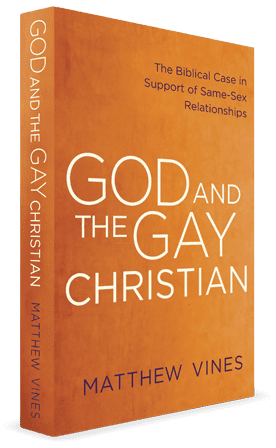 Matthew Vines has done us an incredible service by writing his book God and the Gay Christian: The Biblical Case in Support of Same-Sex Relationships. Matthew’s book is an articulate and engaging argument for Christians to support same-sex relationships. It is a great book and I highly recommend it to anyone interested in debate over Christianity and the support of same-sex relationships.
I appreciate this book for primarily two reasons. First, Matthew presents scholarship on the topic in a thoughtful way that won’t bore you to death. If you’ve already done your homework on the topic you probably won’t find anything new, but by reading this book you will encounter scholarly arguments in an engaging way. There are other books on the topic, of course, but what makes Matthew’s book different than most of them is that this is an engaging page turner.
Matthew skillfully debunks many of the arguments against same-sex marriage throughout the book and replaces them with arguments to support same-sex marriage. He not only takes a look at the biblical “clobber texts,” the six passages in the Bible often used to denounce same-sex relationships, but he also takes a look at the historical and cultural context of the ancient world’s view of sexuality. His argument is convincing. I encourage you to buy the book for yourself and for anyone you know who is open to hearing his side of the debate.
Which leads me to the second reason that I appreciate God and the Gay Christian. Matthew’s arguments, which I find convincing, won’t be convincing to others. (That may sound like a criticism of the book, but stick with me.) Matthew’s arguments that the ancient view of sexuality is not like our modern view of sexual orientation, that the biblical passages aren’t talking about committed same-sex relationships but rather abusive relationships, and that the meaning of biblical marriage is fully compatible with same-sex marriage won’t be convincing to those on the other side of the debate. Extended members of my family wouldn’t be convinced by those arguments. That they find those arguments unconvincing is not due to the fact that they are bad, homophobic people; it’s due to the fact that they are human.
Facts and arguments rarely change anyone’s mind. In fact, at least one study shows that when presented with facts people become “even more strongly set in their beliefs.” Why? Because nobody wants to be wrong. This is true for liberals, conservatives, and everyone in between. Arguments don’t work because nobody wants to be wrong. Being wrong threatens our sense of self, our very identity. In most cases arguments only serve to reinforce someone’s previously held position. Arguments simply don’t work to convince people on the other side of this, or any other, debate.
Matthew, I think, knows this. For those looking for arguments for supporting same-sex relationships, the book is worth reading. But throughout the book Matthew provides us with something more important than intellectual arguments.
God and the Gay Christian is delightfully personal. Interspersed between the scholarly arguments, Matthew tells the story of how he came out to his parents. His personal story is worth the price of the book because Matthew models how to be in loving, committed relationships with people on the other side of the debate.
Matthew’s parents were strict conservatives on this topic and at first were disappointed in Matthew. His dad even stated that the day Matthew came out “was the worst day of his life.” And yet, his parents continued to love Matthew. People who affirm same-sex relationship can often demonize those who don’t affirm it, but Matthew won’t let us do that. He says that, “Ours is a Christian family story. It is also a loving loyal, confused church story.” If that sounds like every Christian family and church story to you, that’s because it is. Families and churches are messy places because humans tend to be messy. And yet, Matthew never demonizes the other side. Rather, he beautifully models how to be in a compassionate relationship with the “other,” those with whom we disagree.
Atonement and the Same-Sex Marriage Debate
I’m convinced that the relational aspect that Matthew models is the most important aspect of his book, and I’d like to talk about it in terms of the Christian doctrine of Atonement. Christian tradition claims the primary place we find atonement, or reconciliation, with God, one another, and creation is on the cross. The Atonement changes our pattern of relating to our fellow human beings. The pattern that it changes is the sinful pattern of scapegoating. We have a natural ability of creating an “other,” either someone or a group that we label as “bad.” Jesus, for example, was labeled “bad” by the religious and political establishment. He was determined to be a heretic and a threat to the political order, so he was crucified.
Now, normal human relationships tend to be tit for tat, eye for an eye, life for a life. Jesus would have had every right to respond to the violence against him with violence of his own. If he would have done that he would have created atonement by the rules of the old order that influenced every human culture. But Jesus created a new order for a new human culture through nonviolence and forgiveness. His words of forgiveness from the cross changes our pattern of scapegoating others into a new pattern of compassionate forgiveness that extends to all people.
Jesus atoned for our sin and brought reconciliation, not through intellectual argument, but through revealing a new pattern of relating to others through compassion, love, and forgiveness.
So buy the book for an engaging presentation of the scholarly arguments for a Christian support of same-sex relationships, but even more importantly, buy the book to read how Matthew and his dad model Christ’s reconciling atonement. But beware, because if you do your presuppositions and scapegoating of the other side will be challenged.
For both sides of this debate, that challenge is a good thing.
For more on Matthew, scroll to the bottom of this page on Patheos to watch a conversation between Matthew, Deborah Arca, Rachel Held-Evans, Tony Jones, and Jay Baker.
Next Post

May 28, 2014 Stop Celebrating Memorial Day!
Browse Our Archives
Select a Category Atonement and Current Events Curriculum Faith and Families Interviews Jesus the Forgiving Victim Lent Montessori politics Reviews The Bible Explained Uncategorized Valentine's Day Wednesday Sermon Who is God?
Select a Month July 2020 November 2019 October 2019 September 2019 August 2019 July 2019 June 2019 May 2019 April 2019 March 2019 February 2019 January 2019 December 2018 November 2018 October 2018 September 2018 August 2018 July 2018 June 2018 May 2018 April 2018 March 2018 February 2018 January 2018 December 2017 November 2017 October 2017 September 2017 August 2017 July 2017 June 2017 May 2017 April 2017 March 2017 February 2017 January 2017 December 2016 November 2016 October 2016 September 2016 August 2016 June 2016 May 2016 April 2016 March 2016 February 2016 January 2016 December 2015 November 2015 October 2015 September 2015 August 2015 July 2015 June 2015 May 2015 April 2015 March 2015 February 2015 January 2015 December 2014 November 2014 October 2014 September 2014 August 2014 July 2014 June 2014 May 2014 April 2014 March 2014 January 2014 December 2013 September 2013 August 2013 July 2013
Follow Us!
TAKE THE
Religious Wisdom Quiz
Why did Jesus wash His disciples' feet?
Select your answer to see how you score.
To show humble service They asked Him to Tradition only To clean them for eating
Related posts from Teaching Nonviolent Atonement

The Secret of Life: An Interview with Audrey...

Forgiveness in the Time of COVID-19 by Julia...

Reflections on Indigenous Wisdom For Healing A Wounded...

How Forgiveness Can Transform Our Violence and Build...
TRENDING AT PATHEOS Progressive Christian

Why Christians Have a Sacred Duty to Vote:...
The Bible offers strong support for the sacred duty to vote. Here...

What Being a Modern-Day Apostle Means to Me
In my last column, I discussed the ins and outs of modern-day...

Did Ancient China Once Worship the God of...
Across human history, a common thread weaves through the origins of the...

Love Your Neighbor – Including Earth-Kin: Lev. 19,...
God’s command to love your neighbor means acting in an ethical and...

Lead a Church Study of “Jesus and Lao...
Guest writer Jack Thomas (The Irreverent Reverend) reflects on leading his church...

Principles for Understanding the Apostolic Ministry Today
Whenever people discover that my formal ministry title is "apostle," as in...
view all Progressive Christian blogs
Ad-Free & Subscriber Log-In Subscription Support
- About Us
- 2026 Calendar
- Videos
- Podcasts
- Library of World Religions
- Faith In Media Tracker
- Advertise With Us
- Write for Us
- Privacy Policy
- Terms of Service
- Do Not Sell My Data
- Contact Us
- Radiant Digital
- Manage Newsletter Subscriptions
- Unsubscribe From Notifications
- Sitemap
Copyright 2008-2026, Patheos. All rights reserved.
Subscription Support Ad-Free & Subscriber Log-In
Follow Patheos