
BuddhistCatholicContemplativeEvangelicalGeneral ChristianHinduJewishLatter-day SaintMuslimNew VisionsProgressive Christian
Beliefs
- Buddhist
- Catholic
- Contemplative
- Evangelical
- General Christian
- Hindu
- Jewish
- Latter-day Saint
- More Voices
- Muslim
- New Visions
- Pagan
- Progressive Christian
Topics
- Religion News
- Food and Religion
- Sports and Religion
- Religious Art
- Religious Music and Entertainment
- Religious Events
- History and Religion
- Style and Religion
- Politics and Religion
- Women in Religion
- Recreation Outdoors and Religion
- Business Finance and Religion
- Careers Workplace and Religion
- Education and Religion
- Family Parenting and Religion
- Health Fitness and Religion
- Home and Religion
- Relationships and Religion
- Technology and Religion
- Travel and Religion
Columnists
- Buddhist Columnists
- Business Finance and Religion Columnists
- Careers Workplace and Religion Columnists
- Catholic Columnists
- Contemplative Columnists
- Education and Religion Columnists
- Evangelists Columnists
- Family Parenting and Religion Columnists
- General Christian Columnists
- Health Fitness and Religion Columnists
- Hindu Columnists
- History and Religion Columnists
- Home and Religion Columnists
- Jewish Columnists
- More Voices Columnists
- Latter Day Columnists
- Muslim Columnists
- New Visions Columnists
- Nonreligious Columnists
- Pagan Columnists
- Politics and Religion Columnists
- Progressive Columnists
- Recreation Outdoors and Religion Columnists
- Relationships and Religion Columnists
- Religion News Columnists
- Religious Art Columnists
- Religious Events Columnists
- Religious Music and Entertainment Columnists
- Sports and Religion Columnists
- Style and Religion Columnists
- Technology and Religion Columnists
- Travel and Religion Columnists
- Women in Religion Columnists
Resource Library
- 2026 Calendar
- Library of World Religions
- The 100 Most Holy Places on Earth
- Patheos Answers
- Podcasts
- Videos
- Faith Leaders Database
- Anglican Episcopalian
- Bahai
- Baptist
- Buddhism
- Christianity
- Confucianism
- Eastern Orthodoxy
- Hinduism
- Holiness and Pentecostal
- ISKCON
- Islam
- Judaism
- Lutheran
- Methodist
- The Church of Jesus Christ of Latter-day Saints
- New Age
- Paganism
- Presbytarian and Reformed
- Protestantism
- Religion Behind the Scenes
- Roman Catholic
- Scientology
- Shia Islam
- Sikhism
- Sufism
- Sunni Islam
- Taoism
- Zen
- See all religions
Research Tools
 Ad-Free & Subscriber Log-In Subscription Support
Ad-Free & Subscriber Log-In Subscription Support
Follow Patheos 

- Trending:
- Forgiveness
- |
- Marriage
- |
- Consciousness
- |
- Death Penalty
- |
- Election
- |
- Halloween
 Teaching Nonviolent Atonement
- Home
- Progressive Christian
- Faith Forward: The Future of Christian Education, Part 2
Faith Forward: The Future of Christian Education, Part 2
Last updated on: April 28, 2014 at 2:10 pm by Suzanne Ross
Faith Forward: The Future of Christian Education, Part 2 2014-04-28T14:10:28-05:00 Suzanne Ross
Patheos Explore the world's faith through different perspectives on religion and spirituality! Patheos has the views of the prevalent religions and spiritualities of the world.
What’s Emerging? A New Perspective on Victims
 Something new is happening in Christianity today. The Spirit is moving among us, shaking up old ways, raising new questions, and challenging thousand year old tenets of our faith. Books with titles like Everything Must Change (Brian McLaren), Jesus Feminist (Sarah Bessey) and Banned Questions About the Bible (Christian Piatt) are populating our bookshelves. Some call these authors heretics who are destroying the fabric of Christianity. Others claim that without these prophetic voices, Christianity is doomed to fade into irrelevance. What’s going on?
Change, that’s what. And change can be exciting or it can be scary – or both at the same time! And just to make things really interesting, this may not be just your average, run of the mill change – we seem to be going through a period of monumental change. Phyllis Tickle (The Great Emergence) argues that we could well be witnessing the kind of historic change that seems to come once every 500 years or so. In her book, Christianity After Religion, Diana Butler Bass says that Harvey Cox of Harvard Divinity School “claims that Christianity is currently making a break from the ‘Age of Belief,’ a fifteen-hundred-year period of Western Christian dominance.” And Butler Bass herself says
“I believe that the United States (and not only the United States) is caught up in the throes of a spiritual awakening, a period of sustained religious and political transformation during which our ways of seeing the world, understanding ourselves, and expressing faith are being, to borrow a phrase, ‘born again.’”
Yikes! What’s the average pew-sitting, tithe paying, Bible reading Christian to make of all this? What, exactly are we supposed to believe and what are we supposed to be teaching our children? The reason I ask is that this is Part 2 in a series I am writing ahead of the Faith Forward Conference in Nashville on May 20-22 where Christian educators are gathering to consider the implications of all this monumental change for Christian formation. (If you missed Part 1, here it is.)
An Emerging Concern for Victims
Of course, change is nothing new. Since the emergence of human civilization, change has been a defining characteristic of the human experience. I’d like to point to two obvious changes that have occurred in human history which I think relate directly to what is emerging today: 1) the rise of a concern for victims and 2) the disappearance of blood sacrifices. Both these changes appear so good and right to us that we don’t think they need explaining.
But stop and think about it for a moment. Slavery, for example, was a completely acceptable part of the social order of things in the ancient world, endorsed and upheld by legal and religious authority. Today we quickly understand that slaves are victims of injustice; their suffering is undeniable. Yet a decided lack of concern for slaves as victims, a certain blindness to their suffering, was in large part the grease that kept the wheels of slavery turning right down to modern times. Similarly, the victims of blood sacrifices are so obviously victims to us that we can’t talk about them without using the term. Here too, a decided lack of concern for ritual victims as victims kept the sacrificial wheels turning.
Because the concern for victims is so unquestioned today, we can miss the import of the change that has slowly taken place over thousands of years. René Girard, the father of mimetic theory, explains:
Our society is the most preoccupied with victims of any that ever was. Even if it is insincere, a big show, the phenomenon has no precedent. No historical period, no society we know, has ever spoken of victims as we do. We can detect in the recent past the beginnings of the contemporary attitude, but every day new records are broken. We are all actors as well as witnesses in a great anthropological first.
… The China of the Mandarins, the Japan of the samurai, the Hindus, the pre-Columbian societies, Athens, republican or imperial Rome – none of these were worried in the least little bit about victims, whom they sacrificed without number to their gods, to the honor of the homeland, to the ambition of conquerors, small or great. (I See Satan Fall Like Lightning, 161)
Girard draws a straight line between a lack of concern for victims and the practice of ritual sacrifice. The latter depends on the former; awaken a concern for victims, and sacrifice crumbles.
The Jesus Effect
So where did this concern for victims come from? It is common to observe that as Christianity spread, blood sacrifices ended. Is that just a coincidence? Did the concern for victims which spelled the end of sacrificial religions emerge in spite of Christianity or because of it?
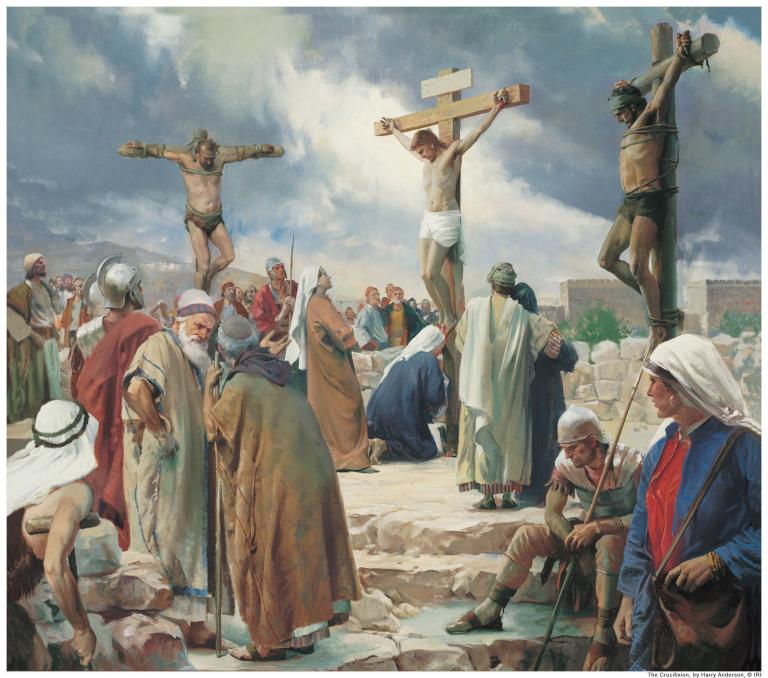
Sometimes the obvious passes our notice, but it does not stretch the truth to say that at the center of Christianity hangs a victim of violence. The Gospels proclaim Jesus as innocent and his suffering is laid bare for all to see. The Apostolic witnesses see Jesus’s death as a sacrifice; he is the definitive unblemished lamb slain on an altar, even though he died at the hands of the state outside the temple compound. This must be understood as a direct commentary on temple sacrifice.* As the Cross of Christ swept through the ancient world, it engendered a concern for victims that gradually eroded sacrificial systems and enabled us to recognize both slaves and blood sacrifices as victims.
Persecutors Without Knowing It
But this insight about victims has a corollary, an inevitable conclusion that flows from it. Because what we often fail to remember is that the sacrifices and slavery that appear misguided, even repugnant, to us from our historical perspective were part of the sacred order of things. Sacrifice, human or otherwise, was the duty of all religious people and slavery was a sanctioned part of the cultural order. The uncomfortable corollary to the insight about victims is that the ancient world’s upstanding citizens were persecutors without knowing it.
This is a mind-blowing and heart breaking conclusion because it breaks down the differences we have used to separate us from them, their past from our present. If the ancient blindness to victims did not afflict the wicked, the unjust, the simple-minded or deliberately unkind – if it afflicted the best and the brightest, the noble and righteous, then, my goodness, the ancient “persecutors without knowing it” are more like you and me than we are comfortable admitting. What if, God forbid, we are also persecutors without knowing it? Is it possible that the ones we persecute, demonize, exclude and kill today are actually Christ among us?
Emerging Questions for Christian Formation
I believe that the fact that we are becoming able to face these questions may be the clearest indicator yet that we are indeed on the cusp of a monumental change in human history. A change that has all too often been thwarted by our theology. The Western church is heir to a tradition that blames God for Jesus’ death and so has effectively prevented us from seeing Jesus as our victim, his suffering as the result of our persecution. Yet despite our persistent efforts, the broken body of Christ refuses to go away.
What if we are gradually becoming aware that striving to be good is no protection against being persecutors without knowing it? Then we must face some very important questions for our programs of Christian formation. If being good involves an ever present risk of doing wrong, then:
What does that mean for what we teach our children about being good? Can our lessons become stumbling blocks to our children’s faith journey if they emphasize praise, rewards and adherence to moral codes rather than self-reflection and a practice of confession?
What does it mean for our own desires to be “good” teachers? If we take pride in our lesson plans, storytelling skills, children’s choirs or art projects, can we become blind to the ever present risk that may be doing harm to the spiritual life of a child?
Engaging with these questions could launch monumental changes in Christian formation programs. I’m eager to see what emerges! (Watch this clip from my interview with Faith Forward Conference founder Dave Csinos, “Beyond Big Box Curricula”.) In the next article we will continue our exploration of what is emerging with a fresh take on a theology of the Cross. We’ll see how it might be possible that faith in the risen and forgiving Christ creates a path to peace which does not require the exclusion, expulsion, or murder (sacrificial or otherwise) of victims. As John Stonecypher commented on Part 1 in this series:
In the Great Reformation, we learned that God saves us not through a mix of grace and works, but through Grace Alone. In the Great Emergence, we are learning that God saves us not with a mix of peace and violence, but by Peace Alone. I can get on board with that.
Of course, the question we’ll be wrestling with at the Faith Forward conference is: how do we get our children on board with that?
*The difference between Jewish and Roman temple practices is very important here. In Roman and other pagan practices, it was the people who were offering a sacrifice to appease an angry God. Jewish practice contained the idea that it was God – Yahweh – who, in the person of High Priest, sacrificed himself for the people. It was the people, and not God, who needed appeasing. Yahweh was understood to be both the High Priest and the slain victim. For more detail on this, see Margaret Barker’s extraordinary book, Temple Theology: An Introduction or Part 3 of James Alison’s adult education course*, Jesus the Forgiving Victim: Listening for the Unheard Voice*. The Jewish followers of Jesus were prepared to understand what happened at the Cross as a reversal of the pagan formula in light of their own Temple practices. As Barker says, “it is beyond doubt that the faith of the temple became Christianity.”
Previous Post

April 25, 2014
Faith Forward: The Future of Christian Education
Next Post
April 30, 2014 Parenting Confessions: How a Child Redeems the Sins of his Father
Browse Our Archives
Select a Category Atonement and Current Events Curriculum Faith and Families Interviews Jesus the Forgiving Victim Lent Montessori politics Reviews The Bible Explained Uncategorized Valentine's Day Wednesday Sermon Who is God?
Select a Month July 2020 November 2019 October 2019 September 2019 August 2019 July 2019 June 2019 May 2019 April 2019 March 2019 February 2019 January 2019 December 2018 November 2018 October 2018 September 2018 August 2018 July 2018 June 2018 May 2018 April 2018 March 2018 February 2018 January 2018 December 2017 November 2017 October 2017 September 2017 August 2017 July 2017 June 2017 May 2017 April 2017 March 2017 February 2017 January 2017 December 2016 November 2016 October 2016 September 2016 August 2016 June 2016 May 2016 April 2016 March 2016 February 2016 January 2016 December 2015 November 2015 October 2015 September 2015 August 2015 July 2015 June 2015 May 2015 April 2015 March 2015 February 2015 January 2015 December 2014 November 2014 October 2014 September 2014 August 2014 July 2014 June 2014 May 2014 April 2014 March 2014 January 2014 December 2013 September 2013 August 2013 July 2013
Follow Us!
TAKE THE
Religious Wisdom Quiz
According to Paul, nothing in all creation can separate you from me—not death, not life, not angels or demons. What am I?
Select your answer to see how you score.
God's grace The love of God Salvation God's mercy
Related posts from Teaching Nonviolent Atonement

Toxic Christianity: 3 Things We Can Do That...

The Secret of Life: An Interview with Audrey...

Forgiveness in the Time of COVID-19 by Julia...

TRENDING AT PATHEOS Progressive Christian

What Being a Modern-Day Apostle Means to Me
In my last column, I discussed the ins and outs of modern-day...

Did Ancient China Once Worship the God of...
Across human history, a common thread weaves through the origins of the...

Love Your Neighbor – Including Earth-Kin: Lev. 19,...
God’s command to love your neighbor means acting in an ethical and...

Lead a Church Study of “Jesus and Lao...
Guest writer Jack Thomas (The Irreverent Reverend) reflects on leading his church...

Pastoral Wisdom for Responding to Sermon Pushback
Getting sermon pushback on your social justice sermon? Learn practical, Proverbs-based strategies...

Principles for Understanding the Apostolic Ministry Today
Whenever people discover that my formal ministry title is "apostle," as in...
view all Progressive Christian blogs
Ad-Free & Subscriber Log-In Subscription Support
- About Us
- 2026 Calendar
- Videos
- Podcasts
- Library of World Religions
- Faith In Media Tracker
- Advertise With Us
- Write for Us
- Privacy Policy
- Terms of Service
- Do Not Sell My Data
- Contact Us
- Radiant Digital
- Manage Newsletter Subscriptions
- Unsubscribe From Notifications
- Sitemap
Copyright 2008-2026, Patheos. All rights reserved.
Subscription Support Ad-Free & Subscriber Log-In
Follow Patheos