
BuddhistCatholicContemplativeEvangelicalGeneral ChristianHinduJewishLatter-day SaintMuslimNew VisionsProgressive Christian
Beliefs
- Buddhist
- Catholic
- Contemplative
- Evangelical
- General Christian
- Hindu
- Jewish
- Latter-day Saint
- More Voices
- Muslim
- New Visions
- Pagan
- Progressive Christian
Topics
- Religion News
- Food and Religion
- Sports and Religion
- Religious Art
- Religious Music and Entertainment
- Religious Events
- History and Religion
- Style and Religion
- Politics and Religion
- Women in Religion
- Recreation Outdoors and Religion
- Business Finance and Religion
- Careers Workplace and Religion
- Education and Religion
- Family Parenting and Religion
- Health Fitness and Religion
- Home and Religion
- Relationships and Religion
- Technology and Religion
- Travel and Religion
Columnists
- Buddhist Columnists
- Business Finance and Religion Columnists
- Careers Workplace and Religion Columnists
- Catholic Columnists
- Contemplative Columnists
- Education and Religion Columnists
- Evangelists Columnists
- Family Parenting and Religion Columnists
- General Christian Columnists
- Health Fitness and Religion Columnists
- Hindu Columnists
- History and Religion Columnists
- Home and Religion Columnists
- Jewish Columnists
- More Voices Columnists
- Latter Day Columnists
- Muslim Columnists
- New Visions Columnists
- Nonreligious Columnists
- Pagan Columnists
- Politics and Religion Columnists
- Progressive Columnists
- Recreation Outdoors and Religion Columnists
- Relationships and Religion Columnists
- Religion News Columnists
- Religious Art Columnists
- Religious Events Columnists
- Religious Music and Entertainment Columnists
- Sports and Religion Columnists
- Style and Religion Columnists
- Technology and Religion Columnists
- Travel and Religion Columnists
- Women in Religion Columnists
Resource Library
- 2026 Calendar
- Library of World Religions
- The 100 Most Holy Places on Earth
- Patheos Answers
- Podcasts
- Videos
- Faith Leaders Database
- Anglican Episcopalian
- Bahai
- Baptist
- Buddhism
- Christianity
- Confucianism
- Eastern Orthodoxy
- Hinduism
- Holiness and Pentecostal
- ISKCON
- Islam
- Judaism
- Lutheran
- Methodist
- The Church of Jesus Christ of Latter-day Saints
- New Age
- Paganism
- Presbytarian and Reformed
- Protestantism
- Religion Behind the Scenes
- Roman Catholic
- Scientology
- Shia Islam
- Sikhism
- Sufism
- Sunni Islam
- Taoism
- Zen
- See all religions
Research Tools
 Ad-Free & Subscriber Log-In Subscription Support
Ad-Free & Subscriber Log-In Subscription Support
Follow Patheos 

- Trending:
- Forgiveness
- |
- Marriage
- |
- Consciousness
- |
- Death Penalty
- |
- Election
- |
- Halloween
 Teaching Nonviolent Atonement
- Home
- Progressive Christian
- Advice on Syria from Gregory the Great
Advice on Syria from Gregory the Great
Last updated on: September 4, 2013 at 11:22 am by Suzanne Ross
Advice on Syria from Gregory the Great 2013-09-04T11:22:10-05:00 Suzanne Ross
Patheos Explore the world's faith through different perspectives on religion and spirituality! Patheos has the views of the prevalent religions and spiritualities of the world.
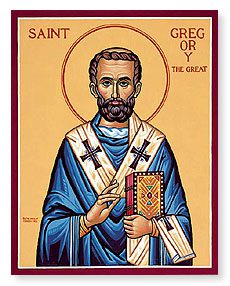
Image from catholicinbrooklyn.
blogspot.com
As I began my morning devotions on Tuesday this week, Syria was on my mind. No surprise, right? The debate about whether to respond militarily to the use of chemical weapons is all over the news right now. Mostly folks are arguing about what actually happened and the larger geo-political questions that a military strike involves, which are important and necessary issues. But here’s the question that was rattling around in my head as I turned to the day’s devotional readings on universalis.com: How does one respond to violence without becoming as guilty as the perpetrators you seek to punish?
The Language of Violence
The temptation when responding to violence is to believe that the only effective response is violence. To do otherwise appears foolhardy. Violence is a form of communication with its own grammar, syntax and lyrical rhythms – perhaps it is the world’s only truly universal language, and an ancient one at that. To think we can respond to the language of violence with a different grammar, let’s say the grammar of nonviolent diplomacy or, heaven forbid, forgiveness, feels as futile as speaking Greek to a snapping alligator. Your only hope is that someone shows up with a loaded gun or a Tarzan-like ability to wrestle the beast into submission. What is the world to do when our only choices are bad ones — either respond in kind or sit on our hands while the alligator feasts? And yet, as morally reprehensible as doing nothing is, we must consider that to stop the alligator attack we risk becoming guilty of violence ourselves, perhaps guilty of the murder of innocent victims. That would be a tragic accident, of course, we only want to kill terrorists. But Assad says that he’s only trying to kill terrorists, that 90% of the opposition fighters are affiliated with Al Qaeda… Holy moral dilemma, Batman!
So I was once again struck by the serendipity of the practice of daily devotional reading when I saw that September 3 was the feast day of Pope St Gregory the Great (540 – 604). I read that St Gregory had his own version of my question in his head as he negotiated with barbarians at the gate of the Roman Empire – literally! Here’s a glimpse of the difficult situations he faced as Pope:
He was elected Pope on 3 September 590, the first monk to be elected to this office… He negotiated treaties with the Lombard tribes who were ravaging northern Italy, and by cultivating good relations with these and other barbarians he was able to keep the Church’s position secure in areas where Roman rule had broken down.
Listening to Gregory
Of course, the problem of facing down threats to national security is not a new one. Gregory wrestled mightily with how to be an effective leader without losing his own soul in the process. Here is an excerpt from one of his sermons that universalis.com excerpted for reflection:
When I lived in a monastic community I was able to keep my tongue from idle topics and to devote my mind almost continually to the discipline of prayer. Since taking on my shoulders the burden of pastoral care, I have been unable to keep steadily recollected because my mind is distracted by many responsibilities.
I am forced to consider questions affecting churches and monasteries and often I must judge the lives and actions of individuals; at one moment I am forced to take part in certain civil affairs, next I must worry over the incursions of barbarians and fear the wolves who menace the flock entrusted to my care; now I must accept political responsibility in order to give support to those who preserve the rule of law; now I must bear patiently the villainies of brigands, and then I must confront them, yet in all charity.
My mind is sundered and torn to pieces by the many and serious things I have to think about. When I try to concentrate and gather all my intellectual resources for preaching, how can I do justice to the sacred ministry of the word? I am often compelled by the nature of my position to associate with men of the world and sometimes I relax the discipline of my speech. If I preserved the rigorously inflexible mode of utterance that my conscience dictates, I know that the weaker sort of men would recoil from me and that I could never attract them to the goal I desire for them. So I must frequently listen patiently to their aimless chatter. Because I am weak myself I am drawn gradually into idle talk and I find myself saying the kind of thing that I didn’t even care to listen to before.
Speaking a New Dialect
As I read I thought, this isn’t a sermon, it’s a confession. I could feel his longing to return to the purity of the monastery where he could immerse himself in prayer and hide from the world. How easy it must have been to feel good and noble from within the monastery! How sorely he must have disappointed himself when his un-sundered mind was “torn to pieces” by association with “the weaker sort of men” – and women, I have no doubt. With his sermon, Pope Gregory tapped into my secret heart and gave voice to my own desire to just stop reading the news, to allow myself to retreat from facing the turmoil of this no-win decision. Better to stay detached and safely confident in my moral purity than wade into these alligator infested waters.
Yet Gregory accepted his “political responsibility” and was astute enough to know that he had to speak the language of these weaker sorts or he “could never attract them to the goal I desire for them”. He was also confessional enough – and this is what makes him a saint in my book – to admit just how much he risked becoming like his adversaries. “Because I am weak myself I am drawn gradually into idle talk and I find myself saying the kind of thing that I didn’t even care to listen to before.” How much weaker are we than, Gregory, I wonder? What if we become infected not only by idle tongues but the moral blindness of our enemies? Are we even aware of the risks we take when we speak the violent language of those we judge to be deserving of punishment? As we ponder the correct response to the violence in Syria, perhaps we can be guided by Pope St Gregory’s dialect of confessional humility. We cannot nor should we hide from the decision of whether to wrestle this particular alligator, but we must do so fully aware of how easily we can become the beast ourselves.
Next Post

December 3, 2013 Sermon: Riding Out the Flood by Rev. Tom Truby
Browse Our Archives
Select a Category Atonement and Current Events Curriculum Faith and Families Interviews Jesus the Forgiving Victim Lent Montessori politics Reviews The Bible Explained Uncategorized Valentine's Day Wednesday Sermon Who is God?
Select a Month July 2020 November 2019 October 2019 September 2019 August 2019 July 2019 June 2019 May 2019 April 2019 March 2019 February 2019 January 2019 December 2018 November 2018 October 2018 September 2018 August 2018 July 2018 June 2018 May 2018 April 2018 March 2018 February 2018 January 2018 December 2017 November 2017 October 2017 September 2017 August 2017 July 2017 June 2017 May 2017 April 2017 March 2017 February 2017 January 2017 December 2016 November 2016 October 2016 September 2016 August 2016 June 2016 May 2016 April 2016 March 2016 February 2016 January 2016 December 2015 November 2015 October 2015 September 2015 August 2015 July 2015 June 2015 May 2015 April 2015 March 2015 February 2015 January 2015 December 2014 November 2014 October 2014 September 2014 August 2014 July 2014 June 2014 May 2014 April 2014 March 2014 January 2014 December 2013 September 2013 August 2013 July 2013
Follow Us!
TAKE THE
Religious Wisdom Quiz
True or False: The Israelites crossed the Red Sea by boat.
Select your answer to see how you score.
FALSE TRUE
Related posts from Teaching Nonviolent Atonement

How Forgiveness Can Transform Our Violence and Build...

Jesus Unmasked: Jesus Brings the Fire!

St. Francis Preaches on Violence

Building God's Kingdom or Destroying Ourselves? Sodom, The...
TRENDING AT PATHEOS Progressive Christian

What Being a Modern-Day Apostle Means to Me
In my last column, I discussed the ins and outs of modern-day...

Did Ancient China Once Worship the God of...
Across human history, a common thread weaves through the origins of the...

Love Your Neighbor – Including Earth-Kin: Lev. 19,...
God’s command to love your neighbor means acting in an ethical and...

Lead a Church Study of “Jesus and Lao...
Guest writer Jack Thomas (The Irreverent Reverend) reflects on leading his church...

Pastoral Wisdom for Responding to Sermon Pushback
Getting sermon pushback on your social justice sermon? Learn practical, Proverbs-based strategies...

Principles for Understanding the Apostolic Ministry Today
Whenever people discover that my formal ministry title is "apostle," as in...
view all Progressive Christian blogs
Ad-Free & Subscriber Log-In Subscription Support
- About Us
- 2026 Calendar
- Videos
- Podcasts
- Library of World Religions
- Faith In Media Tracker
- Advertise With Us
- Write for Us
- Privacy Policy
- Terms of Service
- Do Not Sell My Data
- Contact Us
- Radiant Digital
- Manage Newsletter Subscriptions
- Unsubscribe From Notifications
- Sitemap
Copyright 2008-2026, Patheos. All rights reserved.
Subscription Support Ad-Free & Subscriber Log-In
Follow Patheos