
BuddhistCatholicContemplativeEvangelicalGeneral ChristianHinduJewishLatter-day SaintMuslimNew VisionsProgressive Christian
Beliefs
- Buddhist
- Catholic
- Contemplative
- Evangelical
- General Christian
- Hindu
- Jewish
- Latter-day Saint
- More Voices
- Muslim
- New Visions
- Pagan
- Progressive Christian
Topics
- Religion News
- Food and Religion
- Sports and Religion
- Religious Art
- Religious Music and Entertainment
- Religious Events
- History and Religion
- Style and Religion
- Politics and Religion
- Women in Religion
- Recreation Outdoors and Religion
- Business Finance and Religion
- Careers Workplace and Religion
- Education and Religion
- Family Parenting and Religion
- Health Fitness and Religion
- Home and Religion
- Relationships and Religion
- Technology and Religion
- Travel and Religion
Columnists
- Buddhist Columnists
- Business Finance and Religion Columnists
- Careers Workplace and Religion Columnists
- Catholic Columnists
- Contemplative Columnists
- Education and Religion Columnists
- Evangelists Columnists
- Family Parenting and Religion Columnists
- General Christian Columnists
- Health Fitness and Religion Columnists
- Hindu Columnists
- History and Religion Columnists
- Home and Religion Columnists
- Jewish Columnists
- More Voices Columnists
- Latter Day Columnists
- Muslim Columnists
- New Visions Columnists
- Nonreligious Columnists
- Pagan Columnists
- Politics and Religion Columnists
- Progressive Columnists
- Recreation Outdoors and Religion Columnists
- Relationships and Religion Columnists
- Religion News Columnists
- Religious Art Columnists
- Religious Events Columnists
- Religious Music and Entertainment Columnists
- Sports and Religion Columnists
- Style and Religion Columnists
- Technology and Religion Columnists
- Travel and Religion Columnists
- Women in Religion Columnists
Resource Library
- 2026 Calendar
- Library of World Religions
- The 100 Most Holy Places on Earth
- Patheos Answers
- Podcasts
- Videos
- Faith Leaders Database
- Anglican Episcopalian
- Bahai
- Baptist
- Buddhism
- Christianity
- Confucianism
- Eastern Orthodoxy
- Hinduism
- Holiness and Pentecostal
- ISKCON
- Islam
- Judaism
- Lutheran
- Methodist
- The Church of Jesus Christ of Latter-day Saints
- New Age
- Paganism
- Presbytarian and Reformed
- Protestantism
- Religion Behind the Scenes
- Roman Catholic
- Scientology
- Shia Islam
- Sikhism
- Sufism
- Sunni Islam
- Taoism
- Zen
- See all religions
Research Tools
 Ad-Free & Subscriber Log-In Subscription Support
Ad-Free & Subscriber Log-In Subscription Support
Follow Patheos 

- Trending:
- Forgiveness
- |
- Marriage
- |
- Consciousness
- |
- Death Penalty
- |
- Election
- |
- Halloween
 Talk with the Preacher
- Home
- Progressive Christian
- Receive This Blessing
Receive This Blessing
Last updated on: November 5, 2017 at 1:46 pm by Amy Butler
Receive This Blessing 2017-11-05T13:46:02-04:00 Amy Butler
Patheos Explore the world's faith through different perspectives on religion and spirituality! Patheos has the views of the prevalent religions and spiritualities of the world.
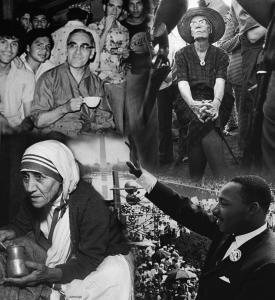
If we were playing a game of word association and I said the word “saint,” what would be your immediate response?
It doesn’t count if you say your own name….
Most of us would eventually call to mind Mother Teresa, of course.
Known in the Catholic Church by her official title, Saint Teresa of Calcutta, Mother Teresa was an Albanian-Indian Roman Catholic nun and missionary. Her service to the church eventually led her to India, where she lived for most of her life.
The Missionaries of Charity is the religious order Mother Teresa founded in 1950. Missionaries of Charity run homes for people who are suffering and dying in 133 countries, working to alleviate poverty in any expression.
Now, starting an order like this sure sounds saintly. And, indeed, in addition to many other honors including a Nobel Peace Prize (1979), Mother Teresa was named a saint of the church on September 4, 2016.
Yes, Mother Teresa is what I think of when I think of a saint.
Today we mark All Saints Day in the liturgical calendar. And we’re a jumbled lot of people of some faith, a lot of faith, no faith—we all understand sainthood a little differently. But today it’s worth remembering how our ideas of sainthood have evolved. Recall:
In the first 300 years after Jesus lived on earth, a saint was someone who lost his or her life for the cause of Christ. We know these folks as martyrs and their willingness to give up their lives for what they believed was the foundation of this fledgling movement called the Christian church. Church father Ignatius said, “the blood of the martyrs was the seeds of the church”.
Around 300 it finally became cool to be a Christian and no one was getting killed for the cause of Christ anymore. So, to be a saint during this time in history was pretty synonymous with being famous. If you died a famous person and had enough money, a chapel would be built in your honor and people could come to your chapel, light a candle and pray to you—hoping of course that your success on earth would translate into a particularly close relationship with God, you know, up there. For 1300 years that’s what it meant to be a saint.
Next, the Catholic Church put an official process of canonization—the process of naming a saint—into place. This process must begin at least 5 years after a person’s death and involves a complicated investigation of a person’s life, approval by a panel of theologians and church leaders, and evidence that the person performed a miracle before and after his or her death. That’s all! This process remains in place today, but in the Protestant tradition we have adopted another idea of sainthood, one that came out of the Reformation.
When Martin Luther started causing trouble for the church and the Reformation began, the idea of praying to saints fell out of vogue among his group of radicals. And so, the concept of sainthood changed again. This time a saint became someone in your life whom you loved who had died. Family members, like mothers, sisters, brothers, grandmothers, etc., who died and went to heaven before us were now known as saints—sort of like scouts who got to the end of the trip first and were saving us a spot.
Most of us think that way these days. In fact, today our nave is lined today with pictures remembering people who have been saints in our lives. My brother John is up there, and I’m sure he’d be amused to be listed among a group of saints. But John was to me: a presence of love that I feel still to this day. That feels like a saint to me.
And I want to live a life like that, don’t you? A life when, after I’m gone, someone might remember a loving word I said or a care-filled action I took. But the problem is: I can assure you, I’m no saint. Most days, I’m just trying to make it through the hard work of being human, and I often fail miserably. And the strain of looming inadequacy threatens to overwhelm me…the thought of trying to be saintly is a bit terrifying.
The scripture text that frames our consideration of sainthood this morning is a familiar one—the Beatitudes, they are often called—a part of what we know as the Sermon on the Mount. Picture this: Jesus has gained quite a following among the common folks. Crowds gathered around to hear what he had to say. His disciples, confused fishermen for the most part, were standing there watching, taking at least mental notes so they could remember later what Jesus said. After all, they were all used to hearing lists of rules, instructions for how one would go about making God happy, being holy, maybe even achieving a status something like sainthood….
And so, Jesus spoke the Beatitudes: “blessed are the poor in spirit, for theirs is the kingdom of heaven, blessed are those who mourn, for they will be comforted….”
Robert Schuller, remember him? Popular televangelist, host of The Hour of Power, founder of the Crystal Cathedral, and prolific writer over the last forty years—he died in 2015. Schuller wrote a book on the Beatitudes and called it The Be Happy Attitudes—I do not recommend that you read it. The point of the book is that with the Beatitudes, Jesus was, in fact, giving us a list of things we needed to do to be holy—to be saintly. Just follow the list and you’re set!
The thing is, I am not so sure that the Beatitudes are a list of how one might take the fast track to sainthood. As one commentator on the text points out, “I’ve been around enough to see the merciful get trampled, the mourners commit suicide, the pure in heart walk away from God, and people who hunger and thirst for righteousness sometimes die of hunger and thirst.” (Mike Baughman, The Hardest Question Blog).
Instead of a list of directions, I wonder if the Beatitudes weren’t just what the words say that they are: a blessing. I wonder if Jesus didn’t look out over that crowd of hurting, oppressed, tired, hopeless people, and know that giving them yet another list to accomplish wouldn’t be much help to their desperation. They were people longing for a life of following God—if they weren’t they wouldn’t have turned up in droves that day to hear what he had to say. But life was hard, and circumstances were punishing. They didn’t need more rules; they needed a blessing.
And so, to aid them in their quest for sainthood, for lives lived reflecting God’s grace and love, Jesus raised his voice and he blessed them.
All of them. The whole crowd. In all of their desperation, poverty, powerlessness, pain…in their quest to live lives that mattered, to please God even with the limited resources and unlikely success they had, Jesus blessed them.
I said it was Mother Teresa who comes to mind when I think of what it means to be a saint. Taking vows of poverty and chastity, spending her whole life in the middle of abject despair and pain… that takes a holiness I definitely don’t have.
But do you remember why Mother Teresa has stayed in our awareness since she died? In August of 2007, Time Magazine published an article in entitled, “Mother Teresa’s Crisis of Faith.”
It was shocking news to everyone that in a collection of her correspondence it became clear that for decades, Mother Teresa felt no presence of God in her life. Writing to one of her confessors toward the end of her life, she wrote: “Jesus has a very special love for you, [But] as for me, the silence and the emptiness is so great, that I look and do not see,–Listen and do not hear … I want you to pray for me.”
This is the same woman who said:
“If we have no peace, it is because we have forgotten that we belong to each other.”
“There are no great things, only small things with great love.”
“Yesterday is gone. Tomorrow has not yet come. We have only today. Let us begin.”
…this woman had trouble believing that God even existed some days. And she is…a saint.
It’s easy to feel rather desperate about our own personal pursuits of sainthood, to think that we’ll have to be long gone before we ever have a shot at saintly status. But if we listen to Jesus’ blessing today, we might begin to realize that chasing sainthood is part of who we are as Christ-followers. And we’re living the life of saints, pointing people toward God, even here and now. Even as we struggle.
Today we give thanks for those who have gone before us; we’re grateful for their examples and their faithfulness. But being saints is more immediate for us; it’s something we’d better attend to right here and now and not wait for the rosy memories of those who love us to reconstruct our witness after we’re gone. Sainthood is a way of life, a way of living out our faith together, right now.
We’re called saints not because we’re particularly or exceptionally holy, but rather because we’re followers of a God who is holy.
So receive the rich and powerful blessing of Jesus today:
You are blessed if you are poor in spirit—not that holy.
You are blessed if you are trying to live with grief.
You are blessed if you are meek—putting others first.
You are blessed if you wonder about whether God exists and what all of this means.
You are blessed if you are merciful to those who don’t deserve it.
You are blessed if you are pure in heart.
You are blessed when you try to make peace.
You are blessed if you are ridiculed when your way of living flies in the face of what’s normally acceptable in our society.
Can you find yourself anywhere in that blessing of Jesus? I sure can. So on this All Saints’ Day we must remember that WE are the saints, living and breathing reflections of God’s love for this world. As we struggle toward sainthood, we’re chasing, not special status for ourselves, but God’s biggest hopes and dreams for the whole world.
And in our trying and failing and trying again, we are not alone. Today Jesus stretches out his hands, looks at us—all of us, and calls us blessed. Today, receive this blessing. And remember the words of one who struggled to sainthood herself: “Yesterday is gone. Tomorrow has not yet come. We have only today. Let us begin.”
Amen.
Previous Post

October 15, 2017
Wedding Crashers
Next Post
November 7, 2017 The Church Must Lead in Talking About Sexual Harassment
Browse Our Archives
Select a Category Answering the Call Being the Church Curating Wisdom Laughing Out Loud Living in Relationship Practicing Discipleship Reclaiming Baptist Speaking from the Pulpit Uncategorized
Select a Month July 2018 June 2018 May 2018 April 2018 March 2018 January 2018 December 2017 November 2017 October 2017 September 2017 June 2017 May 2017 April 2017 March 2017 February 2017 January 2017 December 2016 November 2016 October 2016 September 2016 August 2016 July 2016 June 2016 May 2016 April 2016 March 2016 February 2016 January 2016 December 2015 November 2015 October 2015 September 2015 August 2015 July 2015 June 2015 May 2015 April 2015 March 2015 February 2015 January 2015 December 2014 November 2014 October 2014 September 2014 August 2014 July 2014 June 2014 May 2014 April 2014 March 2014 February 2014 January 2014 December 2013 November 2013 October 2013 September 2013 August 2013 July 2013 June 2013 May 2013 April 2013 March 2013 February 2013 January 2013 December 2012 November 2012 October 2012 September 2012 August 2012 July 2012 June 2012 May 2012 April 2012 March 2012 February 2012 January 2012 December 2011 October 2011 September 2011 August 2011 July 2011 June 2011 May 2011 April 2011 March 2011 February 2011 January 2011 December 2010 November 2010 October 2010 September 2010 August 2010 July 2010 June 2010 May 2010 April 2010 March 2010 February 2010 January 2010 December 2009 November 2009 October 2009 September 2009 August 2009 July 2009 June 2009 May 2009 April 2009 March 2009 February 2009 January 2009 December 2008 November 2008 October 2008 September 2008 August 2008 July 2008 June 2008 May 2008 April 2008 March 2008 February 2008 January 2008 December 2007 November 2007 October 2007 September 2007 August 2007 July 2007 June 2007 May 2007 April 2007 March 2007 February 2007 January 2007 December 2006 November 2006 October 2006 September 2006 August 2006 July 2006 June 2006 May 2006 April 2006 March 2006 February 2006 January 2006 December 2005
Search for:
Recent Posts
- Sabbath as Radical Witness
- Learning Leadership: A Pilgrimage to Hawaii
- A Prayer for the Living of These Days
- Sabbath as Relationship
- Dressing Up Faith
Recent Comments
Archives
- July 2018
- June 2018
- May 2018
- April 2018
- March 2018
- January 2018
- December 2017
- November 2017
- October 2017
- September 2017
- June 2017
- May 2017
- April 2017
- March 2017
- February 2017
- January 2017
- December 2016
- November 2016
- October 2016
- September 2016
- August 2016
- July 2016
- June 2016
- May 2016
- April 2016
- March 2016
- February 2016
- January 2016
- December 2015
- November 2015
- October 2015
- September 2015
- August 2015
- July 2015
- June 2015
- May 2015
- April 2015
- March 2015
- February 2015
- January 2015
- December 2014
- November 2014
- October 2014
- September 2014
- August 2014
- July 2014
- June 2014
- May 2014
- April 2014
- March 2014
- February 2014
- January 2014
- December 2013
- November 2013
- October 2013
- September 2013
- August 2013
- July 2013
- June 2013
- May 2013
- April 2013
- March 2013
- February 2013
- January 2013
- December 2012
- November 2012
- October 2012
- September 2012
- August 2012
- July 2012
- June 2012
- May 2012
- April 2012
- March 2012
- February 2012
- January 2012
- December 2011
- October 2011
- September 2011
- August 2011
- July 2011
- June 2011
- May 2011
- April 2011
- March 2011
- February 2011
- January 2011
- December 2010
- November 2010
- October 2010
- September 2010
- August 2010
- July 2010
- June 2010
- May 2010
- April 2010
- March 2010
- February 2010
- January 2010
- December 2009
- November 2009
- October 2009
- September 2009
- August 2009
- July 2009
- June 2009
- May 2009
- April 2009
- March 2009
- February 2009
- January 2009
- December 2008
- November 2008
- October 2008
- September 2008
- August 2008
- July 2008
- June 2008
- May 2008
- April 2008
- March 2008
- February 2008
- January 2008
- December 2007
- November 2007
- October 2007
- September 2007
- August 2007
- July 2007
- June 2007
- May 2007
- April 2007
- March 2007
- February 2007
- January 2007
- December 2006
- November 2006
- October 2006
- September 2006
- August 2006
- July 2006
- June 2006
- May 2006
- April 2006
- March 2006
- February 2006
- January 2006
- December 2005
Categories
- Answering the Call
- Being the Church
- Curating Wisdom
- Laughing Out Loud
- Living in Relationship
- Practicing Discipleship
- Reclaiming Baptist
- Speaking from the Pulpit
- Uncategorized
Meta
Follow Us!
TAKE THE
Religious Wisdom Quiz
Who wrote many of the Psalms?
Select your answer to see how you score.
Peter Solomon Paul David
Related posts from Talk with the Preacher

A Prayer for the Living of These Days


Invitation, a Meditation for Maundy Thursday

Simple Gifts: When a Letter is Not Enough
TRENDING AT PATHEOS Progressive Christian

Why Christians Have a Sacred Duty to Vote:...
The Bible offers strong support for the sacred duty to vote. Here...

What Being a Modern-Day Apostle Means to Me
In my last column, I discussed the ins and outs of modern-day...

Did Ancient China Once Worship the God of...
Across human history, a common thread weaves through the origins of the...

Love Your Neighbor – Including Earth-Kin: Lev. 19,...
God’s command to love your neighbor means acting in an ethical and...

Lead a Church Study of “Jesus and Lao...
Guest writer Jack Thomas (The Irreverent Reverend) reflects on leading his church...

Principles for Understanding the Apostolic Ministry Today
Whenever people discover that my formal ministry title is "apostle," as in...
view all Progressive Christian blogs
Ad-Free & Subscriber Log-In Subscription Support
- About Us
- 2026 Calendar
- Videos
- Podcasts
- Library of World Religions
- Faith In Media Tracker
- Advertise With Us
- Write for Us
- Privacy Policy
- Terms of Service
- Do Not Sell My Data
- Contact Us
- Radiant Digital
- Manage Newsletter Subscriptions
- Unsubscribe From Notifications
- Sitemap
Copyright 2008-2026, Patheos. All rights reserved.
Subscription Support Ad-Free & Subscriber Log-In
Follow Patheos