
BuddhistCatholicContemplativeEvangelicalGeneral ChristianHinduJewishLatter-day SaintMuslimNew VisionsProgressive Christian
Beliefs
- Buddhist
- Catholic
- Contemplative
- Evangelical
- General Christian
- Hindu
- Jewish
- Latter-day Saint
- More Voices
- Muslim
- New Visions
- Pagan
- Progressive Christian
Topics
- Religion News
- Food and Religion
- Sports and Religion
- Religious Art
- Religious Music and Entertainment
- Religious Events
- History and Religion
- Style and Religion
- Politics and Religion
- Women in Religion
- Recreation Outdoors and Religion
- Business Finance and Religion
- Careers Workplace and Religion
- Education and Religion
- Family Parenting and Religion
- Health Fitness and Religion
- Home and Religion
- Relationships and Religion
- Technology and Religion
- Travel and Religion
Columnists
- Buddhist Columnists
- Business Finance and Religion Columnists
- Careers Workplace and Religion Columnists
- Catholic Columnists
- Contemplative Columnists
- Education and Religion Columnists
- Evangelists Columnists
- Family Parenting and Religion Columnists
- General Christian Columnists
- Health Fitness and Religion Columnists
- Hindu Columnists
- History and Religion Columnists
- Home and Religion Columnists
- Jewish Columnists
- More Voices Columnists
- Latter Day Columnists
- Muslim Columnists
- New Visions Columnists
- Nonreligious Columnists
- Pagan Columnists
- Politics and Religion Columnists
- Progressive Columnists
- Recreation Outdoors and Religion Columnists
- Relationships and Religion Columnists
- Religion News Columnists
- Religious Art Columnists
- Religious Events Columnists
- Religious Music and Entertainment Columnists
- Sports and Religion Columnists
- Style and Religion Columnists
- Technology and Religion Columnists
- Travel and Religion Columnists
- Women in Religion Columnists
Resource Library
- 2026 Calendar
- Library of World Religions
- The 100 Most Holy Places on Earth
- Patheos Answers
- Podcasts
- Videos
- Faith Leaders Database
- Anglican Episcopalian
- Bahai
- Baptist
- Buddhism
- Christianity
- Confucianism
- Eastern Orthodoxy
- Hinduism
- Holiness and Pentecostal
- ISKCON
- Islam
- Judaism
- Lutheran
- Methodist
- The Church of Jesus Christ of Latter-day Saints
- New Age
- Paganism
- Presbytarian and Reformed
- Protestantism
- Religion Behind the Scenes
- Roman Catholic
- Scientology
- Shia Islam
- Sikhism
- Sufism
- Sunni Islam
- Taoism
- Zen
- See all religions
Research Tools
 Ad-Free & Subscriber Log-In Subscription Support
Ad-Free & Subscriber Log-In Subscription Support
Follow Patheos 

- Trending:
- Forgiveness
- |
- Marriage
- |
- Consciousness
- |
- Death Penalty
- |
- Election
- |
- Halloween
 Talk with the Preacher
- Home
- Progressive Christian
- Learning to Listen (Pentecost Sunday)
Learning to Listen (Pentecost Sunday)
Last updated on: June 4, 2017 at 1:08 pm by Amy Butler
Learning to Listen (Pentecost Sunday) 2017-06-04T13:08:43-04:00 Amy Butler
Patheos Explore the world's faith through different perspectives on religion and spirituality! Patheos has the views of the prevalent religions and spiritualities of the world.
I know that extra room in a Manhattan apartment is unusual, so I’m well aware of how fortunate I am to live in a space with a little study that turns into a guest room.
Of late, this has been more of a guest room than a study. Several friends and a sister have visited this month, and I’ve spent hours showing my guests around my amazing neighborhood. On many of these beautiful Spring evenings my visitors and I have walked the several blocks where I live, and here is what we’ve seen and heard:
A little group of people in the park next door, radio tuned to a Latin beat, an older man playing a steel drum along to the music, another shaking a bright yellow maraca while bystanders sway and sing along in Spanish.
A little further down the street, on the corner, children chasing each other in the playground sprinklers, their mothers, wearing colorful hijabs, calling out in Arabic, cautioning care.
And just around the corner, in front of the hostel, a group of tourists standing on the sidewalk consulting a map, animatedly planning their day in the city…speaking German.
One more block up, on the next corner, men with yarmulkes streamed into a church, ready to worship in Hebrew on a Friday evening.
And another block down, two games of sidewalk checkers right next to each other, onlookers shouting out support for their player—in English, if you’re listening carefully.
This, I proudly tell my guests, is my little corner of New York. And unfailingly, every single one of them commented on those walks: “I’ve never heard so many languages in one place!”
You know, I hadn’t noticed. It’s just part of daily life for us, isn’t it? The maracas and the sprinklers and the tourists and all the different languages are just another day for us in the big city.
Because this is our reality, we might not be surprised to know that there are over 800 languages spoken in this city. That’s A LOT. Walking around Queens you might hear folks talking in Vlashki, a remote mountain dialect from Croatia. Or in the Bronx you could stumble into a church where Mass is said once a month in Garifuna, a language that comes from African slaves shipwrecked in the Caribbean. The only person in New York who speaks Mamuju, as far as he knows, is a man who lives in Queens but learned the language growing up in Indonesia. His wife can’t speak it; neither can his children. He only speaks it with his brother. On the telephone.
New York is the most linguistically diverse city in the entire world, “the capital of language density,” one scholar says. A 2010 New York Times article calls our city “a Babel in reverse.”
Thank goodness for even marginal biblical literacy, because we’ll immediately know when we hear that, that the author of that article is referencing the passage we heard this morning from Genesis 11, the story we know as the story of the Tower of Babel. Perhaps you felt as optimistic as I did when you heard the beginning phrase of the text: “Now the whole earth had one language and the same words.”
That sounds good to me, you know? Everybody getting along; business meetings short and sweet; all the people understanding each other…right?
With the same language and the same words, the text says, the people decided to build a tower that reached to the sky—something bigger than anyone had seen before, something that would make a name for themselves. With the optimism of uniformity and power, the people were sure that nothing they proposed to do was impossible.
But God…God did not feel optimistic when God saw what was going on, and as the tower went up, brick by brick, God came down and said: no. God scattered the people and mixed up their languages and sent them out all around the earth.
Why would Go do such a thing? Everybody was getting along and speaking the same language; everything seemed to be going so well! Building a tower, making a name for ourselves, making humanity great again.
But God is having none of that at all. We might imagine God looking down at our frantic human striving and sighing with exasperation. “No! This is not what I intended when I spun the world into existence and created the teeming life and vast seas and so much diverse and beautiful variety! Do not limit the possibility and promise of my creation by imposing your shot-sighted uniformity.”
Because God knew, even if we forget again and again, that only one language, one expression, one color is too atonal for the work of God in the world. With conformity and uniformity, what happens? The culture that emerges is not the blissful Pleasantville we imagine, but rather a one-note refrain of domination and greed, where we wear identical uniforms and wave our flags and march in lockstep…where our life together celebrates only power, arrogance, self-adulation, and privilege.
And that is nothing like what God imagines for human community—no building the biggest and speaking the same and looking identical. No.
It should not go unnoticed today that we tell the story of God’s holy confusion at the Tower of Babel from the nave of The Riverside Church, the tallest church in America, one of the richest countries on this planet.
And how shall we grapple with the reality that Church in America, organized Christianity, has come to represent many things antithetical to the way of God? That 81% of white evangelicals in this country claimed the self-righteous piety of their faith when they cast their votes for racism, misogyny, the trampling of the poor and the false conformity that represents privilege?
What are we, people of faith on the birthday of the Church, to do with this?
Rather than claiming this edifice as a monument to conformity, or participating in any way with voices claiming the “right” or even “Christian” way of doing things, perhaps from this tower we commit again to doing what seems impossible: welcoming the wild and holy work of God’s Spirit here among us, and in our world…speaking forth a new reality as we resist the efforts of the powerful to reduce our religion, our country, our humanity, to nothing more than the repeating refrain dominance—not unity.
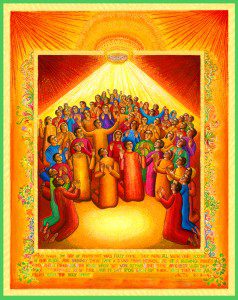
Today, of course, is the perfect day to commit ourselves again to this work, because it’s Pentecost Sunday. On Pentecost Sunday we celebrate “the birthday of the Church,” and we tell the tale of scared disciples visited by doves and fire, empowered to speak in a cacophony of languages so that everyone—everyone in the vast crowd—would hear her own, would understand, would be invited into the work of God in the world.
On Pentecost, God shows up to create unity through diversity, where what sounds at first like chaos and confusion is woven together to create a revolutionary human community where everyone can hear a message of love and grace and truth and justice, and where the lively Spirit of God beckons us to join God’s work in the world, where nothing we propose to do will be impossible.
On the day of Pentecost, Jerusalem was filled with people from all over—the text says “Jews from every nation under heaven.”
Many of them were visiting Jerusalem because it was Shavuot, the Jewish Festival of Weeks, and devout Jews were required by Jewish law to come to Jerusalem to celebrate.
But not everybody there was Jewish, because it was also a holiday in the way that holidays bring families and celebrations, travel and obligation into our lives, and lots of worshippers, merchants, and travelers joined the regular population of Jerusalem to celebrate the holiday. And right along with them were the disciples, waiting like Jesus said, for power from on high.
And then it came.
The overpowering sound of a rushing wind filled the house, slamming doors, flapping shutters, blowing around so hard that they had to cover their ears it was so loud. And fire…fire came down and rested on each one of them, a flame the text says. And they were filled with the Spirit, and everybody started talking in other languages. All of the sudden, what they’d been waiting for had arrived, and everybody there, all of the people visiting the city, all of the foreigners providing services, all of them heard a message of transformational power in their very own languages.
And once again, God showed up to remind us that conformity and structure, safety and ease are not the way of God in the world. Instead, God’s Spirit insists on diversity, difference, maracas and yarmulkes and the voices of children and neighbors calling out, “as-salaam ‘alaykum” as you pass on the sidewalk.
When we propose to build walls that keep people out of the utopia we foolishly imagine, empowered by the Spirit of Pentecost, the Church will resist.
When we hear, “You’re in America now, learn to speak English,” empowered by the Spirit of Pentecost, the Church will resist.
When in arrogance we step away from the shared work of caring for the earth because we short-sightedly prefer to maximize our wealth at the expense of the planet’s future, empowered by the Spirit of Pentecost, the Church will resist.
When hate-filled rhetoric fueled by fear and evil turns to violence…at concerts, on train rides, spray painted on prominent homes, in the heart of our cities, empowered by the Spirit of Pentecost, the Church will resist.
Why will the Church resist? Because if we learned anything at Babel…or on Pentecost, we learned that God perpetually invites us, not to conform, but to listen. To learn to listen to the beautiful cacophony around us…to welcome the work of God’s Spirit…to live out the lively diversity that God envisioned when God first spun the world into being.
I have to warn you, though. Living into the promise of Pentecost is hard work. It takes discipline to listen for more than the one note, one language, one ideology with which we feel comfortable.
Welcoming God’s Spirit will feel disorienting and unsettling. When we listen for God, we will hear the unfamiliar, the exotic, the new.
But it seems like today, the birthday of the Church and the Day of Pentecost, is just the day to remember that all the comfort of uniformity is not the way of God. Our human structures of order, dominance, hierarchy can’t possibly express the holy, uncontained, creative presence of God’s Spirit in the world…and it is our work as the Church, to learn to listen instead for God in the beautiful, holy expression all around us.
Learn to listen: for justice.
Learn to listen: for grace.
Learn to listen: for peace.
Learn to listen: for love.
Learn to listen, Church. Because when we do, nothing we propose together will be impossible.
May it be so.
Amen.
Previous Post

May 24, 2017
Strong Leadership and 'Making Straight What Has Been Crooked"
Next Post
June 6, 2017 You Can Never Go Home Again
Browse Our Archives
Select a Category Answering the Call Being the Church Curating Wisdom Laughing Out Loud Living in Relationship Practicing Discipleship Reclaiming Baptist Speaking from the Pulpit Uncategorized
Select a Month July 2018 June 2018 May 2018 April 2018 March 2018 January 2018 December 2017 November 2017 October 2017 September 2017 June 2017 May 2017 April 2017 March 2017 February 2017 January 2017 December 2016 November 2016 October 2016 September 2016 August 2016 July 2016 June 2016 May 2016 April 2016 March 2016 February 2016 January 2016 December 2015 November 2015 October 2015 September 2015 August 2015 July 2015 June 2015 May 2015 April 2015 March 2015 February 2015 January 2015 December 2014 November 2014 October 2014 September 2014 August 2014 July 2014 June 2014 May 2014 April 2014 March 2014 February 2014 January 2014 December 2013 November 2013 October 2013 September 2013 August 2013 July 2013 June 2013 May 2013 April 2013 March 2013 February 2013 January 2013 December 2012 November 2012 October 2012 September 2012 August 2012 July 2012 June 2012 May 2012 April 2012 March 2012 February 2012 January 2012 December 2011 October 2011 September 2011 August 2011 July 2011 June 2011 May 2011 April 2011 March 2011 February 2011 January 2011 December 2010 November 2010 October 2010 September 2010 August 2010 July 2010 June 2010 May 2010 April 2010 March 2010 February 2010 January 2010 December 2009 November 2009 October 2009 September 2009 August 2009 July 2009 June 2009 May 2009 April 2009 March 2009 February 2009 January 2009 December 2008 November 2008 October 2008 September 2008 August 2008 July 2008 June 2008 May 2008 April 2008 March 2008 February 2008 January 2008 December 2007 November 2007 October 2007 September 2007 August 2007 July 2007 June 2007 May 2007 April 2007 March 2007 February 2007 January 2007 December 2006 November 2006 October 2006 September 2006 August 2006 July 2006 June 2006 May 2006 April 2006 March 2006 February 2006 January 2006 December 2005
Search for:
Recent Posts
- Sabbath as Radical Witness
- Learning Leadership: A Pilgrimage to Hawaii
- A Prayer for the Living of These Days
- Sabbath as Relationship
- Dressing Up Faith
Recent Comments
Archives
- July 2018
- June 2018
- May 2018
- April 2018
- March 2018
- January 2018
- December 2017
- November 2017
- October 2017
- September 2017
- June 2017
- May 2017
- April 2017
- March 2017
- February 2017
- January 2017
- December 2016
- November 2016
- October 2016
- September 2016
- August 2016
- July 2016
- June 2016
- May 2016
- April 2016
- March 2016
- February 2016
- January 2016
- December 2015
- November 2015
- October 2015
- September 2015
- August 2015
- July 2015
- June 2015
- May 2015
- April 2015
- March 2015
- February 2015
- January 2015
- December 2014
- November 2014
- October 2014
- September 2014
- August 2014
- July 2014
- June 2014
- May 2014
- April 2014
- March 2014
- February 2014
- January 2014
- December 2013
- November 2013
- October 2013
- September 2013
- August 2013
- July 2013
- June 2013
- May 2013
- April 2013
- March 2013
- February 2013
- January 2013
- December 2012
- November 2012
- October 2012
- September 2012
- August 2012
- July 2012
- June 2012
- May 2012
- April 2012
- March 2012
- February 2012
- January 2012
- December 2011
- October 2011
- September 2011
- August 2011
- July 2011
- June 2011
- May 2011
- April 2011
- March 2011
- February 2011
- January 2011
- December 2010
- November 2010
- October 2010
- September 2010
- August 2010
- July 2010
- June 2010
- May 2010
- April 2010
- March 2010
- February 2010
- January 2010
- December 2009
- November 2009
- October 2009
- September 2009
- August 2009
- July 2009
- June 2009
- May 2009
- April 2009
- March 2009
- February 2009
- January 2009
- December 2008
- November 2008
- October 2008
- September 2008
- August 2008
- July 2008
- June 2008
- May 2008
- April 2008
- March 2008
- February 2008
- January 2008
- December 2007
- November 2007
- October 2007
- September 2007
- August 2007
- July 2007
- June 2007
- May 2007
- April 2007
- March 2007
- February 2007
- January 2007
- December 2006
- November 2006
- October 2006
- September 2006
- August 2006
- July 2006
- June 2006
- May 2006
- April 2006
- March 2006
- February 2006
- January 2006
- December 2005
Categories
- Answering the Call
- Being the Church
- Curating Wisdom
- Laughing Out Loud
- Living in Relationship
- Practicing Discipleship
- Reclaiming Baptist
- Speaking from the Pulpit
- Uncategorized
Meta
Follow Us!
TAKE THE
Religious Wisdom Quiz
True or False: The Israelites wandered in the wilderness for forty years.
Select your answer to see how you score.
TRUE FALSE
Related posts from Talk with the Preacher

A Prayer for the Living of These Days


Invitation, a Meditation for Maundy Thursday

Simple Gifts: When a Letter is Not Enough
TRENDING AT PATHEOS Progressive Christian

Why Christians Have a Sacred Duty to Vote:...
The Bible offers strong support for the sacred duty to vote. Here...

What Being a Modern-Day Apostle Means to Me
In my last column, I discussed the ins and outs of modern-day...

Did Ancient China Once Worship the God of...
Across human history, a common thread weaves through the origins of the...

Love Your Neighbor – Including Earth-Kin: Lev. 19,...
God’s command to love your neighbor means acting in an ethical and...

Lead a Church Study of “Jesus and Lao...
Guest writer Jack Thomas (The Irreverent Reverend) reflects on leading his church...

Principles for Understanding the Apostolic Ministry Today
Whenever people discover that my formal ministry title is "apostle," as in...
view all Progressive Christian blogs
Ad-Free & Subscriber Log-In Subscription Support
- About Us
- 2026 Calendar
- Videos
- Podcasts
- Library of World Religions
- Faith In Media Tracker
- Advertise With Us
- Write for Us
- Privacy Policy
- Terms of Service
- Do Not Sell My Data
- Contact Us
- Radiant Digital
- Manage Newsletter Subscriptions
- Unsubscribe From Notifications
- Sitemap
Copyright 2008-2026, Patheos. All rights reserved.
Subscription Support Ad-Free & Subscriber Log-In
Follow Patheos