
BuddhistCatholicContemplativeEvangelicalGeneral ChristianHinduJewishLatter-day SaintMuslimNew VisionsProgressive Christian
Beliefs
- Buddhist
- Catholic
- Contemplative
- Evangelical
- General Christian
- Hindu
- Jewish
- Latter-day Saint
- More Voices
- Muslim
- New Visions
- Pagan
- Progressive Christian
Topics
- Religion News
- Food and Religion
- Sports and Religion
- Religious Art
- Religious Music and Entertainment
- Religious Events
- History and Religion
- Style and Religion
- Politics and Religion
- Women in Religion
- Recreation Outdoors and Religion
- Business Finance and Religion
- Careers Workplace and Religion
- Education and Religion
- Family Parenting and Religion
- Health Fitness and Religion
- Home and Religion
- Relationships and Religion
- Technology and Religion
- Travel and Religion
Columnists
- Buddhist Columnists
- Business Finance and Religion Columnists
- Careers Workplace and Religion Columnists
- Catholic Columnists
- Contemplative Columnists
- Education and Religion Columnists
- Evangelists Columnists
- Family Parenting and Religion Columnists
- General Christian Columnists
- Health Fitness and Religion Columnists
- Hindu Columnists
- History and Religion Columnists
- Home and Religion Columnists
- Jewish Columnists
- More Voices Columnists
- Latter Day Columnists
- Muslim Columnists
- New Visions Columnists
- Nonreligious Columnists
- Pagan Columnists
- Politics and Religion Columnists
- Progressive Columnists
- Recreation Outdoors and Religion Columnists
- Relationships and Religion Columnists
- Religion News Columnists
- Religious Art Columnists
- Religious Events Columnists
- Religious Music and Entertainment Columnists
- Sports and Religion Columnists
- Style and Religion Columnists
- Technology and Religion Columnists
- Travel and Religion Columnists
- Women in Religion Columnists
Resource Library
- 2026 Calendar
- Library of World Religions
- The 100 Most Holy Places on Earth
- Patheos Answers
- Podcasts
- Videos
- Faith Leaders Database
- Anglican Episcopalian
- Bahai
- Baptist
- Buddhism
- Christianity
- Confucianism
- Eastern Orthodoxy
- Hinduism
- Holiness and Pentecostal
- ISKCON
- Islam
- Judaism
- Lutheran
- Methodist
- The Church of Jesus Christ of Latter-day Saints
- New Age
- Paganism
- Presbytarian and Reformed
- Protestantism
- Religion Behind the Scenes
- Roman Catholic
- Scientology
- Shia Islam
- Sikhism
- Sufism
- Sunni Islam
- Taoism
- Zen
- See all religions
Research Tools
 Ad-Free & Subscriber Log-In Subscription Support
Ad-Free & Subscriber Log-In Subscription Support
Follow Patheos 

- Trending:
- Forgiveness
- |
- Marriage
- |
- Consciousness
- |
- Death Penalty
- |
- Election
- |
- Halloween
 Talk with the Preacher
- Home
- Progressive Christian
- Everything Must Change: Home
Everything Must Change: Home
Last updated on: March 12, 2017 at 1:10 pm by Amy Butler
Everything Must Change: Home 2017-03-12T13:10:26-04:00 Amy Butler
Patheos Explore the world's faith through different perspectives on religion and spirituality! Patheos has the views of the prevalent religions and spiritualities of the world.
Genesis 12:1-9
 Even if I had a blindfold on, I would know I was at home.
There’s something unique about the air of the Hawaiian Islands, where I grew up. For one thing, the air smells…sweet. It’s a smell that’s a mixture of ocean and flowers that I have never smelled anywhere else.
And it’s hard to explain, but there’s a quality in the air that is soft. Maybe it’s because of the constant trade winds coming off the ocean, or the moisture that is always in the atmosphere, but stepping off the airplane at home feels like the air around you is giving you a hug.
And home sounds different, too. The sounds of birds and wind in the trees and ocean, along with the notes of a slack key guitar, those sounds tug at my heart because they are the soundtrack of home. I would know those smells and sounds, the feel of the air, anywhere, and their familiarity always settles over me like a soft blanket. The feeling of being home is a feeling of rightness, of belonging, of your feet solid underneath you, your foundation strong and familiar. For what would you ever trade that?
I bet you can think of something that reminds you of the feeling of home: a certain smell, or taste. The sound of someone’s voice, or a special kind of music.
And I bet Abram could, too.
We learn from the Genesis text that home for him was Haran, where he lived with his father’s camp—a boisterous collection of siblings and half-brothers and cousins, their wives and children and grandchildren, their tents pitched together, for safety in the desert. And the desert, though austere, had a sharp beauty to it. Sand dunes as far as you could see, the light playing tricks on your eyes. Beautiful plants and breathtaking rock formations appeared in places you never expected, and every once in awhile, a shock of green, an oasis. Abram lived in the dessert community with his wife Sarai. To their great and abiding grief, they did not have any children, but as the extended family swirled around them, full of love and life and activity, they never felt completely childless.
Every morning Sarai would walk with the other women to the well to fetch water, while Abram sat by the fire planning the day with the other men. And after breakfast they would gather their tools and fill their water bags and set off into the nearby hills. Abram and the other men would care for the needs of the animals—delivering lambs, nursing those that were sick, moving the flocks toward grass and water. And back at the camp, Sarai and the other women would watch the children and bake the bread and tend to the tasks of making a home. They’d share supplies and ideas, everyone pitching in to make sure the camp was well cared for.
And in the evening everyone would gather around the fire, animals secure for the night and all of them together, safe in their community. They would review the day and tell stories their parents told them when they were children sitting around the fire. They’d sing familiar songs and the notes would carry over the surrounding hills.
For Abram and Sarai, this was home: the flocks he tended, the life she’d built. It was the sharp smell of the campfire, the shouts of the children and the bustle of the community as it tended to its shared life. This was the place where they belonged, where the ground was strong and secure underneath their feet, where they knew others and were known by their community, where they knew who they were.
Home.
Until one day God showed up and told Abram it was time to pack up and leave, to go from the countryside he knew and loved, away from the network of family surrounding him, from the neighborhood where he’d walk and everyone would recognize him, to…well, he didn’t know where. And God didn’t say.
In fact, Abram didn’t know anything except the truth that if he had the courage to follow God’s direction, everything would change. God made promises to Abram, most significantly the promise of God’s presence. But as Abram looked out over uncertainty, he didn’t have the answers to any of his questions. How could he leave the easy camaraderie of the shepherds he worked with every day? What if he never saw his family again? And how could leaving—just setting out all alone to a place he didn’t know—how could that be even safe? In order to follow God’s call, to answer God’s invitation, Abram would have to change everything, and most of all the way he thought about home.
Today is the second Sunday in the season of Lent, forty days of reflection and repentance that lead to Easter. During these next few weeks we’re reading the stories in the Hebrew texts assigned in the lectionary and thinking about God’s constant invitation to humanity to change the way we look at the world. Change is hard for us because it challenges our assumptions and invades our comfortable delusions. Lent is the season to do this hard work, however, and guiding our deliberations today is a story that comes just a few chapters after the story we read last week, the story of God creating the world. In today’s story, God intervenes in the life of one man and one woman, Abram and Sarai, and asks them to leave their home. More than that, God asks them to change the way they think of home altogether, to begin the hard work of finding home, not in the outward trappings of life that we work so hard to build…but in God.
Our scripture lesson today begins with God telling Abram to pack up and leave, and it’s interesting to note that God doesn’t pull any punches here. God doesn’t say: “Let’s take a trip,” or “Come on, this will be a piece of cake!” No, God says go…from your country and your relatives and your community to a place that I will show you. Pack up everything you have, leave everything familiar behind you, and hit the road.
My biblical Hebrew is rusty at best, but even I can tell you that there’s something unusual in the original language of this little passage. When God speaks to Abram with the command “Go!” there are two words instead of one. In the Hebrew instead of just the word lek, to go, there is another word: lekha. Because of the grammatical structure of the sentence it’s difficult to know what the configuration means exactly, but a rabbi friend of mine told me this week that some scholars understand this to mean something like, “Go to yourself.” What exactly that means is also unknown, but the writer of this text obviously has included a layer of meaning beyond the physical command to move. When God talks to Abram here, it’s like God is saying: look inside. Be who you were created to be. Find the home you are longing for with me.
Well, that would be a change, wouldn’t it?
Everything would change for Abram and Sarai, and if we heard God’s words and applied them, everything would change for us, too. We live in a country where what we have often defines our worth, where we understand home by the walls that contain our stuff, and where we spend money we don’t have on things we don’t need to impress people we don’t like. This process of defining our lives—what feels firm and unmovable under our feet—by looking inward at who we are instead of outward at what we have, is exactly the adventure of finding home that God was inviting Abram and Sarai to embark on.
In fact, life with God seems to be a something of a journey all the time, always calling us out of the familiar into something new. Our entire biblical text has running through it the theme of journey: biblical patriarchs and matriarchs like Abram and Sarai; even Jesus setting his face toward Jerusalem and a cross; and the first Christians who left their homes to take the gospel message to new places. It seems that following God requires a life that is characterized by less dependence on the people, places, and things that we assemble around us and use to define us, and more by an inward focused posture dependent on the God who created us and who keeps calling us toward all the possibilities of who we were created to be.
There is a story of a man who once traveled from America to Poland to visit the great Rabbi Yisrael Meir Kagan, author of many famous codes of Jewish law. The man made the pilgrimage to meet the great thinker, and he was excited as, finally after a long journey, he knocked on Rabbi Kagan’s door and was greeted by an elderly, stooped gentleman who asked him to please enter. The man entered the house and looked around, a bit stunned. The rabbi’s house was totally empty, bare of furniture as if no one lived there. The room contained only the very basic, spare furnishings: one table, two chairs, a bookcase and a bed.
This was the home of a famous rabbi, so the man was confused. “Rabbi, may I ask a question?” said the man. “I don’t notice much of anything here in your home. Where are your things? Have you fallen on hard times?”
The rabbi, unaffected by his guest’s question, turned to the visitor. “And may I ask you a question, young man?”
“Certainly,” came the reply.
“Where is all your furniture?”
“I have a custom kitchen, an oak dining room table, and a beautiful bedroom set all at my house in New York,” said the man. “Do tourists generally take such possessions along in a moving van? I’m just passing through!”
The great rabbi gave his guest a gentle smile. “As for this world I, too, am just passing through,” said Kagan. “Then again, aren’t we all?”[1]
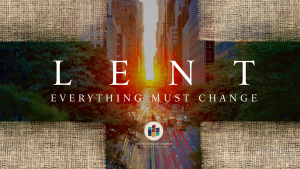
This Lent, everything must change. That means how we think about home must change, too. Like Abram, “[God] speaks to us where we are, as we are, living our self-satisfied existences, surrounded by all the securities upon which we build our lives. We know who we are and what we are, and what we know tends to please us. Of all the things in the world, we are most interested in those to which we can attach the possessive pronoun: my family, my home, my possessions, my life. We dwell in our private Harans…and we are content. God’s gospel shatters that contentment like a hammer blow on pottery. It tells of a world completely different from the one we live in: a family made up of brothers and sisters who do the will of God, where earth becomes like heaven.”[2]
Just think what would never have happened if Abram and Sarai didn’t have the courage to set out for somewhere new, to find their home in God? There would have been no Isaac, or Jacob, or Joseph. There would have been no Moses and no Exodus story; no promised land and prophetic voices; no young, unwed mother giving birth in a stable.
The truth is that we die a spiritual death when we limit just how far God can lead us and work in our lives. But if we make a home with God, we’ll be ready to go anytime, anywhere…ready to take on the adventure of our lives. And when everything changes, the possibilities are endless.
Amen.
[1] http://bhcbe.org/cpt_sermons/passing/
[2] Mayes, James L. “God Has Spoken: A Meditation on Genesis 12:1-4,” Interpretation 14, no. 4 (October 1960), p.420
Previous Post

March 7, 2017
Truth in a Post-Fact World
Next Post
March 19, 2017 Everything Must Change: The Past
Browse Our Archives
Select a Category Answering the Call Being the Church Curating Wisdom Laughing Out Loud Living in Relationship Practicing Discipleship Reclaiming Baptist Speaking from the Pulpit Uncategorized
Select a Month July 2018 June 2018 May 2018 April 2018 March 2018 January 2018 December 2017 November 2017 October 2017 September 2017 June 2017 May 2017 April 2017 March 2017 February 2017 January 2017 December 2016 November 2016 October 2016 September 2016 August 2016 July 2016 June 2016 May 2016 April 2016 March 2016 February 2016 January 2016 December 2015 November 2015 October 2015 September 2015 August 2015 July 2015 June 2015 May 2015 April 2015 March 2015 February 2015 January 2015 December 2014 November 2014 October 2014 September 2014 August 2014 July 2014 June 2014 May 2014 April 2014 March 2014 February 2014 January 2014 December 2013 November 2013 October 2013 September 2013 August 2013 July 2013 June 2013 May 2013 April 2013 March 2013 February 2013 January 2013 December 2012 November 2012 October 2012 September 2012 August 2012 July 2012 June 2012 May 2012 April 2012 March 2012 February 2012 January 2012 December 2011 October 2011 September 2011 August 2011 July 2011 June 2011 May 2011 April 2011 March 2011 February 2011 January 2011 December 2010 November 2010 October 2010 September 2010 August 2010 July 2010 June 2010 May 2010 April 2010 March 2010 February 2010 January 2010 December 2009 November 2009 October 2009 September 2009 August 2009 July 2009 June 2009 May 2009 April 2009 March 2009 February 2009 January 2009 December 2008 November 2008 October 2008 September 2008 August 2008 July 2008 June 2008 May 2008 April 2008 March 2008 February 2008 January 2008 December 2007 November 2007 October 2007 September 2007 August 2007 July 2007 June 2007 May 2007 April 2007 March 2007 February 2007 January 2007 December 2006 November 2006 October 2006 September 2006 August 2006 July 2006 June 2006 May 2006 April 2006 March 2006 February 2006 January 2006 December 2005
Search for:
Recent Posts
- Sabbath as Radical Witness
- Learning Leadership: A Pilgrimage to Hawaii
- A Prayer for the Living of These Days
- Sabbath as Relationship
- Dressing Up Faith
Recent Comments
Archives
- July 2018
- June 2018
- May 2018
- April 2018
- March 2018
- January 2018
- December 2017
- November 2017
- October 2017
- September 2017
- June 2017
- May 2017
- April 2017
- March 2017
- February 2017
- January 2017
- December 2016
- November 2016
- October 2016
- September 2016
- August 2016
- July 2016
- June 2016
- May 2016
- April 2016
- March 2016
- February 2016
- January 2016
- December 2015
- November 2015
- October 2015
- September 2015
- August 2015
- July 2015
- June 2015
- May 2015
- April 2015
- March 2015
- February 2015
- January 2015
- December 2014
- November 2014
- October 2014
- September 2014
- August 2014
- July 2014
- June 2014
- May 2014
- April 2014
- March 2014
- February 2014
- January 2014
- December 2013
- November 2013
- October 2013
- September 2013
- August 2013
- July 2013
- June 2013
- May 2013
- April 2013
- March 2013
- February 2013
- January 2013
- December 2012
- November 2012
- October 2012
- September 2012
- August 2012
- July 2012
- June 2012
- May 2012
- April 2012
- March 2012
- February 2012
- January 2012
- December 2011
- October 2011
- September 2011
- August 2011
- July 2011
- June 2011
- May 2011
- April 2011
- March 2011
- February 2011
- January 2011
- December 2010
- November 2010
- October 2010
- September 2010
- August 2010
- July 2010
- June 2010
- May 2010
- April 2010
- March 2010
- February 2010
- January 2010
- December 2009
- November 2009
- October 2009
- September 2009
- August 2009
- July 2009
- June 2009
- May 2009
- April 2009
- March 2009
- February 2009
- January 2009
- December 2008
- November 2008
- October 2008
- September 2008
- August 2008
- July 2008
- June 2008
- May 2008
- April 2008
- March 2008
- February 2008
- January 2008
- December 2007
- November 2007
- October 2007
- September 2007
- August 2007
- July 2007
- June 2007
- May 2007
- April 2007
- March 2007
- February 2007
- January 2007
- December 2006
- November 2006
- October 2006
- September 2006
- August 2006
- July 2006
- June 2006
- May 2006
- April 2006
- March 2006
- February 2006
- January 2006
- December 2005
Categories
- Answering the Call
- Being the Church
- Curating Wisdom
- Laughing Out Loud
- Living in Relationship
- Practicing Discipleship
- Reclaiming Baptist
- Speaking from the Pulpit
- Uncategorized
Meta
Follow Us!
TAKE THE
Religious Wisdom Quiz
How many Beatitudes are in the Sermon on the Mount?
Select your answer to see how you score.
7 12 10 8
Related posts from Talk with the Preacher
Everything Must Change: The Past



TRENDING AT PATHEOS Progressive Christian

Why Christians Have a Sacred Duty to Vote:...
The Bible offers strong support for the sacred duty to vote. Here...

What Being a Modern-Day Apostle Means to Me
In my last column, I discussed the ins and outs of modern-day...

Did Ancient China Once Worship the God of...
Across human history, a common thread weaves through the origins of the...

Love Your Neighbor – Including Earth-Kin: Lev. 19,...
God’s command to love your neighbor means acting in an ethical and...

Lead a Church Study of “Jesus and Lao...
Guest writer Jack Thomas (The Irreverent Reverend) reflects on leading his church...

Principles for Understanding the Apostolic Ministry Today
Whenever people discover that my formal ministry title is "apostle," as in...
view all Progressive Christian blogs
Ad-Free & Subscriber Log-In Subscription Support
- About Us
- 2026 Calendar
- Videos
- Podcasts
- Library of World Religions
- Faith In Media Tracker
- Advertise With Us
- Write for Us
- Privacy Policy
- Terms of Service
- Do Not Sell My Data
- Contact Us
- Radiant Digital
- Manage Newsletter Subscriptions
- Unsubscribe From Notifications
- Sitemap
Copyright 2008-2026, Patheos. All rights reserved.
Subscription Support Ad-Free & Subscriber Log-In
Follow Patheos