
BuddhistCatholicContemplativeEvangelicalGeneral ChristianHinduJewishLatter-day SaintMuslimNew VisionsProgressive Christian
Beliefs
- Buddhist
- Catholic
- Contemplative
- Evangelical
- General Christian
- Hindu
- Jewish
- Latter-day Saint
- More Voices
- Muslim
- New Visions
- Pagan
- Progressive Christian
Topics
- Religion News
- Food and Religion
- Sports and Religion
- Religious Art
- Religious Music and Entertainment
- Religious Events
- History and Religion
- Style and Religion
- Politics and Religion
- Women in Religion
- Recreation Outdoors and Religion
- Business Finance and Religion
- Careers Workplace and Religion
- Education and Religion
- Family Parenting and Religion
- Health Fitness and Religion
- Home and Religion
- Relationships and Religion
- Technology and Religion
- Travel and Religion
Columnists
- Buddhist Columnists
- Business Finance and Religion Columnists
- Careers Workplace and Religion Columnists
- Catholic Columnists
- Contemplative Columnists
- Education and Religion Columnists
- Evangelists Columnists
- Family Parenting and Religion Columnists
- General Christian Columnists
- Health Fitness and Religion Columnists
- Hindu Columnists
- History and Religion Columnists
- Home and Religion Columnists
- Jewish Columnists
- More Voices Columnists
- Latter Day Columnists
- Muslim Columnists
- New Visions Columnists
- Nonreligious Columnists
- Pagan Columnists
- Politics and Religion Columnists
- Progressive Columnists
- Recreation Outdoors and Religion Columnists
- Relationships and Religion Columnists
- Religion News Columnists
- Religious Art Columnists
- Religious Events Columnists
- Religious Music and Entertainment Columnists
- Sports and Religion Columnists
- Style and Religion Columnists
- Technology and Religion Columnists
- Travel and Religion Columnists
- Women in Religion Columnists
Resource Library
- 2026 Calendar
- Library of World Religions
- The 100 Most Holy Places on Earth
- Patheos Answers
- Podcasts
- Videos
- Faith Leaders Database
- Anglican Episcopalian
- Bahai
- Baptist
- Buddhism
- Christianity
- Confucianism
- Eastern Orthodoxy
- Hinduism
- Holiness and Pentecostal
- ISKCON
- Islam
- Judaism
- Lutheran
- Methodist
- The Church of Jesus Christ of Latter-day Saints
- New Age
- Paganism
- Presbytarian and Reformed
- Protestantism
- Religion Behind the Scenes
- Roman Catholic
- Scientology
- Shia Islam
- Sikhism
- Sufism
- Sunni Islam
- Taoism
- Zen
- See all religions
Research Tools
 Ad-Free & Subscriber Log-In Subscription Support
Ad-Free & Subscriber Log-In Subscription Support
Follow Patheos 

- Trending:
- Forgiveness
- |
- Marriage
- |
- Consciousness
- |
- Death Penalty
- |
- Election
- |
- Halloween
 Talk with the Preacher
- Home
- Progressive Christian
- Overcome by Faith
Overcome by Faith
Last updated on: February 26, 2017 at 2:16 pm by Amy Butler
Overcome by Faith 2017-02-26T14:16:08-04:00 Amy Butler
Patheos Explore the world's faith through different perspectives on religion and spirituality! Patheos has the views of the prevalent religions and spiritualities of the world.
Matthew 17:1-9 Transfiguration
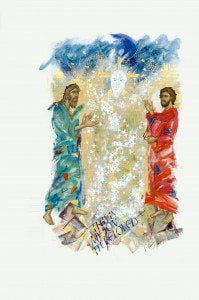
Transfiguration, Donald Jackson with contributions from Aidan Hart, Copyright 2002, The Saint John’s Bible, Saint John’s University, Collegeville, Minnesota USA. Used by permission. All rights reserved.
Early in my career I was responsible for planning and leading a women’s retreat. I made up a carefully detailed schedule and lists of preparations that began the very first night with an ice breaker. We went around the room and everyone was asked to describe and demonstrate, if possible, a special talent they have. We were about a quarter of the way around the circle when I suddenly had the panicked realization that not only had I not prepared a special talent to display, I couldn’t even think of one.
Had I prepared to share my own talent, I would have undoubtedly thought to demonstrate my exceptionally well developed skill of sword drill. Some of you have heard me talk about this before. Sword drill is a skill taught to children in many conservative, evangelical Bible churches, like the churches in which I grew up. It’s a game in which you compete to see who can find passages in the Bible the quickest. It’s called sword drill to reference the book of Ephesians, where Paul refers to the word of God as the “sword of the Spirit.”
Anyway, the way I learned, all the kids would line up seated in a row of chairs. We’d stand, draw our “swords,” and compete to find the passage the Sunday School teacher would call out. Once you found the passage, you’d sit down, and first person to sit down was the winner.
As I mentioned, I am very good at this.
Today I want to share with you one of the secrets of being a champion sword drill competitor. Take out your Bibles—there are some in the pews if you don’t have one with you. Now, open the Bible to the middle—just estimate. Chances are you’ve opened the Bible to the book of Psalms, the prayer book of the Bible. Psalms is in the exact middle of the Bible, and once you find the book of Psalms, it’s much easier to gauge where you are in terms of the rest of the book, so as to easily find the passage you’re seeking. See? Insider’s tip. For the next time you compete at sword drill….
I bring this up because today in worship and in the revised common lectionary gospel passage from the gospel of Matthew, we find ourselves in the exact middle—not of the Bible, but of the story of Jesus’ time on earth. Today we’re at the end of the season after Epiphany, part of the church year that begins with Jesus’ baptism, when the heavens opened up and he heard God’s voice. During the weeks following Epiphany, we read the stories of Jesus and his disciples and we experience what my friend describes as the knob on a light switch not unlike you might find in the dining area in my apartment. Once it’s clicked on, you can turn the knob to adjust the brightness of the bulbs in the light fixture. We’ve been following Jesus and his disciples around, listening to what Jesus has to say, watching him bless and heal and feed people, and with every story we read, the light gets turned up just a little bit, letting us in on more and more of the story and the message that will change the world.
Today is Transfiguration Day, the very middle point of Jesus’ earthly ministry. Today the light is turned up to the very brightest setting and we’re standing on edge of Lent, where Jesus will be required to set his human face toward Jerusalem where he will suffer and die because of the message he preached.
And for those first disciples—and us, too!—today we’re beginning a descent into darkness, 40 days of looking hard at what happens when the rubber meets the road and the cost of following Jesus begins to be counted in earnest. Once we’re not dazzled and squinting with the glory of encountering God, we will begin to make out the road ahead, and this midpoint moment of decision—will we go with Jesus?—is right where the disciples found themselves in today’s passage.
By the time we get to Matthew chapter 17, the political situation surrounding Jesus and his disciples was getting tense. Jesus had known for some time, even if the disciples didn’t, that he was soon going to have the spotlight of legal scrutiny fixed upon him and his followers with an intensity the disciples had not experienced up until that point and, frankly, for which they were totally unprepared.
Chapter 17 begins with Peter, James, and John joining Jesus on a hike up a very tall mountain. Maybe asking the disciples to go on a strenuous hike was just what Jesus needed to do then…perhaps it was symbolic of this life-cycle event for Jesus, during which he needed to assess who among his disciples had the stamina and courage it would take to stick with him in times like this one, at the very top of that mountain surrounded by all kinds of tangible evidence of God’s presence and plan…all the way down the mountain, to the dusty streets of Jerusalem, up a winding path to the place of the skull, and down then to the lowest place any human being can go—the place where we look death straight in the eye and where God seems utterly, totally absent.
But for the disciples, following Jesus up until that time continued with the same adventure and possibility with which it had been laced since they first laid down their fishing nets and left everything to follow him.
You can see it in Peter’s reaction to their experience. You’ll recall that once they’d hoofed it all the way to the top of the mountain, they had something of a vision. Jesus suddenly began to glow, to shine like the sun, and his clothes were dazzlingly white. Moses and Elijah—two of the greatest Hebrew prophets—appeared in person and began talking with Jesus.
Well, Peter was not about to let this miraculous event pass by without proper acknowledgement, so he suggested what any good Jew would suggest: that they build three shelters—tents, monuments, something permanent to mark the place where this great appearance had occurred. That way they would never, ever forget it.
And then they could go back to life as they knew it.
But the next thing they knew a bright cloud enveloped them and they heard God’s voice, of all things. It was utterly, completely terrifying, and in that moment if they had not realized it before, they knew that their lives had changed…that nothing would ever be the same again. There they were, cowering on the ground, couldn’t even think straight. In the silence that followed God’s voice they remained there, quaking, “overcome by fear,” the text says.
…until Jesus reached down and touched them. He told them to get up. And he told them not to be afraid.
When they finally managed to stand up, brush the dirt off their robes, rub their eyes, and look around…well, they saw the top of the mountain as it had been when they’d arrived after their long hike. And, the text says, they saw Jesus, alone. Only Jesus…nobody else…only Jesus and the decision before them: would they remain there, overcome by fear? Or would they return, would they hike back down the mountain, would they face the changes that were coming with courage and conviction, overcome, instead, by faith?
While they do not universally include the appearance of famous Biblical heroes, all human life presents us with moments like this, moments where we are overcome by fear, just knocked down and kicked to the curb with the breath-taking terror of human living. The disciples felt it that day—an unknown future stretched out before them, fear sucking the breath from their throats, and Jesus standing at the edge of the path back down the mountain—toward an uncertain and fear-filled future—and beckoning them to get up and follow. And it was this—Jesus himself—that helped them finally get up, overcome by faith that was stronger than fear.
Earlier this week I received a text message from a pastor friend who lives in another state. Her text read, “What do we do with fear? I am scared we may be called to give up our lives with this administration. That scares me and keeps me up at night. I am wondering what my limits will be—how will we get through this?”
I wish I had easy answers to questions like this. Most days I only have my own questions and fear to grapple with. But no one should think about faith and fear, about the cost of being a disciple of Jesus, without thinking about Dietrich Bonhoeffer. And with the current political climate in which we’re living, I don’t think we can remember his story often enough, especially here, in this corner of Manhattan, where he spent so much time in the 1930s.
Dietrich Bonhoeffer was a German pastor and theologian who spoke, wrote, and pastored in the 1930s and early 1940s in Germany.
Recall that the German people were demoralized after the defeat of World War I and the resulting depression they suffered; right then, the charismatic Adolf Hitler appeared on the scene. Not many questioned Hitler’s rhetoric, but one who did was Dietrich Bonhoeffer, who found the politics of Nazi Germany completely counter to the gospel message.
Bonhoeffer had been born into a nominally religious aristocratic family, his father a prominent neurologist and professor of psychiatry at the University of Berlin. After graduating from the University of Berlin in 1927, he came Union Theological Seminary right across the street to study for a year. As the story goes, he attended church here at The Riverside Church a few times, but found it a bit “dead” for his tastes. He underwent a huge theological transformation just down the street at Abyssinian Baptist Church instead.
After finishing his studies, Bonhoeffer returned to Germany, where Hitler was quickly rising to power, becoming chancellor of Germany in January 1933, and president a year and a half later. Hitler’s anti-Semitic rhetoric and actions intensified, and Bonhoeffer was particularly concerned that the Christian church in Germany was not speaking out loudly or clearly enough against the hateful rhetoric of the time. Together with other pastors and theologians, Bonhoeffer organized the Confessing Church, which announced publicly in its Barmen Declaration (1934) its allegiance first to Jesus Christ, not the German government or the Nazi party.
In the meantime, Bonhoeffer had written The Cost of Discipleship (1937), a call to more faithful and radical obedience to Christ and a severe rebuke of comfortable Christianity: “Cheap grace is grace without discipleship, grace without the cross, grace without Jesus Christ, living and incarnate.”
By this time, Bonhoeffer was teaching and training pastors in an underground seminary because the government had banned him from teaching openly. But after the seminary was discovered and closed, the Confessing Church became increasingly reluctant to speak out against Hitler, and moral opposition proved increasingly ineffective. The fear had begun to take over as Christians in Germany faced the landscape ahead of them.
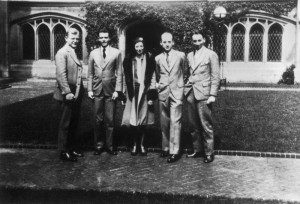
Dietrich Bonhoeffer in the quad of Union Theological Seminary.
It was during this time that Bonhoeffer had returned to our neighborhood to teach at Union, but he couldn’t shake a feeling of responsibility for his country. Within months of his arrival, he wrote, “I have made a mistake in coming to America. I must live through this difficult period in our national history with the Christian people of Germany. I will have no right to participate in the reconstruction of Christian life in Germany after the war if I do not share the trials of this time with my people.”
It was a moment in his life when he had a choice: would he be overcome by fear? Instead, he was overcome by faith.
He did, in fact, return to Germany, and eventually his resistance efforts, his involvement in a plot to assassinate Adolf Hitler and his role in rescuing Jews were discovered. On an April afternoon in 1943, two men arrived at his home in a black Mercedes, put Bonhoeffer in the car, and drove him to prison. And on April 9, 1945, one month before Germany surrendered, he was hanged with six other resisters.
This story of resistance, of speaking up for the way of radical love against political policies that exploited and destroyed weak, vulnerable, different cost Bonhoeffer his life. His story is not ancient history, nor is it foreign to this very place. Only a few decades ago, this man walked down Claremont Avenue and listened to jazz in Harlem. And what he lived—the decision to let faith overcome fear—is not outside of our own realm of experience as we face the human question of how to handle fear every single day of our lives.
And now we find ourselves living in a political climate where every single day we are hearing of policies that exploit and destroy those who are weak, vulnerable, and different. And the message of the gospel—that we claim to follow—will not allow for us to stay silent.
Perhaps, with me, you are feeling the witness and presence of so many who have gone before us, even in this place, and asking similar questions to those of my friend: “What do we do with fear? That keeps me up at night. I am wondering what my limits will be—how will we get through this?”
Here’s what we will do: we will do what Jesus’ first followers and every faithful follower since then has done. We will feel ourselves overcome by fear, but we will then fix our gaze on Jesus alone and allow our fear to be overcome by faith. And then we’ll turn and walk down the mountain into the darkness of Lent, toward the reality of the cross, and in the way that leads toward life.
Beginning this Wednesday we will enter the season of Lent, forty days that lead us straight to a cross. As we prepare to go with Jesus, may we feel overcome, not by fear, but by faith. Amen.
Previous Post

February 21, 2017
Some Uncomfortable Words
Next Post

March 1, 2017 Ashes, Ashes
Browse Our Archives
Select a Category Answering the Call Being the Church Curating Wisdom Laughing Out Loud Living in Relationship Practicing Discipleship Reclaiming Baptist Speaking from the Pulpit Uncategorized
Select a Month July 2018 June 2018 May 2018 April 2018 March 2018 January 2018 December 2017 November 2017 October 2017 September 2017 June 2017 May 2017 April 2017 March 2017 February 2017 January 2017 December 2016 November 2016 October 2016 September 2016 August 2016 July 2016 June 2016 May 2016 April 2016 March 2016 February 2016 January 2016 December 2015 November 2015 October 2015 September 2015 August 2015 July 2015 June 2015 May 2015 April 2015 March 2015 February 2015 January 2015 December 2014 November 2014 October 2014 September 2014 August 2014 July 2014 June 2014 May 2014 April 2014 March 2014 February 2014 January 2014 December 2013 November 2013 October 2013 September 2013 August 2013 July 2013 June 2013 May 2013 April 2013 March 2013 February 2013 January 2013 December 2012 November 2012 October 2012 September 2012 August 2012 July 2012 June 2012 May 2012 April 2012 March 2012 February 2012 January 2012 December 2011 October 2011 September 2011 August 2011 July 2011 June 2011 May 2011 April 2011 March 2011 February 2011 January 2011 December 2010 November 2010 October 2010 September 2010 August 2010 July 2010 June 2010 May 2010 April 2010 March 2010 February 2010 January 2010 December 2009 November 2009 October 2009 September 2009 August 2009 July 2009 June 2009 May 2009 April 2009 March 2009 February 2009 January 2009 December 2008 November 2008 October 2008 September 2008 August 2008 July 2008 June 2008 May 2008 April 2008 March 2008 February 2008 January 2008 December 2007 November 2007 October 2007 September 2007 August 2007 July 2007 June 2007 May 2007 April 2007 March 2007 February 2007 January 2007 December 2006 November 2006 October 2006 September 2006 August 2006 July 2006 June 2006 May 2006 April 2006 March 2006 February 2006 January 2006 December 2005
Search for:
Recent Posts
- Sabbath as Radical Witness
- Learning Leadership: A Pilgrimage to Hawaii
- A Prayer for the Living of These Days
- Sabbath as Relationship
- Dressing Up Faith
Recent Comments
Archives
- July 2018
- June 2018
- May 2018
- April 2018
- March 2018
- January 2018
- December 2017
- November 2017
- October 2017
- September 2017
- June 2017
- May 2017
- April 2017
- March 2017
- February 2017
- January 2017
- December 2016
- November 2016
- October 2016
- September 2016
- August 2016
- July 2016
- June 2016
- May 2016
- April 2016
- March 2016
- February 2016
- January 2016
- December 2015
- November 2015
- October 2015
- September 2015
- August 2015
- July 2015
- June 2015
- May 2015
- April 2015
- March 2015
- February 2015
- January 2015
- December 2014
- November 2014
- October 2014
- September 2014
- August 2014
- July 2014
- June 2014
- May 2014
- April 2014
- March 2014
- February 2014
- January 2014
- December 2013
- November 2013
- October 2013
- September 2013
- August 2013
- July 2013
- June 2013
- May 2013
- April 2013
- March 2013
- February 2013
- January 2013
- December 2012
- November 2012
- October 2012
- September 2012
- August 2012
- July 2012
- June 2012
- May 2012
- April 2012
- March 2012
- February 2012
- January 2012
- December 2011
- October 2011
- September 2011
- August 2011
- July 2011
- June 2011
- May 2011
- April 2011
- March 2011
- February 2011
- January 2011
- December 2010
- November 2010
- October 2010
- September 2010
- August 2010
- July 2010
- June 2010
- May 2010
- April 2010
- March 2010
- February 2010
- January 2010
- December 2009
- November 2009
- October 2009
- September 2009
- August 2009
- July 2009
- June 2009
- May 2009
- April 2009
- March 2009
- February 2009
- January 2009
- December 2008
- November 2008
- October 2008
- September 2008
- August 2008
- July 2008
- June 2008
- May 2008
- April 2008
- March 2008
- February 2008
- January 2008
- December 2007
- November 2007
- October 2007
- September 2007
- August 2007
- July 2007
- June 2007
- May 2007
- April 2007
- March 2007
- February 2007
- January 2007
- December 2006
- November 2006
- October 2006
- September 2006
- August 2006
- July 2006
- June 2006
- May 2006
- April 2006
- March 2006
- February 2006
- January 2006
- December 2005
Categories
- Answering the Call
- Being the Church
- Curating Wisdom
- Laughing Out Loud
- Living in Relationship
- Practicing Discipleship
- Reclaiming Baptist
- Speaking from the Pulpit
- Uncategorized
Meta
Follow Us!
TAKE THE
Religious Wisdom Quiz
Who healed a blind man by making mud and placing it on his eyes?
Select your answer to see how you score.
Jesus Moses Peter Elijah
Related posts from Talk with the Preacher

Learning Leadership: A Pilgrimage to Hawaii

A Prayer for the Living of These Days


TRENDING AT PATHEOS Progressive Christian

Why Christians Have a Sacred Duty to Vote:...
The Bible offers strong support for the sacred duty to vote. Here...

What Being a Modern-Day Apostle Means to Me
In my last column, I discussed the ins and outs of modern-day...

Did Ancient China Once Worship the God of...
Across human history, a common thread weaves through the origins of the...

Love Your Neighbor – Including Earth-Kin: Lev. 19,...
God’s command to love your neighbor means acting in an ethical and...

Lead a Church Study of “Jesus and Lao...
Guest writer Jack Thomas (The Irreverent Reverend) reflects on leading his church...

Principles for Understanding the Apostolic Ministry Today
Whenever people discover that my formal ministry title is "apostle," as in...
view all Progressive Christian blogs
Ad-Free & Subscriber Log-In Subscription Support
- About Us
- 2026 Calendar
- Videos
- Podcasts
- Library of World Religions
- Faith In Media Tracker
- Advertise With Us
- Write for Us
- Privacy Policy
- Terms of Service
- Do Not Sell My Data
- Contact Us
- Radiant Digital
- Manage Newsletter Subscriptions
- Unsubscribe From Notifications
- Sitemap
Copyright 2008-2026, Patheos. All rights reserved.
Subscription Support Ad-Free & Subscriber Log-In
Follow Patheos