
BuddhistCatholicContemplativeEvangelicalGeneral ChristianHinduJewishLatter-day SaintMuslimNew VisionsProgressive Christian
Beliefs
- Buddhist
- Catholic
- Contemplative
- Evangelical
- General Christian
- Hindu
- Jewish
- Latter-day Saint
- More Voices
- Muslim
- New Visions
- Pagan
- Progressive Christian
Topics
- Religion News
- Food and Religion
- Sports and Religion
- Religious Art
- Religious Music and Entertainment
- Religious Events
- History and Religion
- Style and Religion
- Politics and Religion
- Women in Religion
- Recreation Outdoors and Religion
- Business Finance and Religion
- Careers Workplace and Religion
- Education and Religion
- Family Parenting and Religion
- Health Fitness and Religion
- Home and Religion
- Relationships and Religion
- Technology and Religion
- Travel and Religion
Columnists
- Buddhist Columnists
- Business Finance and Religion Columnists
- Careers Workplace and Religion Columnists
- Catholic Columnists
- Contemplative Columnists
- Education and Religion Columnists
- Evangelists Columnists
- Family Parenting and Religion Columnists
- General Christian Columnists
- Health Fitness and Religion Columnists
- Hindu Columnists
- History and Religion Columnists
- Home and Religion Columnists
- Jewish Columnists
- More Voices Columnists
- Latter Day Columnists
- Muslim Columnists
- New Visions Columnists
- Nonreligious Columnists
- Pagan Columnists
- Politics and Religion Columnists
- Progressive Columnists
- Recreation Outdoors and Religion Columnists
- Relationships and Religion Columnists
- Religion News Columnists
- Religious Art Columnists
- Religious Events Columnists
- Religious Music and Entertainment Columnists
- Sports and Religion Columnists
- Style and Religion Columnists
- Technology and Religion Columnists
- Travel and Religion Columnists
- Women in Religion Columnists
Resource Library
- 2026 Calendar
- Library of World Religions
- The 100 Most Holy Places on Earth
- Patheos Answers
- Podcasts
- Videos
- Faith Leaders Database
- Anglican Episcopalian
- Bahai
- Baptist
- Buddhism
- Christianity
- Confucianism
- Eastern Orthodoxy
- Hinduism
- Holiness and Pentecostal
- ISKCON
- Islam
- Judaism
- Lutheran
- Methodist
- The Church of Jesus Christ of Latter-day Saints
- New Age
- Paganism
- Presbytarian and Reformed
- Protestantism
- Religion Behind the Scenes
- Roman Catholic
- Scientology
- Shia Islam
- Sikhism
- Sufism
- Sunni Islam
- Taoism
- Zen
- See all religions
Research Tools
 Ad-Free & Subscriber Log-In Subscription Support
Ad-Free & Subscriber Log-In Subscription Support
Follow Patheos 

- Trending:
- Forgiveness
- |
- Marriage
- |
- Consciousness
- |
- Death Penalty
- |
- Election
- |
- Halloween
 Talk with the Preacher
- Home
- Progressive Christian
- What Lies Behind
What Lies Behind
Last updated on: October 3, 2016 at 10:46 am by Amy Butler
What Lies Behind 2016-10-03T10:46:28-04:00 Amy Butler
Patheos Explore the world's faith through different perspectives on religion and spirituality! Patheos has the views of the prevalent religions and spiritualities of the world.
2 Timothy 1:1-14
World Communion Sunday
In addition to my well-known aversion to most animals (please do not judge me, and take the opportunity to watch me look extremely uncomfortable by coming to the Blessing of the Animals next Sunday afternoon), it is common knowledge that I am not as interested in sports as, say, some of my dear friends…or even my children. I only attend games of any sort for the purpose of being with people I like. I cannot carry on a conversation about sports, athletes, or any related subject for any significant length of time. And I only exercise because I’ve been scared into a strong assurance that I will die very soon if I don’t.
This fact about the preacher should worry us all, because for the next several weeks we’ve been handed for our consideration the little New Testament book of 2 Timothy, which is shot through with sports references, analogies, and language. In other words, I’m going to have to do my best to talk about sports in the pulpit. Here we go.
1 and 2 Timothy are two letters supposedly written to a young leader in the church who worked with Paul—Timothy. And if you take the beginning verses of each letter literally, it sure sounds like they were actually letters written by Paul to Timothy—you’ll recall the reading this morning began with the traditional three-part salutation found in almost every New Testament epistle: first a statement of the author (the text says Paul); a statement of the recipient (here, Timothy); and a traditional greeting (“Grace, mercy, and peace from God the Father and Christ Jesus our Lord.”).
And while this formula is typical, you may not be surprised to hear that most scholars are doubtful about the named author and recipient for various reasons, including the time references in the letter and the theology, which appears to differ pretty significantly from the letters we’re sure Paul wrote. So today I’m going to go with the opinion that these were not actual letters from Paul to Timothy, but rather, as one commentator called them, “pious forgeries.”
Sounds a bit dishonest, but it wasn’t back then. Leaders in the church wrote in the name of a well-known apostle, and in the case of 1 and 2 Timothy, the letters are written in the style of a wise elder imparting final words of wisdom to a son or beloved student.
You can read 1 and 2 Timothy in about 10 minutes, and when you do you will note that the books are full of very, very specific instructions for the first church, detailed directions for how to select and organize leaders. These directives were applied to small Christian communities in the first century, but the modern church has gotten into all kinds of trouble trying to make the organizing instructions in books like 1 and 2 Timothy into cookie cutter directions for the way we organize Christian community.
Still, as I always say, while these letters were not written to us specifically, our work as modern readers is to parse them for culturally confined strictures and universal truths, then to be sure we pay attention to the lessons we need to hear. Which is where sports comes in.
Probably the most familiar sports reference in the book of 2 Timothy is found in chapter four. You’ll recognize it, because it is often read at funerals: “I have fought the good fight, I have finished the race, I have kept the faith…”. Remember that one? But all throughout both first and second Timothy, the writer of the letters makes veiled references to the life of an athlete and compares it to the life of faith. He seems to emphasize the three essential qualities of a successful athlete: strength, endurance, and flexibility, suggesting that these are three qualities the early Christians would need if they were going to survive the considerable challenges of living their faith in a world that not only disagreed, but persecuted them for their beliefs.
Today we have the very start of 2 Timothy to consider, where the writer is talking about the kind of strength Timothy will need to summon if he’s going to run the race set out before him. To find it, the author of 2 Timothy seems to suggest, Timothy is going to have to look back, at what lies behind, to gather the strength he needs to push forward. ”Hold to the standard of sound teaching you’ve heard…guard the good treasure entrusted to you…remember the faith you have, a faith that lived first in your grandmother and your mother and now lives in you.” Look at what lies behind, because running the race of faith may seem lonely at times, and our own stores of strength insufficient. But when things get hard, and you feel your strength and resolve waning, and you know there’s no way you can keep going, remember the foundation that has been laid for you…the great cloud of witnesses standing with you and pushing you forward. You are not alone.
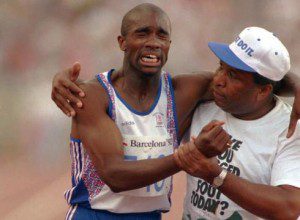
Every Olympic games there’s a standout—an athlete with an unbelievable story of overcoming the odds to win the race. These names get stuck in our memories, their faces on Wheaties boxes. But sometimes the best stories fade into distant memory—many of those are stories, not about winning, but instead about heroically finishing. It’s one of those that illustrates for me most powerfully what it means to draw strength from the race by reaching back for the strength of others who got you to where you are to begin with—through encouragement, example, support.
Derek Redmond is the runner who shattered the British 400-meter record at age 19 and headed to the 1988 Olympics in Seoul bound for a medal. He injured himself at those games and, after 5 surgeries and relentless training, he was ecstatic to be headed to Barcelona in 1992 to try again for a medal—any medal—for running the 400 on the world’s stage.
The event that day in Barcelona would determine four finishers who would compete in the Olympic final, and the stadium was packed that day—over 65,000 fans, including Derek’s father, Jim, who had been with him through all the pain and heartbreak of the previous few years. Derek had made a pact with his father: no matter what happened, he was going to finish the race.
Mark, set, go: the starting gun sounded. Down the backstretch, only 175 meters away from finishing, Redmond was pulling out ahead of the pack, a shoo-in to make the finals. Suddenly, he heard a pop and felt his right hamstring tear.
Everyone watching could tell something had happened, because Derek suddenly slowed down, began hopping on one leg, and fell to the ground. As he lay there, holding his leg, a medical team ran toward him, and rushing toward the track, too, was Jim Redmond, who raced down from the top row of the stands toward his son.
Laying on the track, Redmond realized his dream of an Olympic medal was gone. Tears were running down his face. “All I could think was, ‘I’m out of the Olympics — again,'” he said later. But as the medical crew arrived, trying to carry him out on a stretcher, Redmond refused. “I made a pact that I would finish the race.”
The other runners had already finished before people realized that Redmond wasn’t dropping out of the race after all. In a true Olympic moment, Redmond lifted himself to his feet and started hobbling down the track.
The crowd slowly rose, beginning to roar with cheers, louder and louder. Through what he described as searing pain, Redmond heard the cheers, but “I wasn’t [trying to finish] for the crowd,” he would later say. “Whether people thought I was an idiot or a hero, I wanted to finish the race.”
One painful step at a time, each one a little slower and more painful than the one before, his face twisted with pain and tears, Redmond limped, and the crowd, many crying with him, cheered him on.
His father Jim finally got to the bottom of the stands, leapt over the railing, pushed away a security guard, and ran out to his son. “That’s my son out there,” he yelled back to security, “and I’m going to help him.” Jim reached Derek at the final curve, about 120 meters from the finish, and wrapped his arm around his waist.
“I’m here, son,” he said, hugging Derek. “We’ll finish together.”
If you go back and watch the video of this moment, I dare you not to tear up. You can see Derek putting his arms around his father’s shoulders, leaning against him as he kept hobbling toward the finish line, and sobbing in pain and relief. Together, arm in arm, father and son, kept going, and a couple steps from the finish line Jim released the grip he had on his son so Derek could cross the finish line by himself.
With the crowd in a frenzy, the two hugged each other just across the finish line, crying, along with everybody there.[1]
Strength.
You’ll notice in worship today that we are sharing communion, the table of Christ where we gather to remember the gift of grace that welcomes us all to the family of faith. Today is a special communion Sunday, celebrated once a year, called World Communion Sunday.
This is a Sunday in which Christian communities all over the world will be sharing communion and thinking, not about the practices and beliefs that divide us, but instead about the gift of grace that we share, that draws us into community and connection so that we may gather the courage it takes to live our lives as agents of transformational change in the name of Jesus Christ.
Whoever wrote the little letters of 1 and 2 Timothy knew that gathering around the table, joining your life to the work of the gospel, would be a grueling race. To run the race of faith we will need to draw strength from somewhere, and this table…and these people…this is just the place. There are many who have run this race before us, so many who are cheering us on, and a world that needs us to keep going until we finish.
So when you get weary…when you don’t think you have the strength to go on…when the road stretches out ahead of you unending and you’re sure you can’t even take one more step…pause for a moment to look at what lies behind. And then keep going, one step at a time, until you finish the race. Amen.
[1] http://www.espn.com/espn/espn25/story?page=moments/94
Previous Post

September 25, 2016
Bridging the Great Divide
Next Post

October 4, 2016 Refuse to be Amused
Browse Our Archives
Select a Category Answering the Call Being the Church Curating Wisdom Laughing Out Loud Living in Relationship Practicing Discipleship Reclaiming Baptist Speaking from the Pulpit Uncategorized
Select a Month July 2018 June 2018 May 2018 April 2018 March 2018 January 2018 December 2017 November 2017 October 2017 September 2017 June 2017 May 2017 April 2017 March 2017 February 2017 January 2017 December 2016 November 2016 October 2016 September 2016 August 2016 July 2016 June 2016 May 2016 April 2016 March 2016 February 2016 January 2016 December 2015 November 2015 October 2015 September 2015 August 2015 July 2015 June 2015 May 2015 April 2015 March 2015 February 2015 January 2015 December 2014 November 2014 October 2014 September 2014 August 2014 July 2014 June 2014 May 2014 April 2014 March 2014 February 2014 January 2014 December 2013 November 2013 October 2013 September 2013 August 2013 July 2013 June 2013 May 2013 April 2013 March 2013 February 2013 January 2013 December 2012 November 2012 October 2012 September 2012 August 2012 July 2012 June 2012 May 2012 April 2012 March 2012 February 2012 January 2012 December 2011 October 2011 September 2011 August 2011 July 2011 June 2011 May 2011 April 2011 March 2011 February 2011 January 2011 December 2010 November 2010 October 2010 September 2010 August 2010 July 2010 June 2010 May 2010 April 2010 March 2010 February 2010 January 2010 December 2009 November 2009 October 2009 September 2009 August 2009 July 2009 June 2009 May 2009 April 2009 March 2009 February 2009 January 2009 December 2008 November 2008 October 2008 September 2008 August 2008 July 2008 June 2008 May 2008 April 2008 March 2008 February 2008 January 2008 December 2007 November 2007 October 2007 September 2007 August 2007 July 2007 June 2007 May 2007 April 2007 March 2007 February 2007 January 2007 December 2006 November 2006 October 2006 September 2006 August 2006 July 2006 June 2006 May 2006 April 2006 March 2006 February 2006 January 2006 December 2005
Search for:
Recent Posts
- Sabbath as Radical Witness
- Learning Leadership: A Pilgrimage to Hawaii
- A Prayer for the Living of These Days
- Sabbath as Relationship
- Dressing Up Faith
Recent Comments
Archives
- July 2018
- June 2018
- May 2018
- April 2018
- March 2018
- January 2018
- December 2017
- November 2017
- October 2017
- September 2017
- June 2017
- May 2017
- April 2017
- March 2017
- February 2017
- January 2017
- December 2016
- November 2016
- October 2016
- September 2016
- August 2016
- July 2016
- June 2016
- May 2016
- April 2016
- March 2016
- February 2016
- January 2016
- December 2015
- November 2015
- October 2015
- September 2015
- August 2015
- July 2015
- June 2015
- May 2015
- April 2015
- March 2015
- February 2015
- January 2015
- December 2014
- November 2014
- October 2014
- September 2014
- August 2014
- July 2014
- June 2014
- May 2014
- April 2014
- March 2014
- February 2014
- January 2014
- December 2013
- November 2013
- October 2013
- September 2013
- August 2013
- July 2013
- June 2013
- May 2013
- April 2013
- March 2013
- February 2013
- January 2013
- December 2012
- November 2012
- October 2012
- September 2012
- August 2012
- July 2012
- June 2012
- May 2012
- April 2012
- March 2012
- February 2012
- January 2012
- December 2011
- October 2011
- September 2011
- August 2011
- July 2011
- June 2011
- May 2011
- April 2011
- March 2011
- February 2011
- January 2011
- December 2010
- November 2010
- October 2010
- September 2010
- August 2010
- July 2010
- June 2010
- May 2010
- April 2010
- March 2010
- February 2010
- January 2010
- December 2009
- November 2009
- October 2009
- September 2009
- August 2009
- July 2009
- June 2009
- May 2009
- April 2009
- March 2009
- February 2009
- January 2009
- December 2008
- November 2008
- October 2008
- September 2008
- August 2008
- July 2008
- June 2008
- May 2008
- April 2008
- March 2008
- February 2008
- January 2008
- December 2007
- November 2007
- October 2007
- September 2007
- August 2007
- July 2007
- June 2007
- May 2007
- April 2007
- March 2007
- February 2007
- January 2007
- December 2006
- November 2006
- October 2006
- September 2006
- August 2006
- July 2006
- June 2006
- May 2006
- April 2006
- March 2006
- February 2006
- January 2006
- December 2005
Categories
- Answering the Call
- Being the Church
- Curating Wisdom
- Laughing Out Loud
- Living in Relationship
- Practicing Discipleship
- Reclaiming Baptist
- Speaking from the Pulpit
- Uncategorized
Meta
Follow Us!
TAKE THE
Religious Wisdom Quiz
Who is the "friend at midnight" in one of Jesus' parables?
Select your answer to see how you score.
A fisherman A neighbor seeking bread A soldier An angel
Related posts from Talk with the Preacher

A Prayer for the Living of These Days


Invitation, a Meditation for Maundy Thursday

#HolyWomenHolyLand: Women Wage Peace
TRENDING AT PATHEOS Progressive Christian

Why Christians Have a Sacred Duty to Vote:...
The Bible offers strong support for the sacred duty to vote. Here...

What Being a Modern-Day Apostle Means to Me
In my last column, I discussed the ins and outs of modern-day...

Did Ancient China Once Worship the God of...
Across human history, a common thread weaves through the origins of the...

Love Your Neighbor – Including Earth-Kin: Lev. 19,...
God’s command to love your neighbor means acting in an ethical and...

Lead a Church Study of “Jesus and Lao...
Guest writer Jack Thomas (The Irreverent Reverend) reflects on leading his church...

Principles for Understanding the Apostolic Ministry Today
Whenever people discover that my formal ministry title is "apostle," as in...
view all Progressive Christian blogs
Ad-Free & Subscriber Log-In Subscription Support
- About Us
- 2026 Calendar
- Videos
- Podcasts
- Library of World Religions
- Faith In Media Tracker
- Advertise With Us
- Write for Us
- Privacy Policy
- Terms of Service
- Do Not Sell My Data
- Contact Us
- Radiant Digital
- Manage Newsletter Subscriptions
- Unsubscribe From Notifications
- Sitemap
Copyright 2008-2026, Patheos. All rights reserved.
Subscription Support Ad-Free & Subscriber Log-In
Follow Patheos