
BuddhistCatholicContemplativeEvangelicalGeneral ChristianHinduJewishLatter-day SaintMuslimNew VisionsProgressive Christian
Beliefs
- Buddhist
- Catholic
- Contemplative
- Evangelical
- General Christian
- Hindu
- Jewish
- Latter-day Saint
- More Voices
- Muslim
- New Visions
- Pagan
- Progressive Christian
Topics
- Religion News
- Food and Religion
- Sports and Religion
- Religious Art
- Religious Music and Entertainment
- Religious Events
- History and Religion
- Style and Religion
- Politics and Religion
- Women in Religion
- Recreation Outdoors and Religion
- Business Finance and Religion
- Careers Workplace and Religion
- Education and Religion
- Family Parenting and Religion
- Health Fitness and Religion
- Home and Religion
- Relationships and Religion
- Technology and Religion
- Travel and Religion
Columnists
- Buddhist Columnists
- Business Finance and Religion Columnists
- Careers Workplace and Religion Columnists
- Catholic Columnists
- Contemplative Columnists
- Education and Religion Columnists
- Evangelists Columnists
- Family Parenting and Religion Columnists
- General Christian Columnists
- Health Fitness and Religion Columnists
- Hindu Columnists
- History and Religion Columnists
- Home and Religion Columnists
- Jewish Columnists
- More Voices Columnists
- Latter Day Columnists
- Muslim Columnists
- New Visions Columnists
- Nonreligious Columnists
- Pagan Columnists
- Politics and Religion Columnists
- Progressive Columnists
- Recreation Outdoors and Religion Columnists
- Relationships and Religion Columnists
- Religion News Columnists
- Religious Art Columnists
- Religious Events Columnists
- Religious Music and Entertainment Columnists
- Sports and Religion Columnists
- Style and Religion Columnists
- Technology and Religion Columnists
- Travel and Religion Columnists
- Women in Religion Columnists
Resource Library
- 2026 Calendar
- Library of World Religions
- The 100 Most Holy Places on Earth
- Patheos Answers
- Podcasts
- Videos
- Faith Leaders Database
- Anglican Episcopalian
- Bahai
- Baptist
- Buddhism
- Christianity
- Confucianism
- Eastern Orthodoxy
- Hinduism
- Holiness and Pentecostal
- ISKCON
- Islam
- Judaism
- Lutheran
- Methodist
- The Church of Jesus Christ of Latter-day Saints
- New Age
- Paganism
- Presbytarian and Reformed
- Protestantism
- Religion Behind the Scenes
- Roman Catholic
- Scientology
- Shia Islam
- Sikhism
- Sufism
- Sunni Islam
- Taoism
- Zen
- See all religions
Research Tools
 Ad-Free & Subscriber Log-In Subscription Support
Ad-Free & Subscriber Log-In Subscription Support
Follow Patheos 

- Trending:
- Forgiveness
- |
- Marriage
- |
- Consciousness
- |
- Death Penalty
- |
- Election
- |
- Halloween
 Talk with the Preacher
- Home
- Progressive Christian
- Bridging the Great Divide
Bridging the Great Divide
Last updated on: September 25, 2016 at 2:10 pm by Amy Butler
Bridging the Great Divide 2016-09-25T14:10:40-04:00 Amy Butler
Patheos Explore the world's faith through different perspectives on religion and spirituality! Patheos has the views of the prevalent religions and spiritualities of the world.
Luke 16:19-31
 Thomas Jefferson, as you know, is famous for many things. One thing in particular is currently housed in the Smithsonian National Museum of American History. It’s a Bible, sort of. He created it by cutting passages out of a Bible with a razor and pasting them with glue into a collection he titled: The Life and Morals of Jesus of Nazareth. He took the parts he liked the best and cut out the rest, making the Bible much more palatable to him.
How nice that would be, I sometimes think, to whip out a pair of scissors and cut out the parts of the Bible that just don’t sit well with us. For me, I might choose to cut out our gospel lesson from today, Jesus telling yet another story about poverty and wealth, class and status. Jesus told stories about those things a lot in the gospel accounts, but unlike those redemptive ones like the Prodigal Son, the Lost Sheep, the Lost Coin—you remember those from a few weeks ago—well, the story of Lazarus and the Rich Man is not about making a mistake, repenting from your mistake, changing your ways, and being welcomed back home. No, this one is about being rich and burning in hell.
See?
Makes me want to go find my scissors.
This parable of Jesus is unique to Luke and stands out because it’s suspiciously similar to popular folklore of the time. In Jewish tradition and even in the cultures in the region Jesus lived and worked there was a strong view of the afterlife just as it is described here, along with clear and eternal retribution against the wealthy. Morality plays and folktales similar to this one were common; you can find a story just like this in almost every culture.
In fact, come to think of it, do you read this parable and recall anything familiar in our culture? You’re right if you’re thinking of Charles Dickens’ A Christmas Carol. His famous story was inspired, he said, by this parable. Perhaps Jesus was doing the same thing Charles Dickens did: telling an old story with a few modern adjustments, just to make a point. But then we have to ask: what point, exactly, was Jesus trying to make?
Even though we know that we’re reading some version of a popular morality folktale, imagining Jesus retelling it might lead us to believe that Jesus was saying that wealthy people are bad people. Listen to the contrast he paints: the rich man lived a life of excess wealth, going about his business dressed in the finest linen—dyed purple no less—and feasting sumptuously every day. Those listening to the story would know: someone of that social and economic stature would live a life of utter luxury, with servants to take on every task and whatever he needed right at his fingertips.
Lazarus, by sharp contrast, was utterly wretched, taking his place in line behind even the stray dogs that prowled the neighborhood at night sniffing for whatever scraps they could find.
And you have heard the rest of this story.
Both the rich man and Lazarus die, and the tale tells what happens in the afterlife: the rich man burns in hell, desperate for just a drop of cool water on his tongue. And Lazarus finally is comforted in the presence of Abraham and the angels. All the loose ends neatly tied up with everybody getting what they deserve, right?
Well, yeah . . . unless you’re a rich man, in which case you may want to join me with the scissors. Reminds me of a cab ride this summer when I attended a conference in Aspen, Colorado. The driver laughed as he told me 90% of the houses in Aspen are occupied one month out of the year. “There are two kinds of people in Aspen. People who have three houses…and people who have three jobs.” A great divide, for sure. But what about this? Here we sit in one of the richest countries in the whole world, often blind to these appalling facts:
- Half the world — nearly three billion people — live on less than two dollars a day.[1]
- 20% of the population in the developed nations, consume 86% of the world’s goods.[2]
- Half of the world’s richest 1% lives in America. If you make $34,000/a year, you fall into that category.[3]
In this world, I’m afraid there’s no avoiding it: WE are the rich man. We are the ones who eat sumptuously and wear fine purple linen . . . and if these statistics are correct, we are the ones who waste our food and live lavishly while others languish in poverty, pain, and despair.
Seems like the message of this parable is pretty straightforward: rich people are bad; poor people are good; and if you’re rich in this life you’re going to burn in hell in the next.
See what I mean about scissors?
Jesus, as you know, is never quite as obvious as we think he is, so we might need to look a little deeper than this first-glance interpretation. Note this: the rich man was not just rich. In that society he controlled things like land and money, laws and systems, even the practices of the Temple. Even the geography of the city was controlled by the rich: the homes of the rich were surrounded by walls and fortifications, and every day they’d let the poor who worked for them come in and out…if they felt like it. There was a chasm that divided the rich and the poor in life, just like the great divide that Abraham pointed out to the rich man after his death.
And the real sin in this story is not necessarily being rich; it’s the rich man’s unwillingness to bridge the great divide that came between him and Lazarus. His sin was building and maintaining systems that created a chasm that kept the poor and oppressed stuck in a cycle of injustice.
Any of this sound familiar?
So how can we hear this lesson from Luke’s gospel in a culture where we own and enjoy so much of the world’s wealth? We have no idea how much privilege we have. How can we gain the perspective to see our privilege and wealth for what it really is and togather the courage to live with generosity and justice? A clue to this answer is found again in this passage.
It’s curious that, in Jesus’s story from the gospel of Luke today, it’s only the poor man who has a name. We don’t know the rich man’s name at all. And while Lazarus is ushered into the community of angels and Father Abraham, the rich man is all alone. No community to challenge his privilege or hold him accountable. And this is how we learn to live counter to our culture, with open, giving hearts and lives that stand with the oppressed: we surround ourselves with a community of people who stand with us and help us learn how to live, not with fists clenched and fear narrating our lives, but with open hands and open hearts, using our privilege and wealth to bridge the great divide. Let me be clear: we are the rich man in this story when our wealth, privilege, arrogance, or fear cut us off from efforts to change hurtful systems or damage the health and well-being of justice-making communities like this one.
In this very nave on April 4, almost 50 years ago, Martin Luther King, Jr. voiced the great lesson of this parable: “We are called to play the Good Samaritan on life’s roadside; but that will be only an initial act. One day the whole Jericho road must be transformed so that men and women will not be beaten and robbed as they make their journey through life. True compassion is more than flinging a coin to a beggar; it understands that an edifice that produces beggars needs restructuring.”[4]
Right now. On this side of eternity.
This week we all have been devastated, again, by bombs detonated in our own city, shootings in Tulsa and Charlotte, ongoing protests that have gotten violent and the horrifying vitriol on our newsfeeds: Donald Trump exclaiming with glee that he predicted the bomb in Chelsea and Seattle Mariners catcher Steve Clevenger tweeting racist opinions and non-apologies. Our country is poisoned by systems that keep the chasms between us deep and unbridged. Here in America we are the rich man, and if we keep this up, we’re headed straight to hell.
I read a story this week by a colleague who lives, as he says, “on Jesus’ side of the tracks” in Charlotte, North Carolina. He recounted this: his living room was filled with neighborhood teenagers playing cards on a crisp fall evening. As darkness fell, suddenly two teenagers from down the street came into the house and said they’d heard gunshots, that they were afraid. So they came to the safest place they knew. As the group started playing cards again, they suddenly become aware of a helicopter droning, hovering nearby, and sirens of police cars cruising the neighborhood looking for a suspect. The droning of the helicopter became stronger and there was a loud knock at the door.
The police explained that they were looking for two young men, dressed in dark clothes. Persons fitting that description had been seen entering the house, my colleague was told.
“This description fit every pair of black men on any street at night, which I now know was the point,” he wrote. He tried to explain to the officer: “These children who just entered my house were looking for safety. I know them and can assure you they are not responsible. You are in the wrong place, and the real suspects are getting further away.”
“[The police and I] discussed, insofar as you can have a discussion when the other side is fortified by a dozen armed men and a helicopter droning overhead. The course of action was laid out to us in this way: The victim of an attempted carjacking was one block over in a patrol car. The two young men were to walk out onto our porch, and an officer would drive the victim by our house. Every police car was equipped with a blinding light mounted to the roof. They would stop the car and shine that light onto our boys for the victim to see. He would then either positively or negatively identify them.”
The boys insisted they do what the police said—they were innocent, after all! But my colleague didn’t know what to do. He didn’t think it was smart to let the boys go stand on his porch, but they were insistent. So he and all the others in the house decided to go out on the front porch and stood, lined up, with their friends as the police car flood lights glared. He writes: “[W]hen the weight of a system designed to crush people you love is bearing down on your friends, you stand next to them. You become potential suspects, loving accomplices…. When the spotlight is robbing them of their dignity, turning boys into men far too young, you keep your eyes open and refuse to look away…. You become a party to the crime of demanding full humanity and nothing less…. Neither dispassionate analysis, nor careful moderation, nor silent contentment, nor running away and pretending not to see will suffice any longer. It is time to show up, to stand up, and to put ourselves on the line for justice.”[5]
I’m pretty sure Jesus didn’t tell this story to say that rich people automatically end up in hell. But hoarding what we have; supporting and perpetuating systems that keep the oppressed crippled; and living our lives absent of a community that calls us to account for the way we use our wealth and privilege will certainly, surely, lead us toward destruction.
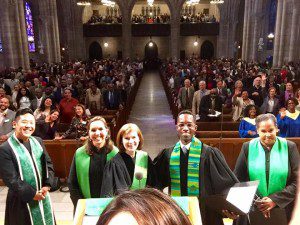
Today is Homecoming Sunday, where we’re gathering back together to be again in this year the community of Christ here at The Riverside Church. Amazing programming is starting up; the choir is back in worship; committee meetings are back on their regular schedules. But all of these things are inconsequential unless we take up the responsibility of reminding each other that our shared calling in the world is to do justice; to change systems; to stand in solidarity with the oppressed; to recognize our privilege; and to open our lives to lavishly share what we have; to live the gospel out loud. If we can manage to do that for each other, it’s then that we will finally begin to bridge the great divide.
Amen.
Today we will stand with those who are oppressed and poor, those who are covered with sores—literal and metaphorical, and those who scramble for crumbs from the table of excess. We are a community of people who are being transformed by the work of God’s Spirit, and we will be, together, agents of transformation in the world. To remind each other and the whole world that we stand alongside all of those who don’t have a fair shot, would you stand now, together?
[1] http://www.un.org/en/globalissues/briefingpapers/food/vitalstats.shtml
[2] http://worldcentric.org/conscious-living/social-and-economic-injustice
[3] http://www.dailymail.co.uk/news/article-2082385/We-1–You-need-34k-income-global-elite–half-worlds-richest-live-U-S.html
[4] “Breaking the Silence: Beyond Vietnam,” April 4, 1967.
Previous Post

September 21, 2016
Bread on the Water
Next Post

October 2, 2016 What Lies Behind
Browse Our Archives
Select a Category Answering the Call Being the Church Curating Wisdom Laughing Out Loud Living in Relationship Practicing Discipleship Reclaiming Baptist Speaking from the Pulpit Uncategorized
Select a Month July 2018 June 2018 May 2018 April 2018 March 2018 January 2018 December 2017 November 2017 October 2017 September 2017 June 2017 May 2017 April 2017 March 2017 February 2017 January 2017 December 2016 November 2016 October 2016 September 2016 August 2016 July 2016 June 2016 May 2016 April 2016 March 2016 February 2016 January 2016 December 2015 November 2015 October 2015 September 2015 August 2015 July 2015 June 2015 May 2015 April 2015 March 2015 February 2015 January 2015 December 2014 November 2014 October 2014 September 2014 August 2014 July 2014 June 2014 May 2014 April 2014 March 2014 February 2014 January 2014 December 2013 November 2013 October 2013 September 2013 August 2013 July 2013 June 2013 May 2013 April 2013 March 2013 February 2013 January 2013 December 2012 November 2012 October 2012 September 2012 August 2012 July 2012 June 2012 May 2012 April 2012 March 2012 February 2012 January 2012 December 2011 October 2011 September 2011 August 2011 July 2011 June 2011 May 2011 April 2011 March 2011 February 2011 January 2011 December 2010 November 2010 October 2010 September 2010 August 2010 July 2010 June 2010 May 2010 April 2010 March 2010 February 2010 January 2010 December 2009 November 2009 October 2009 September 2009 August 2009 July 2009 June 2009 May 2009 April 2009 March 2009 February 2009 January 2009 December 2008 November 2008 October 2008 September 2008 August 2008 July 2008 June 2008 May 2008 April 2008 March 2008 February 2008 January 2008 December 2007 November 2007 October 2007 September 2007 August 2007 July 2007 June 2007 May 2007 April 2007 March 2007 February 2007 January 2007 December 2006 November 2006 October 2006 September 2006 August 2006 July 2006 June 2006 May 2006 April 2006 March 2006 February 2006 January 2006 December 2005
Search for:
Recent Posts
- Sabbath as Radical Witness
- Learning Leadership: A Pilgrimage to Hawaii
- A Prayer for the Living of These Days
- Sabbath as Relationship
- Dressing Up Faith
Recent Comments
Archives
- July 2018
- June 2018
- May 2018
- April 2018
- March 2018
- January 2018
- December 2017
- November 2017
- October 2017
- September 2017
- June 2017
- May 2017
- April 2017
- March 2017
- February 2017
- January 2017
- December 2016
- November 2016
- October 2016
- September 2016
- August 2016
- July 2016
- June 2016
- May 2016
- April 2016
- March 2016
- February 2016
- January 2016
- December 2015
- November 2015
- October 2015
- September 2015
- August 2015
- July 2015
- June 2015
- May 2015
- April 2015
- March 2015
- February 2015
- January 2015
- December 2014
- November 2014
- October 2014
- September 2014
- August 2014
- July 2014
- June 2014
- May 2014
- April 2014
- March 2014
- February 2014
- January 2014
- December 2013
- November 2013
- October 2013
- September 2013
- August 2013
- July 2013
- June 2013
- May 2013
- April 2013
- March 2013
- February 2013
- January 2013
- December 2012
- November 2012
- October 2012
- September 2012
- August 2012
- July 2012
- June 2012
- May 2012
- April 2012
- March 2012
- February 2012
- January 2012
- December 2011
- October 2011
- September 2011
- August 2011
- July 2011
- June 2011
- May 2011
- April 2011
- March 2011
- February 2011
- January 2011
- December 2010
- November 2010
- October 2010
- September 2010
- August 2010
- July 2010
- June 2010
- May 2010
- April 2010
- March 2010
- February 2010
- January 2010
- December 2009
- November 2009
- October 2009
- September 2009
- August 2009
- July 2009
- June 2009
- May 2009
- April 2009
- March 2009
- February 2009
- January 2009
- December 2008
- November 2008
- October 2008
- September 2008
- August 2008
- July 2008
- June 2008
- May 2008
- April 2008
- March 2008
- February 2008
- January 2008
- December 2007
- November 2007
- October 2007
- September 2007
- August 2007
- July 2007
- June 2007
- May 2007
- April 2007
- March 2007
- February 2007
- January 2007
- December 2006
- November 2006
- October 2006
- September 2006
- August 2006
- July 2006
- June 2006
- May 2006
- April 2006
- March 2006
- February 2006
- January 2006
- December 2005
Categories
- Answering the Call
- Being the Church
- Curating Wisdom
- Laughing Out Loud
- Living in Relationship
- Practicing Discipleship
- Reclaiming Baptist
- Speaking from the Pulpit
- Uncategorized
Meta
Follow Us!
TAKE THE
Religious Wisdom Quiz
I am a donkey that spoke to rebuke my master, a prophet. What am I?
Select your answer to see how you score.
Balaam's donkey A miracle donkey A prophet's beast A talking animal
Related posts from Talk with the Preacher


Learning Leadership: A Pilgrimage to Hawaii

A Prayer for the Living of These Days

TRENDING AT PATHEOS Progressive Christian

Why Christians Have a Sacred Duty to Vote:...
The Bible offers strong support for the sacred duty to vote. Here...

What Being a Modern-Day Apostle Means to Me
In my last column, I discussed the ins and outs of modern-day...

Did Ancient China Once Worship the God of...
Across human history, a common thread weaves through the origins of the...

Love Your Neighbor – Including Earth-Kin: Lev. 19,...
God’s command to love your neighbor means acting in an ethical and...

Lead a Church Study of “Jesus and Lao...
Guest writer Jack Thomas (The Irreverent Reverend) reflects on leading his church...

Principles for Understanding the Apostolic Ministry Today
Whenever people discover that my formal ministry title is "apostle," as in...
view all Progressive Christian blogs
Ad-Free & Subscriber Log-In Subscription Support
- About Us
- 2026 Calendar
- Videos
- Podcasts
- Library of World Religions
- Faith In Media Tracker
- Advertise With Us
- Write for Us
- Privacy Policy
- Terms of Service
- Do Not Sell My Data
- Contact Us
- Radiant Digital
- Manage Newsletter Subscriptions
- Unsubscribe From Notifications
- Sitemap
Copyright 2008-2026, Patheos. All rights reserved.
Subscription Support Ad-Free & Subscriber Log-In
Follow Patheos