
BuddhistCatholicContemplativeEvangelicalGeneral ChristianHinduJewishLatter-day SaintMuslimNew VisionsProgressive Christian
Beliefs
- Buddhist
- Catholic
- Contemplative
- Evangelical
- General Christian
- Hindu
- Jewish
- Latter-day Saint
- More Voices
- Muslim
- New Visions
- Pagan
- Progressive Christian
Topics
- Religion News
- Food and Religion
- Sports and Religion
- Religious Art
- Religious Music and Entertainment
- Religious Events
- History and Religion
- Style and Religion
- Politics and Religion
- Women in Religion
- Recreation Outdoors and Religion
- Business Finance and Religion
- Careers Workplace and Religion
- Education and Religion
- Family Parenting and Religion
- Health Fitness and Religion
- Home and Religion
- Relationships and Religion
- Technology and Religion
- Travel and Religion
Columnists
- Buddhist Columnists
- Business Finance and Religion Columnists
- Careers Workplace and Religion Columnists
- Catholic Columnists
- Contemplative Columnists
- Education and Religion Columnists
- Evangelists Columnists
- Family Parenting and Religion Columnists
- General Christian Columnists
- Health Fitness and Religion Columnists
- Hindu Columnists
- History and Religion Columnists
- Home and Religion Columnists
- Jewish Columnists
- More Voices Columnists
- Latter Day Columnists
- Muslim Columnists
- New Visions Columnists
- Nonreligious Columnists
- Pagan Columnists
- Politics and Religion Columnists
- Progressive Columnists
- Recreation Outdoors and Religion Columnists
- Relationships and Religion Columnists
- Religion News Columnists
- Religious Art Columnists
- Religious Events Columnists
- Religious Music and Entertainment Columnists
- Sports and Religion Columnists
- Style and Religion Columnists
- Technology and Religion Columnists
- Travel and Religion Columnists
- Women in Religion Columnists
Resource Library
- 2026 Calendar
- Library of World Religions
- The 100 Most Holy Places on Earth
- Patheos Answers
- Podcasts
- Videos
- Faith Leaders Database
- Anglican Episcopalian
- Bahai
- Baptist
- Buddhism
- Christianity
- Confucianism
- Eastern Orthodoxy
- Hinduism
- Holiness and Pentecostal
- ISKCON
- Islam
- Judaism
- Lutheran
- Methodist
- The Church of Jesus Christ of Latter-day Saints
- New Age
- Paganism
- Presbytarian and Reformed
- Protestantism
- Religion Behind the Scenes
- Roman Catholic
- Scientology
- Shia Islam
- Sikhism
- Sufism
- Sunni Islam
- Taoism
- Zen
- See all religions
Research Tools
 Ad-Free & Subscriber Log-In Subscription Support
Ad-Free & Subscriber Log-In Subscription Support
Follow Patheos 

- Trending:
- Forgiveness
- |
- Marriage
- |
- Consciousness
- |
- Death Penalty
- |
- Election
- |
- Halloween
 Talk with the Preacher
- Home
- Progressive Christian
- Can I Give Up My Life?
Can I Give Up My Life?
Last updated on: February 21, 2016 at 2:21 pm by Amy Butler
Can I Give Up My Life? 2016-02-21T14:21:34-04:00 Amy Butler
Patheos Explore the world's faith through different perspectives on religion and spirituality! Patheos has the views of the prevalent religions and spiritualities of the world.
Can I Give Up My Life?
A few weeks ago, on Transfiguration Sunday, we were reminded of Jesus’ powerful words to his disciples as they all turned toward Jerusalem and what would be his crucifixion and death: “If any want to become my followers, let them deny themselves and take up their cross daily and follow me, for those who want to save their life will lose it, and those who lose their life for my sake will save it…” which I personally think, as I often say, is the worst marketing slogan ever.
This Lent we’re asking hard questions of God and of ourselves, doing the work of internal examination as we seek to live with intention in a world filled with voices pulling us away from true meaning and purpose. Today’s question is a tough one: can I give up my life?
 Sitting warm and comfortable in this beautiful space today, we’re sort of asking the question in theory, but Jesus wasn’t, and we know of many modern prophets who have actually given up their lives for what they believe in. So today we’re going to wonder about this hard question and think deeply about what we really believe in—believe so much, we would theoretically and maybe even actually give up our lives.
Before we look closely at our gospel passage from Luke this morning, I want to here say that I am not unaware of the tender and painful places questions like these might touch among those of us who have lost loved ones–particularly if that loss was by suicide. I know I could not think about this question without feeling some sharp pain myself. So I want to name that possibility for some of us today and say up front that asking a question like “Can I give up my life?” is not for the faint of heart.
Today’s passage is one of the more unusual passages of Lent. It’s not a parable of Jesus or a familiar story. It’s the recounting of an interaction Jesus has with his followers and with those who are standing and watching him from afar. It gives us some insight into what Jesus was thinking…why he would put everything on the line and end up, well, giving up his life.
For a quick review, you might remember that the gospel of Luke was written by Luke, who also wrote the book of Acts. Luke was a Gentile—not a Jew—and the perspective from which he recounts the story of Jesus is the perspective of the outsider. All through the gospel of Luke we meet a Jesus who is a radical includer—women, the sick, the poor, social outcasts—the Jesus in Luke’s gospel is not afraid to include anybody who wants to know more about the message he’s preaching.
And what a message it was!
It was powerful and grating, unrelenting in its challenge to those who held power and misused it. He consistently spoke out for the inclusion of those who were outcast, and he made everybody nervous by challenging powers and systems that oppressed people and corrupted society.
His aim was to speak the truth that nobody else dared to speak, to risk whatever cost that endeavor would exact, and to consistently extend invitations to anybody and everybody to join this movement away from the brokenness and pain of this world toward the way of the wholeness and goodness of the kingdom of God.
In Luke’s gospel Jesus is on a journey toward Jerusalem. Scholars call this part of Luke—seven chapters through chapter 19—Luke’s Travel Narrative, the tension and intrigue mounting as Jesus gets closer and closer to Jerusalem. Today we encounter Jesus at the beginning of that journey while he’s still in Galilee, preaching as usual, when some Jewish leaders with whom he had tussled previously, approach him to tell him that he’d better watch out, that the Roman ruler Herod was out to kill him.
Not that this was news to Jesus, but it’s curious how Jesus responds. He begins by calling Herod a fox (and not in a good way!), then basically talking through his calendar for the following three days. I am around for the next three days, he says, casting out demons, healing people, going about my work. For three more days that’s what I’ll be doing—kind of as if he’s saying: just try to stop me!
He then goes on to talk about the city of Jerusalem. So many prophets have come to that powerful city and tried their best to preach a message of justice and peace, and one by one by one they were killed.
And then, as if he is talking to himself, Jesus says almost wistfully: “Jerusalem, Jerusalem, how often have I desired to gather your children together as a hen gathers her brood under her wings, and you were not willing!” He loves them. Jesus loves them, and he’s not willing to give up on them, no matter what the cost. Bringing a message of wholeness and hope to these people is the purpose of his life.
While last week we found Jesus in the desert, tempted and wondering about what his life would mean, this week he’s steely-eyed and determined: he knows exactly what he’s meant to do with his life and he’s going to do it, even if he has to give up his life in the process.
What about us? Just ordinary people trying to make it in the world, going about our business, trying to find happiness and fulfillment where we can. But do our lives have meaning and purpose? Do we know for what we would be willing to give up even our lives?
We’d better begin asking, because our lives are precious…and fleeting…and how terribly sad it would be to get to their end and not have found a way to articulate that purpose in which we believe so deeply that we would even pay the ultimate price.
See what I mean about asking hard questions?
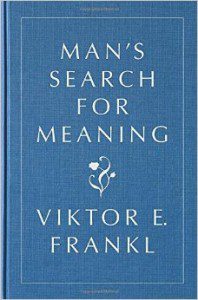
I recently read a fascinating article about Viktor Frankl, a Jewish psychiatrist and neurologist, and author of the book, Man’s Search for Meaning, which was published in 1946.[1] In 1991 the Library of Congress listed Man’s Search for Meaning as one of the ten most influential books in the United States.
The book’s premise is based on an experience Frankl had during the years in which he and his family were imprisoned in a Nazi concentration camp: Frankl’s thesis was that the difference between those who survived the camps and those who did not, was one thing: purpose.
While Gallup polls show that Americans are happier than we have ever been, almost half of us report that we have not discovered a satisfying purpose to our lives.
Many of us can’t name anything that makes our lives meaningful.
This is a problem, because research shows that having a purpose in life “increases overall well-being and life satisfaction, improves mental and physical health, enhances resiliency, enhances self-esteem, and decreases the chances of depression.” Meanwhile, happiness is fleeting and, in fact, the single-minded pursuit of happiness can make us…unhappy.
Are you happy? Well, that’s good, but happiness is not the same thing as meaning or purpose. Happiness and purpose, in fact, are almost opposites. While happiness is based on receiving benefits from others, meaning or purpose is always found in giving to others. Martin Seligman, a psychologist who studies this topic says that when you live a meaningful life “you use your highest strengths and talents to belong to and serve something you believe is larger than the self.”
Happiness is fleeting…it can change with a change of circumstances. Finding meaning and purpose, however, transcends circumstances and allows you to live for something bigger than yourself.
Which brings me back to Viktor Frankl, and how he came to the hypothesis of Man’s Search for Meaning. I quote, “In his early adulthood, before he and his family were taken away to the camps, Frankl had established himself as one of the leading psychiatrists in Vienna and the world. By 1941, his theories had received international attention and he was working as the chief of neurology at Vienna’s Rothschild Hospital.
That was the same year when he had a decision to make, a decision that would change his life. With his career on the rise and the threat of the Nazis looming over him, Frankl had applied for a visa to America, which he was granted in 1941. By then, the Nazis had already started rounding up the Jews and taking them away to concentration camps, focusing on the elderly first. Frankl knew it would only be a matter of time before the Nazis came to take his parents away. He also knew that once they did, his parents would live through significant trauma of adjusting to camp life. Frankl felt that he should be with his parents, to help them. On the other hand, as a newly married man with his visa in hand, he was tempted to leave for America and flee to safety, where he could distinguish himself even further in his field.
He was at a loss for what to do, so he set out for St. Stephen’s Cathedral in Vienna to clear his head. Listening to the organ music, he repeatedly asked himself, “Should I leave my parents behind? … Should I say goodbye and leave them to their fate?” Where did his responsibility lie? What would his life stand for? He was looking for a sign.
When he returned home that day, he found it. A piece of marble was lying on the table. His father explained that it was from the rubble of one of the nearby synagogues the Nazis had destroyed. The marble contained the fragment of one of the Ten Commandments — the one about honoring your father and your mother.
With that, Frankl decided to stay in Vienna and forgo whatever opportunities for safety and career advancement awaited him in the United States. He decided to put aside his individual pursuits to serve his family and, later, other inmates in the camps. His entire family, including his pregnant wife, died in the camps.
The wisdom that Frankl derived from his experiences in the camps, in the middle of unimaginable human suffering, is just as relevant now as it was then. He wrote, “Being human always points, and is directed, to something or someone, other than oneself — be it a meaning to fulfill or another human being to encounter. The more one forgets himself — by giving himself to a cause to serve or another person to love — the more human he is.”
Sound familiar? Kind of like: “If any want to become my followers, let them deny themselves and take up their cross daily and follow me, for those who want to save their life will lose it, and those who lose their life for my sake will save it?”
In our gospel passage today, Jesus knew where living his purpose would lead him, but he was driven and determined. Do you have something, anything, for which you would give up everything? Do you have a passion and calling that defines your life, that gives it meaning, that sets it apart from the hum drum, day in and day out rhythm of life that threatens to swallow us whole, to render our living inconsequential?
We may not end up having to put our lives on the line like Jesus did, but we certainly will face the question of what, if anything, our lives will offer this world. Finding our purpose is not the same thing as being happy; finding our purpose is living each day with intention, of being and becoming what we were created to be, making our little lives count in the larger redemption and salvation of this broken world.
Because when you and I have lived whatever number of years we’ll live on this planet, and when our lives are over and we’re dead and gone, what legacies we will leave?
This Lent we’re asking hard, hard questions: Can I give up my life? For what would you give your life?
Amen.
[1] http://www.theatlantic.com/health/archive/2013/01/theres-more-to-life-than-being-happy/266805/
Previous Post

February 14, 2016
Can I Resist Temptation?
Next Post

February 25, 2016 Parched
Browse Our Archives
Select a Category Answering the Call Being the Church Curating Wisdom Laughing Out Loud Living in Relationship Practicing Discipleship Reclaiming Baptist Speaking from the Pulpit Uncategorized
Select a Month July 2018 June 2018 May 2018 April 2018 March 2018 January 2018 December 2017 November 2017 October 2017 September 2017 June 2017 May 2017 April 2017 March 2017 February 2017 January 2017 December 2016 November 2016 October 2016 September 2016 August 2016 July 2016 June 2016 May 2016 April 2016 March 2016 February 2016 January 2016 December 2015 November 2015 October 2015 September 2015 August 2015 July 2015 June 2015 May 2015 April 2015 March 2015 February 2015 January 2015 December 2014 November 2014 October 2014 September 2014 August 2014 July 2014 June 2014 May 2014 April 2014 March 2014 February 2014 January 2014 December 2013 November 2013 October 2013 September 2013 August 2013 July 2013 June 2013 May 2013 April 2013 March 2013 February 2013 January 2013 December 2012 November 2012 October 2012 September 2012 August 2012 July 2012 June 2012 May 2012 April 2012 March 2012 February 2012 January 2012 December 2011 October 2011 September 2011 August 2011 July 2011 June 2011 May 2011 April 2011 March 2011 February 2011 January 2011 December 2010 November 2010 October 2010 September 2010 August 2010 July 2010 June 2010 May 2010 April 2010 March 2010 February 2010 January 2010 December 2009 November 2009 October 2009 September 2009 August 2009 July 2009 June 2009 May 2009 April 2009 March 2009 February 2009 January 2009 December 2008 November 2008 October 2008 September 2008 August 2008 July 2008 June 2008 May 2008 April 2008 March 2008 February 2008 January 2008 December 2007 November 2007 October 2007 September 2007 August 2007 July 2007 June 2007 May 2007 April 2007 March 2007 February 2007 January 2007 December 2006 November 2006 October 2006 September 2006 August 2006 July 2006 June 2006 May 2006 April 2006 March 2006 February 2006 January 2006 December 2005
Search for:
Recent Posts
- Sabbath as Radical Witness
- Learning Leadership: A Pilgrimage to Hawaii
- A Prayer for the Living of These Days
- Sabbath as Relationship
- Dressing Up Faith
Recent Comments
Archives
- July 2018
- June 2018
- May 2018
- April 2018
- March 2018
- January 2018
- December 2017
- November 2017
- October 2017
- September 2017
- June 2017
- May 2017
- April 2017
- March 2017
- February 2017
- January 2017
- December 2016
- November 2016
- October 2016
- September 2016
- August 2016
- July 2016
- June 2016
- May 2016
- April 2016
- March 2016
- February 2016
- January 2016
- December 2015
- November 2015
- October 2015
- September 2015
- August 2015
- July 2015
- June 2015
- May 2015
- April 2015
- March 2015
- February 2015
- January 2015
- December 2014
- November 2014
- October 2014
- September 2014
- August 2014
- July 2014
- June 2014
- May 2014
- April 2014
- March 2014
- February 2014
- January 2014
- December 2013
- November 2013
- October 2013
- September 2013
- August 2013
- July 2013
- June 2013
- May 2013
- April 2013
- March 2013
- February 2013
- January 2013
- December 2012
- November 2012
- October 2012
- September 2012
- August 2012
- July 2012
- June 2012
- May 2012
- April 2012
- March 2012
- February 2012
- January 2012
- December 2011
- October 2011
- September 2011
- August 2011
- July 2011
- June 2011
- May 2011
- April 2011
- March 2011
- February 2011
- January 2011
- December 2010
- November 2010
- October 2010
- September 2010
- August 2010
- July 2010
- June 2010
- May 2010
- April 2010
- March 2010
- February 2010
- January 2010
- December 2009
- November 2009
- October 2009
- September 2009
- August 2009
- July 2009
- June 2009
- May 2009
- April 2009
- March 2009
- February 2009
- January 2009
- December 2008
- November 2008
- October 2008
- September 2008
- August 2008
- July 2008
- June 2008
- May 2008
- April 2008
- March 2008
- February 2008
- January 2008
- December 2007
- November 2007
- October 2007
- September 2007
- August 2007
- July 2007
- June 2007
- May 2007
- April 2007
- March 2007
- February 2007
- January 2007
- December 2006
- November 2006
- October 2006
- September 2006
- August 2006
- July 2006
- June 2006
- May 2006
- April 2006
- March 2006
- February 2006
- January 2006
- December 2005
Categories
- Answering the Call
- Being the Church
- Curating Wisdom
- Laughing Out Loud
- Living in Relationship
- Practicing Discipleship
- Reclaiming Baptist
- Speaking from the Pulpit
- Uncategorized
Meta
Follow Us!
TAKE THE
Religious Wisdom Quiz
Who was Jesus' mother?
Select your answer to see how you score.
Anna Mary Elizabeth Martha
Related posts from Talk with the Preacher


Learning Leadership: A Pilgrimage to Hawaii

A Prayer for the Living of These Days

TRENDING AT PATHEOS Progressive Christian

Why Christians Have a Sacred Duty to Vote:...
The Bible offers strong support for the sacred duty to vote. Here...

What Being a Modern-Day Apostle Means to Me
In my last column, I discussed the ins and outs of modern-day...

Did Ancient China Once Worship the God of...
Across human history, a common thread weaves through the origins of the...

Love Your Neighbor – Including Earth-Kin: Lev. 19,...
God’s command to love your neighbor means acting in an ethical and...

Lead a Church Study of “Jesus and Lao...
Guest writer Jack Thomas (The Irreverent Reverend) reflects on leading his church...

Principles for Understanding the Apostolic Ministry Today
Whenever people discover that my formal ministry title is "apostle," as in...
view all Progressive Christian blogs
Ad-Free & Subscriber Log-In Subscription Support
- About Us
- 2026 Calendar
- Videos
- Podcasts
- Library of World Religions
- Faith In Media Tracker
- Advertise With Us
- Write for Us
- Privacy Policy
- Terms of Service
- Do Not Sell My Data
- Contact Us
- Radiant Digital
- Manage Newsletter Subscriptions
- Unsubscribe From Notifications
- Sitemap
Copyright 2008-2026, Patheos. All rights reserved.
Subscription Support Ad-Free & Subscriber Log-In
Follow Patheos