
BuddhistCatholicContemplativeEvangelicalGeneral ChristianHinduJewishLatter-day SaintMuslimNew VisionsProgressive Christian
Beliefs
- Buddhist
- Catholic
- Contemplative
- Evangelical
- General Christian
- Hindu
- Jewish
- Latter-day Saint
- More Voices
- Muslim
- New Visions
- Pagan
- Progressive Christian
Topics
- Religion News
- Food and Religion
- Sports and Religion
- Religious Art
- Religious Music and Entertainment
- Religious Events
- History and Religion
- Style and Religion
- Politics and Religion
- Women in Religion
- Recreation Outdoors and Religion
- Business Finance and Religion
- Careers Workplace and Religion
- Education and Religion
- Family Parenting and Religion
- Health Fitness and Religion
- Home and Religion
- Relationships and Religion
- Technology and Religion
- Travel and Religion
Columnists
- Buddhist Columnists
- Business Finance and Religion Columnists
- Careers Workplace and Religion Columnists
- Catholic Columnists
- Contemplative Columnists
- Education and Religion Columnists
- Evangelists Columnists
- Family Parenting and Religion Columnists
- General Christian Columnists
- Health Fitness and Religion Columnists
- Hindu Columnists
- History and Religion Columnists
- Home and Religion Columnists
- Jewish Columnists
- More Voices Columnists
- Latter Day Columnists
- Muslim Columnists
- New Visions Columnists
- Nonreligious Columnists
- Pagan Columnists
- Politics and Religion Columnists
- Progressive Columnists
- Recreation Outdoors and Religion Columnists
- Relationships and Religion Columnists
- Religion News Columnists
- Religious Art Columnists
- Religious Events Columnists
- Religious Music and Entertainment Columnists
- Sports and Religion Columnists
- Style and Religion Columnists
- Technology and Religion Columnists
- Travel and Religion Columnists
- Women in Religion Columnists
Resource Library
- 2026 Calendar
- Library of World Religions
- The 100 Most Holy Places on Earth
- Patheos Answers
- Podcasts
- Videos
- Faith Leaders Database
- Anglican Episcopalian
- Bahai
- Baptist
- Buddhism
- Christianity
- Confucianism
- Eastern Orthodoxy
- Hinduism
- Holiness and Pentecostal
- ISKCON
- Islam
- Judaism
- Lutheran
- Methodist
- The Church of Jesus Christ of Latter-day Saints
- New Age
- Paganism
- Presbytarian and Reformed
- Protestantism
- Religion Behind the Scenes
- Roman Catholic
- Scientology
- Shia Islam
- Sikhism
- Sufism
- Sunni Islam
- Taoism
- Zen
- See all religions
Research Tools
 Ad-Free & Subscriber Log-In Subscription Support
Ad-Free & Subscriber Log-In Subscription Support
Follow Patheos 

- Trending:
- Forgiveness
- |
- Marriage
- |
- Consciousness
- |
- Death Penalty
- |
- Election
- |
- Halloween
 Talk with the Preacher
- Home
- Progressive Christian
- Shine, Jesus, Shine
Shine, Jesus, Shine
Last updated on: February 7, 2016 at 3:04 pm by Amy Butler
Shine, Jesus, Shine 2016-02-07T15:04:30-04:00 Amy Butler
Patheos Explore the world's faith through different perspectives on religion and spirituality! Patheos has the views of the prevalent religions and spiritualities of the world.
Shine, Jesus, Shine
Today we’re at the fifth Sunday following the Epiphany, this little season of the church year that begins with the Magi following one star in dark sky, leads us through story after story about Jesus’ earthly ministry, and lands us here—this year it’s in the gospel of Luke, chapter 9—on a special Sunday called Transfiguration Sunday. One commentator claims this is the most difficult passage to preach all year long—I’m not sure I completely agree with that, but I will say: this is a pretty strange story.
Immediately following Luke’s version of the feeding of the 5,000, Jesus decides to take a hike up a mountain to pray. This isn’t unusual; we read in the gospels incidence after incidence of Jesus escaping the crowds for some quiet time. That day he took three of his disciples with him: Peter, James and John, and when they got up to the top of the hill, Jesus began to pray.
My guess is that Peter, James, and John were maybe not quite as holy as Jesus, because they got bored and were about to fall asleep when they noticed that Jesus began to look a little different. His face changed, the text says, and his clothes began to sparkle until they appeared “dazzling white.” If that wasn’t enough, all of the sudden Moses and Elijah appeared with him and began talking business, conversation about Jesus’ next stop: Jerusalem, and these strange mentions of his departure.
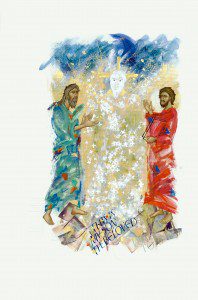
Transfiguration, Donald Jackson with contributions from Aidan Hart, Copyright 2002, The Saint John’s Bible, Saint John’s University, Collegeville, Minnesota USA. Used by permission. All rights reserved.
Good thing they hadn’t fallen completely asleep, because Peter, James and John witnessed the whole glowing event, and Peter—because that’s how Peter was—got really enthusiastic. It isn’t everyday that your friend starts glowing and heroes of your faith suddenly show up, after all. In his enthusiasm Peter suggested that the group construct three dwellings, monuments maybe: one for Jesus, one for Moses, and one for Elijah, just to mark this special occasion.
This suggestion might seem a bit of a strange reaction to us, but it probably recalls the Jewish festival of booths, instruction requiring devout Jews to travel to Jerusalem to worship in the temple, where they’d build little booths and stay in them for seven days to remember God’s provision while the Israelites wandered in the desert. It could have been that, or it could have just been Peter’s first, sleepy response to seeing Jesus in a whole new way: shiny and glowing, and hanging out with the patriarchs of their faith: let’s build a monument!
You can’t blame Peter for getting excited. All this time, with all the teaching and healing and preaching Jesus had done, you’d think the disciples would have understood that Jesus wasn’t especially interested in fame or power or political office. If they had understood who he was and what he came to teach them, they would have known that Jesus would think Peter’s idea of building a dwelling or a monument or anything that diluted the stark challenge of his message…completely missed the point. Though the pronouns in the original Greek text are a bit confusing, I think Luke probably meant Peter when, immediately after Peter’s suggestion, Luke writes, essentially: “he didn’t know what he was saying.”
It was the height of misunderstanding, of completely missing the point, of shielding his eyes from the light and choosing to see Jesus, not as Jesus had been teaching them, but as he preferred: a shiny, glowing, magical political savior. A superhero.
I was called to pastor my former congregation in Washington, DC, when the church was in the middle of a large renovation and construction project. Before I’d arrived, church volunteers had spent countless hours cleaning out closets and file cabinets, store rooms and Sunday School classrooms, throwing away decades of accumulated junk, packing away salvageable items and sending them to storage, and uncovering some real treasures. I assure you, you would be surprised at what you will find in long-untouched church storage closets.
One of the many interesting finds became a large and eclectic collection of framed paintings of Jesus. They were hanging in classrooms; stashed away in dusty corners; salvaged from the back of closets. I think they didn’t throw any of them away because, well, are you even allowed to throw away pictures of Jesus?
When the construction finished and the unpacking began, the staff began to take note of all of this Jesus art, so we started collecting all the paintings we found and propped them up all along the walls in the church library. When it was all said and done, there had to be nearing 50 paintings of Jesus all in one place. There were many copies of that one—you know that one I’m talking about—with Jesus standing on a hillside, hair blowing in the wind, baby lamb draped over his shoulders. Or Jesus sitting on a rock, surrounded by beatific children staring up at him in awe. And there were several of that one—you know the one I mean—with the darker and more dramatic background, a glowing halo behind Jesus’ head, where his blond hair is flowing and his blue eyes staring off into the distance thoughtfully. There were at least two copies of the Jesus that looks sort of like Bob Marley laughing, and my favorite: a giant Jesus with a picture of the United Nations behind him.
(We also found a black velvet painting of a snarling Doberman pinscher, but that probably doesn’t relate to my point here.)
With the slight exception of the Bob Marley version of Jesus, which likely got closest to more of his real Middle Eastern skin tone, all of the pictures of Jesus we had were someone who looked like a nice, white, middle class American you might see in a television commercial. And in every painting, without exception, Jesus looked thoughtful, mild, kind, happy, and almost always: glowing.
Standing in the church library surveying all those pictures of Jesus collected in one place, I recall thinking: we must really like this kind of Jesus. The kind of Jesus that looks familiar; a Jesus who’s kind and thoughtful; a soft, almost benign Jesus; and certainly, definitely, we love a shiny Jesus. There’s no doubt about it. In fact, it’s one of our favorite things to do, isn’t it? To make Jesus into just who we’d like him to be.
Up there on the top of the mountain that day, Peter, James, and John, did, too.
Mark Throntveit, professor of Old Testament at Luther Seminary, points out that on this Sunday, Transfiguration Sunday, we’re presented with a Jesus on top of a mountain, glowing like a magical fairytale prince. And today is the very last Sunday before we begin the season of Lent, at the end of which we’ll encounter Jesus on the top of a mountain again, crucified and dead, hanging on the cross in utter darkness.
I mean, which Jesus would you prefer? We can’t be too hard on Peter, James, and John…because you and I do the same exact thing: we make Jesus into who we wish he would be.
As we stand here looking out over Lent, beginning this week on Ash Wednesday, it might be good to look hard at the shiny Jesus and decide whether we have the courage to hear the voice of God (booming with exasperation I imagine) that Peter and James and John did when the shine around Jesus started to fade and a dark cloud covered the mountain, “Stop it! This is my Son; listen to him!”
As the somber reflection of Lent begins this week, we’ll be asked whether we will turn with Jesus and head back down that mountain, toward Jerusalem, where crucifixion awaits. Because the way Jesus invites us to live is not shiny and fun. It makes us look hard at what we value and asks us to put our lives on the line for what is really important; it’s difficult, full of sacrifice, and it flies right in the face of what the world considers success.
Last year a few days before Ash Wednesday, Time magazine published an article about the season of Lent. The article claimed that more people show up to church on Ash Wednesday than any other day of the year, including Easter and Christmas, and that the practice of fasting or giving something up for Lent is common and widely observed. Curious about why we do this, the reporter went to the top and investigated what Pope Francis thought we should be giving up for Lent. The Pope didn’t talk about giving up chocolate, or carbs, or alcohol for Lent. Instead, he suggested during Lent we give up…indifference. “I distrust a charity that costs nothing and does not hurt,” he said.
Describing the phenomenon he calls the globalization of indifference, Pope Francis writes that “whenever our interior life becomes caught up in its own interests and concerns, there is no longer room for others, no place for the poor. God’s voice is no longer heard, the quiet joy of his love is no longer felt, and the desire to do good fades…. We end up being incapable of feeling compassion at the outcry of the poor, weeping for other people’s pain, and feeling a need to help them, as though all this were someone else’s responsibility and not our own.”[1]
It’s easy to understand why Peter, James, and John were so taken with a shiny Jesus, because we like it when Jesus is shiny, too. It’s more exciting. It’s considerably easier. It’s much more fun. Make no mistake, we’re headed for glory—healing, hope, resurrection. We are people who insist that out of death comes life, always. And maybe when we get there, Jesus will look shiny. But the way there is not a trip to Disneyland.
On this Transfiguration Sunday, as you and I stand on a mountain with Jesus, glowing, and look toward Lent, toward that other mountain ahead of us, hear again the words of Jesus—words he spoke just before they’d climbed the mountain that day: ‘If any want to become my followers, let them deny themselves and take up their cross daily and follow me. For those who want to save their life will lose it, and those who lose their life for my sake will save it.”
The not-so-shiny word of God for the people of God: thanks be to God?
Amen.
[1] http://time.com/3714056/pope-francis-lent-2015-fasting/
Previous Post

January 31, 2016
Jesus Offends Me
Next Post

February 9, 2016 Defaulting to Grace
Browse Our Archives
Select a Category Answering the Call Being the Church Curating Wisdom Laughing Out Loud Living in Relationship Practicing Discipleship Reclaiming Baptist Speaking from the Pulpit Uncategorized
Select a Month July 2018 June 2018 May 2018 April 2018 March 2018 January 2018 December 2017 November 2017 October 2017 September 2017 June 2017 May 2017 April 2017 March 2017 February 2017 January 2017 December 2016 November 2016 October 2016 September 2016 August 2016 July 2016 June 2016 May 2016 April 2016 March 2016 February 2016 January 2016 December 2015 November 2015 October 2015 September 2015 August 2015 July 2015 June 2015 May 2015 April 2015 March 2015 February 2015 January 2015 December 2014 November 2014 October 2014 September 2014 August 2014 July 2014 June 2014 May 2014 April 2014 March 2014 February 2014 January 2014 December 2013 November 2013 October 2013 September 2013 August 2013 July 2013 June 2013 May 2013 April 2013 March 2013 February 2013 January 2013 December 2012 November 2012 October 2012 September 2012 August 2012 July 2012 June 2012 May 2012 April 2012 March 2012 February 2012 January 2012 December 2011 October 2011 September 2011 August 2011 July 2011 June 2011 May 2011 April 2011 March 2011 February 2011 January 2011 December 2010 November 2010 October 2010 September 2010 August 2010 July 2010 June 2010 May 2010 April 2010 March 2010 February 2010 January 2010 December 2009 November 2009 October 2009 September 2009 August 2009 July 2009 June 2009 May 2009 April 2009 March 2009 February 2009 January 2009 December 2008 November 2008 October 2008 September 2008 August 2008 July 2008 June 2008 May 2008 April 2008 March 2008 February 2008 January 2008 December 2007 November 2007 October 2007 September 2007 August 2007 July 2007 June 2007 May 2007 April 2007 March 2007 February 2007 January 2007 December 2006 November 2006 October 2006 September 2006 August 2006 July 2006 June 2006 May 2006 April 2006 March 2006 February 2006 January 2006 December 2005
Search for:
Recent Posts
- Sabbath as Radical Witness
- Learning Leadership: A Pilgrimage to Hawaii
- A Prayer for the Living of These Days
- Sabbath as Relationship
- Dressing Up Faith
Recent Comments
Archives
- July 2018
- June 2018
- May 2018
- April 2018
- March 2018
- January 2018
- December 2017
- November 2017
- October 2017
- September 2017
- June 2017
- May 2017
- April 2017
- March 2017
- February 2017
- January 2017
- December 2016
- November 2016
- October 2016
- September 2016
- August 2016
- July 2016
- June 2016
- May 2016
- April 2016
- March 2016
- February 2016
- January 2016
- December 2015
- November 2015
- October 2015
- September 2015
- August 2015
- July 2015
- June 2015
- May 2015
- April 2015
- March 2015
- February 2015
- January 2015
- December 2014
- November 2014
- October 2014
- September 2014
- August 2014
- July 2014
- June 2014
- May 2014
- April 2014
- March 2014
- February 2014
- January 2014
- December 2013
- November 2013
- October 2013
- September 2013
- August 2013
- July 2013
- June 2013
- May 2013
- April 2013
- March 2013
- February 2013
- January 2013
- December 2012
- November 2012
- October 2012
- September 2012
- August 2012
- July 2012
- June 2012
- May 2012
- April 2012
- March 2012
- February 2012
- January 2012
- December 2011
- October 2011
- September 2011
- August 2011
- July 2011
- June 2011
- May 2011
- April 2011
- March 2011
- February 2011
- January 2011
- December 2010
- November 2010
- October 2010
- September 2010
- August 2010
- July 2010
- June 2010
- May 2010
- April 2010
- March 2010
- February 2010
- January 2010
- December 2009
- November 2009
- October 2009
- September 2009
- August 2009
- July 2009
- June 2009
- May 2009
- April 2009
- March 2009
- February 2009
- January 2009
- December 2008
- November 2008
- October 2008
- September 2008
- August 2008
- July 2008
- June 2008
- May 2008
- April 2008
- March 2008
- February 2008
- January 2008
- December 2007
- November 2007
- October 2007
- September 2007
- August 2007
- July 2007
- June 2007
- May 2007
- April 2007
- March 2007
- February 2007
- January 2007
- December 2006
- November 2006
- October 2006
- September 2006
- August 2006
- July 2006
- June 2006
- May 2006
- April 2006
- March 2006
- February 2006
- January 2006
- December 2005
Categories
- Answering the Call
- Being the Church
- Curating Wisdom
- Laughing Out Loud
- Living in Relationship
- Practicing Discipleship
- Reclaiming Baptist
- Speaking from the Pulpit
- Uncategorized
Meta
Follow Us!
TAKE THE
Religious Wisdom Quiz
True or False: The armor of God includes the belt of truth and the breastplate of fortitude.
Select your answer to see how you score.
TRUE FALSE
Related posts from Talk with the Preacher

Learning Leadership: A Pilgrimage to Hawaii

A Prayer for the Living of These Days


Invitation, a Meditation for Maundy Thursday
TRENDING AT PATHEOS Progressive Christian

Why Christians Have a Sacred Duty to Vote:...
The Bible offers strong support for the sacred duty to vote. Here...

What Being a Modern-Day Apostle Means to Me
In my last column, I discussed the ins and outs of modern-day...

Did Ancient China Once Worship the God of...
Across human history, a common thread weaves through the origins of the...

Love Your Neighbor – Including Earth-Kin: Lev. 19,...
God’s command to love your neighbor means acting in an ethical and...

Lead a Church Study of “Jesus and Lao...
Guest writer Jack Thomas (The Irreverent Reverend) reflects on leading his church...

Principles for Understanding the Apostolic Ministry Today
Whenever people discover that my formal ministry title is "apostle," as in...
view all Progressive Christian blogs
Ad-Free & Subscriber Log-In Subscription Support
- About Us
- 2026 Calendar
- Videos
- Podcasts
- Library of World Religions
- Faith In Media Tracker
- Advertise With Us
- Write for Us
- Privacy Policy
- Terms of Service
- Do Not Sell My Data
- Contact Us
- Radiant Digital
- Manage Newsletter Subscriptions
- Unsubscribe From Notifications
- Sitemap
Copyright 2008-2026, Patheos. All rights reserved.
Subscription Support Ad-Free & Subscriber Log-In
Follow Patheos