
BuddhistCatholicContemplativeEvangelicalGeneral ChristianHinduJewishLatter-day SaintMuslimNew VisionsProgressive Christian
Beliefs
- Buddhist
- Catholic
- Contemplative
- Evangelical
- General Christian
- Hindu
- Jewish
- Latter-day Saint
- More Voices
- Muslim
- New Visions
- Pagan
- Progressive Christian
Topics
- Religion News
- Food and Religion
- Sports and Religion
- Religious Art
- Religious Music and Entertainment
- Religious Events
- History and Religion
- Style and Religion
- Politics and Religion
- Women in Religion
- Recreation Outdoors and Religion
- Business Finance and Religion
- Careers Workplace and Religion
- Education and Religion
- Family Parenting and Religion
- Health Fitness and Religion
- Home and Religion
- Relationships and Religion
- Technology and Religion
- Travel and Religion
Columnists
- Buddhist Columnists
- Business Finance and Religion Columnists
- Careers Workplace and Religion Columnists
- Catholic Columnists
- Contemplative Columnists
- Education and Religion Columnists
- Evangelists Columnists
- Family Parenting and Religion Columnists
- General Christian Columnists
- Health Fitness and Religion Columnists
- Hindu Columnists
- History and Religion Columnists
- Home and Religion Columnists
- Jewish Columnists
- More Voices Columnists
- Latter Day Columnists
- Muslim Columnists
- New Visions Columnists
- Nonreligious Columnists
- Pagan Columnists
- Politics and Religion Columnists
- Progressive Columnists
- Recreation Outdoors and Religion Columnists
- Relationships and Religion Columnists
- Religion News Columnists
- Religious Art Columnists
- Religious Events Columnists
- Religious Music and Entertainment Columnists
- Sports and Religion Columnists
- Style and Religion Columnists
- Technology and Religion Columnists
- Travel and Religion Columnists
- Women in Religion Columnists
Resource Library
- 2026 Calendar
- Library of World Religions
- The 100 Most Holy Places on Earth
- Patheos Answers
- Podcasts
- Videos
- Faith Leaders Database
- Anglican Episcopalian
- Bahai
- Baptist
- Buddhism
- Christianity
- Confucianism
- Eastern Orthodoxy
- Hinduism
- Holiness and Pentecostal
- ISKCON
- Islam
- Judaism
- Lutheran
- Methodist
- The Church of Jesus Christ of Latter-day Saints
- New Age
- Paganism
- Presbytarian and Reformed
- Protestantism
- Religion Behind the Scenes
- Roman Catholic
- Scientology
- Shia Islam
- Sikhism
- Sufism
- Sunni Islam
- Taoism
- Zen
- See all religions
Research Tools
 Ad-Free & Subscriber Log-In Subscription Support
Ad-Free & Subscriber Log-In Subscription Support
Follow Patheos 

- Trending:
- Forgiveness
- |
- Marriage
- |
- Consciousness
- |
- Death Penalty
- |
- Election
- |
- Halloween
 Talk with the Preacher
- Home
- Progressive Christian
- The Light Moves With You
The Light Moves With You
Last updated on: October 14, 2015 at 7:59 pm by Amy Butler
The Light Moves With You 2015-10-14T19:59:30-04:00 Amy Butler
Patheos Explore the world's faith through different perspectives on religion and spirituality! Patheos has the views of the prevalent religions and spiritualities of the world.
The Light Moves With You
Matthew 2:1-12
Happy new year, church! As we come to worship this morning, the first Sunday of 2015, we’re looking at the lectionary texts for the season of Epiphany, which begins officially this coming Wednesday with the familiar story of the star and the kings and a story of intrigue, espionage, and murder told in Matthew’s gospel.
I don’t know about you, but I can’t think of the story of the Magi following the star to find the baby Jesus without thinking of Barbara Robinson’s classic, The Best Christmas Pageant Ever. You might remember that story; it’s a story about a church Christmas pageant and the year the Herdman kids showed up to participate.
The Herdmans were, of course, “the worst kids in the history of the world. They lied and stole and smoked cigars (even the girls) and talked dirty and hit little kids and cussed their teachers and took the name of the Lord in vain and set fire to Fred Shoemaker’s old broken-down toolhouse.”
The story that unfolds is a hilarious description of trying to produce a respectable children’s Christmas pageant with a whole family of children who had never heard the Christmas story before.
In the story, the Herdman boys are cast as the three kings, but the day of the pageant they decided the traditional gifts, jars of some of the church ladies’ bath salts, were stupid gifts to bring a baby, so they went home and dug a ham out of the charitable food basket the church had delivered to their house—they thought they might use that as a gift!
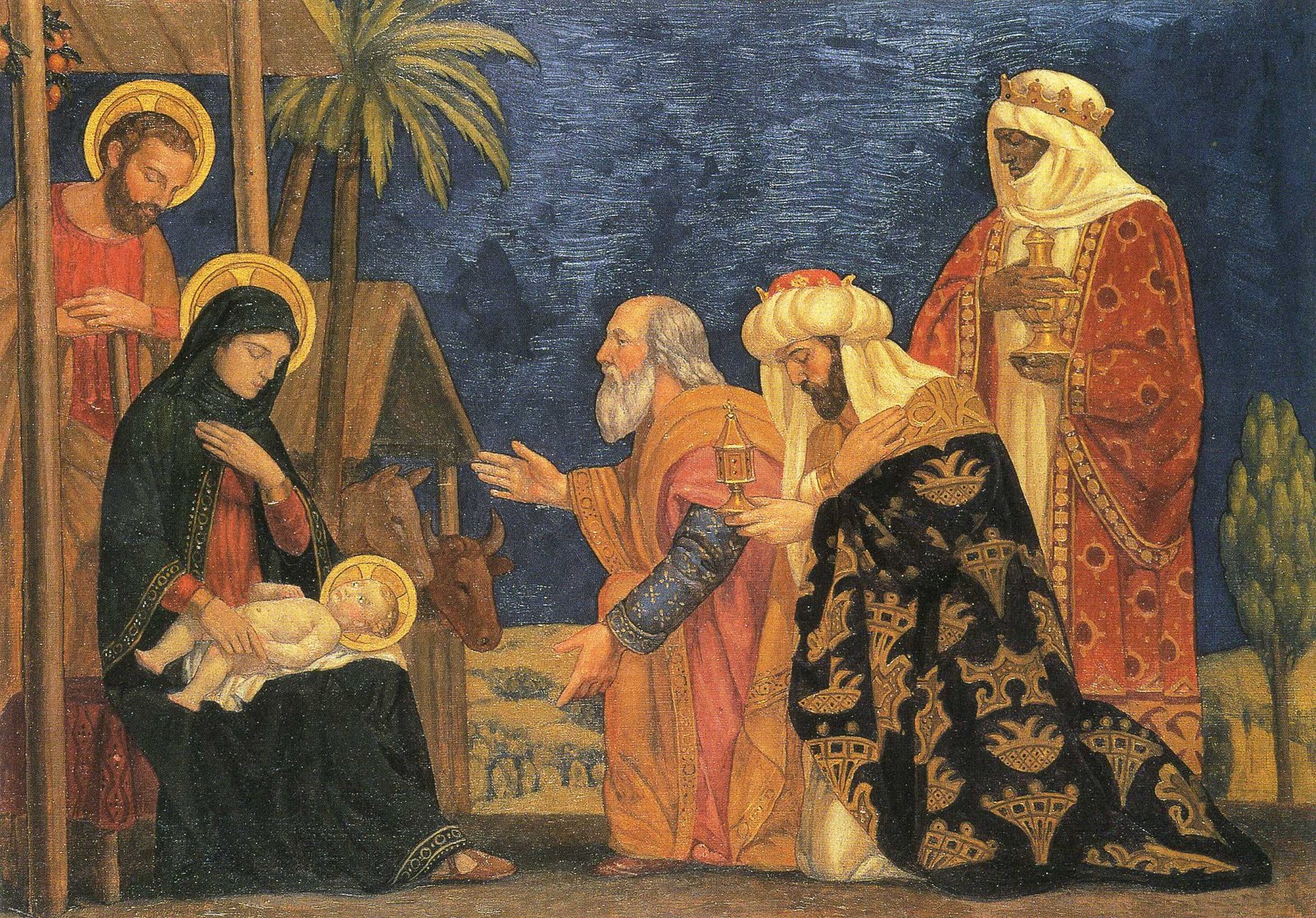 With the beginning strains of We Three Kings of Orient Are, then, the three Herdman boys, Leroy, Claude and Ollie, arrived from the East (like my uncle from New Jersey, the narrator explains), carried the ham from their food basket, wrapped in a large red ribbon, and dropped it right in front of the manger.
After delivering the gift, the three kings were supposed to confer and then turn to leave through a different door, because the Bible says they left a different way and didn’t go back to report to King Herod.
But the three Herdman boys playing the kings didn’t want to leave; they wanted to stay with the baby, so they pushed some shepherds aside and sat right down next to the manger, all the way through Silent Night to the very end. Nothing in the Christmas pageant went the way it was supposed to, especially not the part about the three kings and the bath salts, but in the end it was the best Christmas pageant ever.
Maybe you have a similar memory of three kids in bathrobes and tin foil crowns? That seems to be our modern-day understanding of this biblical story.
You might be aware that there are four accounts of life with Jesus included in our Bibles. They are individual memoirs of experiences with this One who changed the world, and they are told from unique perspectives. The New Testament begins with Matthew’s account, but Matthew did not write his memories first. Scholars think it was Mark who beat everyone to the punch, writing down his memories.
A little later, you might imagine that Matthew, Luke, and John sat down with Mark’s memoir and began to reconstruct their own accounts of events. Naturally, this would make for different perspectives on the same events and, in some cases, different stories altogether.
You might remember that Matthew is the only gospel writer who included this strange story of the Magi and their trip to visit Jesus—the only one! But Matthew had a reason for including this story even though the others perhaps thought it peripheral: Matthew, you recall, was a Jewish writer. It was important to him to paint a picture of Jesus the Messiah as KING of the Jews—a figure worthy of royal acclaim, someone who fit the Jewish expectation of the coming Messiah.
For that reason, it makes perfect sense that Matthew would tell of the wise men from the East traveling to see the baby, a story around which you and I and all of our cultural constructs have created legend and lore that is hard to separate from the actual text. For one thing, nobody said anything about kings visiting; Matthew calls them wise men—sages, astrologers, magicians. Remember they stopped to visit King Herod, asking about a newborn KING of the Jews—setting Matthew’s designation of Jesus as royalty perfectly. But the wise men weren’t kings. And there weren’t three of them—at least as far as we know. They brought three gifts, it’s true, but Matthew never tells us how many of them there were.
And though we know as modern scholars of the text that Matthew had a literary and thematic motive here, it’s hard for you and me to keep the text separated from our traditions, and its definitely hard to think about what this text might have to say to us, 21st century followers of Jesus.
It may help us to note that this week begins the church’s lectionary season of Epiphany. Epiphany begins with a dark, inky sky lit by the light of one star. And as we walk through these next several weeks, think of our work of discipleship as that of following the light. As we meander through gospel stories about Jesus and his work in the world, each week the dial on the light switch turns up, little by little, showing us the bigger picture about this one we claim to follow.
But today we’re still in the dark, the night sky of our comprehension lit only with the light of one star, and we’re hearing the story of a group of seekers who also found themselves in the same situation: looking for meaning in this human life, but having only a little bit of light by which to take next steps.
And perhaps it’s here: not in the intrigue-filled story of seekers and sages, kings and babies born to poor peasants, but instead in the seeking itself, that we find meaning.
Perhaps especially at the start of a new year, you and I are looking for meaning in our lives. We want to know where we’re going and why. Like us, there are so many people in this story who are looking for the meaning of their lives. There’s Herod, who was appointed by the Romans to rule over Judea—which he did for over 30 years. He was infamous for his brutality, suspicious and insecure, prone to kill people close to him if he thought for a moment that they were a threat to his power. He murdered his wife, three sons, his mother-in-law, his uncle, his brother-in-law, and after the passage we read today, so many Jewish babies all over Galilee. He built many monuments in his time, including the rebuilding of the temple in Jerusalem, but he was desperately scared to lose his power, and his approach to finding purpose in life was intimidating those around him.
Also in this story were the chief priests and scribes of the people, who desperately clung to meaning in their lives through knowledge—knowing the law backwards and forwards, able to say definitively any answer to any question that was raised. They were peripheral to the court, but they functioned in much the same way as Herod did. Control, control—our knowledge and expertise will save the day!
And then, finally, there are these sages…the wise men. They rejected power and control, knowledge and education, in order to set out on a journey that seemed dark and foreboding, the end of which they could not see and did not know.
Isn’t their experience more like your life and mine?
We’d like to use our education or our position or our power to influence the future, but in our deepest hearts, we know that we can’t.
The search for meaning and purpose in our lives comes with giving up the trappings of importance as dictated by this world, and stepping into darkness—hoping that the light—just enough light—will show us where our next steps should be.
It’s not the baby that’s the point of this story.
It’s the darkness, and the courage it took to step into the darkness, trusting that there would be light—just enough light to see for the next step.
Looking for meaning, purpose in your life?
I’m pretty sure you won’t find it by wielding your power or depending on your education and experience.
It seems to me that the lesson from Matthew’s story of the wise men for you and me—modern folks with so many resources to call on—is that we are going to have to step into the darkness, to trust in something bigger than ourselves, to believe that the light will follow us, all the way to the manger.
Can we do it?
I don’t know. But I do know this question is not unique. This is, in fact, the question all of humanity has been asking forever. What is the meaning of my life? Where do I go next?
I wonder if we could take the example—not of Herod or the scribes and High Priests, who preferred to fall back on what they knew—but of the wise men, who stepped into that inky black darkness, lit only by the light of one single star.
This is, in fact, the struggle of all humanity, isn’t it?
The biblical text is full of examples of this—it’s not just the wise men in Matthew’s gospel. So, as you consider whether you will take such a risk in this new year, hear the words of Ruth Sohm’s poem about another biblical character, Miriam, as she faced a similar question.
I Shall Sing to the Lord a New Song
Ruth H. Sohn
I, Miriam, stand at the sea
and turn
to face the desert
stretching endless and
still.
My eyes are dazzled
The sky brilliant blue
Sunburnt sands unyielding white.
My hands turn to dove wings.
My arms
reach for the sky
and I want to sing
the song rising inside me.
My mouth open
I stop.
Where are the words?
Where the melody?
In a moment of panic
My eyes go blind.
Can I take a step
Without knowing a
Destination?
Will I falter
Will I fall
Will the ground sink away from under me?
The song still unformed –
How can I sing?
To take the first step –
To sing a new song –
Is to close one’s eyes
and dive
into unknown waters.
For a moment knowing nothing risking all –
But then to discover
The waters are friendly
The ground is firm.
And the song –
the song rises again.
Out of my mouth
come words lifting the wind.
And I hear
for the first
the song
that has been in my heart
silent
unknown
even to me.”
You and I, we are seekers in this new year: seekers for the meaning of our lives. Will we step into the unknown?
I hope so.
Surely, God will meet us there.
Amen.
Previous Post

December 30, 2014
On Saying Goodbye and Saying Hello
Next Post
January 11, 2015 Spotlight
Browse Our Archives
Select a Category Answering the Call Being the Church Curating Wisdom Laughing Out Loud Living in Relationship Practicing Discipleship Reclaiming Baptist Speaking from the Pulpit Uncategorized
Select a Month July 2018 June 2018 May 2018 April 2018 March 2018 January 2018 December 2017 November 2017 October 2017 September 2017 June 2017 May 2017 April 2017 March 2017 February 2017 January 2017 December 2016 November 2016 October 2016 September 2016 August 2016 July 2016 June 2016 May 2016 April 2016 March 2016 February 2016 January 2016 December 2015 November 2015 October 2015 September 2015 August 2015 July 2015 June 2015 May 2015 April 2015 March 2015 February 2015 January 2015 December 2014 November 2014 October 2014 September 2014 August 2014 July 2014 June 2014 May 2014 April 2014 March 2014 February 2014 January 2014 December 2013 November 2013 October 2013 September 2013 August 2013 July 2013 June 2013 May 2013 April 2013 March 2013 February 2013 January 2013 December 2012 November 2012 October 2012 September 2012 August 2012 July 2012 June 2012 May 2012 April 2012 March 2012 February 2012 January 2012 December 2011 October 2011 September 2011 August 2011 July 2011 June 2011 May 2011 April 2011 March 2011 February 2011 January 2011 December 2010 November 2010 October 2010 September 2010 August 2010 July 2010 June 2010 May 2010 April 2010 March 2010 February 2010 January 2010 December 2009 November 2009 October 2009 September 2009 August 2009 July 2009 June 2009 May 2009 April 2009 March 2009 February 2009 January 2009 December 2008 November 2008 October 2008 September 2008 August 2008 July 2008 June 2008 May 2008 April 2008 March 2008 February 2008 January 2008 December 2007 November 2007 October 2007 September 2007 August 2007 July 2007 June 2007 May 2007 April 2007 March 2007 February 2007 January 2007 December 2006 November 2006 October 2006 September 2006 August 2006 July 2006 June 2006 May 2006 April 2006 March 2006 February 2006 January 2006 December 2005
Search for:
Recent Posts
- Sabbath as Radical Witness
- Learning Leadership: A Pilgrimage to Hawaii
- A Prayer for the Living of These Days
- Sabbath as Relationship
- Dressing Up Faith
Recent Comments
Archives
- July 2018
- June 2018
- May 2018
- April 2018
- March 2018
- January 2018
- December 2017
- November 2017
- October 2017
- September 2017
- June 2017
- May 2017
- April 2017
- March 2017
- February 2017
- January 2017
- December 2016
- November 2016
- October 2016
- September 2016
- August 2016
- July 2016
- June 2016
- May 2016
- April 2016
- March 2016
- February 2016
- January 2016
- December 2015
- November 2015
- October 2015
- September 2015
- August 2015
- July 2015
- June 2015
- May 2015
- April 2015
- March 2015
- February 2015
- January 2015
- December 2014
- November 2014
- October 2014
- September 2014
- August 2014
- July 2014
- June 2014
- May 2014
- April 2014
- March 2014
- February 2014
- January 2014
- December 2013
- November 2013
- October 2013
- September 2013
- August 2013
- July 2013
- June 2013
- May 2013
- April 2013
- March 2013
- February 2013
- January 2013
- December 2012
- November 2012
- October 2012
- September 2012
- August 2012
- July 2012
- June 2012
- May 2012
- April 2012
- March 2012
- February 2012
- January 2012
- December 2011
- October 2011
- September 2011
- August 2011
- July 2011
- June 2011
- May 2011
- April 2011
- March 2011
- February 2011
- January 2011
- December 2010
- November 2010
- October 2010
- September 2010
- August 2010
- July 2010
- June 2010
- May 2010
- April 2010
- March 2010
- February 2010
- January 2010
- December 2009
- November 2009
- October 2009
- September 2009
- August 2009
- July 2009
- June 2009
- May 2009
- April 2009
- March 2009
- February 2009
- January 2009
- December 2008
- November 2008
- October 2008
- September 2008
- August 2008
- July 2008
- June 2008
- May 2008
- April 2008
- March 2008
- February 2008
- January 2008
- December 2007
- November 2007
- October 2007
- September 2007
- August 2007
- July 2007
- June 2007
- May 2007
- April 2007
- March 2007
- February 2007
- January 2007
- December 2006
- November 2006
- October 2006
- September 2006
- August 2006
- July 2006
- June 2006
- May 2006
- April 2006
- March 2006
- February 2006
- January 2006
- December 2005
Categories
- Answering the Call
- Being the Church
- Curating Wisdom
- Laughing Out Loud
- Living in Relationship
- Practicing Discipleship
- Reclaiming Baptist
- Speaking from the Pulpit
- Uncategorized
Meta
Follow Us!
TAKE THE
Religious Wisdom Quiz
True or False: King Josiah found the Book of the Law hidden in the temple during repairs.
Select your answer to see how you score.
FALSE TRUE
Related posts from Talk with the Preacher

A Prayer for the Living of These Days



Invitation, a Meditation for Maundy Thursday
TRENDING AT PATHEOS Progressive Christian

Why Christians Have a Sacred Duty to Vote:...
The Bible offers strong support for the sacred duty to vote. Here...

What Being a Modern-Day Apostle Means to Me
In my last column, I discussed the ins and outs of modern-day...

Did Ancient China Once Worship the God of...
Across human history, a common thread weaves through the origins of the...

Love Your Neighbor – Including Earth-Kin: Lev. 19,...
God’s command to love your neighbor means acting in an ethical and...

Lead a Church Study of “Jesus and Lao...
Guest writer Jack Thomas (The Irreverent Reverend) reflects on leading his church...

Principles for Understanding the Apostolic Ministry Today
Whenever people discover that my formal ministry title is "apostle," as in...
view all Progressive Christian blogs
Ad-Free & Subscriber Log-In Subscription Support
- About Us
- 2026 Calendar
- Videos
- Podcasts
- Library of World Religions
- Faith In Media Tracker
- Advertise With Us
- Write for Us
- Privacy Policy
- Terms of Service
- Do Not Sell My Data
- Contact Us
- Radiant Digital
- Manage Newsletter Subscriptions
- Unsubscribe From Notifications
- Sitemap
Copyright 2008-2026, Patheos. All rights reserved.
Subscription Support Ad-Free & Subscriber Log-In
Follow Patheos