
BuddhistCatholicContemplativeEvangelicalGeneral ChristianHinduJewishLatter-day SaintMuslimNew VisionsProgressive Christian
Beliefs
- Buddhist
- Catholic
- Contemplative
- Evangelical
- General Christian
- Hindu
- Jewish
- Latter-day Saint
- More Voices
- Muslim
- New Visions
- Pagan
- Progressive Christian
Topics
- Religion News
- Food and Religion
- Sports and Religion
- Religious Art
- Religious Music and Entertainment
- Religious Events
- History and Religion
- Style and Religion
- Politics and Religion
- Women in Religion
- Recreation Outdoors and Religion
- Business Finance and Religion
- Careers Workplace and Religion
- Education and Religion
- Family Parenting and Religion
- Health Fitness and Religion
- Home and Religion
- Relationships and Religion
- Technology and Religion
- Travel and Religion
Columnists
- Buddhist Columnists
- Business Finance and Religion Columnists
- Careers Workplace and Religion Columnists
- Catholic Columnists
- Contemplative Columnists
- Education and Religion Columnists
- Evangelists Columnists
- Family Parenting and Religion Columnists
- General Christian Columnists
- Health Fitness and Religion Columnists
- Hindu Columnists
- History and Religion Columnists
- Home and Religion Columnists
- Jewish Columnists
- More Voices Columnists
- Latter Day Columnists
- Muslim Columnists
- New Visions Columnists
- Nonreligious Columnists
- Pagan Columnists
- Politics and Religion Columnists
- Progressive Columnists
- Recreation Outdoors and Religion Columnists
- Relationships and Religion Columnists
- Religion News Columnists
- Religious Art Columnists
- Religious Events Columnists
- Religious Music and Entertainment Columnists
- Sports and Religion Columnists
- Style and Religion Columnists
- Technology and Religion Columnists
- Travel and Religion Columnists
- Women in Religion Columnists
Resource Library
- 2026 Calendar
- Library of World Religions
- The 100 Most Holy Places on Earth
- Patheos Answers
- Podcasts
- Videos
- Faith Leaders Database
- Anglican Episcopalian
- Bahai
- Baptist
- Buddhism
- Christianity
- Confucianism
- Eastern Orthodoxy
- Hinduism
- Holiness and Pentecostal
- ISKCON
- Islam
- Judaism
- Lutheran
- Methodist
- The Church of Jesus Christ of Latter-day Saints
- New Age
- Paganism
- Presbytarian and Reformed
- Protestantism
- Religion Behind the Scenes
- Roman Catholic
- Scientology
- Shia Islam
- Sikhism
- Sufism
- Sunni Islam
- Taoism
- Zen
- See all religions
Research Tools
 Ad-Free & Subscriber Log-In Subscription Support
Ad-Free & Subscriber Log-In Subscription Support
Follow Patheos 

- Trending:
- Forgiveness
- |
- Marriage
- |
- Consciousness
- |
- Death Penalty
- |
- Election
- |
- Halloween
 Talk with the Preacher
- Home
- Progressive Christian
- Aftermath
Aftermath
Last updated on: October 14, 2015 at 8:00 pm by Amy Butler
Aftermath 2015-10-14T20:00:13-04:00 Amy Butler
Patheos Explore the world's faith through different perspectives on religion and spirituality! Patheos has the views of the prevalent religions and spiritualities of the world.
Aftermath
Acts 6:1-7, Trinity Sunday
Good morning, and welcome to Trinity Sunday, the Sunday of the church year in which we celebrate the idea of one God expressed in three persons: Father, Son, Holy Spirit…Creator, Redeemer, Sustainer…God, Jesus, Spirit…. However you want to say it, it’s that simple, easy to understand Christian concept of one God, except three expressions.
Christians have long argued with each other about the idea of the Trinity, which you can easily see with just a passing glance at the first few centuries of church history. Honestly, we don’t really understand it either. Yet, here we are on Trinity Sunday supposed to be giving voice to the concept. Lucky for me, Pastor Leah already explained everything you need to know during the children’s sermon, so there’s really no need for us to go over it again….
No, actually, our work during this part of the service this morning is to take a look at what happened after the Trinity came into being…that is, after the wind rushed through the gathered church and the tongues of fire sat on the heads of everyone there and Peter preached a great sermon and the first church, well, took off. Last week we celebrated Pentecost and told that story again, the story of God’s Spirit coming to earth as Jesus had promised, to fill and energize Jesus’ followers, to be their advocate now that Jesus had gone. Today we read a little further in the book of Acts and take a look at what happened in the aftermath of the Spirit’s arrival.
Our passage this morning comes from the first seven verses of Acts chapter 6. If you recall, the writer of Luke’s gospel also wrote the book of Acts; 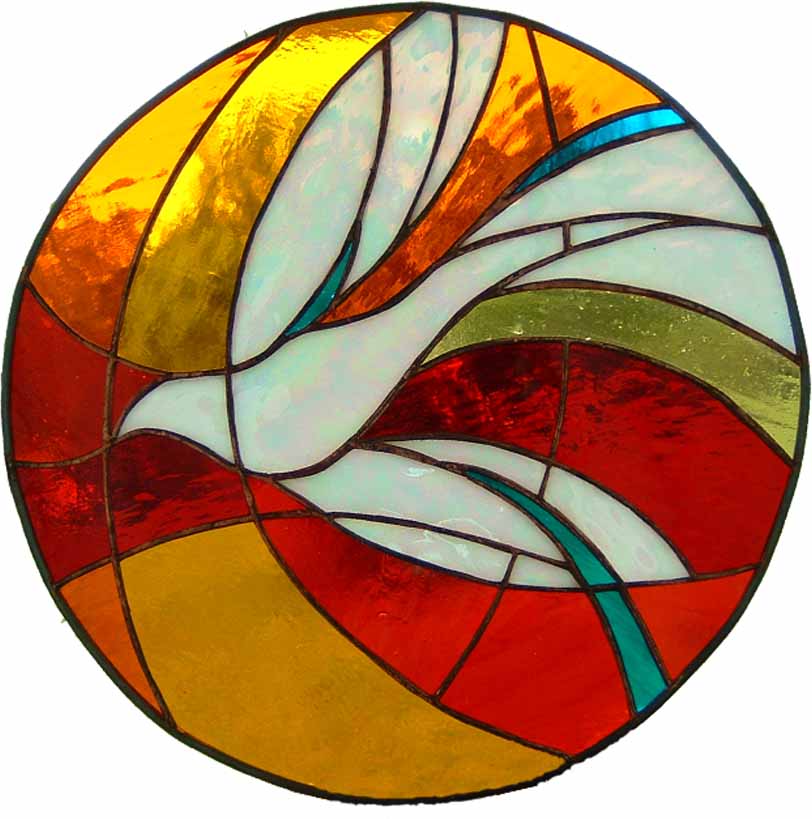 the entire book is the story of the very first church—what happened to the first disciples of Jesus after Jesus’ ascension. The background to our passage today is the coming of the Spirit, as we saw last week, and a phenomenal change in the early church.
That is, when the disciples were gathered together and the Spirit of God arrived on the Day of Pentecost, scholars estimate that the gathered group numbered about 120 people. But after the coming of the Spirit everything changed. The disciples were speaking in different languages, drawing people to their message. Peter preached what must have been the best revival sermon EVER, as Acts reports 3000 converts in one day. So, in other words, at the beginning of the book of Acts we had this small group of scared disciples, hiding from the authorities…by chapter 6, in the aftermath of the Spirit’s arrival, there were over 3000 members of the new church, and things had gotten crazy.
You can imagine. With such a big, sudden change, the administrative, ideological, structural, logistical, personal…challenges for the disciples had exponentially increased, and they were quickly at a loss for what to do. Chapter six opens with the church, young as it was, already embroiled in controversy.
In the early church there was one major division, and it had to do largely with language. While most of the members of the early church were Jews, some came from Palestine and spoke Aramaic as their native tongue. Others in the group were from the Diaspora—scattered all over the modern world. While they were also Jews, they were called Hellenists as they spoke Greek as their first language. Along with the language difference, of course, came cultural and experiential differences that made functioning as a unified group a bit challenging. They didn’t understand each other on so many levels.
Here was the problem: remember, the group at that time was still a functioning Jewish group. Under Levitical law, it was usually up to a man’s brother to take in his widow after he died. There was no social security, food stamps, Meals on Wheels. Society was changing, though, and many people were living far away from extended family systems. In the big city there were plenty of widows, both Hellenist and Hebrew, who needed taking care of. As they were directed in Levitical law, the group cared for the widows and orphans among them. It seems some of the Hellenist widows were being neglected (that’s the word the text uses) in the distribution of food,–either intentionally or unintentionally, we don’t know…while the Hebrew widows were being well taken care of. Naturally, this caused hard feelings. And now this misunderstanding…conflict…had come to the attention of the disciples in leadership, and they had to deal with it somehow, before it tore the assembly apart.
So here’s what they did. They appointed seven leaders from among the group—all Hellenists, a curious, intentional nod at diversity, since all of the original disciples were Hebrews. And they created the next iteration of a church structure, in which these assigned leaders would do the practical work of the church—the administration—while the disciples focused on teaching and worship leadership. It was a wonderful, innovative approach to dealing with the situation.
With the coming of the Spirit, chaos ensued and tension and conflict were high. Instead of ripping the church apart, though, this chaos became the impetus for innovation and change, a living out of the idea that God’s Spirit is ever and always in the business of creating something new.
Back in February CNN ran a story about Richard Turere, a 13 year old Kenyan boy whose family lives just South of Nairobi National Park, a game preserve that attracts thousands of visitors every year, visitors on which the Kenyan economy depends. But Richard and his family had an ongoing problem with lion prides in the preserve. The lions regularly ventured out of bounds to raid the family’s cattle, sheep and goats, resulting in devastating financial loss to Richard’s family and their neighbors.
The lions are important to the Kenyan tourist trade; the livestock critical for the villagers’ survival. High level government officials and scientists funded by the Kenyan government had been studying the problem, but despite best efforts, they’d been unable to come up with a solution. Meanwhile, the loss of livelihood was destroying Richard’s family and village. In the middle of crisis for his family, then 11 year old Richard had an idea.
One day, when I was walking around,” he says, “I discovered that the lions were scared of the moving light.” He put his young mind to work and a few weeks later he’d come up with an innovative, simple and low-cost system to scare the predators away. He fitted a series of flashing LED bulbs onto poles around the livestock enclosure, facing outward. The lights were wired to a box with switches and to an old car battery powered by a solar panel. They were designed to flicker on and off intermittently, thus tricking the lions into believing that someone was moving around carrying a flashlight.
And it worked. Since Richard rigged up his “Lion Lights,” his family has not lost any livestock, to the great delight of his father and to the astonishment of his neighbors. “I did it myself, no one taught me, I just came up with it,” says Richard. “I had to look after my dad’s cows and make sure that they were safe.”
Since Richard’s family installed his lion lights, over 75 other light systems just like it have been installed in Kenya. And, there you have it: a major national economic problem solved by the innovation and ingenuity of someone willing to think in new ways, not cowed by the situation, but spurred on to see the current troubles as opportunity to birth something brand new.[1]
And, such was the case in the aftermath of God’s Spirit coming to dwell in the first church.
Very often this little passage from Acts chapter 6 is used to teach the idea that there is a correct, biblical way to organize a church, or even to teach a biblical requirement that any church anywhere have some kind of appointed body—deacons, to use the Greek word in this passage—set aside to deal with administrative matters within the church.
But when we use this passage to dictate church structure, as if there is one magical way every church everywhere should be organized if they want to do it right, then we’re really missing the point. It wasn’t Luke’s objective when he wrote the book of Acts to pen a policy manual for Christian churches everywhere. Instead, in this passage we find some fundamental truths about what it means to live in the aftermath of the coming of God’s Spirit.
Because when God’s Spirit arrives, we should expect chaos to ensue. And when things change and we don’t quite know what to think when we look around us, then we start to get scared. Fear makes us resist diversity and change, looking at people in our community who are different than we are and finding issues and ideas on which we don’t see eye to eye. When that happens in a church, as some of us know all too well, conflict arises; relationships are broken; the Gospel message in our lives and in the world suffers as a result.
But as we know from reading this story, the nature of God’s Spirit is one of living, growing, breathing…life. That means inevitable change. In other words, if we’re on the adventure of living the Gospel message in the world around us, God’s Spirit is here, spurring us on to new and challenging possibilities, opportunities to be the church in ways that those first 12 disciples never, ever imagined that day when Jesus came to them on the Sea of Galilee and invited them to follow him.
Yet, for all their faults, somehow the first disciples seemed to get it: the idea that change, shift, opportunity, new ways of looking at the world…all of these are what happens when God’s Spirit shows up.
The early church didn’t have to be afraid of their suddenly changing circumstances, the diversity among them, or the conflicts they experienced with each other. These were challenges that only foretold the possibility of amazing new ways of being the church together…if only they had the courage and conviction to follow the wind of God’s Spirit wherever it took them.
And, so it is with us.
Next Sunday is the 151st birthday of this church, CalvaryBaptistChurch. For over 151 years, this congregation has been here in the city of Washington, D.C., a living community of faith in the middle of the city. As I think about all the many generations of people who have sat in these pews, puzzled over how to be the church together, and struggled to live in the chaos that comes when God’s Spirit is at work, I remember that this church at various times has looked very, very different.
Sometimes there were thousands of people in the pews; sometimes less than there are today. Sometimes the deacons wore long white gloves to serve communion; sometimes everybody pitched in—no gloves required. There were years in which most of the people gathered here looked about the same as each other; in some seasons of the church’s life, diversity was the order of the day.
And what about now? Right now, we, along with the entire rest of institutionalized religion in this country, are facing big changes. Society is shifting in such a way that the church as we know it is not the popular place it once was. Because of this shift, among others, we are already beginning to feel the change in the air. And this can make us uneasy. What is the future going to look like? Where will we go from here? How can we possibly keep things going as they have been?
Like the first church, we live in the aftermath of the coming of God’s Spirit. And as such, we should never rest on our laurels, expecting our life as a family of faith to remain constant. Oh no! Things are always, ever changing! The question for us now is whether we will feel the tension and crumble under its pressures, or whether we’ll open our arms and our hearts to new possibilities and opportunities we’d never imagined before…new ways to be the church that have never been done ever before…before God’s Spirit arrived!
And so, here we sit in the aftermath of Pentecost, the Trinity complete but our own lives and community blown into chaos by the coming of God’s Spirit. We have to ask ourselves, “What will it be?” Change as division and misunderstanding? Or change as opportunity and possibility we never even imagined?
Scary as it sounds, I’m going to hope we go with option #2…and then just see which way the wind blows!
Amen.
[1] http://www.cnn.com/2013/02/26/tech/richard-turere-lion-lights
Previous Post

May 16, 2013
Two Rabbis and a Pastor Walk Into a Bar...
Next Post
June 9, 2013 From the Margins: A Sad Mother
Browse Our Archives
Select a Category Answering the Call Being the Church Curating Wisdom Laughing Out Loud Living in Relationship Practicing Discipleship Reclaiming Baptist Speaking from the Pulpit Uncategorized
Select a Month July 2018 June 2018 May 2018 April 2018 March 2018 January 2018 December 2017 November 2017 October 2017 September 2017 June 2017 May 2017 April 2017 March 2017 February 2017 January 2017 December 2016 November 2016 October 2016 September 2016 August 2016 July 2016 June 2016 May 2016 April 2016 March 2016 February 2016 January 2016 December 2015 November 2015 October 2015 September 2015 August 2015 July 2015 June 2015 May 2015 April 2015 March 2015 February 2015 January 2015 December 2014 November 2014 October 2014 September 2014 August 2014 July 2014 June 2014 May 2014 April 2014 March 2014 February 2014 January 2014 December 2013 November 2013 October 2013 September 2013 August 2013 July 2013 June 2013 May 2013 April 2013 March 2013 February 2013 January 2013 December 2012 November 2012 October 2012 September 2012 August 2012 July 2012 June 2012 May 2012 April 2012 March 2012 February 2012 January 2012 December 2011 October 2011 September 2011 August 2011 July 2011 June 2011 May 2011 April 2011 March 2011 February 2011 January 2011 December 2010 November 2010 October 2010 September 2010 August 2010 July 2010 June 2010 May 2010 April 2010 March 2010 February 2010 January 2010 December 2009 November 2009 October 2009 September 2009 August 2009 July 2009 June 2009 May 2009 April 2009 March 2009 February 2009 January 2009 December 2008 November 2008 October 2008 September 2008 August 2008 July 2008 June 2008 May 2008 April 2008 March 2008 February 2008 January 2008 December 2007 November 2007 October 2007 September 2007 August 2007 July 2007 June 2007 May 2007 April 2007 March 2007 February 2007 January 2007 December 2006 November 2006 October 2006 September 2006 August 2006 July 2006 June 2006 May 2006 April 2006 March 2006 February 2006 January 2006 December 2005
Search for:
Recent Posts
- Sabbath as Radical Witness
- Learning Leadership: A Pilgrimage to Hawaii
- A Prayer for the Living of These Days
- Sabbath as Relationship
- Dressing Up Faith
Recent Comments
Archives
- July 2018
- June 2018
- May 2018
- April 2018
- March 2018
- January 2018
- December 2017
- November 2017
- October 2017
- September 2017
- June 2017
- May 2017
- April 2017
- March 2017
- February 2017
- January 2017
- December 2016
- November 2016
- October 2016
- September 2016
- August 2016
- July 2016
- June 2016
- May 2016
- April 2016
- March 2016
- February 2016
- January 2016
- December 2015
- November 2015
- October 2015
- September 2015
- August 2015
- July 2015
- June 2015
- May 2015
- April 2015
- March 2015
- February 2015
- January 2015
- December 2014
- November 2014
- October 2014
- September 2014
- August 2014
- July 2014
- June 2014
- May 2014
- April 2014
- March 2014
- February 2014
- January 2014
- December 2013
- November 2013
- October 2013
- September 2013
- August 2013
- July 2013
- June 2013
- May 2013
- April 2013
- March 2013
- February 2013
- January 2013
- December 2012
- November 2012
- October 2012
- September 2012
- August 2012
- July 2012
- June 2012
- May 2012
- April 2012
- March 2012
- February 2012
- January 2012
- December 2011
- October 2011
- September 2011
- August 2011
- July 2011
- June 2011
- May 2011
- April 2011
- March 2011
- February 2011
- January 2011
- December 2010
- November 2010
- October 2010
- September 2010
- August 2010
- July 2010
- June 2010
- May 2010
- April 2010
- March 2010
- February 2010
- January 2010
- December 2009
- November 2009
- October 2009
- September 2009
- August 2009
- July 2009
- June 2009
- May 2009
- April 2009
- March 2009
- February 2009
- January 2009
- December 2008
- November 2008
- October 2008
- September 2008
- August 2008
- July 2008
- June 2008
- May 2008
- April 2008
- March 2008
- February 2008
- January 2008
- December 2007
- November 2007
- October 2007
- September 2007
- August 2007
- July 2007
- June 2007
- May 2007
- April 2007
- March 2007
- February 2007
- January 2007
- December 2006
- November 2006
- October 2006
- September 2006
- August 2006
- July 2006
- June 2006
- May 2006
- April 2006
- March 2006
- February 2006
- January 2006
- December 2005
Categories
- Answering the Call
- Being the Church
- Curating Wisdom
- Laughing Out Loud
- Living in Relationship
- Practicing Discipleship
- Reclaiming Baptist
- Speaking from the Pulpit
- Uncategorized
Meta
Follow Us!
TAKE THE
Religious Wisdom Quiz
In what city was Jesus born?
Select your answer to see how you score.
Nazareth Capernaum Jerusalem Bethlehem
Related posts from Talk with the Preacher


Learning Leadership: A Pilgrimage to Hawaii

A Prayer for the Living of These Days

TRENDING AT PATHEOS Progressive Christian

Why Christians Have a Sacred Duty to Vote:...
The Bible offers strong support for the sacred duty to vote. Here...

What Being a Modern-Day Apostle Means to Me
In my last column, I discussed the ins and outs of modern-day...

Did Ancient China Once Worship the God of...
Across human history, a common thread weaves through the origins of the...

Love Your Neighbor – Including Earth-Kin: Lev. 19,...
God’s command to love your neighbor means acting in an ethical and...

Lead a Church Study of “Jesus and Lao...
Guest writer Jack Thomas (The Irreverent Reverend) reflects on leading his church...

Principles for Understanding the Apostolic Ministry Today
Whenever people discover that my formal ministry title is "apostle," as in...
view all Progressive Christian blogs
Ad-Free & Subscriber Log-In Subscription Support
- About Us
- 2026 Calendar
- Videos
- Podcasts
- Library of World Religions
- Faith In Media Tracker
- Advertise With Us
- Write for Us
- Privacy Policy
- Terms of Service
- Do Not Sell My Data
- Contact Us
- Radiant Digital
- Manage Newsletter Subscriptions
- Unsubscribe From Notifications
- Sitemap
Copyright 2008-2026, Patheos. All rights reserved.
Subscription Support Ad-Free & Subscriber Log-In
Follow Patheos